Your shopping cart is empty!

Joints and exercise: why supplements don't replace training
Published: 09/11/2026
Times Read: 29
Comments : 0
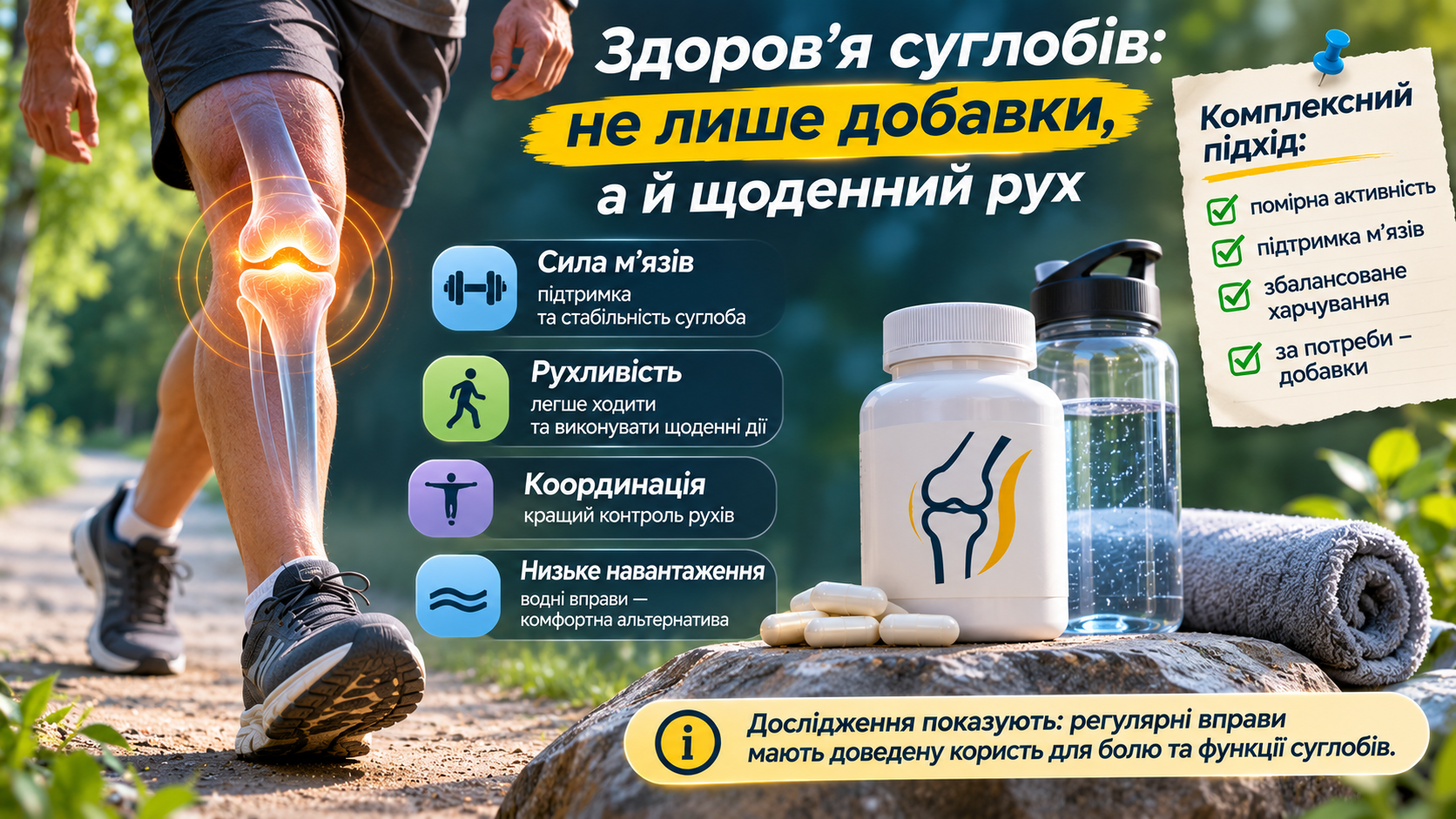
Joint health involves more than glucosamine, chondroitin, MSM or collagen found in dietary supplements. Daily loads, muscle strength, coordination and habitual mobility affect how comfortably a person walks, climbs stairs and performs everyday tasks. A supplement cannot replace the physical work performed by muscles. These are different approaches with different evidence bases.
In joint research, scientists compare not only supplement ingredients but also exercise programmes, lifestyle changes, body weight and functional outcomes. Let us examine what conclusions the evidence actually supports and why searching for a single universal remedy can divert attention from more important factors.
Why joints need movement, not just nutrients
A joint functions as a system, not merely as a piece of cartilage. Cartilage, subchondral bone, synovial membrane, capsule, ligaments and muscles work together to enable movement and distribute forces. When loading changes, the demands on the entire system change. The idea that adding a substance will automatically make a joint more resilient is therefore an oversimplification.
Muscles around a joint help control its position while walking, squatting, climbing stairs and carrying objects. Strength alone is not enough: coordination, endurance and force distribution also matter. When discomfort causes prolonged avoidance of movement, muscle activity may decline and familiar tasks may become harder. This creates a cycle: less movement leads to less physical readiness for movement.
Movement also affects the mechanical environment of cartilage and the movement of fluid within a joint. However, this does not mean that any exercise “regrows cartilage”. Physical activity studies most often assess pain, daily function, strength and quality of life, rather than proven restoration of damaged tissue.
Anyone wishing to preserve mobility should therefore look beyond the ingredients on a package. Daily activity, muscle strength, rest, individual tolerance of loading and coexisting conditions all matter.
What research on exercise for joints actually shows
The American College of Rheumatology/Arthritis Foundation guidelines (2019) strongly recommend exercise for people with knee and hip osteoarthritis. Walking, strengthening, neuromuscular and aquatic exercises are listed as options. The OARSI guidelines (Bannuru et al., 2019) likewise place importance on structured activity programmes and patient education.
These recommendations concern people with specific clinical conditions. They should not automatically become exercise instructions for everyone. They do, however, demonstrate an important distinction: movement is not an optional decorative suggestion but an approach supported by its own research.
The Cochrane review by Lawford et al. (2024) on exercise for knee osteoarthritis found probable short-term improvements in pain, physical function and quality of life. The authors nevertheless noted that the clinical relevance of the average improvement is not always clear; individual changes may be noticeable or small.
A meta-analysis by Lim, Choi and Kim (2024), covering 27 studies and 1,712 participants, also found average improvements in pain, strength and function with resistance exercise. These results do not identify a single universally suitable exercise or intensity. Age, joint condition, baseline mobility and other limitations affect the choice of activity.
Studies examining exercise outcomes usually compare groups following different programmes or receiving usual care. This is a different type of evidence from trials of capsules. It is inappropriate to combine them into a claim that “supplements plus sport restore joints” without a direct trial of that combination.
Types of exercise studied and how they differ
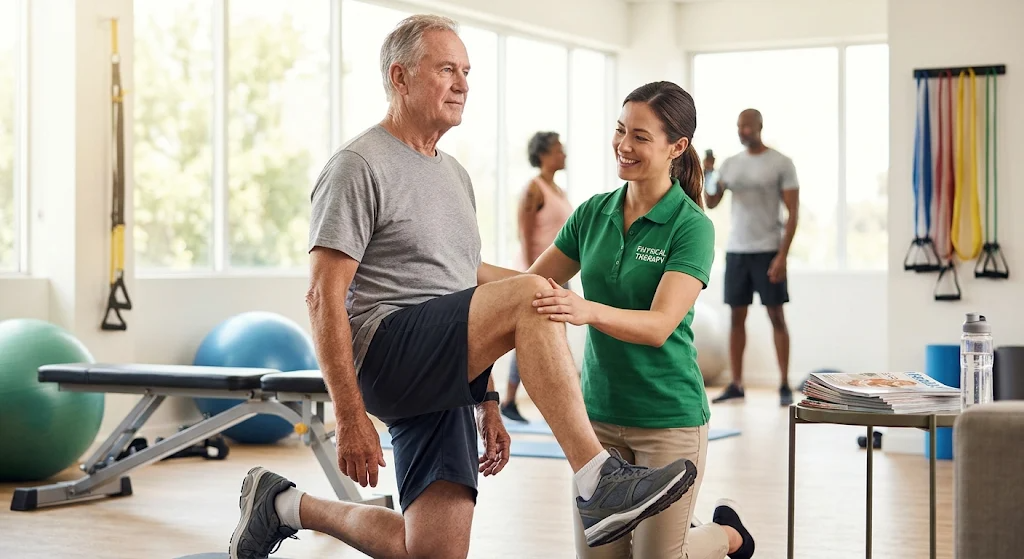
Different exercises target different components of physical function. Walking provides regular moderate loading and supports daily activity. Resistance exercises build the muscles’ ability to generate force. Balance exercises train postural control. Aquatic activity may be more comfortable when weight-bearing exercise is difficult to tolerate.
| Type of activity | What it primarily develops | What to consider |
|---|---|---|
| Walking and other aerobic activity | Habitual mobility, endurance and overall activity | Duration, pace and joint response after activity |
| Resistance exercises | Muscle strength and movement control | Technique, range of motion and individual tolerance |
| Balance exercises | Coordination and stability | Safe conditions and support when needed |
| Aquatic activities | Mobility with reduced weight-bearing load | Accessibility, water temperature and other restrictions |
| Mobility and stretching | Comfortable range of motion and flexibility | Do not force movement through sharp pain or restriction |
More intense loading does not always produce better results. A 2025 systematic review with meta-regression of 14 resistance-exercise trials in knee osteoarthritis found no clear linear relationship between the total prescribed exercise “dose” and changes in pain or function. This does not prove intensity is irrelevant; rather, it does not support the simple rule that more is always better.
Two different aspects matter in practice: the load during a particular session and the ability to repeat activity consistently. A single excessive effort is not equivalent to a progressive, manageable programme, even though both could be called “training”.
Loading, body weight and joint function
For the knees and hips, not only the exercise programme but also forces acting on tissues during everyday movements matter. Body weight is one contributor to mechanical loading, but it is not the sole indicator of joint health. A person's health cannot be judged by the number on a scale alone.
In the IDEA trial (Messier et al., 2013), 454 older adults with excess body weight and knee osteoarthritis were assigned to dietary change plus exercise, dietary change alone or exercise alone. Over 18 months, investigators assessed knee loading, laboratory markers, pain and function. The combined intervention group showed better average pain and function outcomes than either of the other groups.
This supports the importance of a comprehensive approach for the population studied. It does not mean everyone needs to lose weight, or that weight change alone explains all differences. Several factors changed at the same time, and the participants met specific eligibility criteria.
The practical lesson is not about finding a “secret ingredient”, but about how movement, nutrition and mechanical loading interact. Individual well-being, activity tolerance and overall health matter more than attempting to reproduce another clinical trial's results.
Why supplements cannot replace muscle work
Glucosamine, chondroitin, MSM and collagen are commonly grouped as joint supplements. Yet consuming these substances does not reproduce the effects of training. It does not train balance, develop movement skills or replace the gradual adaptation of muscles to physical activity.
The large GAIT trial (Clegg et al., 2006) investigated glucosamine, chondroitin and their combination in adults with knee osteoarthritis. In the overall population, no substantial advantage over placebo was found for the primary pain-reduction outcome. The positive result in a subgroup with more severe pain was described by the authors as an exploratory observation that cannot automatically be generalised.
By contrast, physical activity recommendations draw on numerous studies directly testing functional changes after exercise. The strength of evidence differs among ingredients, formulations and conditions. A supplement should therefore not be treated as equivalent to a movement programme.
This does not mean supplement composition is irrelevant. Consumers should understand what a product contains, whether its specific formulation has been directly studied and which conclusions the evidence allows. Even a well-documented formulation cannot justify promises of stronger muscles, steadier gait or structural joint changes without appropriate data.
There is likewise no basis for assuming that adding glucosamine, chondroitin or collagen to exercise necessarily enhances its effects. Such a conclusion would require trials directly comparing identical exercise programmes with and without supplementation.
How to assess progress without unrealistic expectations
It is easy to focus on one subjective feeling: less knee aching today must mean the programme works, while more pain tomorrow must mean it does not. Research uses broader assessments, including pain scales, walking tests, chair-rise speed, muscle strength, self-reported function and quality of life.
These measures answer different questions. Less pain does not necessarily mean greater strength, and walking farther does not establish structural changes in cartilage. No single number can fully describe joint condition.
In practice, it helps to distinguish activity tolerance, consistency and everyday function. If a particular movement leads to persistent worsening, sharp pain or swelling, the answer is not to push harder but to discuss it with a professional. When loading is comfortable, progress is usually assessed over time rather than from one day.
It is also important not to attribute every change to a supplement if someone has simultaneously begun walking more, altered their diet or started physical rehabilitation. Without a comparative design, it is impossible to determine which factor caused the result.

When loading requires individual assessment
The advice to “just move more” is not suitable for every joint condition. Severe movement restrictions, instability, recent injury, swelling, acute pain, coexisting illnesses or preparation for surgery may require another approach. In such cases, an assessment by a doctor or physical therapist is safer.
Exercise should never be treated as a reason to ignore symptoms. Rapidly worsening pain, a hot or markedly swollen joint, inability to bear weight or deterioration after injury requires medical assessment rather than experimenting with exercise or supplements.
People taking medicines, living with allergies or chronic conditions, or who are pregnant or breastfeeding should discuss supplements separately with their clinician. The presence of an ingredient in a food product does not make it appropriate in every situation.
In short, maintaining everyday joint function involves more than diet. Regular, manageable movement works through muscles, coordination and physical ability to perform ordinary tasks. Supplements are a separate product category with varying levels of evidence and cannot substitute for these mechanisms.
Frequently asked questions
Can joint supplements replace exercise?
No. Supplements do not train muscle strength, coordination or movement skills. They should not replace manageable physical activity.
Is going to a gym necessary for joint health?
No. Research includes walking, home exercise and aquatic activities. The right format depends on individual circumstances.
What exercises are best for knees?
There is no universal choice. Different approaches can develop strength, mobility and endurance, depending on knee condition and tolerance.
Does pain after exercise mean the joint is being damaged?
Not always. However, persistent worsening, pronounced swelling or sharp pain should not be ignored and calls for professional assessment.
Can glucosamine and chondroitin enhance the effects of exercise?
There is no convincing basis for claiming this for everyone. Studies of the ingredients alone do not automatically prove benefits when combined with exercise.
Can joint condition be assessed only by reduced pain?
No. Mobility, function, muscle strength and the ability to perform daily tasks also matter. Pain relief does not mean tissue restoration.
Why do studies follow outcomes for weeks and months?
To assess changes in function and tolerance during repeated activity. These are research follow-up periods, not promises of a specific effect for everyone.
When should someone consult a professional before becoming active?
With severe pain, instability, swelling, past injury or marked restriction of movement. A professional can help identify a safe activity plan.
References
- Kolasinski S. L. et al. (2020). 2019 American College of Rheumatology/Arthritis Foundation Guideline for the Management of Osteoarthritis of the Hand, Hip, and Knee. Arthritis Care & Research, 72(2), 149–162. PubMed
- Bannuru R. R. et al. (2019). OARSI guidelines for the non-surgical management of knee, hip, and polyarticular osteoarthritis. Osteoarthritis and Cartilage, 27(11), 1578–1589. PubMed
- Lawford B. J. et al. (2024). Exercise for osteoarthritis of the knee. Cochrane Database of Systematic Reviews, 2024(12), CD004376. DOI
- Messier S. P. et al. (2013). Effects of intensive diet and exercise on knee joint loads, inflammation, and clinical outcomes among overweight and obese adults with knee osteoarthritis: the IDEA randomized clinical trial. JAMA, 310(12), 1263–1273. PubMed
- Clegg D. O. et al. (2006). Glucosamine, chondroitin sulfate, and the two in combination for painful knee osteoarthritis. The New England Journal of Medicine, 354(8), 795–808. PubMed
- Marriott K. A. et al. (2024). Are the Effects of Resistance Exercise on Pain and Function in Knee and Hip Osteoarthritis Dependent on Exercise Volume, Duration, and Adherence? A Systematic Review and Meta-Analysis. Arthritis Care & Research, 76(6), 821–830. PubMed
- Lim J., Choi A., Kim B. (2024). The Effects of Resistance Training on Pain, Strength, and Function in Osteoarthritis: Systematic Review and Meta-Analysis. Journal of Personalized Medicine, 14(12), 1130. PubMed
- de Wit J. et al. (2025). Association Between Prescribed Dosage of Resistance Exercise and Change in Pain and Physical Function in Knee Osteoarthritis: A Systematic Review With Meta-Regression. Musculoskeletal Care, 23(2), e70110. PubMed
Dietary supplement. Not a medicinal product. Consult your doctor before use.
Products related to this post
Related Posts
Comments
Information
Customer Service
Extras
My Account


Sports nutrition manufacturer in Ukraine StarkPharm © 2026


