Your shopping cart is empty!

Glucosamine and collagen for joints: what's the difference and should you combine them?
Published: 08/11/2026
Times Read: 57
Comments : 0
Glucosamine and collagen are often found together in joint supplements, but they are not two names for the same ingredient. Glucosamine is a small amino sugar molecule involved in the formation of glycosaminoglycans. Collagen is a group of structural proteins that give tissues strength. Both are associated with connective tissue, but occupy different places in its structure.
That is why the question “which is better for joints — glucosamine or collagen?” does not have a single answer without specifying the form of the substance, the type of study, and the indicator that was evaluated. Biochemical participation in tissues does not mean that taking the supplement will restore worn cartilage or change the course of the disease.
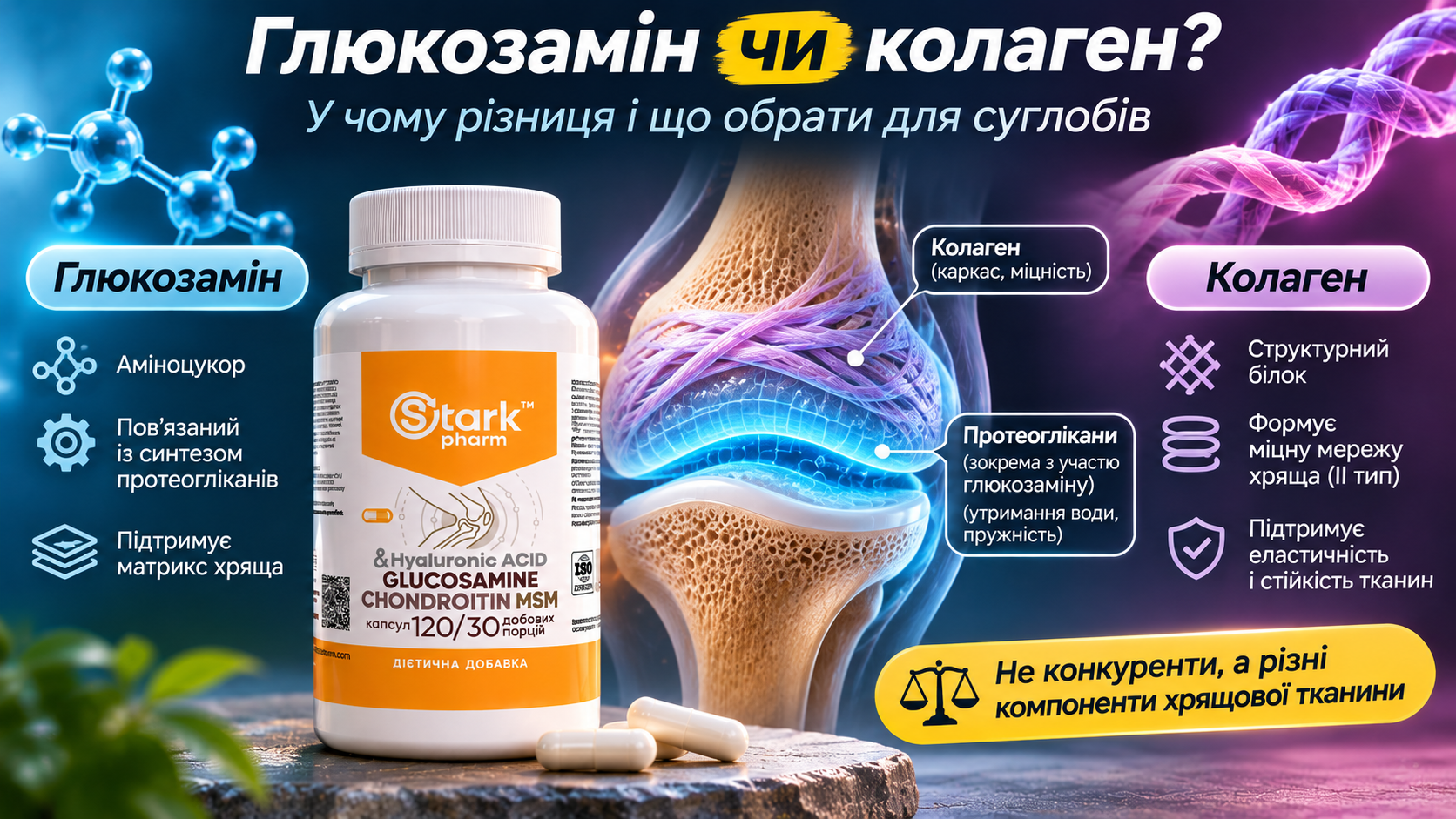
Cartilage is not made up of one substance: how its matrix works
Articular cartilage is not just a “cushion” between bones. Its extracellular matrix contains primarily water, a collagen network, and proteoglycans. Type II collagen forms a fibrous framework that resists stretching, and aggrecan with glycosaminoglycan chains retains water and helps resist compression. These elements work together: without the appropriate water and proteoglycan content, the matrix changes its mechanical properties, and without a complete collagen network, it is more difficult to stabilize.
Chondrocytes maintain and remodel this matrix, but their ability to compensate for damage is limited. There is no straight line from the ingestion of a particular molecule in food to its incorporation into the desired joint site. In between these stages, digestion, absorption, metabolism, and regulation of synthesis in the tissues occur.
It is also worth distinguishing between articular cartilage, ligaments, and tendons: different types of collagen predominate in different tissues, and the load, blood supply, and recovery capabilities differ significantly.
Glucosamine and Collagen: A Brief Comparison
| Criterion | Glucosamine | Collagen |
|---|---|---|
| What is it | Aminosugar; derivatives are used in the synthesis of glycosaminoglycans | Connective tissue structural protein family |
| Role in cartilage | Associated with components of the proteoglycan matrix | Type II collagen forms a fibrous matrix network |
| What comes from the supplement | Usually glucosamine sulfate or hydrochloride | Hydrolyzed peptides, gelatin or undenatured type II collagen |
| What was researched? | Pain, function, and joint structure indicators in specific populations | Symptom and function indicators; for some forms, biomarkers of collagen metabolism |
| The main limitation | Data is inconsistent across different forms and studies | Data from different types of collagen cannot be combined without clarification. |
The table describes biological differences, not efficacy ratings. One component does not replace the other in terms of chemical structure, but this does not prove that their combined use is stronger than either alone.
What happens to glucosamine after it enters the body?
Glucosamine is a precursor for the synthesis of compounds that make up glycosaminoglycans. In cartilage, they participate in the formation of proteoglycans, in particular aggrecan. But if glucosamine is indicated on the label, this does not mean that the entire amount will enter the cartilage and turn into a new matrix there. The body uses substances according to its own metabolic needs, and the final result depends on many factors.
It is also important to clarify the form. Glucosamine sulfate and glucosamine hydrochloride are not identical objects of clinical research. In the GAIT trial (Clegg et al., 2006), which used glucosamine hydrochloride, there was no convincing advantage in the main indicator in the overall group compared to placebo. At the same time, some other studies with certain forms of sulfate reported positive results. It is incorrect to transfer the conclusion from a specific form to any powder or capsule.
Even if a study does show a change in discomfort or function, this is a different type of evidence than direct evidence of new cartilage growth. Glucosamine's involvement in matrix synthesis alone does not produce such a result.
Collagen: Hydrolyzed Peptides and Undenatured Type II Are Not the Same Thing
In supplements, the word “collagen” can refer to ingredients that vary in technology and properties. Hydrolyzed collagen is a protein that has been broken down into shorter peptides. These are further broken down during digestion; some of the small peptides may be found in the blood. This is not the same as transferring a whole collagen fiber into your knee.
Widely cited data for one collagen ingredient should not be automatically extrapolated to another. For example, the Shaw et al. (2017) study looked at gelatin with vitamin C combined with brief exercise, not any collagen in any combination. This study only included eight men, and the primary outcome was biomarkers, not clinical cartilage repair.
A separate study on different collagen derivatives with vitamin C (Lis & Baar, 2019) also observed high variability and did not find statistically significant differences for the respective marker within this small experiment. Therefore, laboratory signals should be interpreted with caution.
What clinical studies show for joints
There are separate clinical evidence bases for glucosamine and collagen ingredients, but they cannot simply be summed up as two parts of a single experiment. Researchers could have used different designs, different durations, different groups of participants, and different rating scales.
In a large randomized trial, Clegg et al. (2006) compared glucosamine, chondroitin, their combination, and a control group. The primary outcome in the general population did not support a convincing advantage of glucosamine over placebo. The trial is important for evaluating glucosamine, but it did not compare glucosamine with collagen.
A meta-analysis by Simental-Mendía et al. (2025), which pooled 11 randomized trials with 870 participants, found mean improvements in pain and function scores for collagen supplements compared to placebo. However, there was considerable heterogeneity between studies, with varying formulations, types of collagen, and conditions. Even a positive mean result does not mean the same effect across all forms and individuals.
An even larger meta-analysis of collagen derivatives (2024) also reported modest mean changes in symptom scores. However, meta-analyses describe average results across trials; they do not establish that supplements repair damaged cartilage, much less demonstrate synergy with glucosamine.
A new comparative study by Narkbunnam et al. (2026) evaluated undenatured type II collagen and prescription crystalline glucosamine sulfate in different groups against placebo. Neither agent demonstrated a statistically significant advantage over placebo on the primary endpoint at week 24. This suggests the limitations of universal promise, but again, the combination of the two agents was not specifically studied.
Therefore, isolated positive results for collagen do not prove that it is better than glucosamine, and the results of glucosamine do not provide grounds to call collagen superfluous. Direct, sufficiently high-quality comparative studies of the same endpoints are needed to conclude that one approach is superior.
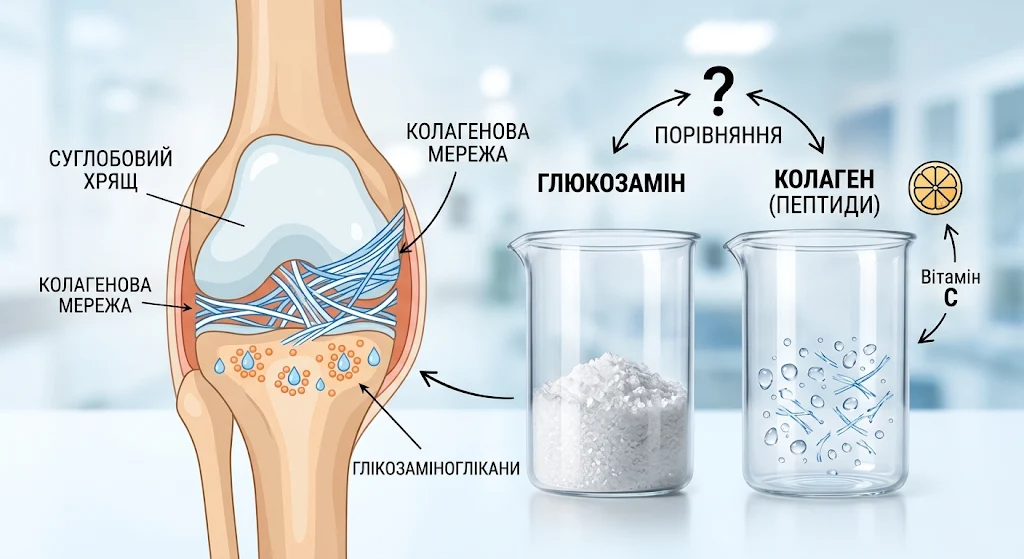
Is there evidence that glucosamine and collagen work better together?
The combination looks logical in the diagram: one ingredient is associated with proteoglycans, the other with the protein structure of the matrix. However, complementarity of mechanisms does not equal proven synergy. In a real organism, there are regulation of synthesis, mechanical loads and other factors that cannot be turned off.
To establish the superiority of a combination, a proper trial would need to compare at least four groups: glucosamine alone, collagen alone, the combination, and placebo. It is desirable that investigators use specifically defined forms of both substances, the same observation period, and a preselected measure of function or well-being.
Most of the known tests that support popular claims have evaluated each ingredient individually or in multi-ingredient blends without being able to separate the contribution of each substance. If a formula also contains chondroitin, MSM, and vitamin C, the mere presence of these ingredients does not tell us which one caused the change in score.
For the practical reader, it is important not to look for a “magic combination” but to understand what data supports the claims about a particular ingredient. There is currently insufficient evidence to suggest that taking glucosamine and collagen together is necessarily superior to taking either alone.
Why is vitamin C important and why does it not prove the effectiveness of the complex?
Vitamin C is involved in the normal formation of collagen in the body: it is needed for the work of enzymes that modify certain amino acid residues in new collagen chains. With its pronounced deficiency, the strength of connective tissue is impaired. But this does not mean that additional amounts of vitamin C above a sufficient level in the diet will automatically accelerate the restoration of articular cartilage.
In an experiment by Shaw et al. (2017), 5 or 15 g of gelatin with vitamin C were studied before exercise. Changes in the marker PINP are interesting for studying collagen turnover, but this marker does not directly indicate how much new tissue was formed in a particular joint. Furthermore, without a separate group receiving only vitamin C, it is impossible to accurately determine the contribution of each element of the study regimen.
Therefore, vitamin C should be considered as an essential nutrient, rather than as evidence that a combination with two other substances has a clinical advantage.
First, pay attention to the exact form of glucosamine: sulfate and hydrochloride have different evidentiary histories. Next, check to see if the type of collagen and how it was processed are listed: “hydrolysate,” “collagen peptides,” “gelatin,” and “undenatured type II” are not interchangeable terms.
Check what the publication describes: a single substance or a combination; healthy athletes or people with pre-existing joint changes; blood biomarkers or assessment of daily function. Data from one context does not automatically transfer to another.
The perception of “complexity” requires special attention. Many ingredients in a composition do not mean that each of them has been studied in this particular combination. Even if scientific publications exist for all substances individually, this is not proof of the effectiveness of a particular multi-component formula.
In case of prolonged discomfort, swelling, limited movement, or after an injury, you should not replace the assessment of the cause with an independent selection of supplements. Food ingredients do not replace a medical examination and proper recommendations from a specialist.
Who needs special care?
If you have an allergy, it is important to find out the origin of the raw materials: glucosamine in some products is obtained from crustacean shells, and collagen can be of fish, pork or other animal origin. If you are intolerant to a specific protein or raw material, you need to check the composition especially carefully.
Caution is also required for people taking anticoagulants, in particular vitamin K antagonists; those with impaired glucose metabolism or bronchial asthma; pregnant women and women during breastfeeding. For children and adolescents, independent selection of such complexes is inappropriate. In case of chronic conditions and simultaneous use of several drugs, it is advisable to consult a doctor.
Changes in well-being should not be interpreted as evidence that a particular component is “rebuilding the joint.” The assessment of joint condition depends on the cause of the symptoms, physical activity, and other individual factors.
Conclusion: Same fabric, but different roles
Glucosamine and collagen are associated with different components of connective tissue: the former with the formation of glycosaminoglycans, the latter with the protein network of the matrix. Their mechanisms do not duplicate each other, but this difference does not allow us to derive a benefit rating.
Clinical studies have yielded mixed results, and there is little direct, convincing evidence that a combination of glucosamine and collagen is superior to either alone. The best guide is the specific form of the ingredient, the trial design, and the actual outcome measure.
Frequently asked questions
Are glucosamine and collagen the same substance?
No. Glucosamine is an amino sugar involved in the synthesis of proteoglycan components, and collagen is a structural protein of connective tissue.
What is more important for cartilage - collagen or glucosamine?
Various components of the matrix are important for cartilage structure. However, this biological role does not prove the benefit of a particular supplement.
Is it proven that glucosamine and collagen together are more effective?
There is not enough convincing direct evidence to draw such a universal conclusion. Positive results from individual studies do not prove synergy.
Do collagen peptides convert directly into new cartilage?
No. They are digested and metabolized; there is no direct transfer of the finished collagen fiber to the joint.
What is the difference between type II collagen and hydrolyzed collagen?
Type II defines the type of protein, and hydrolysis describes the processing. Undenatured type II and hydrolyzed peptides have different properties and research protocols.
Can the results of glucosamine sulfate studies be transferred to the hydrochloride?
Not automatically. They are different forms, and their clinical research base is different.
Why is vitamin C added to collagen?
Vitamin C is necessary for normal collagen synthesis. Its presence in a combination does not by itself prove its clinical benefit.
Can such supplements replace a joint examination by a doctor?
No. If there is prolonged discomfort, swelling, injury, or limitation of movement, you should consult a specialist to determine the cause of your symptoms.
Sources
- Clegg D. O. et al. (2006). Glucosamine, chondroitin sulfate, and the two in combination for painful knee osteoarthritis. New England Journal of Medicine, 354(8), 795–808. PubMed.
- Simental-Mendía M. et al. (2025). Effect of collagen supplementation on knee osteoarthritis: an updated systematic review and meta-analysis of randomised controlled trials. Clinical and Experimental Rheumatology, 43(1), 126–134. PubMed.
- Shaw G. et al. (2017). Vitamin C-enriched gelatin supplementation before intermittent activity augments collagen synthesis. American Journal of Clinical Nutrition, 105(1), 136–143. PubMed.
- Narkbunnam R. et al. (2026). A Comparison of Clinical Outcomes Among Undenatured Collagen Type II, Glucosamine Sulfate, and Diacerein on Osteoarthritic Knee Treatment: A Randomized Clinical Trial. JB & JS Open Access, 11(3), e26.00225. PubMed.
- Lis D. M., Baar K. (2019). Effects of Different Vitamin C-Enriched Collagen Derivatives on Collagen Synthesis. International Journal of Sport Nutrition and Exercise Metabolism, 29(5), 526–531. PubMed.
- Liang C.-W. et al. (2024). Efficacy and safety of collagen derivatives for osteoarthritis: A trial sequential meta-analysis. Osteoarthritis and Cartilage, 32(5), 574–584. PubMed.
Products related to this post
Related Posts
Comments
Information
Customer Service
Extras
My Account


Sports nutrition manufacturer in Ukraine StarkPharm © 2026


