Your shopping cart is empty!

MSM for Joints and Recovery: What the Research Shows
Published: 08/11/2026
Times Read: 58
Comments : 0
SM (methylsulfonylmethane) is an organic sulfur compound that is added to joint and sports recovery supplements. Its popularity is due to its effects on cellular signaling related to oxidative stress, as well as a few small clinical trials. However, there is a significant difference between the biochemical mechanism, the change in the laboratory indicator, and the tangible result for humans.
In this article, we will look specifically at the data from MSM studies for joint mobility and recovery from exercise: who was involved in the trials, what was measured, and what conclusions can be drawn. It is incorrect to confuse the data on MSM with the results of studies on glucosamine, chondroitin, or multi-ingredient complexes: these are different interventions.
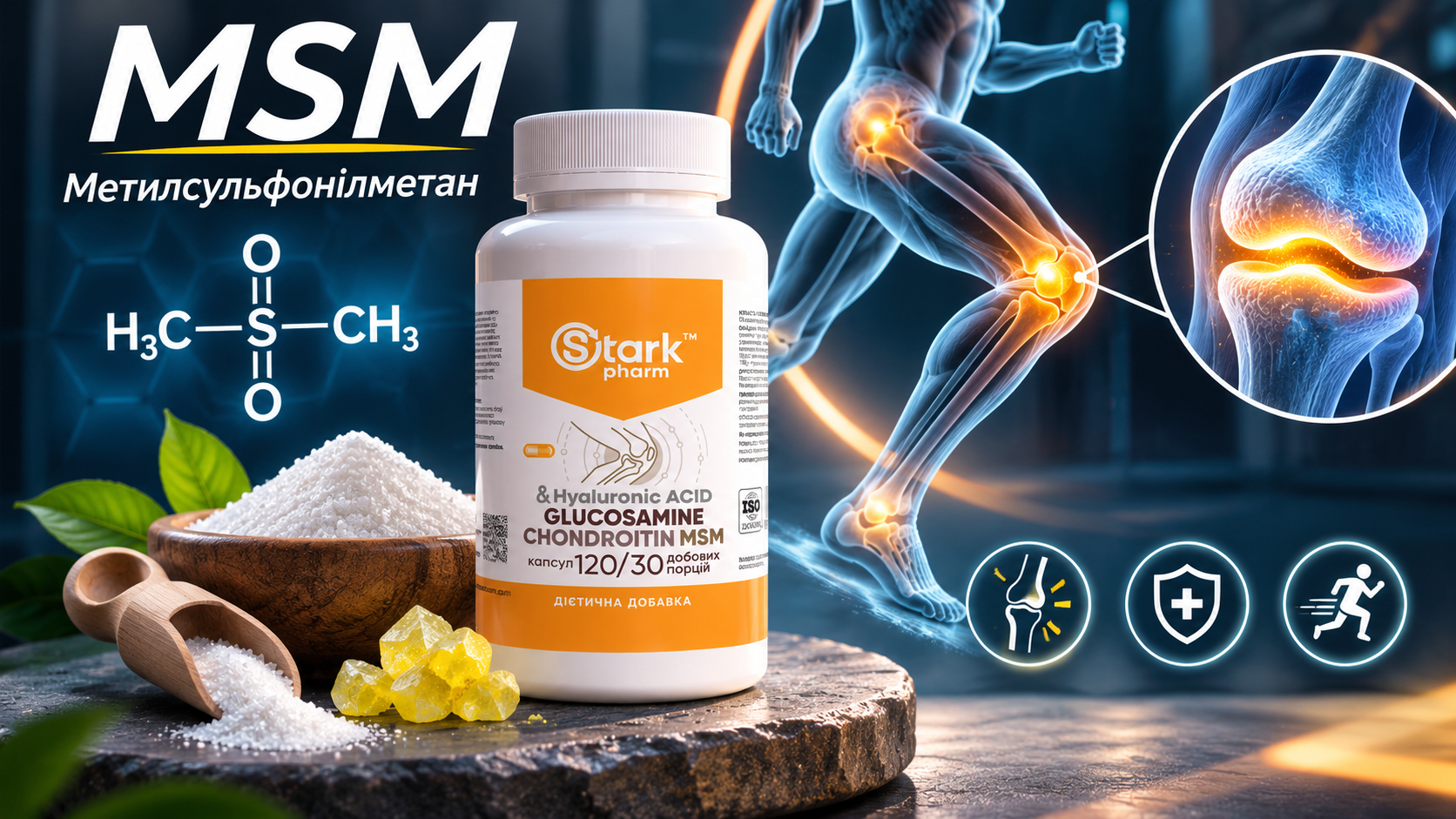
What is MSM and how is it different from cartilage components?
Methylsulfonylmethane, or dimethylsulfone, is a small organic molecule containing sulfur. It is different from both glucosamine, which is an amino sugar, and chondroitin sulfate, a complex chain that is part of cartilage proteoglycans. That is, MSM is not a ready-made fragment of cartilage tissue and cannot automatically “replace” damaged structures after ingestion.
Sulfur is indeed present in amino acids, proteins, and other compounds in the body. However, the thesis “MSM contains sulfur, therefore it restores cartilage” does not follow from physiology. The body does not assemble cartilage from ingested molecules directly, and structural changes in the joints require separate confirmation by instrumental methods and long-term observations.
Laboratory models have been used to investigate the possible effects of MSM on the regulation of inflammatory signaling pathways and markers of oxidative stress. A review by Butawan, Benjamin, and Bloomer (2017) summarizes these mechanisms, but is essentially a review of heterogeneous experimental and clinical data. A cellular response in the laboratory does not equate to proven benefit in a person with a specific joint problem.
What results are evaluated in joint studies?
Before comparing studies, it is important to distinguish between several endpoints. Pain is a subjective sensation, often measured on a scale; function is how easily a person can walk, climb stairs, or perform daily activities; and stiffness is another separate measure. These may not change at the same time.
The WOMAC questionnaire is widely used, which separately assesses pain, stiffness and function. A positive difference in one of its sections does not yet indicate that the condition of the articular cartilage itself has changed. To make a statement about the structure, for example, specially designed studies are required with the measurement of relevant anatomical parameters.
It is also important to distinguish between statistical significance and clinical significance. A small change may be noticeable in statistical analysis but not enough for a person to notice a practical difference in everyday life. This is especially important for short studies with small groups.
MSM in Knee Research: Kim and Debbi
A pilot randomized trial by Kim et al. (2006) included 50 adults with symptomatic knee osteoarthritis. The investigators compared MSM with placebo for 12 weeks; the MSM protocol was 3 g twice daily. The MSM group showed statistically significant differences in individual pain and physical function scores, but not in all stiffness scales or total symptoms. The authors themselves emphasized that the study was small and did not allow for confirmation of long-term results.
A second randomized trial, Debbi et al. (2011), evaluated the use of MSM for 12 weeks in a group of adults with knee osteoarthritis. The study protocol used 1.125 g three times a day. The authors found differences in some measures of physical function and the WOMAC total score, but did not find a convincing difference between groups on all measures of pain and stiffness. The conclusion of the article is cautious: the observed changes were small, and their clinical significance remains uncertain.
The figures from these two trials are a description of the research protocols, not advice on MSM dosage. The participants had specific medical inclusion criteria, and the results cannot be automatically extrapolated to healthy individuals, athletes, or any other supplement formulation. In particular, these results should not be taken as evidence of the repair of damaged cartilage.
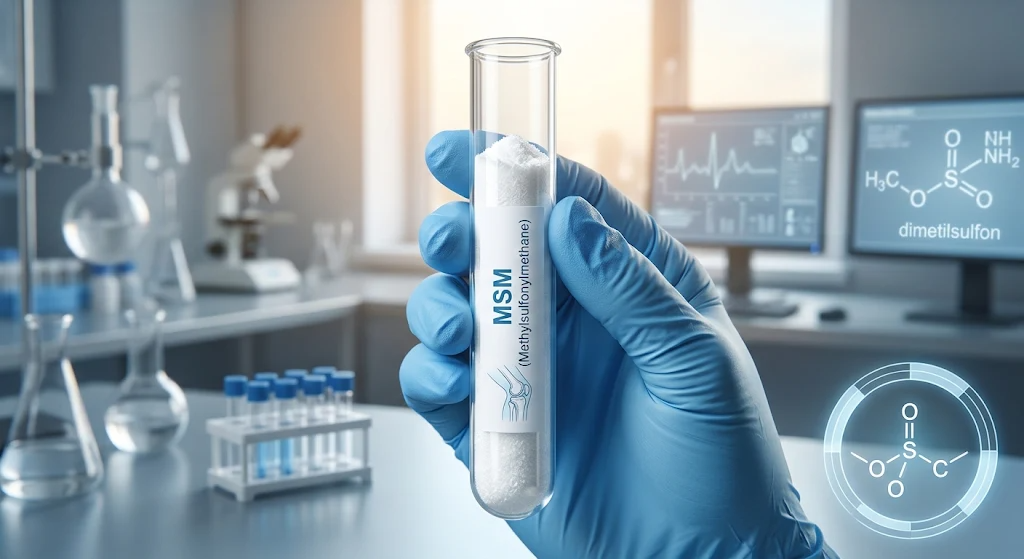
Comparison of key clinical trials
| Research | Who and what was studied? | Main result | The main limitation |
|---|---|---|---|
| Kim et al., 2006 | 50 adults, knee osteoarthritis; 12 weeks | Positive changes in individual pain and function scales | Small sample; not all indicators changed |
| Debbi et al., 2011 | Adults with knee osteoarthritis; 12 weeks | Some changes in WOMAC function and total score | Small effect; relevance to daily life unclear |
| Barmaki et al., 2012 | 18 active men; 14 km run after 10 days of protocol | Changes to individual markers after loading | Biomarkers do not equal faster recovery |
| Bloomer et al., 2012 | Pilot signals regarding recovery markers | Very small sample, limited reliability of findings | |
| Withee et al., 2017 | Half marathon participants; randomized trial | Pain, oxidative stress, and injury markers were assessed | Individual indicators cannot be generalized to all sports. |
The table does not show an “effectiveness rating,” but the difference in the questions the researchers answered. The mobility score in the clinical group and the creatine kinase score after running are not interchangeable results.
MSM after training: what was studied in athletes
The second area of research is recovery from exercise. This topic most often measures muscle soreness, subjective well-being, creatine kinase, plasma antioxidant capacity, and other laboratory parameters. Importantly, even improving a biomarker does not guarantee better running speed, strength, or ability to train the next day.
Barmaki et al. (2012) recruited 18 healthy, active men. After a 10-day study regimen, participants completed a 14 km run. The authors reported differences in some measures related to muscle load and antioxidant capacity. The sample size was nine per group, so the work should be interpreted as preliminary and not as evidence of overall accelerated recovery.
In Bloomer et al. (2012), eight healthy men underwent a resistance exercise protocol after a period of MSM. The researchers looked at markers of recovery and physical performance, but the small number of participants limits the precision of any estimates. Such pilot experiments may help to generate hypotheses for larger trials, rather than definitively establishing benefits.
Withee et al. (2017) conducted a randomized, placebo-controlled study after a half marathon. They compared several markers of oxidative stress, muscle damage, and post-exercise sensation. The results were assessed at individual endpoints and time points; it is not correct to translate these into a promise that MSM will “remove the muscle” or improve performance for every athlete.
Are anti-inflammatory and antioxidant mechanisms confirmed?
In experimental models, MSM has been described to have effects on NF-κB-related signaling, cellular response regulation, and oxidative stress. Scientific reviews have considered these findings as a possible basis for future clinical trials. However, the concept of “anti-inflammatory activity” in cell culture and the outcome in a randomized human trial are at different levels of evidence.
Measures like total blood antioxidant capacity are also difficult to interpret in isolation. They are affected by the time of blood collection, exercise, diet, and the specific laboratory method. Even if a measure changes in a test, it does not mean that the person has changed their cartilage condition or experienced long-term benefits.
The review by Butawan et al. (2017) summarizes experimental and human studies of MSM. However, one of the co-authors reported employment with a company associated with the ingredient industry. This does not invalidate the review, but it does highlight the need to assess the quality of primary research and the independence of the evidence, rather than relying solely on general positive statements.
Why the results of individual works cannot be transferred to all complexes
MSM is often combined with glucosamine, chondroitin, collagen peptides, and vitamins. However, testing pure MSM does not prove that a mixture of several ingredients will have the same result. Similarly, testing a complex product does not allow us to determine which component explains the observed change.
Even in one study, the form of the raw material, dosage, duration of use, physical condition of the participants and evaluation criteria are important. Comparing the amount of MSM in an arbitrary portion with values from publications without taking into account the protocol is incorrect. In a scientific article, numbers are needed to understand the methodology, not to draw up an individual regimen.
It is also important not to mix the findings of different studies: if three different substances have separate studies, their effects cannot be mechanically added. To talk about synergy, a specific test of this particular combination with appropriate control groups is needed.
What is known about tolerability and long-term safety?
In short-term clinical trials, MSM has been generally described as relatively well-tolerated. However, small groups and a few weeks of follow-up are insufficient to detect all rare adverse reactions or to assess the effects of long-term use. The review by Butawan et al. summarizes the available data but is not a substitute for large, long-term safety studies.
Individual digestive reactions or intolerance to individual components of the complexes are possible. People who are constantly taking medications, pregnant women, breastfeeding women and people with chronic conditions should discuss the use with a doctor. For children and adolescents, the data of adult samples should not be transferred.
If a joint suddenly becomes swollen, hot, red, has severe limitation of movement, or feels unwell, seek medical evaluation. Trying to find a supplement based on a single symptom may delay the diagnosis.
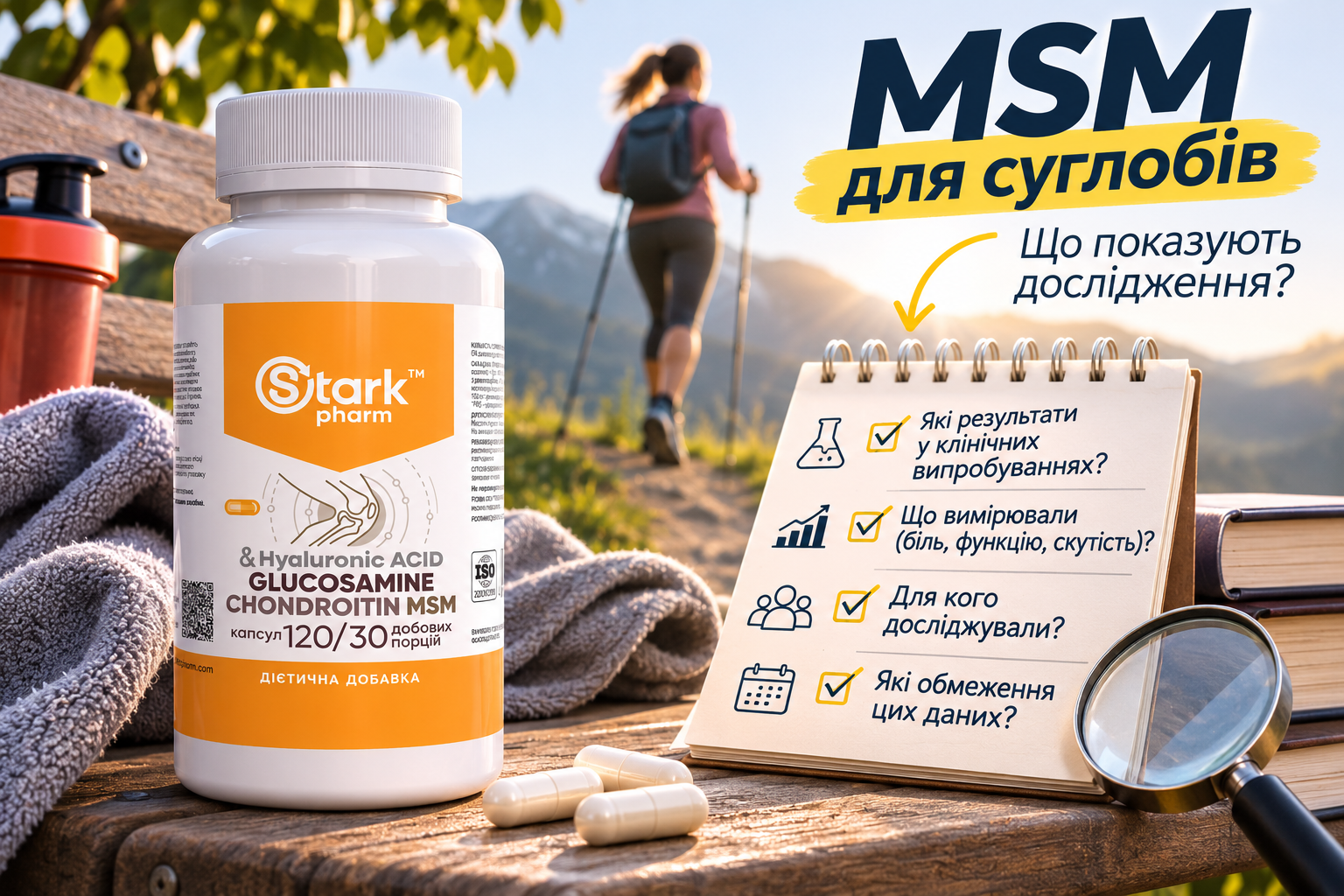
How to read MSM findings correctly
It’s best to ask four questions about each study. Who participated? For example, adults with knee osteoarthritis, healthy men after weight training, or runners. What exactly was studied? Sometimes it was MSM alone, sometimes a multi-ingredient product. What was measured? Pain, function, stiffness, a laboratory marker, or athletic performance. How reliable is the conclusion? It depends on the sample size, the control group, the duration, and the completeness of the results.
Today, the data often only provide preliminary, mixed signals on individual symptomatic and recovery measures. They do not prove that MSM repairs cartilage, changes the course of joint disease, or consistently improves athletic performance. This is a more cautious but accurate conclusion than the advertised “helps joints under any load.”
Frequently asked questions
What does MSM mean in a supplement?
This is an abbreviation for methylsulfonylmethane, an organic sulfur-containing compound.
Is MSM the same as chondroitin?
No. Chondroitin is a component of the extracellular matrix, and MSM is a small molecule with a different chemical structure.
Is MSM proven to restore joint cartilage?
No. The available short clinical studies have mainly evaluated symptoms and function, rather than conclusive structural cartilage repair.
Why have some MSM studies shown positive results?
Some small trials have found changes in certain function scales or laboratory markers. This does not mean that it has the same effect in all people.
Does MSM help you recover faster after sports?
There is preliminary data on individual markers after exercise, but a consistent benefit for real-world performance has not been proven.
Can doses from studies be compared to any complex?
No. Studies vary in design, participants, duration, and outcomes; study numbers are not a set schedule.
Does antioxidant activity mean that MSM protects joints?
No. A change in biomarker does not prove a structural benefit to the joint or long-term clinical outcome.
Is there enough data on the long-term safety of MSM?
No. Most clinical studies are short-term, so the lack of frequent reactions does not establish safety for long-term use.
Sources
- Kim L. S. et al. (2006). Efficacy of methylsulfonylmethane (MSM) in osteoarthritis pain of the knee: a pilot clinical trial. Osteoarthritis and Cartilage, 14(3), 286–294. PubMed.
- Debbi E. M. et al. (2011). Efficacy of methylsulfonylmethane supplementation on osteoarthritis of the knee: a randomized controlled study. BMC Complementary and Alternative Medicine, 11, 50. PubMed.
- Barmaki S. et al. (2012). Effect of methylsulfonylmethane supplementation on exercise - Induced muscle damage and total antioxidant capacity. Journal of Sports Medicine and Physical Fitness, 52(2), 170–174. PubMed.
- Bloomer R. J. et al. (2012). Influence of methylsulfonylmethane on markers of exercise recovery and performance in healthy men: a pilot study. Journal of the International Society of Sports Nutrition, 9, 46. PubMed.
- Withee E. D. et al. (2017). Effects of Methylsulfonylmethane (MSM) on exercise-induced oxidative stress, muscle damage, and pain following a half-marathon: a double-blind, randomized, placebo-controlled trial. Journal of the International Society of Sports Nutrition, 14, 24. PubMed.
- Butawan M. et al. (2017). Methylsulfonylmethane: Applications and Safety of a Novel Dietary Supplement. Nutrients, 9(3), 290. PubMed.
Dietary supplement. Not a medicine. Consult a doctor before use.
Products related to this post
Related Posts
Comments
Information
Customer Service
Extras
My Account


Sports nutrition manufacturer in Ukraine StarkPharm © 2026


