Your shopping cart is empty!

Glucosamine sulfate or hydrochloride: what's the difference for joints?
Published: 07/11/2026
Times Read: 30
Comments : 0
Glucosamine sulfate and glucosamine hydrochloride are two forms of the same substance that are often found in joint products. Their names differ by one word, but in clinical studies the results turned out to be different. To understand why, it is not enough to compare the labels on the package: the composition of the salt, the specific formula, the quality of the study and what indicator was measured in it are important.
Glucosamine is an amino sugar that the body uses in its own biochemical processes, in particular during the formation of components of the extracellular matrix. However, the mere fact that it is involved in the metabolism of connective tissue does not prove that the additional intake of any glucosamine salt gives the same result for the joints. It is the difference between the mechanism and the clinical data that is the main topic of this comparison.
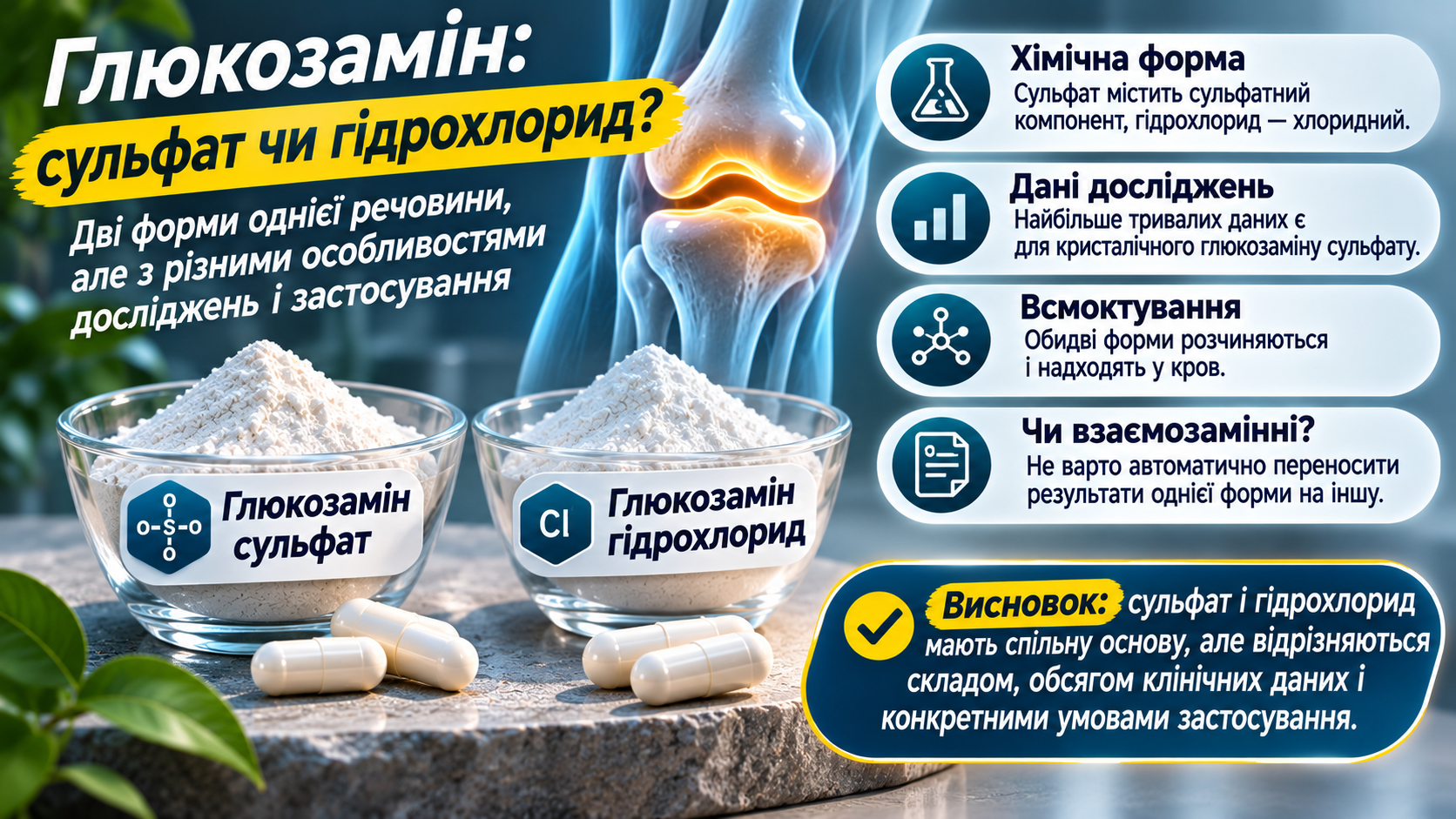
Glucosamine sulfate and hydrochloride: main differences
| Criterion | Glucosamine sulfate | Glucosamine hydrochloride |
|---|---|---|
| Chemical form | Glucosamine is in the form of a salt with a sulfate component; preparations may contain stabilizing salts. | Glucosamine in the form of a salt with a chloride component. |
| What is important on the label | The exact name: crystalline, stabilized, or other sulfate, as well as the method of indicating mass. | The exact weight of the hydrochloride and, if available, the conversion to glucosamine itself. |
| Test data | There are long-term trials of specific crystalline sulfate, but the results are not equally reproducible for all products. | There is a large GAIT trial where the overall primary outcome did not confirm superiority over placebo. |
| Absorption | Measured in pharmacokinetic studies. | Also enters the bloodstream after oral administration; direct qualitative comparison of forms is limited. |
| Are they interchangeable? | You should not automatically transfer the test result of a certain formula to all products with this label. | Evidence for sulfate should not be considered evidence for hydrochloride. |
The table compares research features, and does not declare one salt to be always more effective. Different studies used different formulations, doses, durations, and success criteria. Therefore, a conclusion about the “best form” is only meaningful if it is specified which formula, under what conditions, and by what indicator it was compared.
What happens to glucosamine salts after ingestion?
Sulfate and hydrochloride are not two completely different amino sugars. In the aqueous environment of the gastrointestinal tract, both salts dissolve, and further metabolism is primarily associated with the glucosamine molecule. Therefore, the statement that sulfate “works in the joint” and hydrochloride “is not absorbed” is a simplification. After taking hydrochloride, the concentration of glucosamine in the blood can also be measured.
However, the same basic molecule does not make the finished products clinically equivalent. The actual amount of glucosamine, the structure of the stabilized salt, the mode of administration and the characteristics of the production can affect the exposure. It is necessary to distinguish between blood indicators and the result for the person: higher levels of the substance in the plasma are not independent evidence of better well-being or changes in the joint tissues.
In a study by Persiani et al. (2005), 12 healthy volunteers were given crystalline glucosamine sulfate in test doses of 750, 1500, and 3000 mg for different periods. The authors measured plasma glucosamine concentrations. This study shows that a specific formulation provides systemic delivery of the substance, but does not compare its clinical effect with the hydrochloride.
Why is crystalline glucosamine sulfate written separately?
Some of the positive studies were not done with just any “glucosamine sulfate,” but with a specific crystalline stabilized formula. Older clinical studies by Reginster et al. (2001) and Pavelka et al. (2002) evaluated long-term outcomes in participants with knee osteoarthritis. They used sulfate in an investigational regimen of 1500 mg daily for three years. Some structural and symptomatic outcomes differed from placebo.
These studies are often cited as an argument in favor of sulfate. However, it is more accurate to talk about the data of a specific studied product, rather than about the proven superiority of all powders or capsules labeled “sulfate.” Other important questions include who funded the trials, how independently validated the results are, what is the risk of bias, and whether the studied composition matches the specific product.
The literature also discusses the stability of glucosamine sulfate and the use of sodium or potassium salts to ensure its stability. Therefore, the name "sulfate" alone does not guarantee identical crystal structure, identical composition, or identical exposure after application. The formulation of a particular product is important, but it should not be concluded that every other form is necessarily ineffective.
The large GAIT study, published by Clegg et al. (2006), included 1583 participants with symptoms of knee osteoarthritis. It evaluated glucosamine hydrochloride alone and in combination with chondroitin sulfate; the study regimen for glucosamine was 1500 mg daily for 24 weeks. The primary outcome was the proportion of participants with measurable pain relief.
In the overall group, glucosamine hydrochloride did not demonstrate a statistically significant advantage over placebo on the primary endpoint. In the subgroup with moderate to severe pain, the authors described a signal for the combination with chondroitin, but this result needs to be interpreted with caution: subgroup analysis does not automatically confirm an effect for all users.
Importantly, GAIT was not a direct “sulfate versus hydrochloride” study. It compared hydrochloride and other trial groups to placebo. Therefore, comparing GAIT to sulfate trials raises questions about form, but does not allow us to isolate it as the sole cause of the different results.

Does this prove that sulfate is better absorbed?
It is easy to confuse two different issues here: absorption and clinical effects. The former is measured by the concentration of the substance in the blood after ingestion; the latter is measured by symptoms, function, or instrumental measurements over weeks and months. Even a convincing difference in concentration does not necessarily translate into a tangible difference in joint outcomes.
Publications sometimes compare numbers from separate pharmacokinetic studies of sulfate and hydrochloride. However, such comparisons can be imprecise: participants, concomitant components, assay methods, and sample collection times are not the same. Direct comparisons using an agreed protocol are needed. A study of the two hydrochloride forms in healthy volunteers, for example, can assess their relative bioavailability, but does not provide an answer as to their superiority over sulfate.
An interesting nuance was added by a pilot study by Chang et al. (2025): ten healthy adults received 1500 mg of two different forms of the sulfate itself in a crossover design. The authors found no statistically significant difference in the main pharmacokinetic parameters. Due to the small sample size, this does not prove complete equivalence, but it reminds us that even widespread claims about the unconditional superiority of the crystalline form need direct verification. And this study did not compare the sulfate with the hydrochloride.
Why scientific reviews and clinical guidelines differ in conclusions
Reviews vary not only in the type of salt used. Some analyses pool all glucosamine products, while others isolate standardized crystalline sulfate. Additionally, participants' symptom severity, duration of follow-up, sample size, measures, and statistical pooling techniques vary.
The American College of Rheumatology and Arthritis Foundation guideline, published by Kolasinski et al. (2020), recommends against relying on glucosamine as a proven clinical benefit for osteoarthritis of the knee, hip, or hand. The authors emphasize the problems of reproducibility of results and possible bias of studies. However, some peer-reviewed reviews have focused more on the crystalline sulfate in particular. This does not mean that there is one universally accepted conclusion for all forms.
Therefore, a fair interpretation is that the data for the forms are mixed, but the available literature does not support the claim that any one form of glucosamine sulfate is universally superior. When a review finds a difference between subgroups, it should be checked whether a direct comparison was made and whether other factors could explain the result.
How to read the composition correctly: sulfate, hydrochloride and mass of the substance
It is important to find not only the word “glucosamine” on the label, but also the full name of its form. The mass of the salt cannot always be equated to the mass of free glucosamine: the chloride or sulfate component is also included in the declared chemical form. For stabilized sulfates, there may be additional components, which further complicates the direct comparison of numbers.
That is why the inscription "1500 mg of glucosamine" without specifying the form and principle of calculation is less informative than the full list of ingredients. You should not independently derive the "equivalent" from approximate percentages: for correct calculation, you need to know the exact salt, hydrated form, and what the manufacturer has already included in the declared mass.
- Full name of the form. Sulfate, stabilized sulfate, or hydrochloride are not the same thing.
- Basis of quantification. The number may refer to the whole salt or to the glucosamine itself.
- Other ingredients: Chondroitin, MSM, and other ingredients are not a substitute for testing the actual form of glucosamine.
- Origin information: For people with food allergies, it is important to check the source of the raw material.
The number of milligrams on the label also cannot be directly identified with the number in the scientific publication unless the formula and method of accounting for the active ingredient match. To understand a study, one should focus on its own protocol, rather than mechanically transferring the values to another formulation.
Glucosamine should not be considered a substitute for evaluation of the cause of pain or limitation of joint movement. If symptoms worsen, are accompanied by swelling, significant redness, or impaired support, medical evaluation is warranted. Scientific evidence on supplements is not a substitute for individualized treatment of such conditions.
Before using glucosamine products, it is especially important to consult a doctor for people with diabetes or prediabetes, asthma, food allergies to crustaceans or insects, and for those taking vitamin K antagonists. Pregnant women, breastfeeding women, and minors are not recommended to use such supplements on their own. If the product contains sodium or potassium salts, this is important for people who need to monitor their intake.
Possible adverse digestive effects and individual sensitivity reactions. The presence of the words "natural" or "joint" in the description of the component does not indicate the absence of risks. If taking other drugs at the same time, check compatibility with a doctor or pharmacist.

What to remember about the two forms
Glucosamine sulfate and hydrochloride contain a related basic substance, but the results of clinical studies cannot be mechanically transferred from one form to the other. Some of the positive results are specific to the crystalline sulfate; a large trial of the hydrochloride did not show a convincing benefit in the general population. However, the difference in results between individual studies does not prove that the salt was always the decisive factor.
The most useful habit is to look at the full name of the formula and the quality of the evidence, not just the word “glucosamine” and the number of milligrams. This helps to separate a plausible biochemical mechanism from real but inconsistent trial results.
Frequently asked questions
Which is better: glucosamine sulfate or hydrochloride?
There is no single answer for all products. Studies of individual forms of sulfate have yielded different results than tests of the hydrochloride, but this does not prove the superiority of any one sulfate.
Is the glucosamine molecule the same in these forms?
The main component is related, but the salt forms and possible features of the finished formulas differ. This is enough to carefully check the composition and specific studies.
Is glucosamine hydrochloride absorbed?
Yes, glucosamine can be measured in the blood after taking it. But the fact of absorption alone does not prove a pronounced effect on the joints.
How is crystalline glucosamine sulfate different from regular glucosamine?
This is a specific, stabilized formula that has been studied in a number of clinical studies. Not every product labeled "glucosamine sulfate" is identical to the studied product.
Why is GAIT often mentioned in form comparisons?
This is a large study using glucosamine hydrochloride that did not show a convincing advantage over placebo on the primary endpoint in the overall group. It did not directly compare the hydrochloride with the sulfate.
Does 1500 mg mean the same amount of glucosamine in different salts?
Not necessarily. The number may indicate the mass of the entire salt or glucosamine in terms of conversion, so you need to read the exact name and how the quantity is indicated.
Can the form of glucosamine affect the results of the study?
It may be a factor along with product composition, dose, duration, and participant characteristics. Its individual contribution is best determined by direct comparative trials.
Can we conclude about cartilage restoration from a blood test?
No. Glucosamine concentration in the blood indicates the intake of the substance, and does not prove the restoration of articular cartilage or improvement in joint function.
Sources
- Persiani S. et al. (2005). Glucosamine oral bioavailability and plasma pharmacokinetics after increasing doses of crystalline glucosamine sulfate in man. Osteoarthritis and Cartilage, 13(12), 1041–1049. PubMed.
- Reginster JY et al. (2001). Long-term effects of glucosamine sulfate on osteoarthritis progression: a randomized, placebo-controlled clinical trial. The Lancet, 357(9252), 251–256. PubMed.
- Pavelka K. et al. (2002). Glucosamine sulfate use and delay of progression of knee osteoarthritis: a 3-year, randomized, placebo-controlled, double-blind study. Archives of Internal Medicine, 162(18), 2113–2123. PubMed.
- Clegg DO et al. (2006). Glucosamine, chondroitin sulfate, and the two in combination for painful knee osteoarthritis. The New England Journal of Medicine, 354(8), 795–808. PubMed.
- Chang C. et al. (2025). Does Salt Form Matter? A Pilot Randomized, Double-Blind, Crossover Pharmacokinetic Comparison of Crystalline and Regular Glucosamine Sulfate in Healthy Volunteers. Nutrients, 17(15), 2491. PubMed.
- Kolasinski SL et al. (2020). 2019 American College of Rheumatology/Arthritis Foundation Guideline for the Management of Osteoarthritis of the Hand, Hip, and Knee. Arthritis Care & Research, 72(2), 149–162. PMC.
- Henrotin Y. et al. (2012). Is there any scientific evidence for the use of glucosamine in the management of human osteoarthritis? Arthritis Research & Therapy, 14(1), 201. PMC.
Dietary supplement. Not a medicine. Consult a doctor before use.
Products related to this post

Related Posts
Comments
Information
Customer Service
Extras
My Account


Sports nutrition manufacturer in Ukraine StarkPharm © 2026


