Your shopping cart is empty!

Glucosamine and chondroitin together: is the combination better for joints?
Published: 08/11/2026
Times Read: 61
Comments : 0
Glucosamine and chondroitin are often combined in a joint supplement. At first glance, the logic is simple: the two substances are associated with cartilage tissue, so together they should work better. But biological plausibility does not equal proven superiority in humans. To answer the question, you need to compare groups that received both components, each of them separately, and a placebo.
Such comparisons do exist. The most important are the large GAIT trial and the two-year LEGS study. They gave mixed results for pain and radiographic changes. Therefore, the statement “the combination is always better” does not follow from the available evidence.
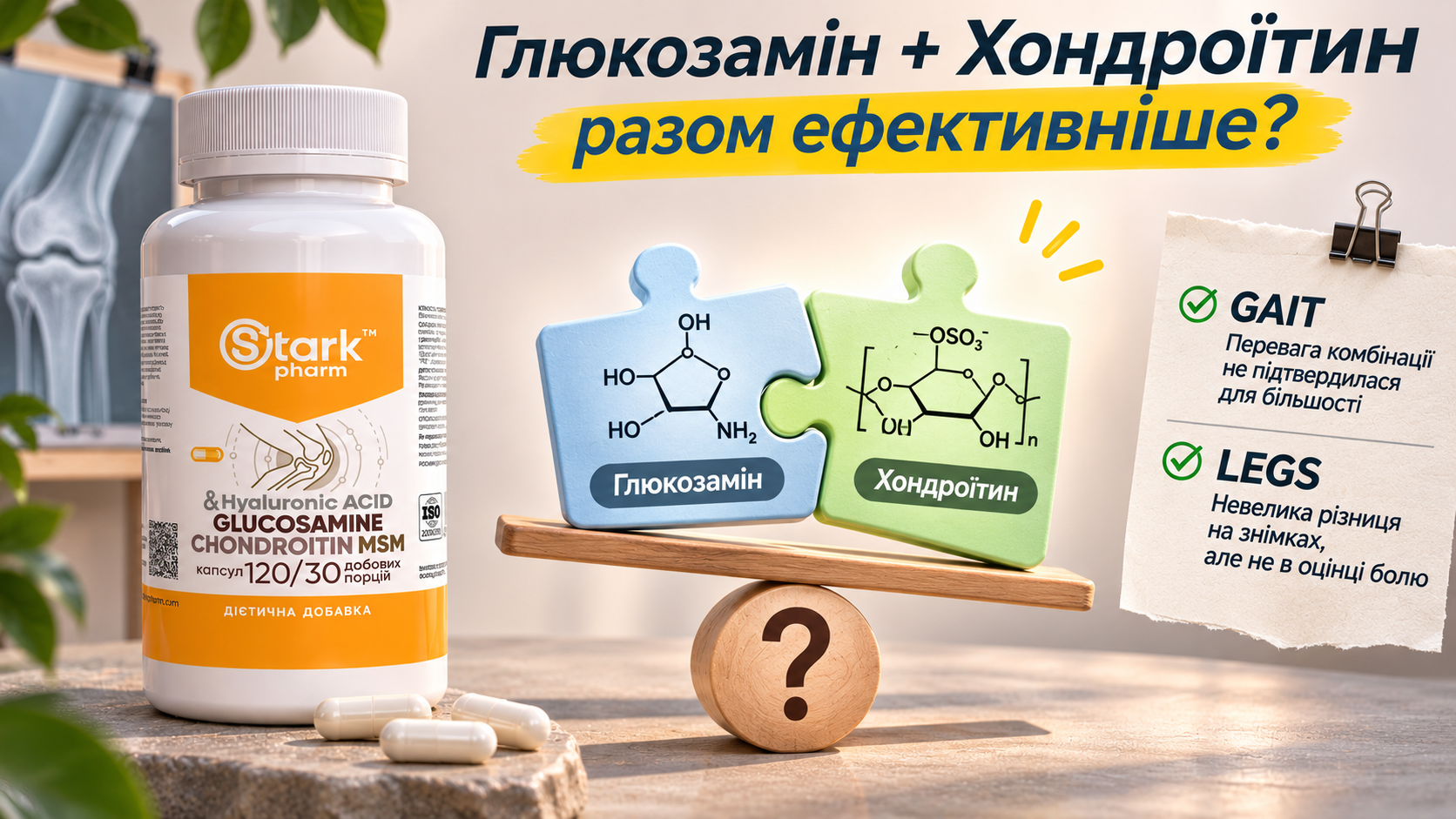
What does "stronger combination" mean and how is it checked?
The word “better” can mean very different things. For one person, it may be less discomfort when walking, for another, it may be easier to climb stairs. For a researcher, it may be a change in scores on a standardized scale or an X-ray of the joint space. These indicators are not interchangeable.
To establish the superiority of the combination, it is not enough to show that the group with two substances feels better than the placebo group. Direct comparisons with glucosamine alone and chondroitin alone under the same conditions are needed. Otherwise, we do not know whether the second component added anything to the effect of the first.
| Comparison | What question does it answer? | What it doesn't prove |
|---|---|---|
| Combination vs. placebo | Is there a difference with inactive control? | That two substances are better than one |
| Combination vs. glucosamine | Does chondroitin add a separate effect? | That the result will be repeated for all forms and doses |
| Combination vs. chondroitin | Does glucosamine add a separate effect? | That the result will be the same for all joint conditions |
| Combination vs. another agent | How do two specific modes compare? | The advantage of the combination over each component separately |
| Change in radiological index | Is there a difference in the picture within the protocol? | Automatic pain improvement or cartilage repair |
Why two components don't necessarily give double the effect
Glucosamine is an amino sugar involved in glycosaminoglycan metabolism. Chondroitin sulfate is a more complex polymer that is a component of the extracellular matrix of cartilage. These descriptive biochemical roles sometimes become the basis for the advertising claim of “synergy.” However, the body does not use orally administered substances in the same way as conventional building blocks that immediately fall into place.
After ingestion, digestion, absorption, transformation, and distribution between tissues occur. The fact that two substances are part of the same biological system does not in itself mean that their mixture will affect clinical indicators more than one of them. In addition, different preparations use different glucosamine salts, chondroitin characteristics, schemes, and quality standards.
To prove synergy, an appropriate analytical technique is needed. Even if the combination exceeds the effect of a single substance, this does not necessarily mean mutual reinforcement: it is possible that the two effects are simply additive. And when there is no difference, it is incorrect to justify “double the power” only by the list of ingredients.
GAIT: a large study that failed to show benefit for most
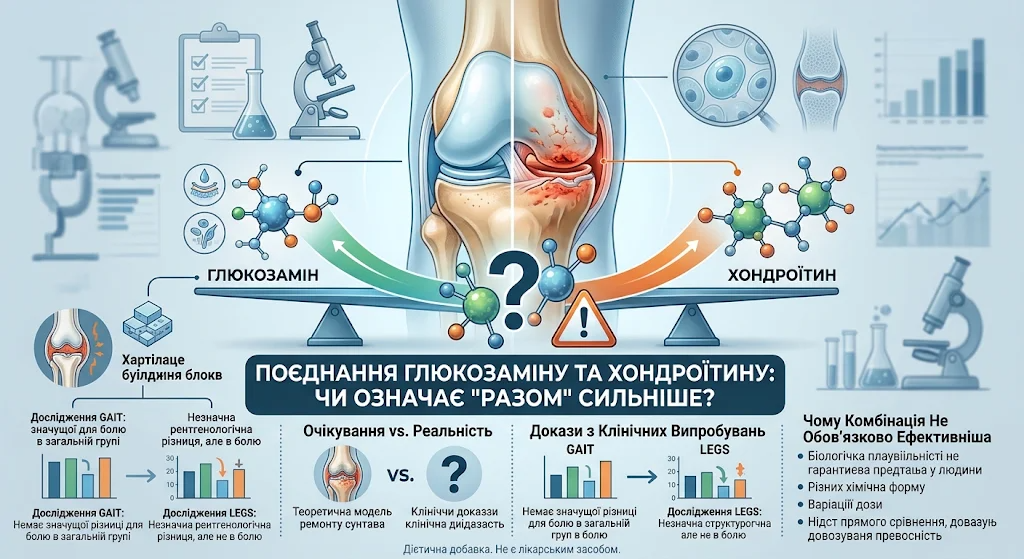
The GAIT trial (Clegg et al., 2006) enrolled 1583 people with symptoms of knee osteoarthritis. Glucosamine 1500 mg daily, chondroitin sulfate 1200 mg daily, their combination, placebo, and a separate active comparator group were compared over 24 weeks. Glucosamine was administered in the hydrochloride form.
The primary outcome measure was the proportion of participants whose pain was reduced by at least 20% from baseline. In the overall population, the response rate was 60.1% with placebo; the difference for the combination was 6.5 percentage points, but did not reach statistical significance (p = 0.09). The individual components also did not show a convincing advantage over placebo on the primary outcome measure.
However, in the subgroup of participants with moderate or severe initial pain, the combination was significantly better than placebo: 79.2% vs. 54.3%. The authors called this result preliminary. The subgroup analysis includes fewer people, and its positive signal does not cancel out the negative overall result. This is a reason for further study, not a promise for all buyers.
LEGS: small difference in images, but not in pain assessment
A different design was used in LEGS (Fransen et al., 2015). In the two-year trial, 605 participants were divided into four groups: glucosamine sulfate 1500 mg/day, chondroitin sulfate 800 mg/day, both substances together, or placebo. The researchers assessed both pain and joint space narrowing on X-rays.
This is one of the central nuances of the topic: a result for an X-ray parameter does not mean that a person will necessarily experience significant relief. The small absolute value and the proximity of the statistical result to the threshold of significance also require caution. It does not follow from LEGS that the combination restores lost cartilage or returns the joint to its previous state.
Why the MOVES study doesn't answer the question "together or separately"
The MOVES trial (Hochberg et al., 2016) is often cited as an argument in favor of combination. It studied 606 randomized participants with painful knee osteoarthritis. One group received a combination of chondroitin sulfate 1200 mg and glucosamine hydrochloride 1500 mg daily, and the other received celecoxib 200 mg daily for six months. The investigators assessed whether the first regimen was non-inferior to the second on a defined criterion.
The study result was favorable for the studied combination relative to the active comparator on the primary criterion of non-inferiority. However, there were no glucosamine-alone and chondroitin-alone groups in MOVES. Therefore, referring to this trial as direct evidence of the superiority of the two substances over each alone is a logical fallacy.
Another difference is that MOVES and GAIT included people with different characteristics and had different comparison designs. A positive result from one protocol does not automatically negate a null result from the other: the researchers asked different questions.
What meta-analyses and clinical recommendations have shown
In a network meta-analysis, Wandel et al. (2010) pooled data from ten large trials involving 3803 people with osteoarthritis of the hip or knee. The authors found no clinically meaningful mean pain reduction for either glucosamine, chondroitin, or their combination compared with placebo. This does not mean that every participant in each trial had the same outcome; it is a composite score based on the criteria chosen.
Network comparison combines direct and indirect data, so its reliability depends on the comparability of trials. Individual meta-analyses may give more optimistic estimates, but the set of studies, model assumptions, endpoints, and assessment of the risk of bias vary. That is why it is worth reading not only the overall conclusion, but also which forms and groups are included in it.
The American College of Rheumatology/Arthritis Foundation guidelines, published in 2020, do not recommend glucosamine and combinations of glucosamine and chondroitin for the management of knee and hip osteoarthritis. These are clinical recommendations that assess the balance of evidence in specific patients, not a conclusion that the chemical impossibility of any biological action of these substances.
What prevents comparing different complexes with each other?
In the first study, glucosamine may be sulfate, in the second, hydrochloride. Chondroitin sulfate may differ in molecular weight, origin, and standardization. The duration of follow-up is also important: several months for symptoms and two years for radiographic changes are not interchangeable terms.
The participants’ baseline condition, pain intensity, age, body weight, concomitant interventions, and how the results were processed are all important. The inclusion of people with confirmed osteoarthritis in a study does not prove that similar effects will occur in healthy athletes or people who just want to “support their joints.” The conclusions about a particular formula studied cannot be automatically transferred to any complex with two familiar words on the label.
It is also important to distinguish between statistical significance and practical significance. A number may be mathematically compelling, but the change may be too small for a person to notice in their daily activities. Conversely, the absence of a statistical difference does not necessarily mean that all individual responses were zero: the study is estimating the average effect in a given sample.
How to read the conclusions about the combination without advertising exaggerations
A practical algorithm for reading a scientific news story starts with three questions: what was compared, what was measured, and how big was the difference? If both ingredients were compared only to a placebo, such work alone does not prove superiority over using each separately. If joint space width was measured, this should not be presented as an automatic reduction in pain.
The next question is whether the result was replicated in independent trials. A positive GAIT subgroup or a small radiographic LEGS difference does not equal a general rule for all people. The scientific answer today is that there are individual signals of possible benefit in certain conditions, but a consistent and clinically meaningful advantage of the combination over each component alone has not been proven for all situations.
Caution and limits of self-administration
Glucosamine and chondroitin may not be appropriate for certain groups. If you have a carbohydrate metabolism disorder, asthma, an allergy to crustaceans, or are taking anticoagulants, including vitamin K antagonists, a doctor's consultation is necessary. Children, pregnant women, and women during breastfeeding should not use such supplements on their own. It is also worth considering the possible sodium or potassium content of certain salts and concomitant diseases.
The doses given in the GAIT, LEGS and MOVES analyses are only parameters of the research protocols. They are not instructions for self-administration and do not establish a universal daily requirement.
Conclusion: Should we expect more from two ingredients?
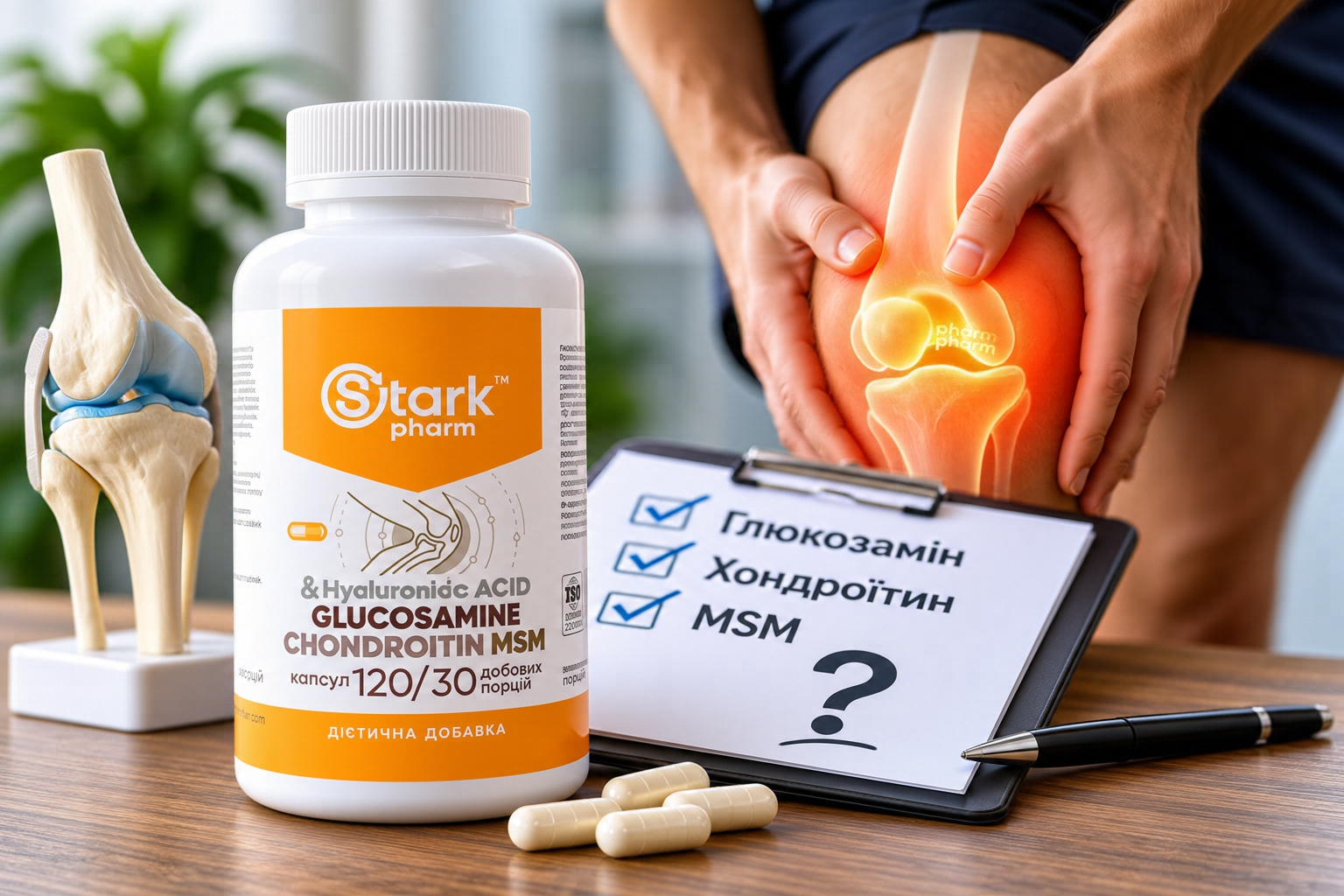
The combination of glucosamine and chondroitin has a clear biochemical explanation, but the studies have not confirmed the simple formula of “two ingredients, twice the result.” GAIT did not show a convincing benefit in the entire sample, LEGS recorded a small difference on X-rays with no noticeable difference in pain, and MOVES answered a different question - comparison with an active drug.
The most correct conclusion for the reader: evaluate the specific results of the research, the form of the components, their quality and the target indicator, and not the number of names in the composition. The issue of daily comfort of movements is solved more broadly than the choice between one and two ingredients.
Frequently asked questions
Is glucosamine with chondroitin better than either alone?
No clear benefit has been proven for all people. Direct trials have yielded mixed results depending on which metric was evaluated.
Did GAIT show a benefit of the combination?
There was no statistically significant benefit over placebo in the overall group. The authors considered the positive result in the subgroup with more intense pain to be preliminary.
Why did the combination look promising in LEGS?
Due to a small, statistically significant difference in radiographic joint space narrowing at two years. At the same time, no significant difference was found between the groups in pain assessment.
Does MOVES prove that two components are more effective than one?
No. MOVES compared the combination with the active drug, and there were no groups with only one ingredient.
Can the quality of a complex be judged by the number of ingredients?
No. What matters is the chemical form, standardization, composition, and compliance with available data, not the quantity of substances themselves.
Does an X-ray change indicate cartilage repair?
No. The joint space index is an indirect marker and does not prove the formation of new healthy cartilage.
Are the results the same for healthy people and patients with osteoarthritis?
No. Most direct clinical comparisons have been conducted in people with symptoms of osteoarthritis; it is not appropriate to extrapolate them to a healthy population.
Can I repeat doses from studies myself?
No. These are test-specific parameters, not dietary advice. If you have a medical condition or are taking medication, it is advisable to discuss supplements with your doctor.
Sources
- Clegg D. O. et al. (2006). Glucosamine, chondroitin sulfate, and the two in combination for painful knee osteoarthritis. The New England Journal of Medicine, 354(8), 795–808. PubMed.
- Fransen M. et al. (2015). Glucosamine and chondroitin for knee osteoarthritis: a double-blind randomised placebo-controlled clinical trial evaluating single and combination regimens. Annals of the Rheumatic Diseases, 74(5), 851–858. PubMed.
- Hochberg M. C. et al. (2016). Combined chondroitin sulfate and glucosamine for painful knee osteoarthritis: a multicentre, randomised, double-blind, non-inferiority trial versus celecoxib. Annals of the Rheumatic Diseases, 75(1), 37–44. PubMed.
- Wandel S. et al. (2010). Effects of glucosamine, chondroitin, or placebo in patients with osteoarthritis of hip or knee: network meta-analysis. BMJ, 341, c4675. PubMed.
- Kolasinski S. L. et al. (2020). 2019 American College of Rheumatology/Arthritis Foundation Guideline for the Management of Osteoarthritis of the Hand, Hip, and Knee. Arthritis & Rheumatology, 72(2), 220–233. PubMed.
Dietary supplement. Not a medicine. Consult a doctor before use.
Products related to this post
Related Posts
Comments
Information
Customer Service
Extras
My Account


Sports nutrition manufacturer in Ukraine StarkPharm © 2026


