Your shopping cart is empty!

Hyaluronic acid in capsules: are there any benefits for joints?
Published: 09/11/2026
Times Read: 36
Comments : 0
Hyaluronic acid for joints is known as a component of synovial fluid, a medium that helps joint surfaces move with less friction. But can we expect a similar effect from capsules that pass through the digestive system? This is a different question than the effectiveness of injections: the substance enters the body in a different way, and its further fate depends on cleavage and absorption.
Clinical trials of oral hyaluronic acid do exist. Some have shown improvements in discomfort and motor function scores, while others have found no conclusive difference. The key is to understand what the researchers were testing: a pure substance or a multi-ingredient supplement, what duration of follow-up they chose, and how they measured the outcome.
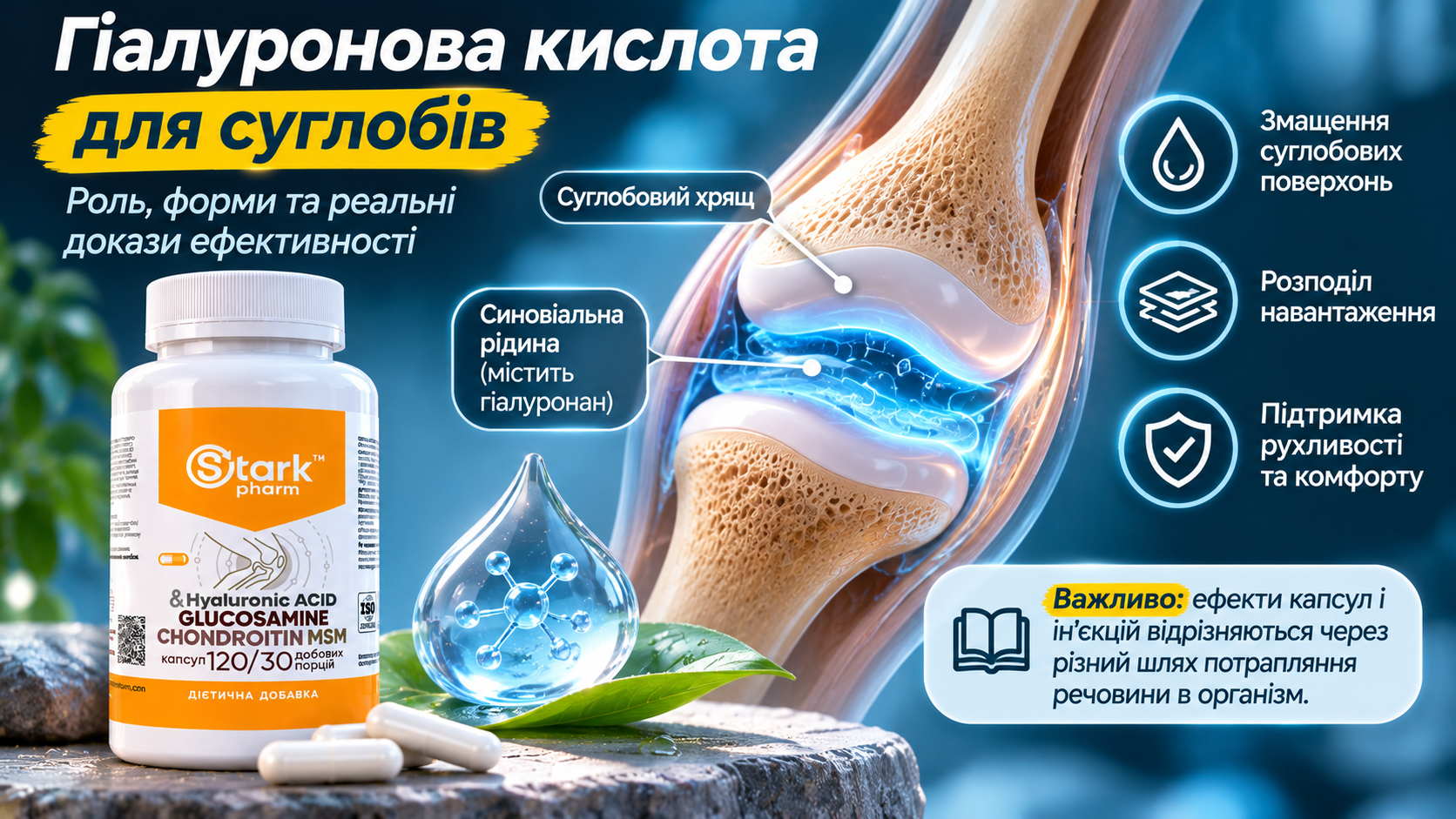
What does hyaluronic acid do in the joint?
Hyaluronic acid, or hyaluronan, is a large polysaccharide from the group of glycosaminoglycans. The body synthesizes it independently. It is found not only in synovial fluid, but also in the skin and other intercellular structures. Its long molecules retain water and form the properties of the medium through which the articular surfaces slide relative to each other.
Synovial fluid performs several functions at the same time: it participates in lubrication, load distribution, and the transfer of nutrients to tissues that do not have their own extensive network of blood vessels. Hyaluronan is one of the components of this system, but not the only substance on which the condition of cartilage, ligaments, and periarticular muscles depend.
During age-related and degenerative changes, the composition and mechanical properties of the synovial medium change. Hence the idea of additionally using hyaluronic acid. However, the biological role of natural hyaluronan does not automatically prove that the ingested molecule will reach the knee or hip joint in an unchanged form.
Capsules and injections are not the same thing
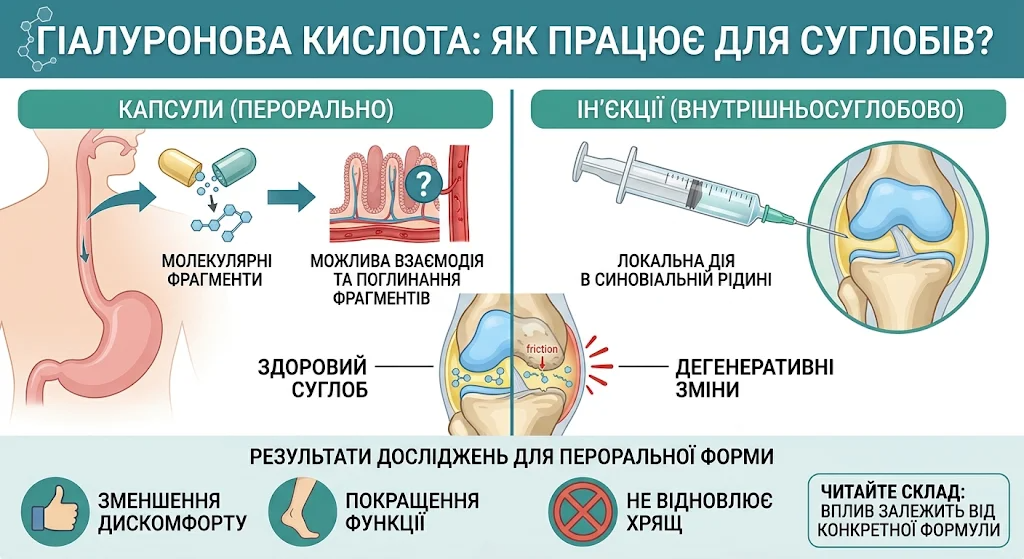
When hyaluronic acid is injected directly into the joint, it does not pass through the stomach and intestines. When administered orally, the molecule comes into contact with digestive enzymes and intestinal microbiota, and some of its fragments may be absorbed or interact with the intestinal mucosa. Therefore, comparing these methods only by the number of milligrams is incorrect.
| Question | Hyaluronic acid in capsules | Intra-articular injection |
|---|---|---|
| How it enters the body | Through the digestive system | Directly into the joint cavity |
| What is important for the mechanism | Digestion, possible absorption of fragments and indirect biological signals | Local effect of the injected substance and properties of a specific drug |
| What can be compared? | Oral drug group vs. control group | Results of injection tests according to their own protocols |
| What the research doesn't prove | That the capsules work the same as an injection into the joint | That the results of injections can be transferred to capsules |
This distinction is important for the reader: the claim of “lubricating the joints from the inside” sounds simple, but it is too straightforward for capsules. Possible mechanisms of action of the oral form are being investigated, but they do not boil down to the literal transfer of the capsule contents into the synovial fluid.
What happens to hyaluronan after ingestion?
Hyaluronan is a large molecule, and its initial molecular weight can vary significantly between raw materials. It can break down into smaller fragments in the digestive tract. Some research hypotheses link these fragments and elements of the intestinal barrier to biological signaling pathways. This is an interesting mechanism, but it does not yet demonstrate an improvement in human well-being.
The review by Oe et al. (2016) describes experimental data on the possible interaction of oral hyaluronan with intestinal cells. However, it is important to separate laboratory results from randomized human trials: confirmed molecular mechanism and measurable clinical benefit are different levels of evidence.
When a product is labeled as “hyaluronic acid” or “sodium hyaluronate,” it doesn’t necessarily mean that the products are identical in molecular weight, purity, form, or other characteristics. Additionally, studies have often used specific standardized blends rather than just any supplement with a similar name.
What clinical studies of the oral form have shown
Nelson et al. (2015) conducted a randomized, placebo-controlled trial of 40 subjects over a three-month period. The researchers assessed not only knee pain and functional outcomes, but also concentrations of specific biomarkers in biological samples. The findings were interesting, but the small sample size and specific inclusion criteria limit the generalizability of the results to all users.
In a small pilot study, Kalman et al. (2008) studied a hyaluronic acid-rich extract for eight weeks. Some measures of well-being were found to improve, but the nature of the pilot study means that the findings need to be confirmed in larger studies.
These examples show why the statement “oral hyaluronic acid has not been studied at all” is incorrect. But the opposite statement—“its effect on joints has been proven for any composition and in every person”—goes far beyond the published data.
Why reviews have positive findings but limited confidence
A systematic review by de Carvalho and Davidson (2024) included 11 studies involving 597 people, mostly involving the knee joint. Nine publications reported improvements in some measures, while two did not show a convincing effect. The authors also noted varying follow-up periods, ranging from four weeks to a year, and varying daily doses of the substance in the protocols.
A critical limitation of this review is that only two of the included studies examined hyaluronic acid as a single ingredient. Nine others combined it with additional substances, such as glucosamine, chondroitin, collagen, or botanicals. If participants reported improvement with a combination of ingredients, it is impossible to determine the contribution of each ingredient without a specific comparative design.
An additional problem is the different assessment scales. One study may measure pain using a visual analogue scale (VAS), another the WOMAC index, and yet another daily activity or laboratory markers. Even a statistically significant result on one scale does not always mean a noticeable change in everyday life. That is why it is worth looking not only at the authors' final wording, but also at the methodology and number of participants.
What indicators can really be evaluated?
For joint studies, subjective discomfort during walking, morning stiffness, ability to climb stairs and perform daily activities are most often important. Some methods, such as WOMAC, combine several aspects. They help to assess well-being, but are not a direct measure of cartilage thickness or repair.
- Pain and discomfort. Scored on a scale; the outcome also depends on the initial severity of symptoms.
- Motor function. Reflects how easily a person performs habitual movements, but also depends on muscle strength and activity.
- Stiffness: Can vary independently of other indicators; it is important to look at the big picture.
- Biomarkers: Changes in certain molecules in the blood or synovial fluid are not yet proof of improved joint function.
- Joint structure. Requires appropriate imaging techniques and long-term follow-up; pain scales alone do not measure it.
If a study shows improvement in discomfort scores over a few months, this does not indicate new cartilage growth. Confusion between relief of a single symptom and changes in tissue structure is one of the main reasons for inflated expectations for supplements.
Who is suitable for research findings and who is not?
Most trials of oral hyaluronic acid have been conducted in adult participants with specific joint complaints or age-related changes. This is not the same as studies in healthy athletes, adolescents, or people after acute trauma. Separate data are needed for these groups—you can’t extrapolate conclusions based on the similarity of the ingredient alone.
It is equally important to distinguish between the knee, hip, and other joints. The review by de Carvalho and Davidson was dominated by knee studies. Consequently, data for other body regions are much less available. Even if the mechanism sounds universal, this does not mean that the outcome is universal.
The duration of the study is also not a set schedule: four, eight, or twelve weeks is the authors' chosen observation horizon, not a promise that a tangible result will appear on a certain day. Longer trials also do not guarantee that a particular supplement will have the same action profile.
What to look for when reading the composition of a supplement
The combination of several substances does not in itself mean either their mutual superiority, nor that the results of the study of one ingredient are valid for the entire complex. The result depends on the specific composition, sample and design of the trial. If there is no direct clinical data for the product, it is more correct to talk about the study of the ingredients, without attributing the same effect to the entire complex.
Individual sensitivity and tolerability are separate issues. In small clinical studies of oral hyaluronic acid, serious adverse events were reported infrequently, but this does not equate to the proven safety of any formulation, especially in the presence of comorbidities, pregnancy, breastfeeding, or concomitant medication. In such cases, it is advisable to coordinate the choice with a specialist.

What can be summed up without exaggeration?
Oral hyaluronic acid has been studied in several clinical trials, and some of the results appear promising for certain measures of knee function and well-being. However, sample sizes are often small, protocols are inconsistent, and many of the studies have tested multiple formulations. As a result, it is not certain that all hyaluronic acid capsules will provide the same results.
The most useful question is not “is there hyaluronic acid in the composition?”, but what form, according to what protocol, and in what group of people was the study conducted. This is how you separate a real scientific signal from a beautiful but too general promise.
Frequently asked questions
Is hyaluronic acid from capsules absorbed?
In the digestive tract, large molecules can partially break down into smaller fragments. But this does not mean that the contents of the capsule pass directly into the joint fluid unchanged.
Are hyaluronic acid and sodium hyaluronate the same?
These are related forms of the same substance. However, the characteristics of the specific raw material and composition may differ.
Can capsules replace joint injections?
No, these conclusions do not follow from the available trials. The routes of administration, study protocols, and mechanisms of action differ.
Is hyaluronic acid proven to restore cartilage?
Available studies of oral formulations mainly assess discomfort and function. They do not provide any promise of cartilage repair.
Why are some studies positive and others not?
They vary in composition, number of groups, duration, and rating scales. Mixtures of several ingredients have often been tested.
Is there a benefit specifically for the hip joints?
There is less convincing individual data than for the knees. Results obtained for one joint should not be automatically extrapolated to another.
How long did it take to check the results in the studies?
The observation periods ranged from a few weeks to a year. These are the terms of specific scientific protocols, not a dosing schedule or a promise of effect.
Is the ingredient name alone enough to evaluate a product?
No. You need to know the full composition, amount of substance, form, and whether a similar composition has been studied in humans.
Sources
- de Carvalho J. F., Davidson J. (2024). Oral Hyaluronic Acid in Osteoarthritis and Low Back Pain: A Systematic Review. Mediterranean Journal of Rheumatology, 35(4), 557–562. PubMed
- Oe M. et al. (2016). Oral hyaluronan relieves knee pain: a review. Nutrition Journal, 15, 11. PubMed
- Tashiro T. et al. (2012). Oral administration of polymer hyaluronic acid alleviates symptoms of knee osteoarthritis: a double-blind, placebo-controlled study over a 12-month period. The Scientific World Journal, 2012, 167928. PubMed
- Nelson F. R. et al. (2015). The effects of an oral preparation containing hyaluronic acid (Oralvisc®) on obese knee osteoarthritis patients determined by pain, function, bradykinin, leptin, inflammatory cytokines, and heavy water analyses. Rheumatology International, 35(1), 43–52. PubMed
- Kalman D. S. et al. (2008). Effect of a natural extract of chicken combs with a high content of hyaluronic acid (Hyal-Joint) on pain relief and quality of life in subjects with knee osteoarthritis: a pilot randomized double-blind placebo-controlled trial. Nutrition Journal, 7, 3. PubMed
Dietary supplement. Not a medicine. Consult a doctor before use.
Products related to this post
Related Posts
Comments
Information
Customer Service
Extras
My Account


Sports nutrition manufacturer in Ukraine StarkPharm © 2026


