Your shopping cart is empty!

Why joint outcomes are evaluated in studies after 3–6 months
Published: 09/11/2026
Times Read: 47
Comments : 0
In studies of glucosamine, chondroitin, and MSM, results are often tested not after a few days, but after 12 or 24 weeks—about 3 to 6 months. This may raise the question: does the body really need that long to see changes? In fact, the length of the trial is chosen based on the research question, the specifics of the measurement, and the expected nature of the changes. It does not mean that the effect will appear in a particular person exactly after three or six months.
It is important to distinguish between three different things: changes in sensation (pain, stiffness), changes in daily function (walking, stairs, weight bearing), and changes in joint structure, which are assessed by imaging. These require different methods and sometimes very different observation periods. It is this distinction that explains why publications mention 12 weeks, 24 weeks, a year, or even two years.

Why researchers choose 3–6 months
If the study lasts only a few days, the results can be too dependent on random fluctuations in symptoms: more exertion today, less tomorrow; easier after rest, worse after a long walk. In joint studies, the condition of the participants is heterogeneous, and pain and function can change even without intervention. Therefore, researchers need enough time to measure the parameters repeatedly and compare them between groups.
Longer follow-up also allows us to see whether changes persist after the initial period or are short-lived. However, a long study in itself does not make the result reliable: randomization of participants, blinding, a control group, a sufficient number of people, and a predetermined main outcome are important.
A case in point is the GAIT trial (Clegg et al., 2006), which compared glucosamine, chondroitin, their combination, and control over 24 weeks. The primary endpoint was not changes in cartilage on imaging, but rather the achievement of a defined reduction in knee pain. Overall, glucosamine and chondroitin were not found to be statistically superior to placebo on this endpoint. Thus, six months is not a promise of benefit, but a sufficient period for the specific protocol after which the comparison results were summed up.
The duration of the study depends on what exactly is being measured.
| What is being assessed? | How is it measured? | What does observation period mean? |
|---|---|---|
| Pain and stiffness | WOMAC scales, VAS, symptom diaries | Allows you to compare feelings between groups in selected weeks |
| Everyday function | Survey about walking, stairs and other activities | Show whether differences are noticeable in habitual movements |
| General assessment of the condition | Participant's own response, combined criteria | Help separate an individual change in an indicator from a complex response |
| Joint space | Repeated radiographs using the same protocol | Structural differences are often studied over years, not weeks. |
| Cartilage and adjacent tissues | MRI and other imaging methods | Requires separate assessment methods and careful interpretation |
The WOMAC scale consists of blocks addressing pain, stiffness, and physical function. Its measurement properties have been studied in many countries, but even a well-validated questionnaire does not convert a change in score into evidence of cartilage repair (systematic review of the measurement properties of the WOMAC (Gandek, 2015)). Human sensation and joint structure are related but not identical outcomes.
What the 12 and 24 week trials really showed
The duration of protocols for different ingredients can vary considerably. In a pilot trial of MSM, Kim et al. (2006) followed 50 participants for 12 weeks. They used 3 g of MSM twice daily or placebo. The authors noted improvements in some measures of pain and physical function, but the study was small and did not allow conclusions to be drawn about long-term effects. The dose and duration given here are purely as study parameters and not as advice on intake.
Another randomized trial comparing glucosamine, MSM, and a combination of the two was also conducted over 12 weeks (Usha & Naidu, 2004). Participants were assessed at baseline and then at 2, 4, 8, and 12 weeks. This design is important because the researchers looked at not only the final outcome but also the dynamics of the outcome. However, one small experiment does not prove that combining the ingredients always produces better results than either one alone.
For chondroitin, the CONCEPT (Reginster et al., 2017) is indicative: the trial lasted six months, and participants received a specific pharmaceutical chondroitin sulfate at a dose of 800 mg per day, a comparator, or a placebo. The researchers assessed pain and function using specific scales and recorded the superiority of the studied form over placebo. This conclusion applies specifically to the tested form and protocol; it is incorrect to transfer it to all supplements labeled “chondroitin”.
Importantly, both positive and negative results after 12 or 24 weeks can be scientifically valuable. It is the comparison with the control group that shows whether the effect is different from changes that occur by themselves or due to concomitant factors.

Why 3–6 months cannot be considered the time for cartilage repair
Cartilage is a complex tissue with collagen, proteoglycans, and a large proportion of water. When a person reports less discomfort after a certain period, this does not provide information about whether the thickness of the cartilage has changed. Similarly, the lack of a significant difference on the pain scale does not automatically answer the question about all structural parameters.
In the LEGS study (Fransen et al., 2015), participants were followed for two years. The authors assessed joint space narrowing on radiographs and pain. For the combination of glucosamine and chondroitin, a small statistically significant difference in the radiographic score was found over two years, but no significant difference was found between the groups for pain. This example clearly shows that structural score and well-being may not change in the same way.
Another biennial GAIT publication (Sawitzke et al., 2010) found no clinically important difference in pain or function compared to placebo for any of the options studied. Discrepancies between the results of individual trials should not be overlooked: they depend on the population, the forms of the substances, the criteria chosen, and statistical uncertainty.
A period of 3–6 months does not prove “new cartilage formation.” Such a conclusion requires appropriate structural measurements, qualitative comparison, and appropriate long-term follow-up. Even a small difference found on MRI or X-ray requires a separate answer to the question of whether it is clinically significant.
How do you determine that the result is not just statistical?
In a scientific article, you may see the phrase “statistically significant difference.” It means that the data meet a pre-selected statistical criterion, but it does not tell us by itself how much of a change a person experiences. If the difference on the scale is small, it is important for practical assessment to know its magnitude, uncertainty, and the threshold for clinically significant change.
The OMERACT–OARSI method (Pham et al., 2004) suggests evaluating the outcome comprehensively, taking into account pain, function, and the participant’s global assessment. It takes into account both relative and absolute changes in indicators. This helps to avoid a situation where one good percentage masked a very small actual difference.
Another important metric is how many people completed the trial. If some participants dropped out and their results are unknown, the score can be skewed. A good publication describes not only averages, but also how missing data were handled, adherence to the protocol, and adverse events.
Why can two studies of the same component have different deadlines?
The design depends on the authors' question. Some studies look for short- or medium-term change in pain, others for the duration of that change, and still others for structural differences. A trial with follow-up visits at 2, 4, 8, and 12 weeks is not the same as a study with only baseline and final assessments at six months. It is also not possible to directly compare the results of studies that use different scales or include people with different symptom severity.
Physical activity, body weight, previous injuries, comorbid conditions, use of other medications, and how closely participants followed the protocol also play a role. Researchers try to reduce the impact of such factors through randomization and blinding, but it is impossible to completely eliminate participant diversity.
Therefore, the phrases “in the first study, the result was checked after 12 weeks, and in the second, after 24” do not contradict each other. They only mean that the authors asked different questions and set different times for observation.
What does the duration of the study mean for the average reader?
The first rule is not to confuse the duration of the trial with the personal intake regimen. If the authors observed the participants for 24 weeks, this does not mean that everyone needs to take the same substance for 24 weeks or that it is not worth assessing well-being before this period. The results of a specific protocol are not instructions for self-administration.
The second is to always clarify what the word “effect” means. One source may talk about pain scores, another about physical function, a third about cartilage thickness or joint space. Without specifying the indicator, the phrase “result after six months” tells almost nothing.
Third, look at the control group. The relief reported by participants does not prove the benefit of the ingredient: symptoms can fluctuate, and attention to one's own health, physical activity, and expectations affect self-assessment of the condition. This is why studies use placebos and identical observation conditions.
Fourth, don't interpret the lack of rapid change as a reason to increase the amount of supplements. Any questions about joint pain, limited movement, prolonged stiffness, or deterioration in function should be discussed with a doctor, rather than postponing a consultation in anticipation of the conditional three months.
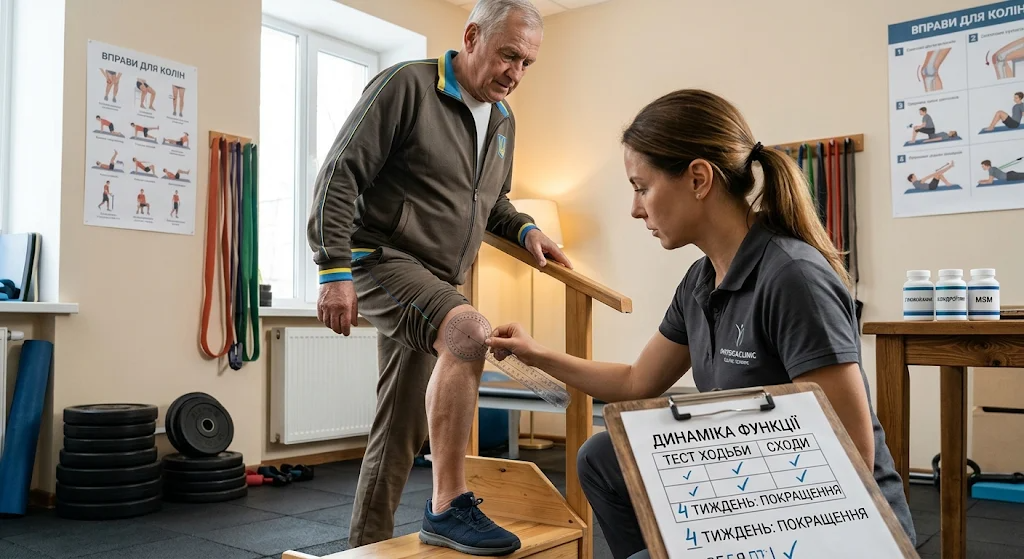
What to look for when reading a scientific publication
- Duration: How many weeks or months the observation lasted and when the measurements were taken.
- Participants: how many people participated, what was their age and initial joint condition. Criterion: Pain, function, quality of life, or structural changes are different endpoints.
- Comparison: placebo, another substance, or no control group.
- Magnitude of difference: Was the deviation not only statistical but also potentially significant?
- Ingredient form: data for a specific form studied do not necessarily extend to another.
- Uncertainty: Are confidence intervals, dropouts, and work limitations provided?
Conclusion: Three to six months in joint studies is primarily a way to organize observations and compare groups objectively. For pain and function, 12 to 24 weeks is sometimes sufficient; for joint structure, years may be needed. None of these time frames is a promise of individual outcome or proof of cartilage repair.
Frequently asked questions
Why are joint supplements studied for 3–6 months?
This period allows for observation of changes in symptoms and comparison with the control group. However, the specific duration is determined by the study protocol.
Does 3 months mean that the effect will definitely appear then?
No. Three months is a possible point in time for evaluation, not a universal time for results to appear in every person.
Why do some jobs only last 12 weeks?
They can study symptoms and function for which researchers have chosen a shorter observation period.
Why do cartilage changes take longer to be evaluated?
Structural changes are measured and measured differently than pain or stiffness, and often require longer follow-up and appropriate imaging.
What is WOMAC in joint research?
This is a questionnaire to assess pain, stiffness, and physical function. It does not measure cartilage thickness.
Does less pain prove joint repair?
No. Improved sensations are not the same as structural changes, which need to be verified by separate methods.
If the study lasted six months, do I need to take the supplements for the same amount of time?
No. The research protocol is not an individual recommendation for duration of use.
Why do the results of different studies not match?
They may differ in the composition of participants, forms of ingredients, assessment scales, timing, and quality of methodology.
Sources
- Clegg D. O. et al. (2006). Glucosamine, chondroitin sulfate, and the two in combination for painful knee osteoarthritis. New England Journal of Medicine, 354(8), 795–808. PubMed.
- Kim L. S. et al. (2006). Efficacy of methylsulfonylmethane (MSM) in osteoarthritis pain of the knee: a pilot clinical trial. Osteoarthritis and Cartilage, 14(3), 286–294. PubMed.
- Usha P. R., Naidu M. U. R. (2004). Randomised, Double-Blind, Parallel, Placebo-Controlled Study of Oral Glucosamine, Methylsulfonylmethane and their Combination in Osteoarthritis. Clinical Drug Investigation, 24(6), 353–363. PubMed.
- Reginster J.-Y. et al. (2017). Pharmaceutical-grade Chondroitin sulfate is as effective as celecoxib and superior to placebo in symptomatic knee osteoarthritis: the ChONdroitin versus CElecoxib versus Placebo Trial (CONCEPT). Annals of the Rheumatic Diseases, 76(9), 1537–1543. PubMed.
- Fransen M. et al. (2015). Glucosamine and chondroitin for knee osteoarthritis: a double-blind randomised placebo-controlled clinical trial evaluating single and combination regimens. Annals of the Rheumatic Diseases, 74(5), 851–858. PubMed.
- Sawitzke A. D. et al. (2010). Clinical efficacy and safety of glucosamine, chondroitin sulphate, their combination, celecoxib or placebo taken to treat osteoarthritis of the knee: 2-year results from GAIT. Annals of the Rheumatic Diseases, 69(8), 1459–1464. PubMed.
- Pham T. et al. (2004). OMERACT-OARSI initiative: Osteoarthritis Research Society International set of responder criteria for osteoarthritis clinical trials revisited. Osteoarthritis and Cartilage, 12(5), 389–399. PubMed.
- Gandek B. (2015). Measurement properties of the Western Ontario and McMaster Universities Osteoarthritis Index: a systematic review. Arthritis Care & Research, 67(2), 216–229. PubMed.
Dietary supplement. Not a medicine. Consult a doctor before use.
Products related to this post
Related Posts
Comments
Information
Customer Service
Extras
My Account


Sports nutrition manufacturer in Ukraine StarkPharm © 2026


