Your shopping cart is empty!

L-Theanine vs. GABA: Why Mechanism of Action Doesn't Determine the Best Supplement
Published: 31/10/2026
Times Read: 2
Comments : 0
L-theanine and gamma-aminobutyric acid (GABA) are often listed side by side in supplement catalogs for relaxation and sleep. This makes it tempting to identify the “stronger” substance using a simple argument: GABA is an inhibitory neurotransmitter, so GABA in a capsule supposedly acts more directly, whereas L-theanine works only indirectly. Such a conclusion conflates three different questions: the biological role of a molecule in the brain, what happens to it after ingestion, and the results of human trials. None of these can be substituted for another.
Theanine occurs naturally in tea leaves and is a non-proteinogenic amino acid. GABA is also a non-proteinogenic compound, but it is also one of the main inhibitory neurotransmitters in the central nervous system. The fact that both substances are involved in neural regulation does not make them interchangeable. A direct clinical comparison even exists, but it addresses a much narrower question than “which is better for everyone.”
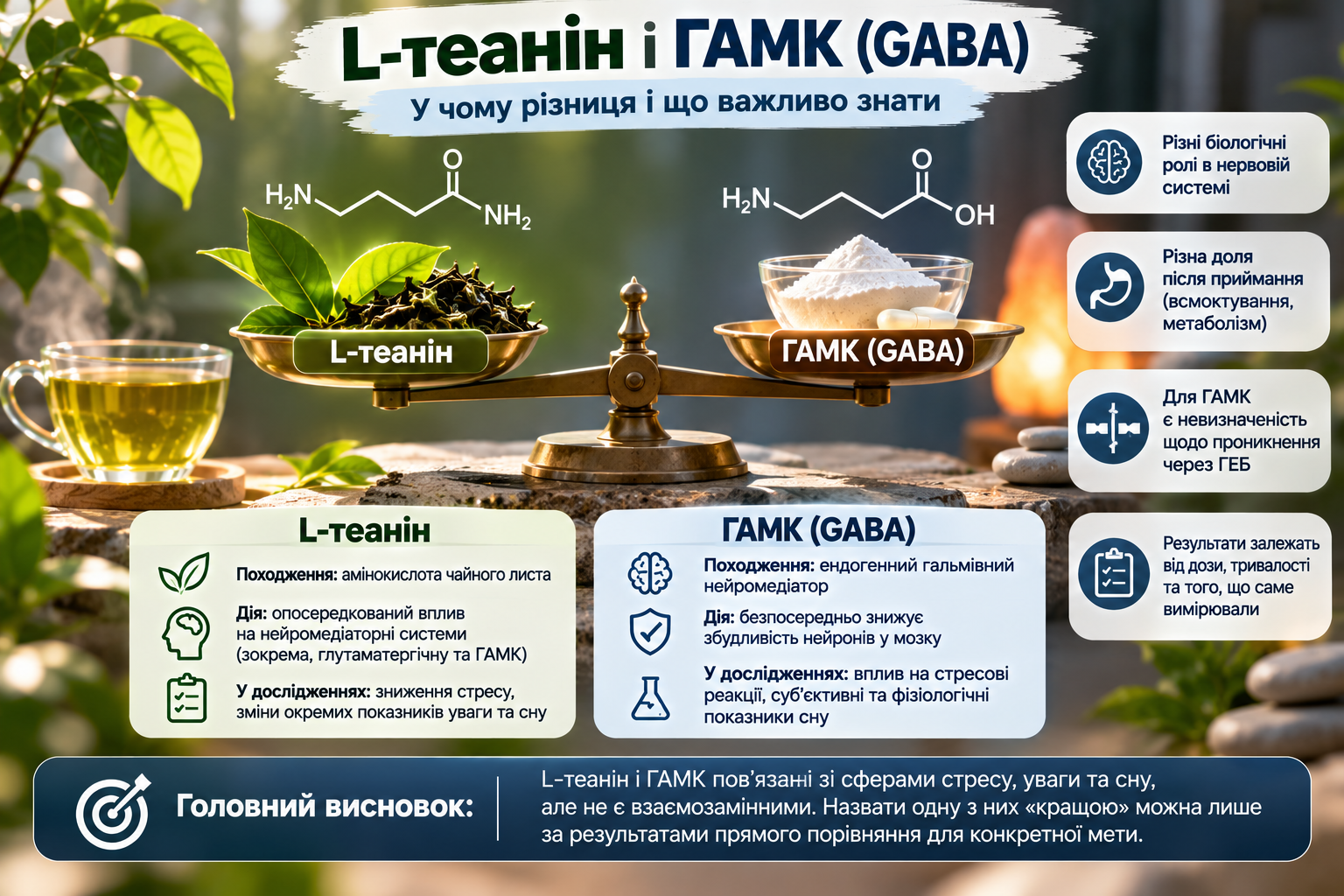
L-Theanine and GABA: Similar Areas of Interest, Different Biological Roles
GABA is synthesized from glutamate in the nervous system and interacts with receptors involved in regulating neuronal excitability. GABA receptors mediate different inhibitory mechanisms: rapid synaptic signals and a slower background, or tonic, component. A major review by Koh and colleagues (2023) shows that tonic GABA signaling is associated not only with reduced excitability but also with fine-tuning neural networks and cognitive processes.
L-theanine is structurally related to glutamate. Preclinical literature discusses its possible interactions with glutamatergic pathways, effects on GABA and other neurotransmitter measures, and changes in electrophysiological activity. However, mechanisms found in cells or animals cannot be considered established for ordinary oral intake in humans without further verification. The review by Williams and colleagues (2019) analyzed the results of human trials rather than confirming a single proven “GABA pathway” through which theanine acts.
It is particularly important to distinguish an increase in the level of a compound in experimental tissue from a demonstrated improvement in a person’s well-being. Between these are pharmacokinetics, dose, duration, participants’ baseline condition, and assessment of clinical outcomes. A plausible neurochemical mechanism does not by itself determine a supplement’s efficacy.
Why GABA in a Capsule Is Not the Same as GABA in a Synapse
When GABA acts as a neurotransmitter, it is synthesized, released, and taken up within specific cellular structures. After oral intake, GABA first passes through the digestive tract, may be absorbed and metabolized, and may participate in peripheral signaling processes. Sharing the same chemical name does not mean that an ingested amount will reach the relevant nerve cells in the same quantity or produce a comparable concentration in synapses.
A key uncertainty concerns the blood–brain barrier (BBB). Boonstra and colleagues (2015) analyzed conflicting experiments on GABA penetration and noted the absence of convincing evidence about the extent to which oral GABA changes GABA concentrations in the human brain. This supports neither a categorical claim of complete impermeability nor an automatic assumption that direct entry into the central nervous system at clinically effective levels has been demonstrated.
Recent reviews also discuss peripheral GABA signaling, gut–nerve interactions, and the possible role of the vagus nerve. However, such potential pathways are not equivalent to a proven mechanism for a particular supplement. Thus, saying that “GABA immediately calms the brain” oversimplifies the situation and overstates the available evidence.
Where the Comparison Becomes Misleading
A comparison is meaningful only when it is clear which outcome was measured, in whom, over what period, and using which methods. It is inappropriate to treat studies with different designs as if they were one experiment. For example, a study of theanine using reaction-time tests in healthy adults cannot be directly set against a study of GABA assessing sleep quality in people with sleep complaints.
| Criterion | L-Theanine | GABA Supplements |
|---|---|---|
| Biological role | An amino acid found in tea; its interaction with signaling systems is being studied | An endogenous neurotransmitter also involved in peripheral processes |
| What cannot be assumed | That a neurochemical hypothesis already proves an effect in humans | That ingested GABA is equivalent to neurotransmitter GABA in the brain |
| Clinical research areas | Stress responses, selected cognitive tests, sleep | Stress responses, subjective and some physiological sleep measures |
| Main limitation | Small samples, different endpoints, results that are not always statistically significant | Heterogeneous protocols and uncertainty regarding central effects of the oral form |
| Can either be called better? | Not without a direct study under the same conditions measuring a specific outcome | |
Even for a single substance, results depend on whether researchers assess reaction time, perceived tension, time to fall asleep, or neurophysiological markers. A positive change in one measure does not automatically imply changes in the others. This is one reason why marketing rankings of “theanine versus GABA” often provide an oversimplified answer to a poorly framed question.

The Direct 2025 Trial: What It Actually Compared
Deshpande and colleagues (2025) published a randomized trial involving 168 patients aged 18–55 who were preparing for major elective surgery. Participants were allocated to three groups: L-theanine 200 mg, GABA 500 mg, or alprazolam 0.25 mg. Researchers assessed preoperative anxiety, sedation, and psychomotor and cognitive outcomes before administration and approximately one hour afterward.
The publication reported stronger sedation in the alprazolam group, while better psychomotor and cognitive performance was recorded on certain tests in the theanine and GABA groups. The authors described both amino acids as promising for the preoperative setting they studied. However, this does not mean that either has a proven advantage for everyday stress or sleep. The sample consisted of presurgical patients, observation lasted about one hour, and the design was not a conventional long-term placebo-controlled trial of two supplements in healthy individuals.
The statistics also require careful reading: finding changes within each group does not necessarily demonstrate a significant difference between L-theanine and GABA. Declaring a “winner” requires a prespecified direct between-group analysis for a particular endpoint. Such a conclusion cannot be drawn merely because the trial had three groups and two showed positive changes.
What Is Known About Stress: Two Separate Bodies of Evidence
For L-theanine, Williams and colleagues (2019) systematically reviewed nine peer-reviewed human trials that compared isolated theanine with a control. The authors described potentially beneficial outcomes in some stressful situations while emphasizing the need for larger and longer trials. In a separate crossover trial by Hidese and colleagues (2019), thirty healthy participants received 200 mg daily for four weeks or placebo. Changes in certain self-reported and cognitive measures do not justify extrapolating these findings to all age groups and situations.
For oral GABA, the systematic review by Hepsomali and colleagues (2020) included 14 placebo-controlled human studies. The authors characterized the overall evidence for stress reduction as limited and that for sleep improvement as very limited. GABA sources, doses, duration, samples, and measurement methods differed. This review was not a head-to-head comparison with theanine and did not establish which substance is stronger.
Consequently, one cannot compare a positive result from one L-theanine test with a less convincing result from a single GABA study and proclaim an overall advantage. Nor can GABA’s superiority be established solely because it is a neurotransmitter. Both approaches ignore clinical context and the distinction between mechanism and outcome.
What if the Goal Is Sleep or Relaxation in the Evening?
Some studies have examined L-theanine and GABA in relation to sleep. A 2023 open-label randomized crossover study involving 160 participants compared individual regimens of several supplements, including L-theanine at 200 mg/day and GABA at 111.1 mg/day. Changes in particular sleep complaints were reported, but differences in baseline conditions, mechanisms, and study design prevent these results from becoming a universal ranking.
A pilot study of a combination of GABA 700 mg/day and L-theanine 200 mg/day, published in 2026, involved 19 people with sleep complaints over four weeks. The authors reported improved self-assessments, but the study had no separate theanine, GABA, or placebo groups. It therefore cannot isolate each ingredient’s contribution or demonstrate synergy. Without a control group, the effects of expectations, natural variation in sleep, or other factors cannot be ruled out.
For everyday decisions, it is most useful to distinguish the intended goal—falling asleep, sleep quality, stress under pressure, or attention—and whether truly relevant human studies exist. If a study involved a specialized population or a multi-ingredient product, its findings are not evidence that one ingredient produces the same effects in everyone.
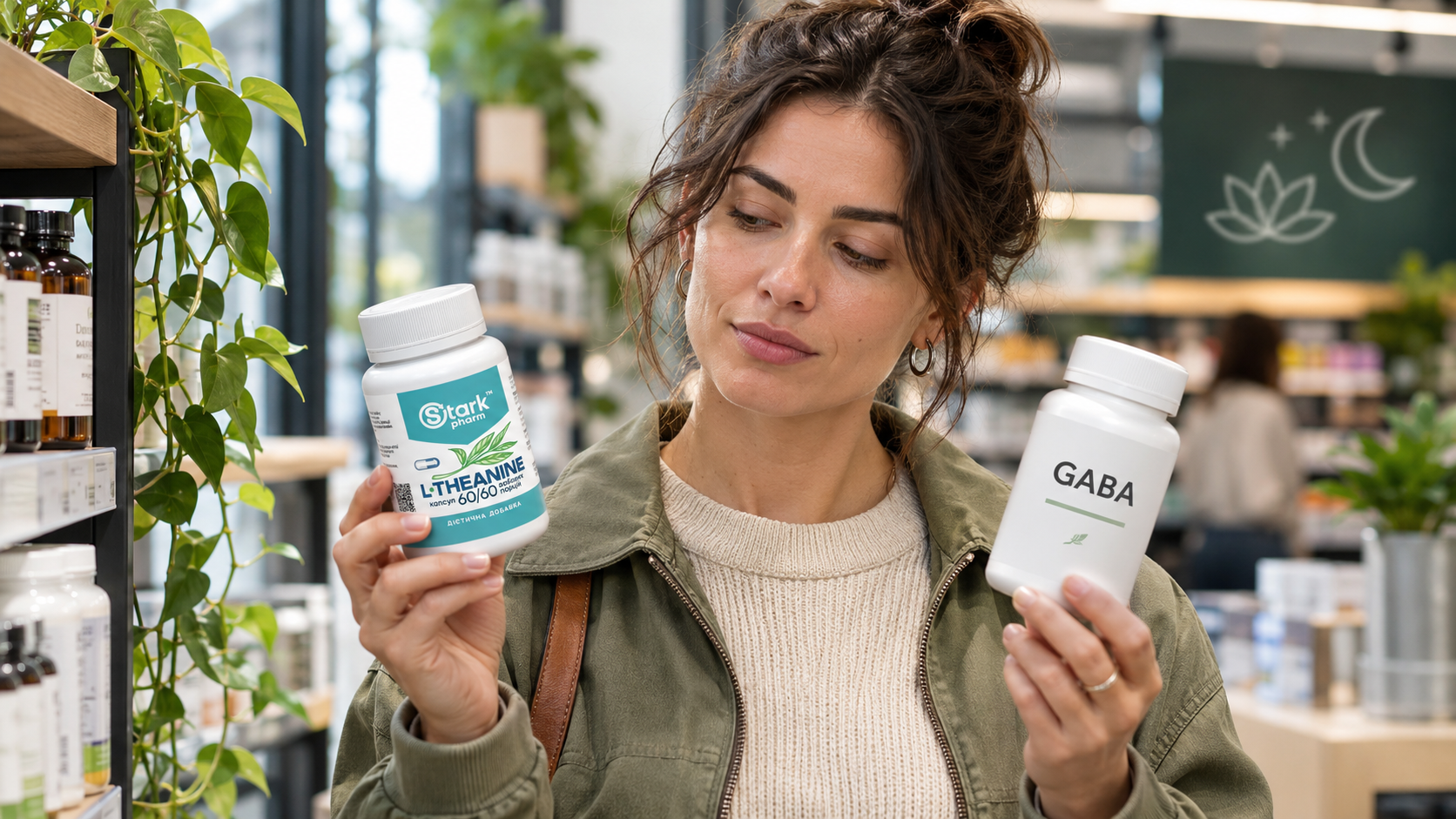
How to Read a Label Without Drawing False Conclusions
The ingredient name and its amount are only the starting point. Terms such as “neurotransmitter,” “natural,” “alpha waves,” or “neurobalance” are not clinical outcomes. It matters exactly which substance the formula contains, whether other ingredients are present, which population was studied, and whether the research objective matches the reader’s question.
- Distinguish doses used in research protocols from the directions for a specific supplement: they are not interchangeable recommendations.
- Do not infer a central effect of GABA merely from its neurotransmitter status.
- Do not attribute the effects of a multi-ingredient formula to a single component.
- Consider potential drowsiness and individual tolerability; consult a physician when taking medications, during pregnancy or breastfeeding, or when living with chronic conditions.
There is no established single criterion for definitively comparing the “strength” of L-theanine and GABA for everyone. A scientifically grounded approach is to compare not label claims, but study results with comparable designs, populations, and measured outcomes. At present, the evidence does not support a universal advantage for either supplement.
Frequently Asked Questions
Are theanine and GABA the same substance?
No. GABA is an endogenous inhibitory neurotransmitter, while L-theanine is an amino acid best known as a component of tea leaves. Their biological roles and research contexts differ.
Does being called GABA mean the supplement acts directly in the brain?
No. There is insufficient evidence to establish confidently how much orally administered GABA reaches the human brain or how it affects central signaling.
Have L-theanine and GABA been compared directly?
Yes. A 2025 study compared them in patients before surgery. This specialized context does not allow broad conclusions about daily supplementation.
Which is better for attention, L-theanine or GABA?
There is no convincing direct evidence supporting one universal choice. Attention studies often use different tasks and conditions, so results cannot automatically be transferred between substances.
Is GABA stronger because it is a neurotransmitter?
No. A neurotransmitter’s endogenous function does not prove the strength or efficacy of an oral supplement.
Has synergy between theanine and GABA been proven?
No. Combination studies without separate control groups cannot isolate each component’s effects or establish synergy.
Is there a universal dose for these substances?
No. Published studies used different doses and durations; these are research protocols and do not replace directions for a particular product.
What should be considered regarding safety?
Take into account individual sensitivity, possible drowsiness, use of other products, and health status. Consulting a healthcare professional before using supplements is advisable.
References
- Koh W., Kwak H., Cheong E., Lee C.J. (2023). GABA tone regulation and its cognitive functions in the brain. Nature Reviews Neuroscience, 24, 523–539. PubMed
- Boonstra E., de Kleijn R., Colzato L.S., Alkemade A., Forstmann B.U., Nieuwenhuis S. (2015). Neurotransmitters as food supplements: the effects of GABA on brain and behavior. Frontiers in Psychology, 6, 1520. PubMed
- Hepsomali P., Groeger J.A., Nishihira J., Scholey A. (2020). Effects of Oral Gamma-Aminobutyric Acid (GABA) Administration on Stress and Sleep in Humans: A Systematic Review. Frontiers in Neuroscience, 14, 923. PubMed
- Deshpande S.S., Kurdi M., Baiju A. et al. (2025). Comparison of the effects of two amino acids, Gamma-aminobutyric acid (GABA) and L-theanine, on sedation, anxiety, and cognition in preoperative surgical patients – A randomized controlled study. Journal of Anaesthesiology Clinical Pharmacology, 41(1), 112–118. PubMed
- Williams J.L., Everett J.M., D’Cunha N.M. et al. (2020). The Effects of Green Tea Amino Acid L-Theanine Consumption on the Ability to Manage Stress and Anxiety Levels: a Systematic Review. Plant Foods for Human Nutrition. PubMed
- Hidese S., Ogawa S., Ota M. et al. (2019). Effects of L-Theanine Administration on Stress-Related Symptoms and Cognitive Functions in Healthy Adults: A Randomized Controlled Trial. Nutrients, 11(10), 2362. PubMed
- Imafuku F., Yamamoto K., Tanaka E., Aoki R., Nishino S. (2023). Analysis of the Effects of Known Sleep-Support Supplements in Relation to Life Habits, Sleep Conditions, and Sleep Problems. Nutrients, 15(10), 2377. PubMed
- Konno H., Naganuma K., Kamada Y. (2026). Effects of combined GABA and L-theanine supplementation on sleep quality: an exploratory study. European Review for Medical and Pharmacological Sciences, 30(1), 37–45. PubMed
- Supplementation of γ-Aminobutyric Acid as a Functional Nutrient (2026). Nutrients, 18(14), 2389. PubMed
Dietary supplement. Not a medicinal product. Consult your doctor before use.
Products related to this post
Related Posts
Comments
Information
Customer Service
Extras
My Account


Sports nutrition manufacturer in Ukraine StarkPharm © 2026


