Your shopping cart is empty!

L-theanine and the alpha rhythm of the brain: what EEG experiments show
Published: 30/10/2026
Times Read: 28
Comments : 0
The connection between L-theanine and alpha waves is often presented very simply: a person takes the amino acid from tea leaves, and the electroencephalogram (EEG) shows an increase in alpha activity, which means the brain goes into a state of rest. In real studies, the picture is more complex. In some experiments, an increase in the power of the alpha rhythm was indeed observed, while during intense attention tasks, its decrease was recorded. This difference is not necessarily a contradiction: the EEG reflects the current organization of brain activity, and does not measure “relaxation” directly.
To understand the results of the L-theanine studies, one must distinguish between background activity, task responses, electrode placement, and the participants’ own feelings. It is these aspects, rather than the general promise of calm, that are the focus of this article.
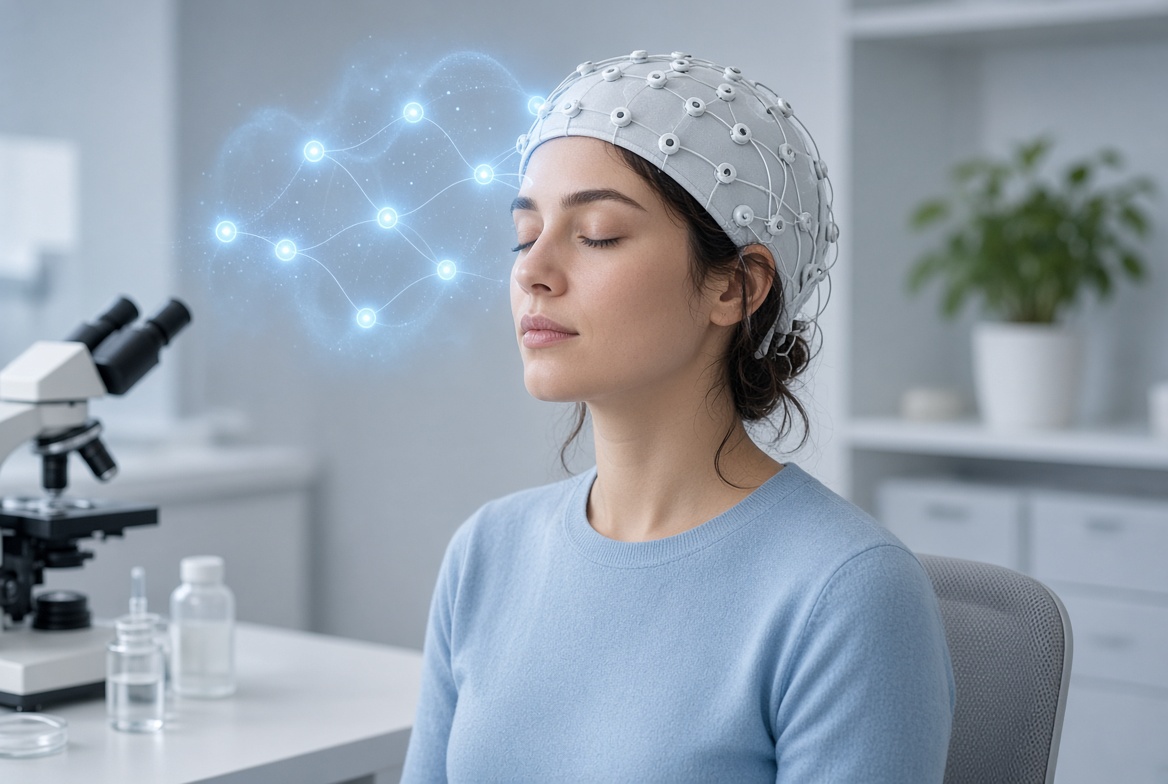
What does an EEG actually record?
An important distinction is that the alpha rhythm is not a separate “resting center.” The electrodes capture the total potential fluctuations that occur in large populations of neurons. Spectral analysis allows us to determine what proportion of the signal falls on certain frequencies, but it does not allow us to directly see which molecules are acting at a particular synapse. Inferences about neurotransmitter mechanisms require other methods than just changing the strength of the rhythm.
Electroencephalography measures electrical potential fluctuations on the surface of the head using electrodes. The alpha range is usually defined as rhythmic activity of approximately 8–13 Hz; the exact limits may vary between protocols. “Alpha power” refers to the intensity of fluctuations in this range under specific recording conditions. It is not a direct measure of neurotransmitter levels, attention span, or psychological comfort.
In a calm state with eyes closed, alpha activity is often more pronounced, especially in the back of the head. When a person opens their eyes or switches to processing sensory information, the distribution and strength of the rhythm can change. Therefore, the indicator cannot be interpreted without specifying when, where, and during what activity it was measured.
First observations: alpha rhythm after 50 mg of L-theanine
This work is important primarily as an early test of the electrophysiological effect of a relatively small single dose. The researchers monitored not just a single point after consumption, but a series of measurements over about an hour. This approach helps to see the temporal profile, but does not answer the question of whether the effect persists after regular consumption for weeks.
In Nobre, Rao, and Owen (2008), researchers recorded EEGs in healthy young volunteers after a single dose of 50 mg of L-theanine or placebo. There were 16 and 19 participants in each group, respectively. Recordings were made before the dose and 45, 60, 75, 90, and 105 minutes later; in one experiment, participants rested with their eyes closed. The authors described a more pronounced increase in alpha activity over time in the L-theanine group. They also observed a similar pattern in another experiment under conditions of passive activity.
These results have supported interest in the electrophysiological effects of theanine, but the small sample sizes and short follow-up do not allow us to conclude that such a change will consistently occur in any individual. It is especially important that resting-state measurements do not answer questions about behavior during complex mental tasks.
Why alpha activity may decrease during an attention task
A separate role is played by the difference between tonic and phasic activity. Tonic is the background level of oscillations over a certain period of time. Phasic is a short-term change associated with the appearance of a signal, a prompt, or the need to respond. If the background alpha power has decreased, but the response to the prompt has not changed, this is not evidence of total suppression of the alpha rhythm: the two indicators answer different questions.
Gomez-Ramirez et al. (2009) studied 13 healthy subjects using multichannel EEG during a complex visuospatial task. In a crossover protocol, a single dose of 250 mg of L-theanine was compared with placebo. In contrast to some of the rest tasks, the researchers found a decrease in background alpha power after L-theanine. However, the expected changes in short-term alpha response to spatial cues were not observed.
This does not mean that the amino acid “excites” the brain in the opposite way. Background alpha activity and short rhythm changes during selective attention describe different aspects of neural work. The direction of the effect depends on which areas and time intervals are analyzed. One should also not automatically equate lower alpha power with better concentration: such a conclusion requires corresponding behavioral results.
What controlled experiments showed
A comparison of several works demonstrates how important the experimental conditions are:
| Research | Conditions | Basic observation | Limitation |
|---|---|---|---|
| Nobre et al., 2008 | 50 mg; EEG recordings at rest and passive state | More pronounced increase in alpha activity compared to placebo | Small groups, short-term observation |
| Gomez-Ramirez et al., 2009 | 250 mg; 13 participants, difficult attention task | Decreased background alpha power; no measurable change in cue responses | Small sample, specific type of task |
| Evans et al., 2021 | 200 mg; 16 randomized participants, stressful task | After 3 hours, the increase in frontal alpha power relative to placebo under certain recording conditions | Small trial, one session, separate EEG conditions |
Evans et al. (2021) used a placebo-controlled crossover design: participants received 200 mg of L-theanine or placebo and performed an oral counting task. Three hours after dosing, they found greater increases in frontal alpha power with eyes open in the L-theanine group (p = 0.038). The authors also measured salivary cortisol, blood pressure, and subjective stress. These additional measures provide context for the EEG, but do not convert the rhythm changes into evidence of a lasting psychological effect.
Alpha waves, relaxation, and attention are not synonymous
Furthermore, statistical significance itself requires careful reading. In neurophysiological protocols, many electrodes, frequency ranges, and time windows are analyzed simultaneously. Researchers must determine key metrics in advance and correctly account for multiple comparisons. Otherwise, a single statistically significant signal among dozens of tests may appear more convincing than the data allow. For the reader, this means that it is not only the p-value that matters, but also the trial design, sample size, and completeness of the reporting of the results.
Another important question in neurophysiology experiments is whether the changes in brain signals are accompanied by an independent outcome that is meaningful to the individual. For example, recording higher alpha power does not automatically mean faster test performance, fewer errors, a better night's sleep, or less subjective stress. Each of these findings requires that the corresponding indicator be separately defined and measured in the study.
The phrase “more alpha waves = more calm” cannot be used as a universal rule. First, alpha activity depends on visual stimulation and the task being performed. Second, its background and short-term components perform different functions in information processing. Third, even a statistically significant change in EEG is not necessarily accompanied by an equally noticeable change in sensations or cognitive test results.
A notable example is the experiment by White et al. (2016), which studied a multi-ingredient drink containing 200 mg of L-theanine and other ingredients. In some participants with higher levels of personal anxiety, an increase in alpha activity was found using magnetoencephalography (MEG), but this change did not correlate with changes in subjective stress. Importantly, MEG is not EEG, and the multi-ingredient drink does not allow us to attribute all the results to L-theanine alone.
What can these works say about L-theanine?
For a reader who sees the words “alpha wave activation” in an advertisement, it is most useful to ask three questions: is this a study on humans, under what conditions was the recording performed, and whether a significant difference with the control group was proven. Even with a positive answer, it should be clarified whether the human condition was measured or only an electrophysiological marker. The presence of an EEG change does not establish a clinical effect.
Human studies suggest that L-theanine can alter alpha activity parameters under specific experimental conditions. They do not allow us to determine from a single EEG reading how relaxed a person is, whether they will become more alert, or whether they will sleep better. Nor has a universal direction of change in alpha power been established for all situations.
The doses of 50, 200, and 250 mg listed above are parameters of individual clinical protocols, not a consumption pattern. This work does not suggest that the amount of L-theanine should be altered to affect EEG. When using supplements, the manufacturer’s instructions, individual characteristics, and the recommendations of a healthcare professional should be considered. Issues of stress, sleep, and caffeine use require separate analysis of clinical outcomes, not just electrical brain activity.
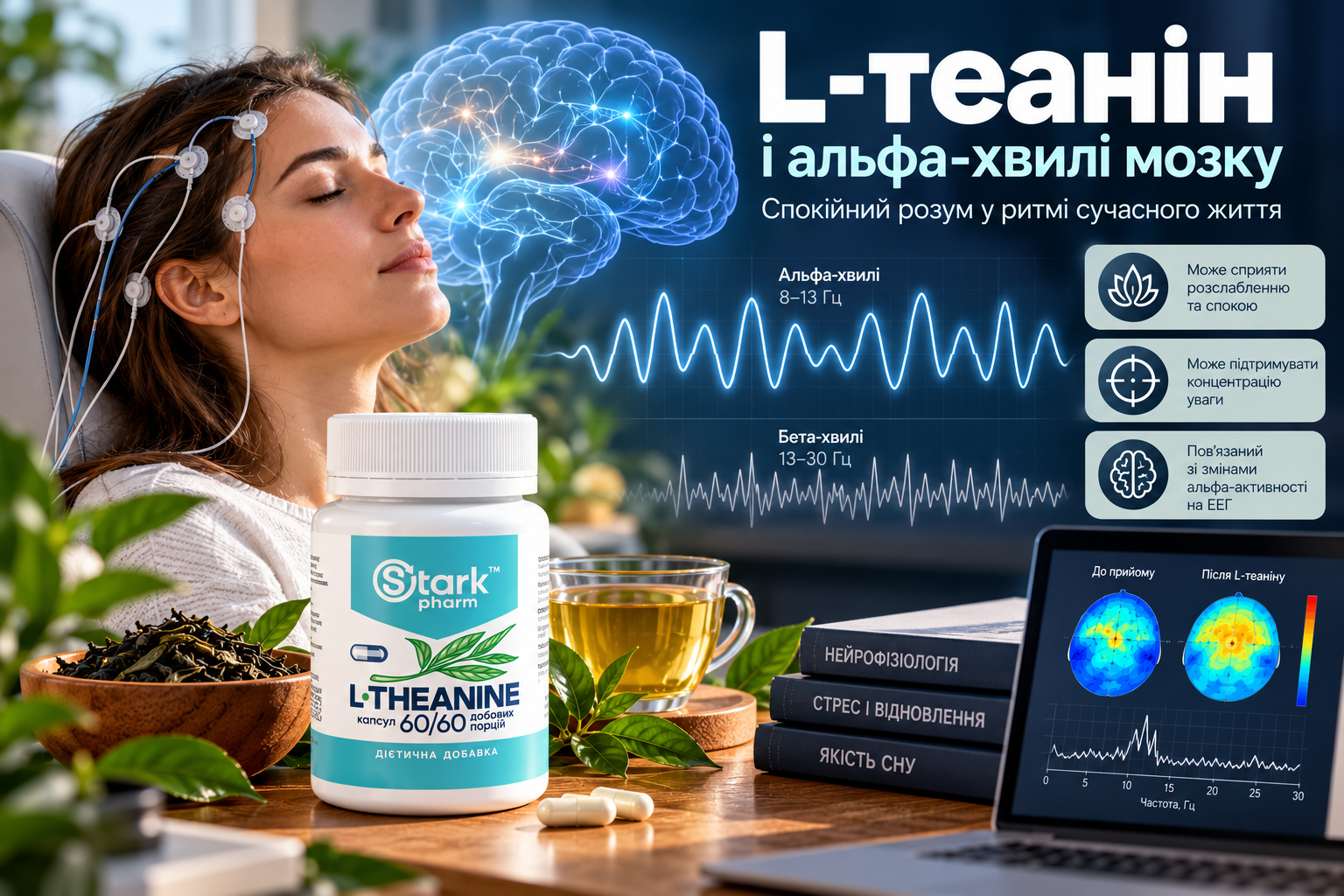
Frequently asked questions
What are alpha brain waves?
These are fluctuations in electrical activity in a specific frequency range, often defined as approximately 8–13 Hz. Their severity depends on the person's condition and the conditions under which the EEG is recorded.
Does L-theanine increase alpha waves?
Some studies have observed increases in alpha power, especially during resting conditions or certain EEG protocols. Results may be different during complex tasks.
Why did alpha activity increase in one study and decrease in another?
The researchers measured different components of the rhythm under different conditions: at rest, with eyes closed or open, or during attentional stress.
Does an increase in alpha rhythm mean that a person is falling asleep?
No. Alpha rhythm is also found in the waking state, and its increase in itself does not indicate drowsiness or falling asleep.
Does EEG prove that L-theanine reduces stress?
No. EEG records electrical activity in the brain; conclusions about stress require separate, valid measures and comparisons with a control group.
Can alpha waves predict improved concentration?
Not by a single metric. Assessing attention requires behavioral tests, and the relationship between EEG and task performance depends on context.
What doses of L-theanine have been studied using EEG?
In the above works, single doses of 50, 200 and 250 mg were used, in particular. This is a description of the experiments, not a recommendation for intake.
Sources
- Nobre AC, Rao A, Owen GN (2008). L-theanine, a natural constituent in tea, and its effect on mental state. Asia Pacific Journal of Clinical Nutrition, 17(Suppl 1), 167–168. PubMed.
- Gomez-Ramirez M, Kelly SP, Montesi JL, Foxe JJ (2009). The effects of L-theanine on alpha-band oscillatory brain activity during a visuo-spatial attention task. Brain Topography, 22(1), 44–51. PubMed.
- Evans M., McDonald AC, Xiong L., Crowley DC, Guthrie N. (2021). A Randomized, Triple-Blind, Placebo-Controlled, Crossover Study to Investigate the Efficacy of a Single Dose of AlphaWave L-Theanine on Stress in a Healthy Adult Population. Neurology and Therapy, 10(2), 1061–1078. PubMed.
- White DJ, de Klerk S, Woods W, Gondalia S, Noonan C, Scholey AB (2016). Anti-Stress, Behavioral and Magnetoencephalography Effects of an L-Theanine-Based Nutrient Drink: A Randomised, Double-Blind, Placebo-Controlled, Crossover Trial. Nutrients, 8(1), 53. PubMed.
Dietary supplement. Not a medicine. Consult a doctor before use.
Products related to this post
Related Posts
Comments
Information
Customer Service
Extras
My Account


Sports nutrition manufacturer in Ukraine StarkPharm © 2026


