Your shopping cart is empty!

Theanine and night rest: what changes in sleep without a hypnotic effect
Published: 30/10/2026
Times Read: 27
Comments : 0
L-theanine is an amino acid found in tea leaves that has been studied not only in relation to stress response but also in the context of a good night's sleep. It is often described as a substance that promotes restful sleep, but this does not mean that it works as a sleeping pill. Sedation, subjective relaxation, speed of falling asleep and quality of sleep are different phenomena. In clinical studies, the results on these are not always consistent.
The more accurate question is not “does theanine make you sleepy?” but “does it change certain sleep parameters and how reliably is this confirmed?” The answer depends on what exactly the researchers measured, who participated in the trial, and whether they used pure L-theanine or a mixture of several components.
Relaxation without sedation: what is the fundamental difference?
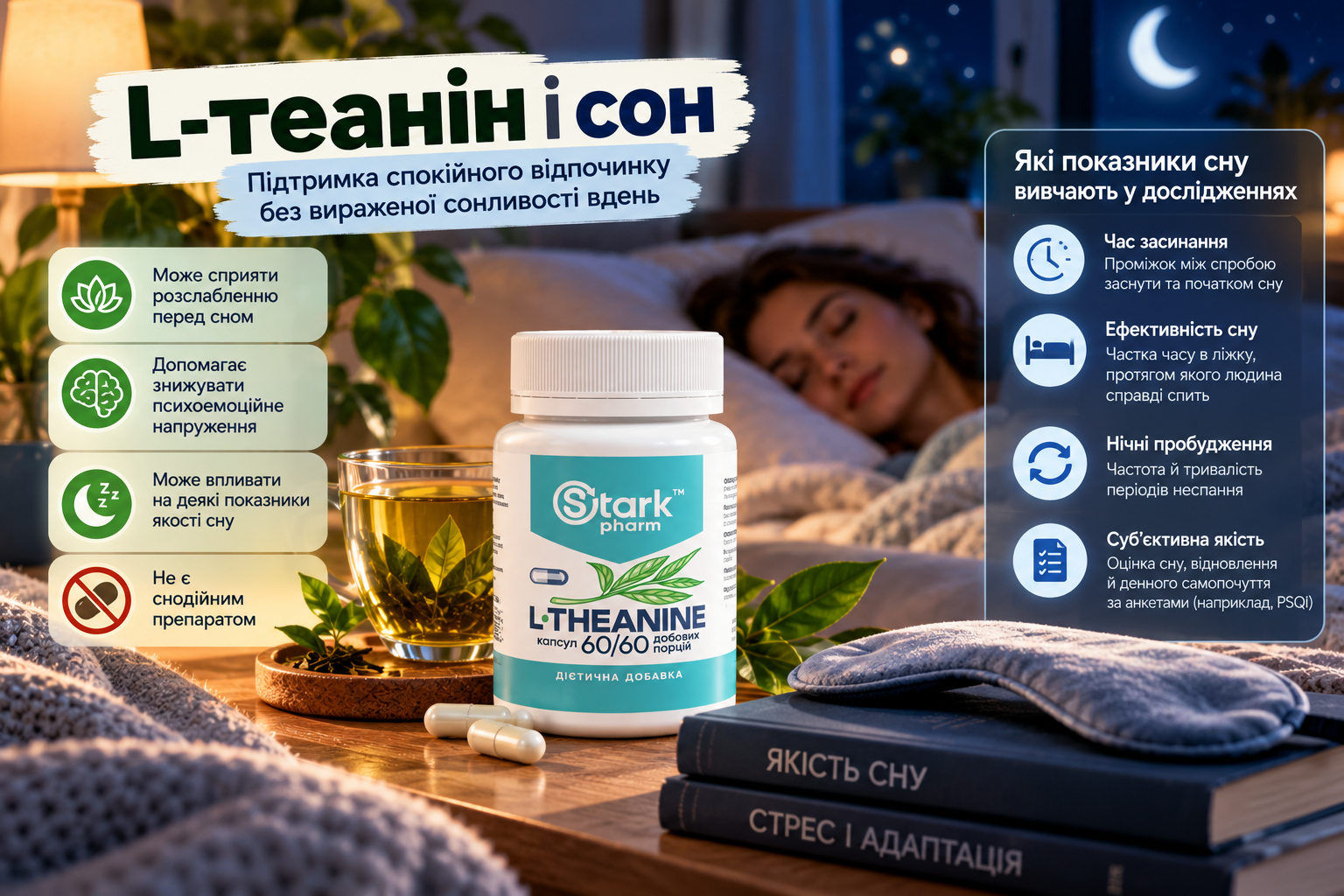
Sleeping pills are drugs that are prescribed to induce sleep for specific medical reasons. Their effects and risks are evaluated in pharmacological trials. L-theanine should not be automatically equated with such drugs: in scientific reviews, it is more often discussed for its ability to alter certain indicators of relaxation without significant daytime sleepiness.
The absence of a pronounced sedative effect does not exclude changes in night rest. A person may feel less psychoemotional tension before bedtime, but this does not guarantee faster falling asleep or longer sleep duration. Conversely, an improvement in the assessment of one's own sleep does not yet prove a change in its objective structure.
What exactly is measured in sleep studies?
The phrase "sleep quality" can cover a wide range of indicators. Some are obtained from questionnaires, others from devices that record movements or physiological signals during the night.
- Falling asleep time is the interval between trying to fall asleep and the onset of sleep.
- Sleep efficiency is the proportion of time in bed during which a person is actually asleep.
- Night awakenings — the frequency and duration of periods of wakefulness after falling asleep.
- Subjective quality is how the participant rates their sleep, recovery, and daytime well-being.
For example, the Pittsburgh Sleep Quality Index (PSQI) questionnaire describes sleep perception over a period of time. It is useful, but it is not the same as polysomnography, which records the physiological stages of sleep. Therefore, the phrase “improved sleep” without specifying a specific indicator may exaggerate the result.
Human trials: positive signals and important limitations
In a randomized crossover study by Hidese et al. (2019), 30 adults without major psychiatric illness were enrolled. Participants received either 200 mg of L-theanine per day or placebo for four weeks in each period. The authors reported changes in the total PSQI score and individual components related to falling asleep and sleep disturbance. However, the small sample size limits the generalizability of this finding to the general population.
In another randomized trial by Moulin et al. (2024), 30 adults with moderate stress were given 400 mg of L-theanine per day or placebo for 28 days. The researchers used questionnaires and actigraphy. The study reported positive changes in some measures, but the small number of participants and specific trial conditions do not allow for a universal conclusion about all forms of theanine.
It is also important to distinguish between studies of L-theanine alone and multi-ingredient mixtures. For example, Lim et al. (2024) studied a product containing L-theanine and Lactium in 40 adults over eight weeks. Even with a positive result, it cannot confirm the effect of theanine alone.
| Work | Participants and protocol | What can be concluded? |
|---|---|---|
| Hidese et al., 2019 | 30 adults; 200 mg/day; 4 weeks each period | Changes in individual subjective sleep parameters; small sample size |
| Moulin et al., 2024 | 30 adults with moderate stress; 400 mg/day; 28 days | Positive signals on some indicators; confirmation needed |
| Lim et al., 2024 | 40 adults; 8 weeks; L-theanine and Lactium blend | The contribution of theanine itself cannot be isolated |
What the major reviews of 2025–2026 added
Bulman et al. (2025) summarized 19 publications with 897 participants, of which 18 were included in the meta-analysis. The combined results found statistically significant changes in some subjective indicators, including assessments of time to fall asleep, daytime dysfunction and overall sleep quality. However, the authors themselves emphasized the limited number of trials with pure L-theanine. Some of the summarized data came from combination formulas.
The two reviews have different inclusion criteria, so their study counts should not be added together. They are partly the same studies, grouped according to different rules. Furthermore, having a statistically significant result does not guarantee that every person will notice a practical change in their sleep.
Will L-theanine help you fall asleep faster?
Individual studies and meta-analyses show positive signals regarding subjective sleep time, but this is not enough to promise a quick effect after each capsule. The trials varied in duration, sample size, doses, and assessment methods. In some studies, participants took L-theanine regularly for weeks, rather than just once before bed.
Particular caution should be exercised in interpreting data in individuals with chronic sleep complaints. The available work does not establish that L-theanine can replace diagnosis of the cause of insomnia or professional help. The study doses and durations are given as characteristics of specific trials and not as instructions for use.
Why more sleep doesn't always mean better sleep
Duration and the feeling of being refreshed after a night are not interchangeable. A person can spend more time in bed but wake up just as tired. The opposite situation is also possible: subjective quality improves, although the total duration is almost unchanged.
This is why the results on falling asleep, waking up at night, sleep efficiency, and daytime well-being should be read separately. For L-theanine, the scientific basis does not yet allow us to say that it affects all of these characteristics equally. Stress, sleep habits, caffeine consumption, concomitant conditions, and the conditions of the study itself are important.
When extra caution is needed
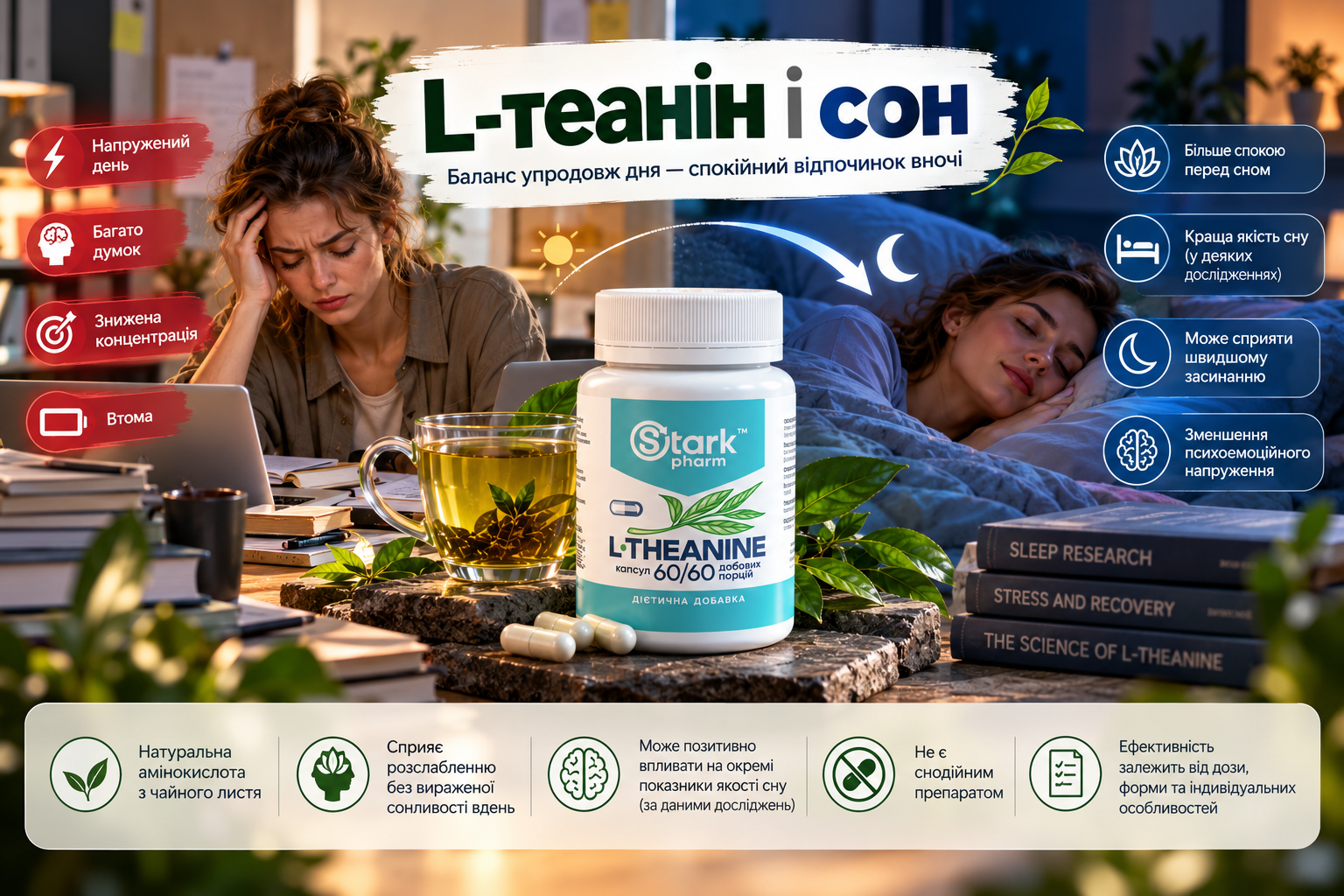
In short-term clinical studies, L-theanine has generally been well tolerated, but data on long-term regular use, specific vulnerable groups, and drug interactions are less available. If you have a chronic condition, are taking medications, or are pregnant or breastfeeding, you should consult your doctor before taking supplements. Particular attention should be paid to the composition of combination products: studies of an isolated substance do not confirm the results of any mixture.
If difficulty falling asleep is recurrent, accompanied by severe daytime sleepiness, snoring with respiratory arrest, or significantly affects daily life, it is important to determine the cause of the sleep disturbance. The biological plausibility of the mechanism is not a substitute for clinical examination.
Frequently asked questions
Is L-theanine a sleeping pill?
No. L-theanine should not be confused with sleeping pills. It is being studied in the context of relaxation and certain sleep characteristics.
Does theanine cause daytime drowsiness?
In scientific papers, it is often described as a substance without pronounced sedation, however, individual reactions may vary.
Can L-theanine reduce the time it takes to fall asleep?
Some studies and meta-analyses have reported positive changes in subjective sleep time. This does not mean that it will have the expected effect for every person.
What is more important: the duration of sleep or its quality?
These are different parameters. A complete assessment takes into account not only the number of hours, but also awakenings, sleep efficiency, and how you feel after the night.
Has pure L-theanine been studied separately?
Yes. There are trials of isolated L-theanine, but some of the available data comes from multi-ingredient products, making it difficult to draw conclusions.
Is there enough evidence for theanine for chronic insomnia?
No. Additional high-quality studies are needed, including those with objective measures and clearly defined clinical groups.
Does a calming feeling mean that sleep will definitely improve?
No. Feeling relaxed is not the same as reducing the time it takes to fall asleep or changing the pattern of your night's sleep.
Sources
- Hidese S. and others. (2019). Effects of L-Theanine Administration on Stress-Related Symptoms and Cognitive Functions in Healthy Adults: A Randomized Controlled Trial. Nutrients, 11(10), 2362. PubMed
- Moulin M. and others. (2024). Safety and Efficacy of AlphaWave® L-Theanine Supplementation for 28 Days in Healthy Adults with Moderate Stress: A Randomized, Double-Blind, Placebo-Controlled Trial. Neurology and Therapy, 13, 1135–1153. PubMed
- Lim SE and others. (2024). Dietary supplementation with lactium and L-theanine alleviates sleep disturbance in adults: a double-blind, randomized, placebo-controlled clinical study. Frontiers in Nutrition, 11, 1419978. PubMed
- Bulman A. and others. (2025). The effects of L-theanine consumption on sleep outcomes: A systematic review and meta-analysis. Sleep Medicine Reviews, 81, 102076. PubMed
- Cotter J. and others. (2026; online 2025). Examining the effect of L-theanine on sleep: a systematic review of dietary supplementation trials. Nutritional Neuroscience, 29(2), 224–238. PubMed
Dietary supplement. Not a medicine. Consult a doctor before use.
Products related to this post
Related Posts
Comments
Information
Customer Service
Extras
My Account


Sports nutrition manufacturer in Ukraine StarkPharm © 2026


