Your shopping cart is empty!

Theanine and caffeine: the best-researched combination — what science shows
Published: 29/10/2026
Times Read: 51
Comments : 0
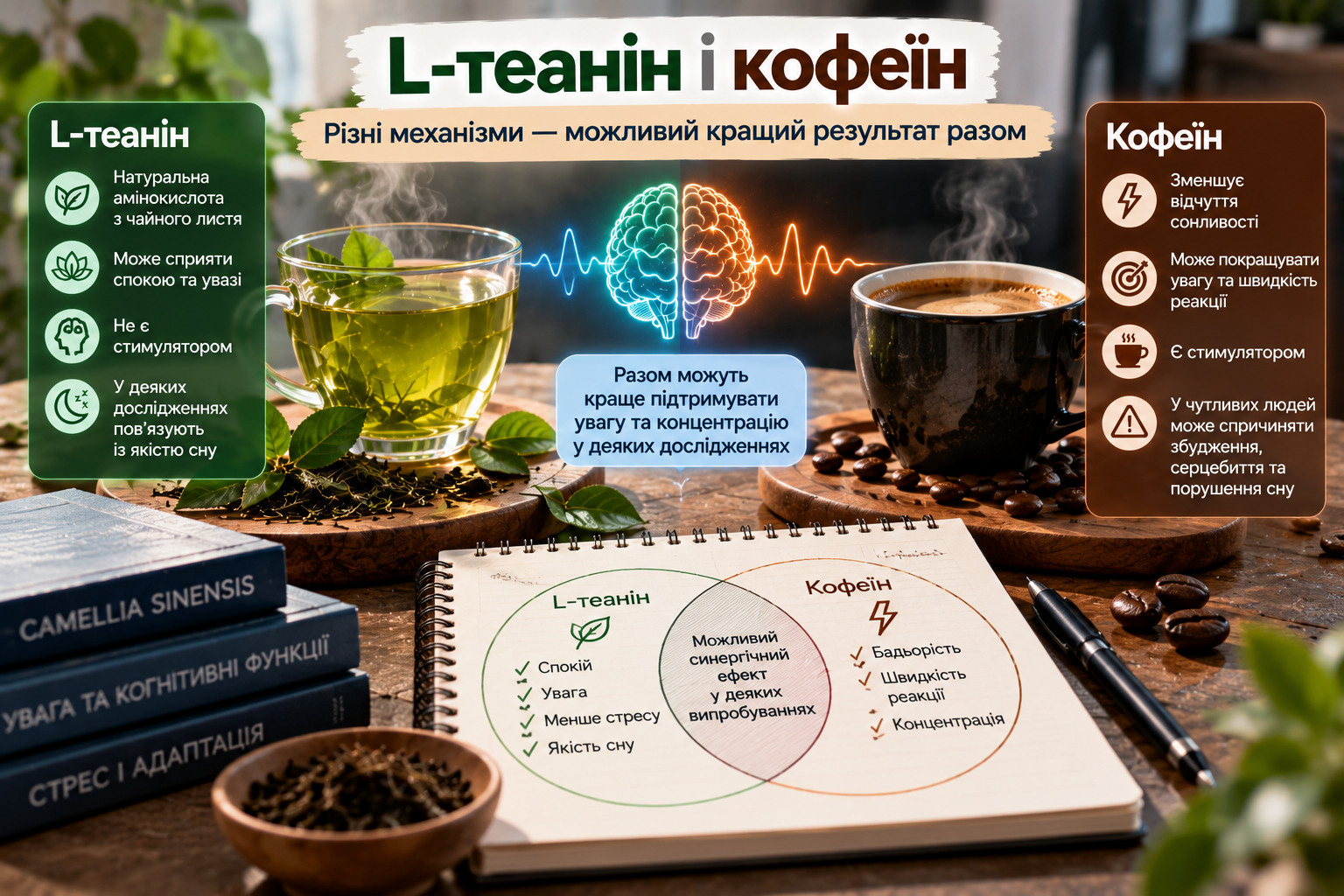
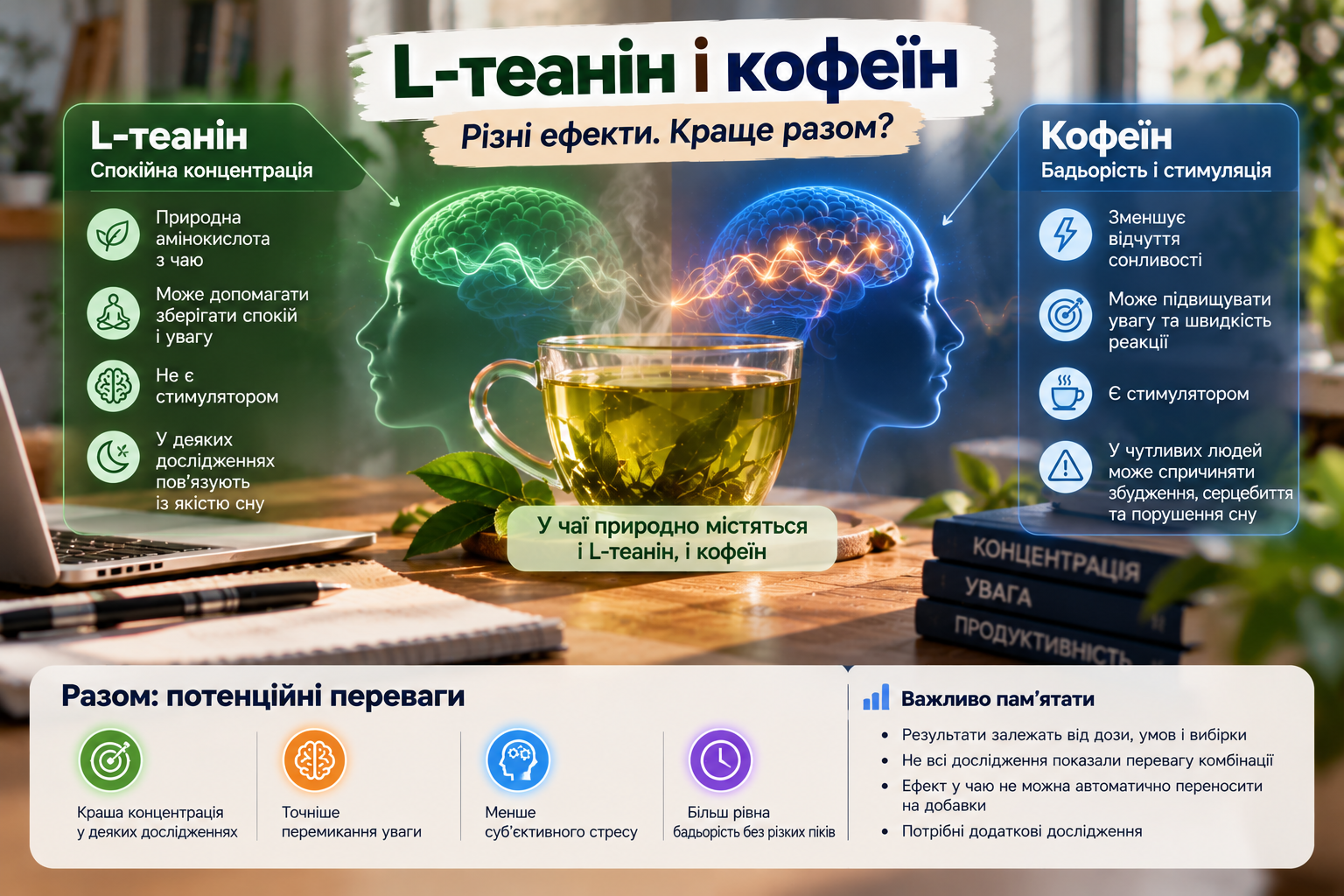
L-theanine and caffeine are two components of tea leaves that work in different ways. Caffeine temporarily reduces feelings of drowsiness by blocking adenosine receptors. L-theanine is a non-protein amino acid that has been studied in relation to attention and response to psychological stress. Their combination has been tested in randomized experiments with tests of concentration, reaction time and attention switching. Some of the results have been positive, but this does not mean that the two substances always work better than either one alone.
Unlike the general question of “what does theanine do,” the precision of the experiment is important here: what the combination was compared to, what amounts of substances were used, when the tests were conducted, and whether it is really possible to separate the contribution of theanine from the effect of caffeine.
Why caffeine and L-theanine are being studied together
Both compounds are naturally present in tea, although their levels vary depending on the type of leaf, how it is grown, and how it is brewed. The amount of each component in a typical beverage is variable; clinical trials have used precisely defined portions. Therefore, results from tests of encapsulated or specially prepared combinations cannot be automatically extrapolated to every cup of tea.
Caffeine has a well-studied stimulant mechanism: it competes with adenosine for its receptors, which can maintain alertness for a short period of time. Adverse reactions are also possible - agitation, palpitations, sleep disturbances and discomfort in sensitive people. L-theanine has a different pharmacological profile. In laboratory and clinical studies, its relationship with attention processes, subjective state and electrical activity of the brain has been studied; the explanation of these observations is not reduced to a simple "switching off" of the stimulant effect of caffeine.
What direct studies of the combination have shown
The key trials were conducted mostly on small samples of healthy people. The researchers used short-term cognitive tasks and did not examine changes in job performance, academic performance, or long-term health. The following are study protocols, not dietary recommendations.
| Research | Quantities used | What was discovered | Key limitation |
|---|---|---|---|
| Haskell et al., 2008 | 250 mg L-theanine and 150 mg caffeine; individual and combined conditions | In some tests, the combination differed from placebo; for one measure of word recognition, a statistical interaction of the components was recorded | Short-term laboratory results, uneven effect across different tests |
| Owen et al., 2008 | 100 mg L-theanine and 50 mg caffeine | In 27 participants, the combination improved the speed and accuracy of attention switching after 60 minutes | Small sample; effect did not apply to all measurements |
| Giesbrecht et al., 2010 | 97 mg L-theanine and 40 mg caffeine | Higher task-switching accuracy and individual changes in self-rated cheerfulness were recorded in 44 young adults | Comparison of the combination with placebo does not establish the contribution of each substance individually |
| Einöther et al., 2010 | 97 mg L-theanine and 40 mg caffeine | Better performance on an attention-switching task, but no statistically significant improvement in intersensory attention or subjective alertness | The conclusion depends on the specific test. |
The most powerful designs for assessing interactions have groups with theanine alone, caffeine alone, their combination, and placebo. If you compare only the combination with placebo, you can estimate the total effect of the mixture, but you cannot prove that theanine itself added benefit over and above the effects of caffeine.
Do they really work better together than separately?
Owen et al. (2008) directly compared 50 mg of caffeine with the same amount of caffeine and 100 mg of theanine. For individual tasks of attention switching and distraction, the combination was superior, although this was not a universal pattern across all cognitive tests. Haskell et al. (2008) evaluated each substance and combination separately, and the results also varied by measure.
The Giesbrecht et al. (2010) study, on the other hand, compared the combination with a placebo. Its positive results indicate an effect of the studied mixture, but do not in themselves show whether it was more effective than the corresponding amount of caffeine alone. This distinction is important: “the combination is better than placebo” and “theanine enhances the effect of caffeine” are two different scientific conclusions.
A 2025 systematic review and meta-analysis included 50 randomized trials of tea, theanine, and theanine plus caffeine; only 15 studies were suitable for quantitative pooling. The authors found small to moderate differences in individual short-term tests, but the confidence intervals often left considerable uncertainty. This supports a cautious conclusion about potential benefits for certain tasks, rather than a claim of proven benefit in any situation.
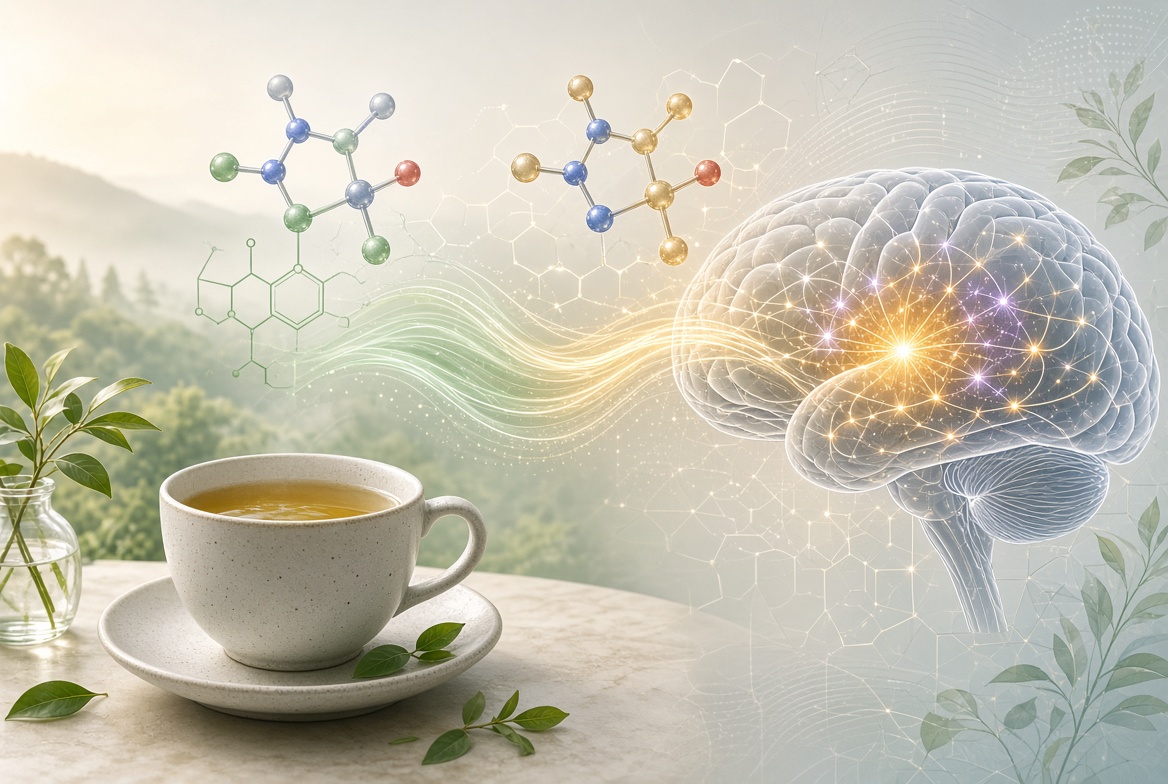
The most frequently recurring interest in studies is in attentional switching — the ability to move from one rule or task to another. Some studies have also found changes in task accuracy and response to distractors. However, results for simple reaction speed, general alertness, or other cognitive measures have been less consistent.
Improvement on a computer test is not the same as a noticeable increase in performance at work or school. In real life, concentration is simultaneously affected by sleep, fatigue, task difficulty, caffeine habit, and individual sensitivity. Participating in a short laboratory trial does not give an answer to how a person will feel after regular use of the combination.
Does L-theanine reduce the unwanted effects of caffeine?
The common explanation that theanine "takes the jitters out of coffee" is too categorical. Some studies have documented subjective differences after combined administration, but direct comparisons with caffeine alone and specifically selected measures are needed to demonstrate a reduction in a specific adverse reaction. Attention studies have not necessarily been of sufficient size or duration to fully assess tolerability.
L-theanine also does not neutralize caffeine or reverse its effects on sleep. The stimulant remains active regardless of whether the amino acid is present. People with caffeine sensitivity, sleep disorders, cardiovascular conditions, or those taking medications should discuss the risks with their doctor.
Why the ratio of theanine to caffeine is not a universal formula
The ratios varied considerably across protocols, from 100 mg theanine to 50 mg caffeine in Owen et al. (2008) to 250 mg to 150 mg in Haskell et al. (2008). These figures cannot be translated into a ready-made recipe. Trials varied in participants, tasks, and conditions, and there is insufficient comparative data to select a “best ratio.”
It is also important to distinguish between the amount of caffeine in the research protocol and its total consumption per day. Caffeine comes from coffee, tea, energy drinks and other products; sensitivity to it varies. The result of one test is not a reason to independently increase the amount of the stimulant. During pregnancy and lactation, in children and adolescents, the issue of caffeine requires special caution.
What remains unknown
The evidence base is best suited to the short-term effects and specific tasks to focus on. Much less research has been done on whether the effects persist over time, how they are affected by regular caffeine consumption, and whether laboratory changes have a tangible practical significance.
Thus, the combination of theanine and caffeine has a more direct experimental basis for individual attention tests than many popular ingredient combinations. However, scientific evidence does not establish a universal advantage over caffeine alone, an optimal ratio, or a predictable outcome for each individual.
Frequently asked questions
What is the difference between L-theanine and caffeine?
Caffeine is primarily associated with blocking adenosine receptors and promoting alertness, while theanine has a different biological profile. They are studied together, but they are not interchangeable.
Can combining theanine with caffeine improve attention?
Some randomized trials have found positive changes in attentional switching tests. The effect was inconsistent across measures and does not prove beneficial in every everyday situation.
Has theanine been proven to enhance the effects of caffeine?
Some direct comparisons have found differences for individual tests, but the results are not universal. If the study compared the mixture only with placebo, the additional effect of theanine alone cannot be established.
What is the best ratio of L-theanine to caffeine?
No single optimal ratio has been established. Scientific studies have used different amounts and tested different tasks.
Does L-theanine relieve caffeine jitters?
There is no convincing evidence that theanine counteracts the adverse effects of caffeine. Tolerance also depends on individual sensitivity and total caffeine intake.
Does a cup of tea equal the combination studied?
No. The content of components in tea varies, while the tests used fixed amounts of substances.
Should I take theanine with caffeine every day?
Short-term trials do not establish the need for daily use. The appropriateness of supplementation and the risks of caffeine should be assessed on an individual basis, especially if you have chronic conditions or are taking medications.
Sources
- Haskell CF et al. (2008). The effects of L-theanine, caffeine and their combination on cognition and mood. Biological Psychology. PubMed
- Owen GN et al. (2008). The combined effects of L-theanine and caffeine on cognitive performance and mood. Nutritional Neuroscience. PubMed
- Giesbrecht T. et al. (2010). The combination of L-theanine and caffeine improves cognitive performance and increases subjective alertness. Nutritional Neuroscience. PubMed
- Einöther SJL et al. (2010). L-theanine and caffeine improve task switching but not intersensory attention or subjective alertness. Appetite. PubMed
- Effects of Tea (Camellia sinensis) or its Bioactive Compounds L-Theanine or L-Theanine plus Caffeine on Cognition, Sleep, and Mood in Healthy Participants: A Systematic Review and Meta-Analysis of Randomized Controlled Trials (2025). Nutrition Reviews. PubMed
Dietary supplement. Not a medicine. Consult a doctor before use.
Products related to this post
Related Posts
Comments
Information
Customer Service
Extras
My Account


Sports nutrition manufacturer in Ukraine StarkPharm © 2026


