Your shopping cart is empty!

L-theanine during stress: why research results vary
Published: 29/10/2026
Times Read: 43
Comments : 0
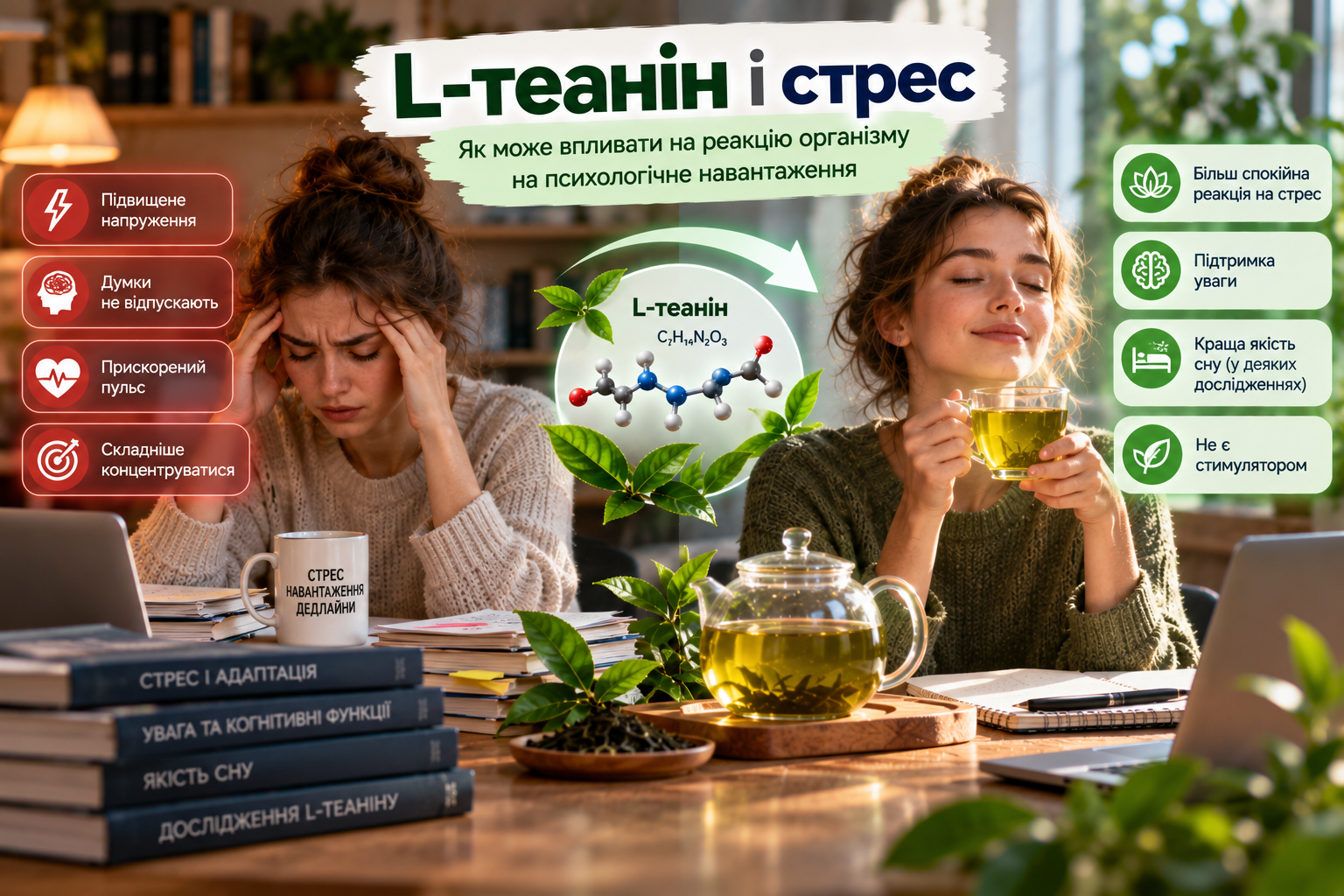
L-theanine and stress have been the subject of clinical studies that have assessed both the perception of stress and the physiological response to a challenging task. L-theanine is a non-protein amino acid found in tea leaves; its effects should not be confused with those of caffeine or multi-ingredient drinks. Small trials have recorded changes in individual measures after acute stress and over several weeks of consumption. However, a positive result in a single test does not mean that a substance has the same effect on everyday stress in all people.
It is particularly important to distinguish between two types of results: within-group changes after administration and differences from placebo. For inferring the specific effect of the test substance, the second type of comparison is much more informative. Below, we will consider what exactly was tested in human studies and where gaps remain.
Pulse, cortisol and self-esteem: how stress response is measured
In everyday speech, stress is called fatigue, anxiety, overwork or tension before an important event. In clinical studies, these feelings are assessed with separate instruments. For example, the Perceived Stress Scale questionnaire reflects the subjective perception of stress, while questions about situational anxiety show the state at a specific moment. These are not the same indicators, and they do not necessarily change synchronously.
Physiological indicators also have different meanings. Heart rate and heart rate variability characterize the response of the autonomic nervous system, cortisol in saliva is one indicator of stress axis activity, and electroencephalography describes the electrical activity of the brain. None of them alone allows us to say that a person has become calmer overall or copes better with difficult life situations.
L-theanine in trials: a brief overview of the results
Publications vary in number of participants, duration, form of substance, and outcome chosen as primary outcome. The table lists validated research protocols; the amounts listed are not recommendations for self-administration.
| Work | Participants and protocol | Main result | Limitation |
|---|---|---|---|
| Kimura et al., 2007 | 12 people; several conditions for one-time admission and control tests | Smaller pulse rate and salivary IgA response during arithmetic exercise relative to placebo | Very small sample size and laboratory stressor |
| Hidese et al., 2019 | 30 healthy adults; 200 mg/day for 4 weeks, crossover design | Changes in individual questionnaire indicators after administration; for a number of indicators, comparison with placebo is less clear | Small sample; not all changes indicate intergroup advantage |
| AlphaWave, 2021 | 16 participants in a crossover study; 200 mg once | Differences from placebo in alpha rhythm activity and cortisol response during a stressful task | Small sample, short-term laboratory values |
| Moulin et al., 2024 | 30 healthy adults with moderate stress; 400 mg/day for 28 days | Subjective stress decreased in both groups; no statistically significant difference was found between groups on PSS | Small sample size; within-group changes do not prove superiority over placebo |
These results should not be generalized as “proven stress reduction.” Some experiments measured changes in physiological responses to stress, others measured subjective ratings. The protocols did not test the same question, and the study samples were relatively small.
Stressful task in the laboratory: results of short experiments
Kimura et al. (2007) used an oral counting task that created a controlled psychological stress. Lower heart rate and salivary immunoglobulin A responses were observed after theanine compared to the control condition. The authors also analyzed heart rate variability. The conclusion was related to a specific response to a brief stressor, rather than a sustained improvement in psychological state.
Another 2021 crossover trial used a single dose of 200 mg of standardized L-theanine and compared performance on a math task with placebo. The researchers observed differences in EEG alpha activity and salivary cortisol. These markers are interesting for understanding the possible response of the nervous system, but are not themselves a measure of long-term stress tolerance.
Similarly, White et al. (2016) found changes in subjective responses to a multitasking stressor and cortisol after a special beverage. However, the beverage contained, in addition to 200 mg of theanine, other active ingredients, including phosphatidylserine, alpha-GPC, and chamomile. Therefore, the results of this experiment cannot be attributed solely to L-theanine.
Four-week follow-up: effect or changes in both groups?
Even more revealing is the study by Moulin et al. (2024). In it, 30 people with moderate levels of stress were given 400 mg of L-theanine per day or placebo for 28 days. On the perceived stress scale, scores improved in both groups. There was no statistically significant difference between groups. This example demonstrates why the phrase “after taking the score decreased” without comparison with the control can mislead the reader.
Both studies were conducted over a period of several weeks. They do not establish the effects of months of use or determine which people will respond better than others.

Are stress, anxiety and anxiety disorders the same?
No. Psychological stress before an exam or deadline, general anxiety disorder, and clinically diagnosed anxiety disorder are different conditions. Most of the studies mentioned involved healthy adults or people with moderate daily stress. Their results should not be extrapolated to people with diagnosed mental illnesses.
Positive changes on a questionnaire or laboratory test also do not prove that the substance is affecting the cause of the psychological difficulties. If the experiences are persistent, disrupt sleep, work, or daily functioning, professional evaluation is appropriate. Dietary supplements should not be a substitute for appropriate medical care.
Biological mechanisms: what remains a hypothesis
The scientific literature discusses the possible interaction of L-theanine with neurotransmitter systems and processes of excitation of nerve cells. Alpha rhythm on EEG has also been studied - one of the indicators of electrical activity, which can vary depending on the state of the person and the conditions of the experiment. However, no single mechanism automatically explains all the differences found in clinical studies.
It is important not to confuse physiological plausibility with proven practical benefit. Even if a substance changes cortisol or brain electrical activity, separate studies are needed to show whether these changes correspond to sustained improvements in a person's well-being and functioning.
What to consider before drawing conclusions about L-theanine
Studies of L-theanine have generally been short and not large enough to assess rare adverse reactions. Tolerability in a particular study does not guarantee the same results for all populations. Data on use during pregnancy and lactation are insufficient; if you have chronic conditions or are taking concomitant medications, you should consult a doctor.
Given the body of evidence, L-theanine is of scientific interest in the context of stress response, but conclusive evidence on its sustained effects on everyday stress remains limited. Short-term laboratory responses and some questionnaire measures are best studied, rather than long-term outcomes.
Frequently asked questions
Does L-theanine help with stress?
Small clinical studies have found changes in some measures of stress response. However, results vary between studies and do not confirm the same benefits for all people.
Is L-theanine proven to reduce anxiety?
There are some positive results from questionnaire assessments, but they are not sufficient to draw conclusions about clinical anxiety disorders.
What do cortisol studies show after L-theanine?
In some short-term experiments, differences in cortisol levels have been observed relative to placebo. This does not establish a long-term effect on psychological state.
Does L-theanine work after a single dose?
Some studies have examined laboratory responses after a single dose, but these results cannot be considered evidence of an effect with daily use.
Why did stress decrease in the placebo group in some studies?
Self-esteem can change over time, due to participants’ expectations or test conditions. Therefore, comparing changes between groups is crucial.
Can the L-theanine in tea be equated to the doses studied?
No. Theanine content in tea varies, and scientific tests have been conducted with specific amounts of the substance.
Does L-theanine replace professional help for constant stress?
No. For persistent symptoms that affect daily life, professional evaluation is required; supplement data is not a substitute for it.
Sources
- Kimura K., Ozeki M., Juneja LR, Ohira H. (2007). L-Theanine reduces psychological and physiological stress responses. Biological Psychology. PubMed
- Hidese S. et al. (2019). Effects of L-Theanine Administration on Stress-Related Symptoms and Cognitive Functions in Healthy Adults: A Randomized Controlled Trial. Nutrients. PubMed
- White DJ et al. (2016). Anti-Stress, Behavioral and Magnetoencephalography Effects of an L-Theanine-Based Nutrient Drink: A Randomised, Double-Blind, Placebo-Controlled, Crossover Trial. Nutrients. PubMed
- A Randomized, Triple-Blind, Placebo-Controlled, Crossover Study to Investigate the Efficacy of a Single Dose of AlphaWave L-Theanine on Stress in a Healthy Adult Population (2021). Neurology and Therapy. PubMed
- Moulin M. et al. (2024). Safety and Efficacy of AlphaWave L-Theanine Supplementation for 28 Days in Healthy Adults with Moderate Stress: A Randomized, Double-Blind, Placebo-Controlled Trial. Neurology and Therapy. PubMed
Products related to this post
Related Posts
Comments
Information
Customer Service
Extras
My Account


Sports nutrition manufacturer in Ukraine StarkPharm © 2026


