Your shopping cart is empty!

L-theanine and attention: when the reaction becomes faster and when it doesn't
Published: 31/10/2026
Times Read: 2
Comments : 0
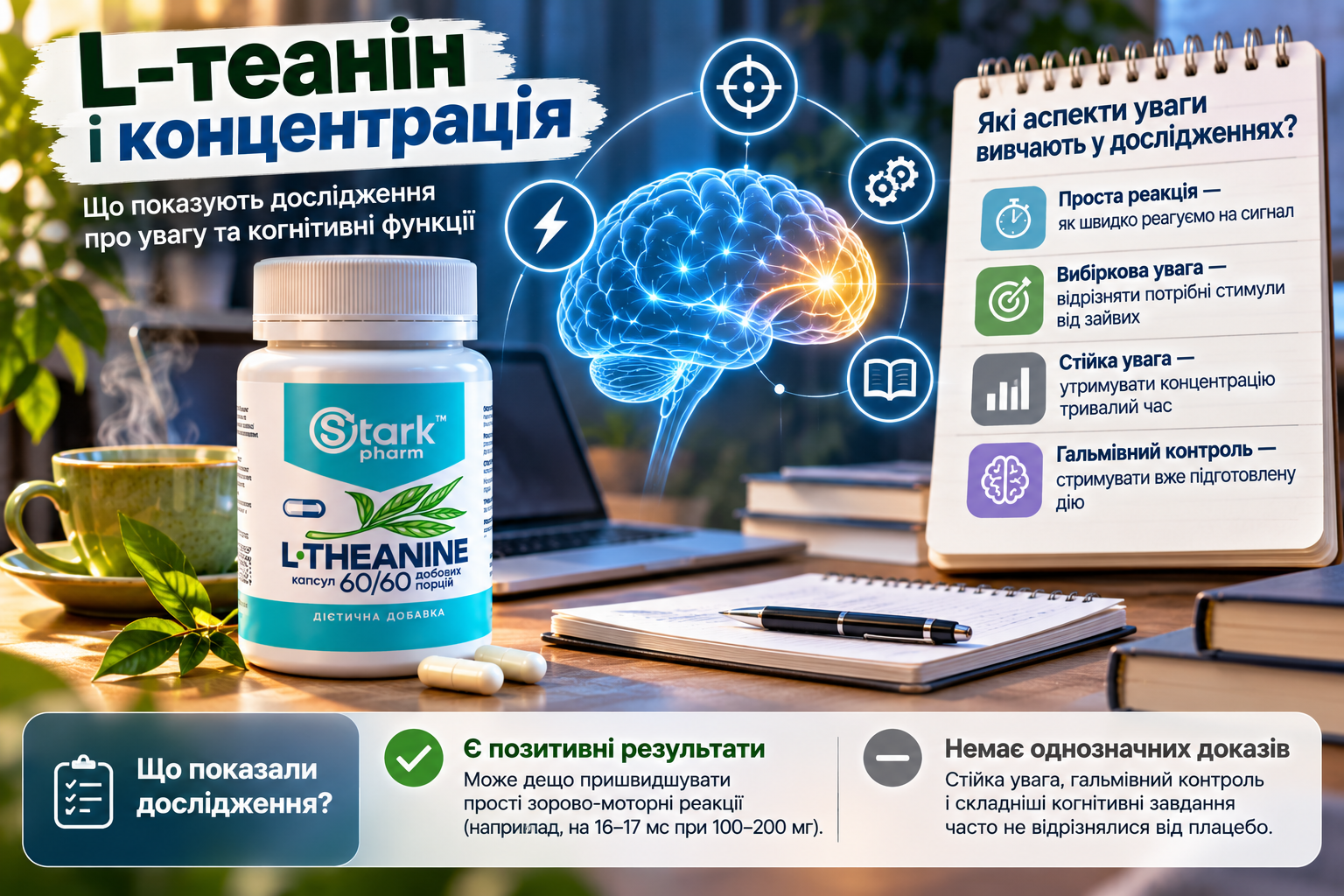
Does L-theanine really help you focus better? The answer depends on which characteristic of attention is being measured. In controlled studies, individual doses of L-theanine have affected the speed of simple visual-motor reactions and some measures of selective attention. At the same time, the results of more complex tasks that require long-term concentration or inhibition of automatic responses have not always been different from placebo. Therefore, the claim that “theanine improves attention” without specifying the test and conditions is much broader than the scientific evidence allows.
To properly assess, it is important to distinguish between three things: changes in reaction time, accuracy of responses, and electrical signals in the brain during the task. They are related, but not identical. Below are the results of tests with L-theanine as a separate substance, not with caffeine or other ingredients.
Attention is not a single indicator: what exactly was measured
In everyday life, the word "concentration" describes the ability to read without distractions, quickly notice an error, stay alert on the road, or switch between tasks. In the laboratory, these are different processes, so the results of one test cannot be transferred to all others.
- Simple response: How quickly a person responds to an expected signal. It can be accelerated without changing the accuracy of complex decisions.
- Selective attention: is it possible to distinguish the desired stimulus from extraneous stimuli and not respond to false signals?
- Sustained attention: How well a person maintains performance on a long or monotonous task.
- Inhibitory control: is it able to stop an already prepared action when circumstances suddenly change.
Just because a substance improves one of these functions doesn’t mean it affects all four. It’s the differences between tests that help explain why you can find both positive and neutral results in the literature on L-theanine.
Where L-theanine worked: short reactions and individual tasks
In a placebo-controlled crossover trial by Dassanayake et al. (2023), 32 healthy young adults were given 100, 200, or 400 mg of L-theanine or placebo on separate days. The researchers tested simple visual-motor reaction time, sustained attention, and the ability to inhibit a response. The measurements were taken approximately 50 minutes before and after the administration.
When the changes that also occurred in the placebo group were taken into account, the advantage in the simple reaction test after 100 and 200 mg remained statistically significant: by about 16–17 ms. At the same time, for more complex tasks of sustained attention and inhibitory control, a convincing advantage over placebo was not obtained. This result should not be described as a general improvement in memory, performance or learning ability.
Another study, by Kahathuduwa et al. (2016), included 20 healthy men and compared 200 mg of L-theanine, caffeine, a combination of both, black tea, and placebo. Visual reaction time and electrophysiological measures were examined. The value of this design is that it has an isolated theanine group: it helps to avoid attributing effects to theanine that might have been due to caffeine. However, the small sample size and single-dose testing limit conclusions about everyday attention.
Where advantages were not found: sustained concentration and self-control
The same test by Dassanayake et al. (2023) showed an important limit: participants could perform individual quick responses faster, but their performance on complex tests had no proven advantage over placebo. In the sustained attention test, the researcher assesses not a single momentary reaction, but the ability to correctly process a continuous stream of signals. In the inhibitory control test, a person must restrain an action, even when he has already started to prepare it. These are different cognitive demands.
A systematic review and meta-analysis by Mátyus et al. (2025) included five randomized trials in 148 healthy adults. For one measure of visual response, the review found a statistical difference, but for the response to a simple stimulus and the Stroop test, no convincing effect was found. The authors emphasized the heterogeneity of the protocols and the small number of participants. Therefore, even averaged results depend on the choice of cognitive test.
This is not a contradiction that needs to be “fixed” by choosing one best study. Different tests answer different questions. Also, a short experiment shows behavior at a certain point in time, not a person’s ability to work without distractions for months.

What the main studies actually found
| Research | Participants and protocol | Result | What limits the conclusion? |
|---|---|---|---|
| Dassanayake et al., 2022 | 27 healthy young adults; 100, 200, and 400 mg, single dose | Decreased latency of the P3b component after 400 mg; lower doses did not produce a significant difference in this measure | Electrophysiological marker is not a direct indicator of daily performance |
| Dassanayake et al., 2023 | 32 healthy young adults; 100, 200, and 400 mg, compared with placebo | Acceleration of simple visual-motor reaction after 100 and 200 mg; no convincing advantage in more complex tests | Short-term effect, small sample |
| 24 young adults after a night of sleep deprivation; 200 mg once | Fewer false alarms and better signal discrimination; change in reaction time had no significant between-group difference | Unusual conditions of acute sleep deprivation, computer model instead of real road | |
| Mátyus et al., 2025 | Meta-analysis of 5 RCTs, total of 148 people | Superiority in some reaction tests, but not in all attention assessment methods | Small total sample, diverse designs |
The table is not a ranking of doses. Different studies have studied different values, and statistical significance of one does not mean the optimal dose for all people. The amounts listed are characteristics of the protocols, not recommendations for intake.
Why EEG can change even when behavior remains almost unchanged
Researchers don’t just measure attention by pressing a button. In an experiment by Dassanayake et al. (2022), they analyzed event-related brain potentials, specifically the P3b component. Its latency is a time parameter of the electrical response associated with processing a meaningful stimulus. After 400 mg of L-theanine, it became shorter compared to placebo, while lower doses did not show the same statistically significant difference.
However, there was no consistent dose-dependent improvement in behavioral reaction time in this study. This distinction is important: a brain signal may indicate a change in a particular stage of information processing, but by itself does not indicate that a person will work more accurately, remember material better, or make fewer mistakes in real life.
Changes in alpha activity on the EEG are another separate area of research. However, the alpha rhythm depends on whether the eyes are open, how difficult the task is, and how the signal was analyzed. It cannot be perceived as a universal “concentration meter.” This method is discussed in more detail in a separate cluster material on L-theanine and alpha waves.
When participants didn't get enough sleep: a unique situation, not a universal benefit
In a study by Karunaratne and Dassanayake (2025), 24 healthy volunteers completed a computer-based task with traffic scenes after a night of sleep deprivation. After a single dose of 200 mg of L-theanine, they were measured for how well they distinguished between dangerous and safe situations and how quickly they pressed a button.
Compared to baseline, theanine reduced the number of false responses to safe scenes and improved the discrimination of desired and extraneous signals. However, the improvement in reaction time compared to the change after placebo was not statistically significant. That is, the result cannot be interpreted as “theanine significantly speeds up the driver’s reaction.”
It is also necessary to distinguish between laboratory simulation and driving. The participants did not undergo road safety tests. This study does not imply that theanine compensates for sleep deprivation, reduces the risk of accidents, or replaces normal rest. The most accurate conclusion is that in specific conditions of acute sleep deprivation, positive changes in certain indicators of selective attention were observed.
What meta-analyses add and why their conclusions vary
A meta-analysis by Mátyus et al. (2025) focused on decaffeinated L-theanine in healthy adults. It found that positive results were not replicated across all cognitive tests. A broader review of studies on tea, L-theanine, and its combination with caffeine (2025) also found small possible benefits for some measures, but highlighted wide confidence intervals and the need for further work.
In a meta-analysis by Gerolymos et al. (2026) of 31 randomized trials (1168 participants), a single dose of 200 mg 30–60 minutes before testing was associated with better choice response performance in the pooled analysis. However, this does not indicate long-term improvements in cognitive ability or academic performance. Importantly, the analysis pooled studies with different designs and endpoints.
Each meta-analysis answers a question formulated by its own selection criteria. If one review includes only theanine alone and another includes tea and combinations, their final scores cannot be compared. Therefore, claims about attention should be tied to the type of test, experimental conditions, and duration of observation.

What research cannot promise
Based on the available results, L-theanine cannot be described as a substance that makes a person constantly focused, error-free, or resistant to any load. The vast majority of the experiments cited evaluated short-term effects in small groups of young adults. They did not test the effectiveness during a long office day, studying for exams throughout the semester, or working under constant stress.
Individual circumstances, concomitant diseases, pregnancy, lactation and use of medications should also be taken into account. A positive test result is not a reason to independently change the doctor's prescriptions or use doses from scientific experiments. In the case of a dietary supplement, the guideline is the instructions on its packaging and specialist consultation if necessary.
Frequently asked questions
Does L-theanine improve concentration?
Some studies have found changes in individual measures of reaction and selective attention. This does not mean the same effect in all tests or situations.
Why did people react faster after theanine, but not perform better on complex tasks?
Simple response, sustained attention, and inhibitory control require different cognitive processes. Improvement in one of them does not necessarily transfer to the others.
Is L-theanine proven to be beneficial for learning and work?
Laboratory studies have not found that theanine improves long-term learning success or performance in real-world settings.
Does theanine have the same effect on people after sleep deprivation and after normal sleep?
No, such results cannot be generalized. The study after a night of sleep deprivation describes special conditions that differ from the usual state.
Does the change in P3b on the EEG mean that attention has improved?
Changes in the P3b component may reflect the brain's processing of the stimulus. To conclude about actual behavior, cognitive test results are also needed.
Does 400 mg of L-theanine work better than 200 mg?
In one experiment, 400 mg affected a specific EEG parameter, and in another, 100–200 mg affected simple reaction time. Comparison of different tests does not allow us to determine a universally best dose.
Can the effects of theanine with caffeine be equated to the effects of theanine alone?
No. The combination changes the exposure conditions, so the results of the mixture do not prove the same effect of isolated L-theanine.
Does L-theanine replace sleep if you need to stay alert?
No. Available research does not prove that it compensates for the effects of sleep deprivation or ensures the safety of activities that require alertness.
Sources
- Dassanayake TL, Kahathuduwa CN, Weerasinghe VS (2022). L-theanine improves neurophysiological measures of attention in a dose-dependent manner: a double-blind, placebo-controlled, crossover study. Nutritional Neuroscience, 25(4), 698–708. PubMed.
- Dassanayake TL and others. (2023). Dose-response effect of L-theanine on psychomotor speed, sustained attention, and inhibitory control: a double-blind, placebo-controlled, crossover study. Nutritional Neuroscience. PubMed.
- Kahathuduwa CN and others. (2016). Acute effects of theanine, caffeine and theanine-caffeine combination on attention. Nutritional Neuroscience. PubMed.
- Karunaratne UW, Dassanayake TL (2025). Effect of L-theanine on selective attention in a traffic-related reaction task in sleep-deprived young adults: a double-blind placebo-controlled, crossover study. Nutritional Neuroscience, 28(4), 471–480. PubMed.
- Mátyus RO and others. (2025). Promising, but Not Completely Conclusive—The Effect of L-Theanine on Cognitive Performance Based on the Systematic Review and Meta-Analysis of Randomized Placebo-Controlled Clinical Trials. Journal of Clinical Medicine, 14(21), 7710. PubMed.
- Payne ER, Aceves-Martins M, Dubost J, Greyling A, de Roos B (2025). Effects of Tea (Camellia sinensis) or its Bioactive Compounds L-Theanine or L-Theanine plus Caffeine on Cognition, Sleep, and Mood in Healthy Participants: A Systematic Review and Meta-Analysis of Randomized Controlled Trials. Nutrition Reviews, 83(10), 1873–1891. PubMed.
- Gerolymos C., Saddier E., Boyer L., Fond G. (2026). Cognitive and affective effects of L-Theanine: a systematic review and meta-analysis of 31 randomized trials. Molecular Psychiatry, 31, 6592–6602. PubMed.
Dietary supplement. Not a medicine. Consult a doctor before use.
Products related to this post
Related Posts
Comments
Information
Customer Service
Extras
My Account


Sports nutrition manufacturer in Ukraine StarkPharm © 2026


