Your shopping cart is empty!

How much L-theanine is in a cup of tea and why studies use 200 mg
Published: 30/10/2026
Times Read: 23
Comments : 0
There is no single fixed amount of L-theanine in a cup of tea. In studies of 200 ml beverages, values ranged approximately from a few milligrams to several dozen milligrams: the result depended on the tea, the amount of dry leaves, brewing time, and laboratory methodology. For comparison, 200 mg of L-theanine is an amount that has been studied separately in clinical trials in humans. These two figures can usefully be compared arithmetically, but it cannot be assumed that a supplement and a certain number of cups of tea have the same effects.
The main question is not whether one cup is “enough.” It is more important to understand how much theanine actually passes from the leaves into the infusion, why values differ even within one type of tea, and where the figure of 200 mg in research protocols came from.
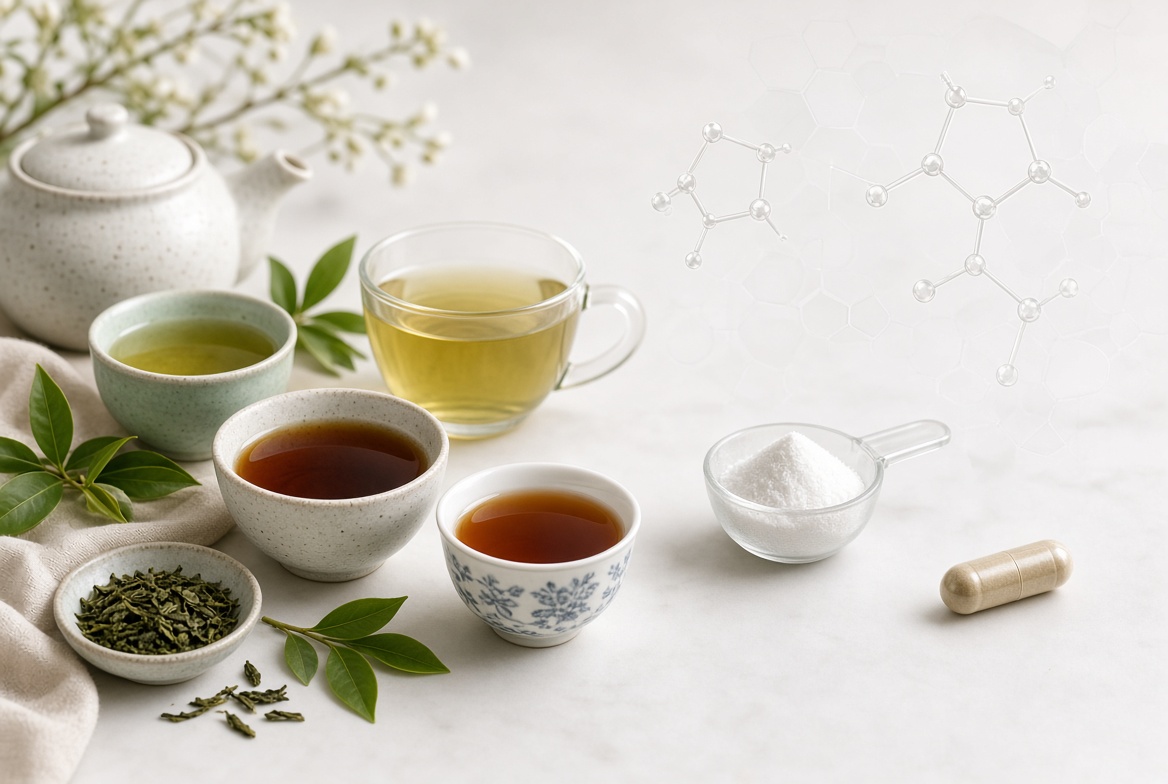
How much L-theanine was found in brewed tea
Let us start with measurements rather than advertising claims. Keenan and co-authors (2011) analyzed commercial teas prepared using a standard method. For a 200 ml cup, they reported an average of 24.2 ± 5.7 mg of L-theanine in black tea and 7.9 ± 3.8 mg in green tea. In these particular samples, black tea contained more theanine, although common perception often gives green tea the lead.
Another study, by Ayakdaş and Ağagündüz (2025), covered six types of tea and different preparation methods. Under one of the standardized conditions, approximately 12–13 mg per 200 ml was found in black and green tea; results for other types were lower. The authors also showed that longer steeping changes concentrations, while the form of tea — tea bags or loose-leaf tea — does not provide a universal advantage in terms of theanine.
The discrepancy between the studies does not mean that one is incorrect. The researchers analyzed different commercial samples, used different brewing procedures, and selected different sets of teas. Both results are valid for the infusions measured in the respective experiments, but neither describes every cup of tea in every household.
Why the figures for green and black tea do not match
The label “green” or “black” indicates how tea leaves are processed, but it does not in itself determine the exact mass of L-theanine in the beverage. Within one type, there are different varieties, degrees of grinding, proportions of buds and older leaves, growing conditions, storage periods, and amounts of tea leaves used. When these factors change simultaneously, the result in the cup becomes even less predictable.
In the work of Boros, Jedlinszki, and Csupor (2016), L-theanine and caffeine were measured in commercial samples using high-performance liquid chromatography. The average theanine values in the dry tea samples studied were similar across several categories; differences by type did not allow the concentration in a particular purchase to be reliably predicted. Importantly, milligrams per gram of dry leaves are not the same as milligrams in a prepared beverage: during steeping, only a certain proportion of the substance passes into the solution.
In a study by Chen and co-authors (2022), shading tea plants was accompanied by an increase in the theanine content of plant material. This explains why growing conditions may matter for leaf composition, but it does not allow a specific dose to be automatically assigned to a drink labeled “matcha” or “shade-grown tea” without measuring the prepared serving.
Brewing changes the amount of theanine — but not according to a simple rule
Increasing the contact time between leaves and water usually increases the extraction of water-soluble compounds. Keenan and co-authors (2011) specifically identified brewing duration as one of the main factors affecting the amount of L-theanine in a cup. Ayakdaş and Ağagündüz (2025) also found an increase with longer steeping for several types of tea, but in their experiment changes in temperature did not always have a statistically significant effect on theanine concentration.
Vuong and co-authors (2011) separately investigated the optimization of aqueous extraction of L-theanine from green tea. For a specific laboratory task, they determined conditions with a temperature of approximately 80 °C, a duration of 30 minutes, a specified leaf particle size, and a defined water-to-material ratio. These are laboratory extraction conditions, not advice to steep ordinary tea for half an hour: the aim of the work was to maximize the yield of the substance being analyzed, not the taste or suitability of an everyday beverage.
In addition, caffeine and other compounds pass into the cup together with theanine. Changing the steeping time affects the composition of the beverage as a whole. Therefore, trying to obtain a large amount of theanine solely through longer brewing does not ensure a controlled ratio of components.
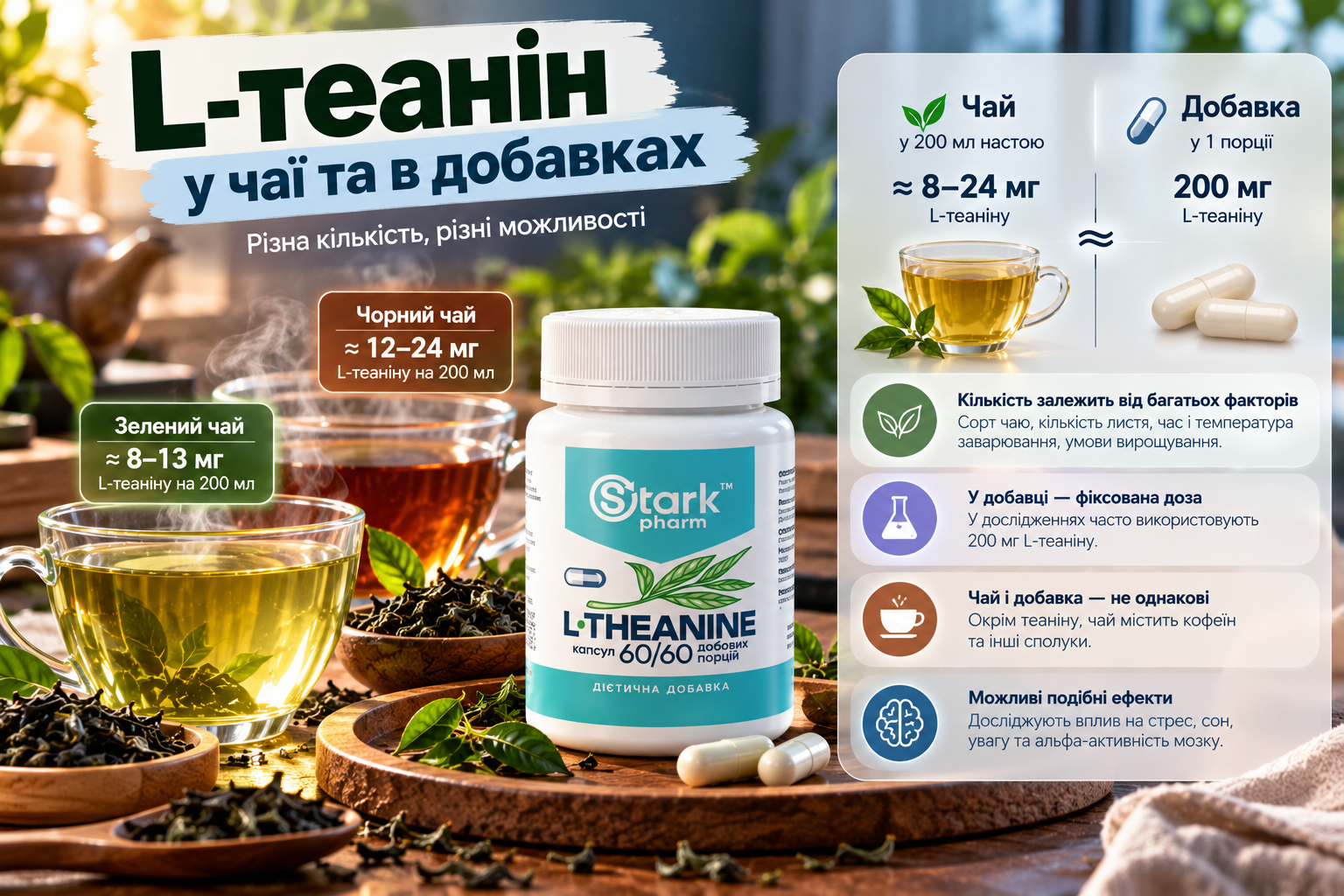
Tea versus 200 mg of L-theanine: what an arithmetic comparison means
Below are data from two studies using a 200 ml serving. They are not a standard for every variety. The approximate number of cups was calculated by simply dividing 200 mg by the reported average content, solely to illustrate the scale of the difference. This is not a recommendation to drink that much.
| Infusion or measurement condition | L-theanine per 200 ml | 200 mg is arithmetically about |
|---|---|---|
| Black tea, Keenan et al. (2011) | 24.2 mg on average | 8.3 cups |
| Green tea, Keenan et al. (2011) | 7.9 mg on average | 25.3 cups |
| Green tea, Ayakdaş and Ağagündüz (2025), selected standard conditions | approximately 12.5 mg | 16 cups |
| Black tea, Ayakdaş and Ağagündüz (2025), selected standard conditions | approximately 12.3 mg | 16.3 cups |
This table does not answer how many cups “replace” a capsule. For example, when comparing 8–25 cups with one serving of an isolated substance, the volume of liquid and the intake of caffeine, catechins, and other tea components all change simultaneously. Even an exact arithmetic match in the mass of theanine does not make these methods of intake biologically identical.
Most people drink tea as a beverage, not as a way to reproduce a clinical trial protocol. Its composition naturally varies, and this is not an error: a food product simply serves a different purpose from a standardized research ingredient.
Why scientists use exactly 200 mg
The figure of 200 mg is not an established universal daily requirement for L-theanine. In clinical studies, it is chosen as one of the experimental doses that can be reproduced precisely and compared with placebo. This is particularly convenient when the aim is to measure attention, stress, or sleep indicators without uncertainty about how much of the substance was present in the tea infusion.
Hidese and co-authors (2019) conducted a double-blind, randomized crossover trial involving 30 healthy adults. The protocol used 200 mg of L-theanine per day for four weeks. The authors assessed several psychometric and cognitive indicators and reported changes in some of them. This small study does not establish a mandatory dose for everyone and does not justify attributing such effects to every dietary supplement containing theanine.
Dassanayake and co-authors (2023) used a different approach: in a crossover study involving 32 healthy young adults, single doses of 100, 200, and 400 mg were compared with placebo in tasks measuring attention and psychomotor responses. Having several doses in one experiment is particularly useful: it demonstrates that 200 mg is one level being studied, not the only possible or always the best one.
In the work of Moulin and co-authors (2024), 400 mg per day for 28 days was examined in healthy adults with moderate stress levels. This protocol shows that research doses can differ depending on the purpose, sample, and duration of observation. Results from such studies should be compared with all these conditions in mind, not just the number of milligrams.
Why tea and concentrated L-theanine are not the same thing
In brewed tea, L-theanine is combined with caffeine, polyphenols, and other compounds. In a standardized study of isolated L-theanine, scientists can control the mass of a specific substance and use a placebo, whereas studying ordinary tea introduces additional variability from the beverage itself. This is precisely why data on 200 mg of isolated L-theanine should not be applied to a cup of green or black tea without a separate experiment.
Conversely, tea does not become a “weak” or “inferior” product merely because it contains fewer milligrams of theanine. The content of a single compound does not measure beverage quality. Tea is part of the diet and eating habits, whereas concentrated ingredients are used in protocols with controlled amounts.
The composition of a particular supplement also matters when interpreting scientific results. If a product contains other active ingredients in addition to L-theanine, the results of a trial of the pure substance do not prove the effect of the entire combination. An experiment on a single ingredient must be distinguished from a study of a finished mixture.
Practical questions: how to read the numbers without drawing false conclusions
When a source states the “amount of theanine in tea,” the first thing to check is the unit of measurement. Values expressed in mg/g of dry leaves, mg/100 ml of prepared infusion, and mg per standard cup describe different things. Conversion is possible only when the mass of tea leaves, volume of water, and preparation method are known. Without this information, comparing figures from different tables is incorrect.
An equally important question is whether the figure is an average for several samples or data from a single variety. In the studies by Keenan (2011) and Ayakdaş and Ağagündüz (2025), the results were obtained for specific samples; both show noticeable variability. Therefore, the phrase “a cup of green tea contains exactly 20 mg” creates unjustified precision.
Scientific doses must be read just as carefully. A clinical study specifies the exact quantity, administration conditions, duration, participant characteristics, and endpoints. The number 200 mg on its own does not answer whether a particular person will experience an effect. When choosing a dietary supplement, one should consider its actual composition and the recommendations on the label, and in the presence of chronic conditions, pregnancy, breastfeeding, or medication use, discuss its use with a doctor.
Thus, a cup of tea and a studied dose of 200 mg belong to different contexts. For tea, it is correct to speak of a measured range in particular infusions; for supplements, of a precisely defined mass of an ingredient and the limitations of the evidence for its use. One is not a direct substitute for the other.
Frequently asked questions
How much L-theanine is in a cup of green tea?
Measurements vary. Keenan and co-authors (2011) obtained an average of 7.9 mg per 200 ml, while Ayakdaş and Ağagündüz (2025) found approximately 12.5 mg per 200 ml under a particular preparation condition.
Does black tea contain L-theanine?
Yes. In the study by Keenan and co-authors (2011), the average result was 24.2 mg per 200 ml cup, but this is not a universal value for all black teas.
Does matcha contain more theanine than ordinary tea?
Shading plants can increase the theanine content in leaves, but the amount in a prepared serving depends on the mass of powder, the origin of the raw material, and the preparation method.
Does brewing time affect the amount of theanine?
Yes, steeping duration affected the extraction of theanine in laboratory studies. At the same time, the extraction of other substances from the leaves also changes.
Why do studies use 200 mg of L-theanine?
It is one of the standardized experimental doses, including in the trial by Hidese and co-authors (2019). It is not an established daily requirement for everyone.
Can 200 mg of theanine be equated to a certain number of cups of tea?
An arithmetic conversion can be made for a specific measured infusion, but this does not mean the effects are the same: tea also contains caffeine and other compounds.
Has it been proven that 200 mg of L-theanine is suitable for everyone?
No. Clinical trial results depend on the sample, duration, measured outcome, and product composition.
Should the amount of tea be increased to obtain a research dose?
No. Research protocols are not recommendations for tea consumption; large volumes of the beverage also increase caffeine intake.
References
- Keenan E. K., Finnie M. D. A., Jones P. S., Rogers P. J., Priestley C. M. (2011). How much theanine in a cup of tea? Effects of tea type and method of preparation. Food Chemistry, 125, 588–594. DOI
- Ayakdaş G., Ağagündüz D. (2025). Determination of L-Theanine and Caffeine Contents in Tea Infusions with Different Fermentation Degrees and Brewing Conditions Using the Chromatographic Method. Foods, 14(13), 2313. PubMed
- Boros K., Jedlinszki N., Csupor D. (2016). Theanine and Caffeine Content of Infusions Prepared from Commercial Tea Samples. Pharmacognosy Magazine, 12(45), 75–79. PubMed
- Chen X. et al. (2022). Effect of Shading on the Morphological, Physiological, and Biochemical Characteristics as Well as the Transcriptome of Matcha Green Tea. International Journal of Molecular Sciences, 23(22), 14169. PubMed
- Vuong Q. V., Stathopoulos C. E., Golding J. B., Nguyen M. H., Roach P. D. (2011). Optimum conditions for the water extraction of L-theanine from green tea. Journal of Separation Science, 34(18), 2468–2474. PubMed
- Hidese S. et al. (2019). Effects of L-Theanine Administration on Stress-Related Symptoms and Cognitive Functions in Healthy Adults: A Randomized Controlled Trial. Nutrients, 11(10), 2362. PubMed
- Dassanayake T. L. et al. (2023). Dose-response effect of L-theanine on psychomotor speed, sustained attention, and inhibitory control: a double-blind, placebo-controlled, crossover study. Nutritional Neuroscience. PubMed
- Moulin M., Crowley D. C., Xiong L., Guthrie N., Lewis E. D. (2024). Safety and Efficacy of AlphaWave L-Theanine Supplementation for 28 Days in Healthy Adults with Moderate Stress: A Randomized, Double-Blind, Placebo-Controlled Trial. Neurology and Therapy, 13(4), 1135–1153. PubMed
Dietary supplement. Not a medicinal product. Consult your doctor before use.
Products related to this post
Related Posts
Comments
Information
Customer Service
Extras
My Account


Sports nutrition manufacturer in Ukraine StarkPharm © 2026


