Your shopping cart is empty!

How to read the composition of dietary supplements: dosage, % NRV and excipients
Published: 24/11/2026
Times Read: 24
Comments : 0
On a dietary supplement label, you may see a familiar name for a substance, but not understand how much of it is per capsule, per serving, or per entire package. The Serving Size, NRV, % DV, mineral forms, and list of excipients answer different questions. When comparing two products, it is important to read them together, rather than choosing a can based solely on the largest number on the front label.
Below is a practical guide for the buyer: from determining the portion to calculating the cost, evaluating the composition and checking for allergens. The examples are conditional and do not describe a specific product. The format and vocabulary of labeling vary between countries, so it is important to focus on the full information on the actual packaging.
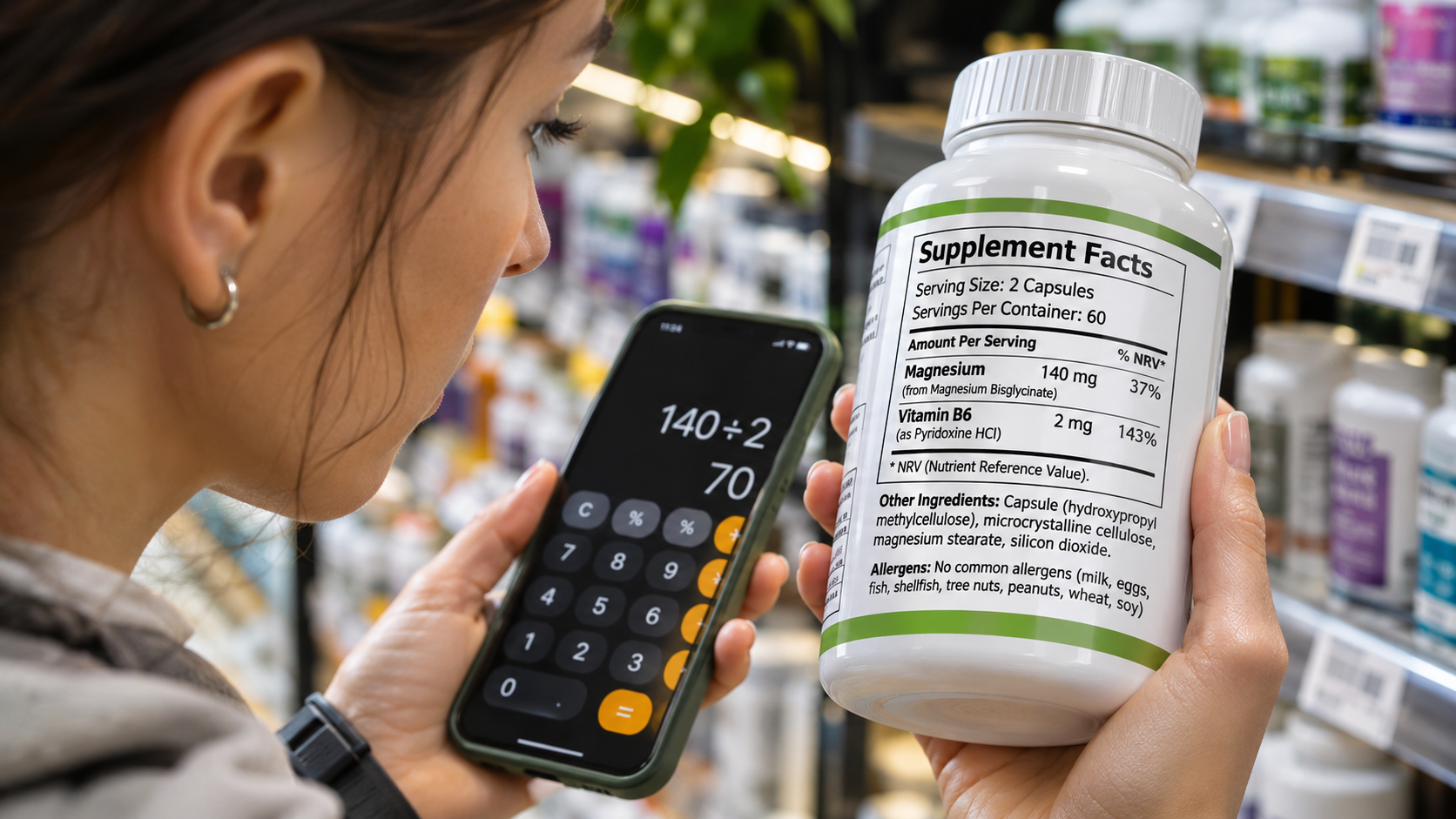
Supplement label: what to check in the first minute
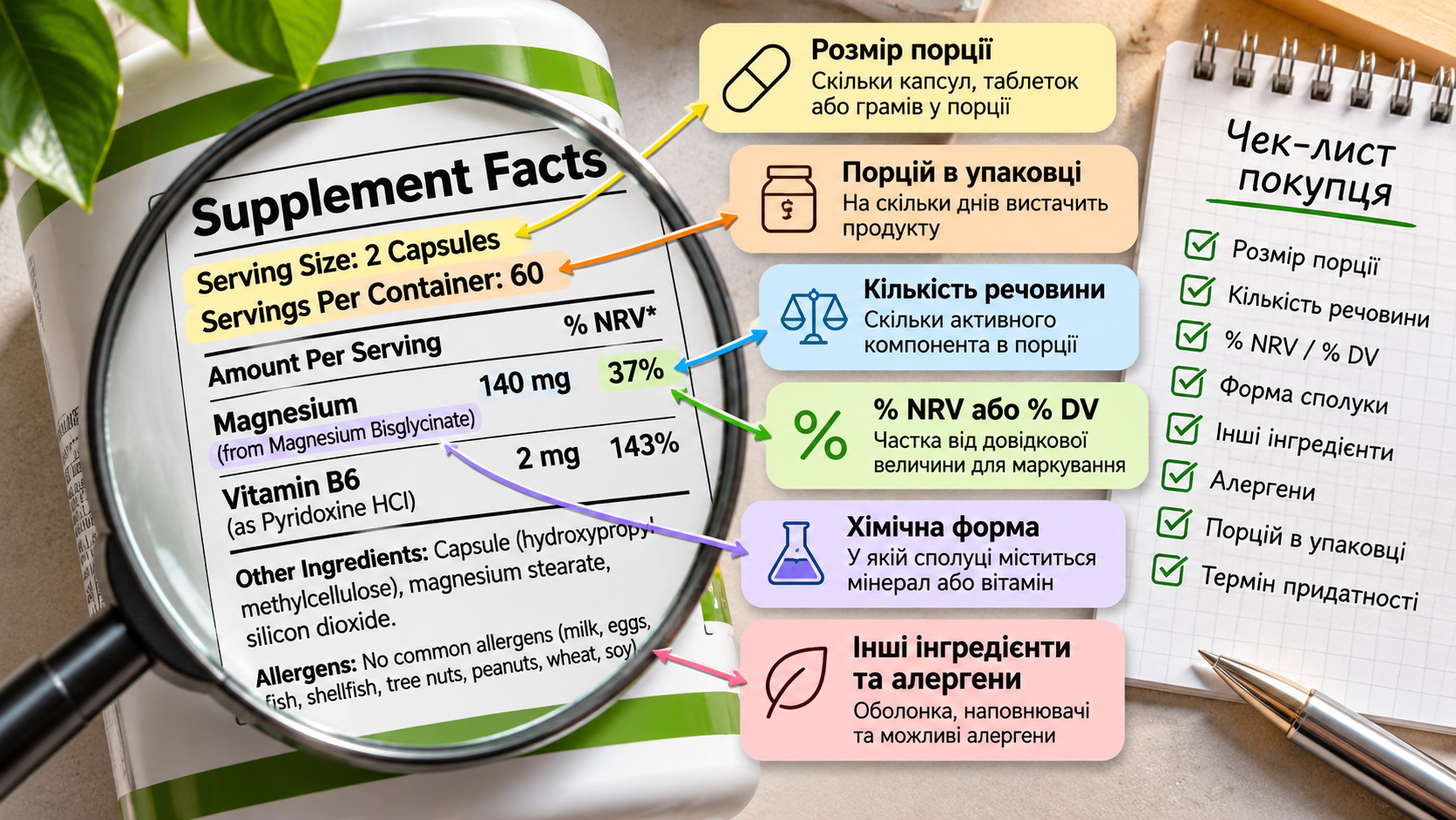
| What to look for | Why is this needed? | Typical trap |
|---|---|---|
| Serving size | Determines how many capsules or powder the composition is for | Treat the contents of two capsules as the contents of one |
| Amount of substance | Shows the actual declared content per selected serving | Confusing the mass of a chemical compound with the amount of an element |
| %NRV or %DV | Compares the amount of a nutrient to the reference value for labeling | Consider this percentage as a personal need |
| Chemical form | Specifies which compound contains the vitamin or mineral | Select only by the advertising name of the form |
| Other ingredients | Helps to see the shell, fillers and flavorings | Ignore allergens and dietary restrictions |
| Servings per package | Allows you to calculate the duration of use and the cost of a portion | Compare only the weight of the can or the number of capsules |
Before analyzing a single substance, also check the expiration date, packaging integrity, storage conditions, and full product name. The inscriptions on the front of the can are often abbreviated, and the defining information is contained in the composition table on the back.
Serving Size and Servings Per Container: Why They're Not the Same
Serving Size — the size of a serving for which the amount of ingredients is listed. This can be two capsules, one tablet, a measuring spoon, or a certain weight of powder. Servings Per Container — the approximate number of such servings in the package. They should not be confused with the number of individual capsules or tablets.
Example: A jar contains 120 capsules. The table shows “Serving Size: 2 Capsules” and “Servings Per Container: 60”. If the table says “Magnesium — 140 mg”, then the amount given is for two capsules. One capsule, assuming a uniform composition, will contain 70 mg of magnesium. If you compare such a jar with another one, where 140 mg is given per capsule, a direct comparison without conversion is incorrect.
For powders, the rule is the same. A portion may be indicated by weight, for example, 5 g, but the weight of the powder itself is not equal to the content of the active ingredient: the rest may be flavorings, carriers and other substances. In multicomponent complexes, the sum of the weights of the individual components should also not be mechanically equal to the weight of the entire portion, without taking into account the forms and auxiliary components.
What does NRV mean on a vitamin and mineral label?
The abbreviation NRV stands for Nutrient Reference Value, a reference value for nutrient intake used for labeling. It helps to understand the proportion of a given reference contained in a serving. It is not a personal diet analysis, an indicator of absorption, or a safe intake limit.
For European labeling, the reference value for magnesium is 375 mg. If a conventional product contains 140 mg of elemental magnesium per serving, its proportion is 140 ÷ 375 × 100 ≈ 37.3%. This may be rounded to 37% on the label. This calculation only explains the arithmetic of the percentage: it does not determine whether a person needs this particular serving.
On American products, % DV, or percentage Daily Value, is often listed instead of NRV. This is a separate reference value system, and the numbers on labels from different markets may not match, even if the amount of active ingredient is the same. When comparing international products, focus primarily on absolute amounts and units of measurement, not percentages from different systems.
Why a high percentage on the package doesn't mean a better choice
A higher NRV is a higher amount of a nutrient relative to a specific labeling guideline. It doesn't say anything about your specific dietary needs. If you're getting enough of a nutrient from food and other sources, an extra high amount isn't necessarily an advantage. For some nutrients, getting too much has its own risks.
The percentage also does not indicate the bioavailability of a particular compound. Two products may have the same magnesium content in milligrams and the same percentage NRV, but differ in chemical form, tolerability, serving size, and other components. Conversely, a high number in the table is not proof that the substance will be fully absorbed.
You should not add up the percentages of different vitamins and make them the "total strength" of the complex. Reference values are set for each nutrient separately. Similarly, the arithmetic mean between the percentages of vitamin C, zinc, and magnesium has no clear nutritional value.
Milligrams, micrograms, grams and international units
| Marking | What does it mean? | How to read |
|---|---|---|
| g/g | Grams | 1 g is equal to 1000 mg |
| mg / mg | Milligrams | 1 mg is equal to 1000 mcg |
| µg / mcg / mcg | Micrograms | It is necessary to be careful not to confuse it with mg |
| IU/MO | International units | Conversion to mass depends on the specific vitamin and form. |
| FCC/ALU and other activity units | Indicate the activity of certain enzymes | Not equal to milligrams without enzyme specification |
The confusion between milligrams and micrograms creates a thousandfold error. It is especially important to read the small units next to vitamin D, vitamin B12, and other substances, the amounts of which are often indicated in micrograms. If there is IU on the jar, you should not apply one universal coefficient to all vitamins: it does not exist.
For example, for vitamin D, 1 mcg is equivalent to 40 IU, according to the established conversion. But this ratio cannot be automatically transferred to vitamin A or E. If the supplement contains multiple forms of the same substance, you should check the way the quantity is presented on the label, and not convert the units “by eye”.
Mineral form: what citrate, bisglycinate, and oxide mean
The name magnesium bisglycinate describes the compound of magnesium with glycine; magnesium citrate describes the compound with citrate, and magnesium oxide describes the oxide form. The form can affect the solubility, availability of the mineral, and tolerability. However, the name alone does not confirm that a particular product is better suited for each individual than another.
For minerals, it is important to distinguish between the mass of the entire compound and the amount of the element itself. The inscription "Magnesium (as citrate) - 150 mg" in the composition table, according to typical logic, denotes 150 mg of magnesium, the source of which is citrate. The inscription "Magnesium Citrate - 1000 mg" may describe the mass of the compound itself. To draw the right conclusions, it is necessary to read the table headings, clarifications and specifications.
For vitamins, the form can also matter: for example, B12 labels may list the names cyanocobalamin and methylcobalamin, while folate may be labeled as folic acid or another form. This does not mean that any more expensive form automatically provides better results. The choice depends on the specific substance and the conditions of use, not on the popularity of the name.
Active and auxiliary components: why are they needed?
Active additives in the context of the composition are vitamins, minerals, amino acids, plant components or other substances for the sake of which the product is formed. Excipients perform technological functions: ensure the shape of the tablet, the homogeneity of the mixture, stability, flowability of the powder or the integrity of the capsule.
| Component | Possible technological role | What to watch |
|---|---|---|
| Microcrystalline cellulose | Filler and tablet forming component | Is the full composition indicated and is there any individual sensitivity? |
| Silicon dioxide | Improving the flowability of the mixture | Presence in the general list of components |
| Magnesium stearate | Technological component of tablet and capsule production | Not to be confused with the declared amount of the nutrient magnesium |
| Gelatin | Capsule shell material | Origin is important for certain dietary restrictions |
| Hypromellose/HPMC | Plant-based shell material | Check the composition of all components, not just the shell |
| Flavorings and sweeteners | Product taste formation | Assess the complete list and personal tolerability |
Important: The word "auxiliary" does not mean that the component is unnecessary or dangerous. Similarly, the technological substance is not necessarily present in large quantities. For specific questions about tolerance and allergens, the complete list of ingredients is decisive, not a general fear of an unfamiliar chemical name.
What do E-numbers on the label mean?
The E-number is a way of identifying certain food additives used in food. It does not mean that we are dealing with an “artificial” or automatically harmful substance. A single substance can have a familiar chemical name and a numerical designation.
The evaluation of the composition should be based on the specific component, its function, quantity and possible individual limitations. You should not conclude about the quality of the supplement just because one product contains an E-number, and another uses the full name of the same substance. At the same time, if the buyer has a confirmed reaction to a certain component, its presence in the composition is important regardless of the way it is written.
Plant extracts: 10:1 and standardization — different metrics
The label “10:1 extract” typically describes the ratio of the plant material to the extract obtained according to the manufacturer’s method. It does not, by itself, tell you how much of a particular bioactive compound is contained in a serving. The ratio should not automatically be taken as an indication of clinical potency or compared to another extract without information about the raw material and method of manufacture.
Two herbal products labeled "500 mg" may differ in the part of the plant, the method of extraction, and the content of characteristic substances. A "five hundred versus five hundred" comparison without these details is often misleading. In mixtures, several extracts may be combined under one total mass, which further limits the accuracy of the comparison.
Allergens, casings and individual restrictions
Before choosing a supplement, it is worth checking not only the main ingredient, but also the full list of milk, soy, wheat, eggs and other potentially significant ingredients. Pay attention to the specific wording: “contains”, “may contain traces” and the technological origin of a particular component convey different information.
Lactose can be an excipient in tablets and capsules. This is a particularly noticeable issue for people with lactose intolerance, but the amount in a particular product should be checked against its specifications. Otherwise, there is a risk of exaggerating the minimum quantities or omitting another component that is truly important.
For people who do not consume animal products, it is important to check the gelatin and the origin of individual ingredients, rather than relying solely on the color or appearance of the capsule. For children, pregnant women, people with chronic conditions, and those taking medications, additional evaluation of the appropriateness of the product is necessary — even if its composition appears simple.
How to compare two supplements by composition: an example without advertising promises
Let’s consider two hypothetical magnesium products. Can A contains 90 capsules, and a serving contains three capsules of 180 mg of magnesium. Can B contains 60 capsules, and a serving contains one capsule of 120 mg of magnesium. At first glance, A has more capsules and more milligrams per serving, but for a fair comparison, you need to convert the data to the same unit.
| Parameter | Conditional product A | Conditional product B |
|---|---|---|
| Capsules in a package | 90 | 60 |
| Capsules per serving | 3 | 1 |
| Magnesium per serving | 180 mg | 120 mg |
| Magnesium per capsule | 60 mg | 120 mg |
| Servings per package | 30 | 60 |
| Magnesium in the whole package | 5400 mg | 7200 mg |
| Mineral shape | Need to clarify | Need to clarify |
| Price per serving | Calculate at current price | Calculate at current price |
In this example, product B has more content per capsule, even though product A has more capsules per can. But none of these facts alone make a supplement better. Composition, tolerability, number of units per serving, mineral form, and individual needs may be important factors in the decision.
To calculate the cost per serving, divide the price of the can by the number of servings in it. To compare the cost of a given amount of a nutrient, first convert the data for both products to the same unit: for example, to 100 mg of magnesium. For complex complexes, this calculation is only partially useful, since the different components and forms are not interchangeable.
Seven mistakes that cause incorrect comparisons of dietary supplements
- Ignore the serving size. The amount for two or three capsules is taken as the content of one.
- They focus only on the front label. They do not read the table of quantities and the form of the substance.
- They confuse the mass of a compound with an elemental mineral. This makes comparing magnesium, zinc, or calcium incorrect.
- Consider NRV as a personal need. Do not take into account food, other supplements, and health conditions.
- Comparing percentages from different countries. The European NRV and the American DV do not always have the same numerical benchmarks.
- They perceive technological components as a sign of low quality. They do not appreciate their role and real importance.
- They don't check for duplication. One component can be included in a multivitamin, a separate supplement, and a sports complex at the same time.
A practical way to avoid these mistakes is to write down three numbers for each product: the amount of nutrient per serving, the number of units per serving, and the number of servings per package. Only then do you compare the forms, additional ingredients, and price.
What else to pay attention to before use
Having the right label doesn’t mean all ingredients are right for everyone. Minerals can interfere with the absorption of some medications, and complexes often duplicate nutrients that a person is already getting from other sources. If using prescription medications, it’s a good idea to check the label for possible interactions and dosing intervals.
It is also important not to equate the number on the label with the amount actually absorbed: bioavailability depends on the chemical form, diet, and individual characteristics. Labeling provides a basis for comparison, but is not a substitute for an assessment of health status or personal needs.
Frequently asked questions
What does Serving Size mean on the label?
This is the serving size for which the listed ingredient is intended. If two capsules are listed, the amounts listed are usually for two capsules.
How is NRV different from DV?
NRV and DV are indicators of different labeling systems. Numerical guidelines can vary, so when comparing products it is important to look at the absolute amount of a substance.
Does a high NRV mean that a supplement is better?
No. The percentage shows the proportion of the reference value, but does not determine individual need, absorption, or appropriateness of use.
How do I know how much magnesium is in one capsule?
Check the amount of magnesium per serving and the number of capsules per serving. If the composition is uniform, divide the amount of magnesium by the number of capsules.
Can 1000 mg of bisglycinate be compared to 1000 mg of magnesium?
No. The mass of a compound and the mass of the element itself are different quantities. You need accurate information about elemental magnesium.
What does Other Ingredients mean?
This is a list of other components, such as casings, fillers or processing agents. These must be considered together with the main composition.
Is an ingredient harmful just because it has an E-number?
No. The numerical code itself does not determine the properties of the substance. What is important is the specific component, its quantity, and personal limitations.
How is a 10:1 extract different from a 5% standardization?
The 10:1 ratio describes the manufacturing aspect of the extract, and the 5% is the claimed proportion of a particular compound or marker. These designations are not interchangeable.
Is a vegetarian capsule always allergen-free?
No. The shell material does not describe the entire composition of the product. Also check the active and auxiliary ingredients and allergen designations.
How do you compare the cost of two supplements?
First, compare the number of servings and the amount of the desired nutrient per serving. Then, calculate the price per serving, taking into account the form of the substance and the full composition.
Sources
- National Institutes of Health, Office of Dietary Supplements. Dietary Supplements: What You Need to Know. NIH ODS.
- National Institutes of Health, Office of Dietary Supplements. Magnesium: Fact Sheet for Health Professionals. NIH ODS.
- National Institutes of Health, Office of Dietary Supplements. Vitamin D: Fact Sheet for Health Professionals. NIH ODS.
- U.S. Food and Drug Administration. Dietary Supplement Labeling Guide: Chapter IV — Nutrition Labeling. FDA.
- U.S. Food and Drug Administration. Dietary Supplement Labeling Guide: Chapter V — Ingredient Labeling. FDA.
- U.S. Food and Drug Administration. Daily Value on the Nutrition and Supplement Facts Labels. FDA.
- European Parliament and Council (2011). Regulation (EU) No 1169/2011, Annex XIII: Reference Intakes. EUR-Lex.
- European Parliament and Council (2002). Directive 2002/46/EC on food supplements. EUR-Lex.
Dietary supplement. Not a medicine. Consult a doctor before use.
Products related to this post
Related Posts
Comments
Information
Customer Service
Extras
My Account


Sports nutrition manufacturer in Ukraine StarkPharm © 2026


