Your shopping cart is empty!

How much elemental magnesium is in different forms: comparison table
Published: 17/11/2026
Times Read: 114
Comments : 0
The inscription "magnesium bisglycinate 1000 mg" does not mean that a person receives 1000 mg of magnesium itself. Bisglycinate is a compound of magnesium with the amino acid glycine, and most of its mass is due to the organic component. For anhydrous pure bisglycinate, the proportion of elemental magnesium is approximately 14.1%. Therefore, 1000 mg of such a substance theoretically contains about 141 mg of magnesium.
In other forms, the proportion of the mineral is different. For example, magnesium oxide has a high mass fraction of magnesium, but this in itself does not mean that it is better absorbed. Below is a table, calculation formulas and an explanation of how not to confuse the chemical composition with the declared amount of magnesium on the label.
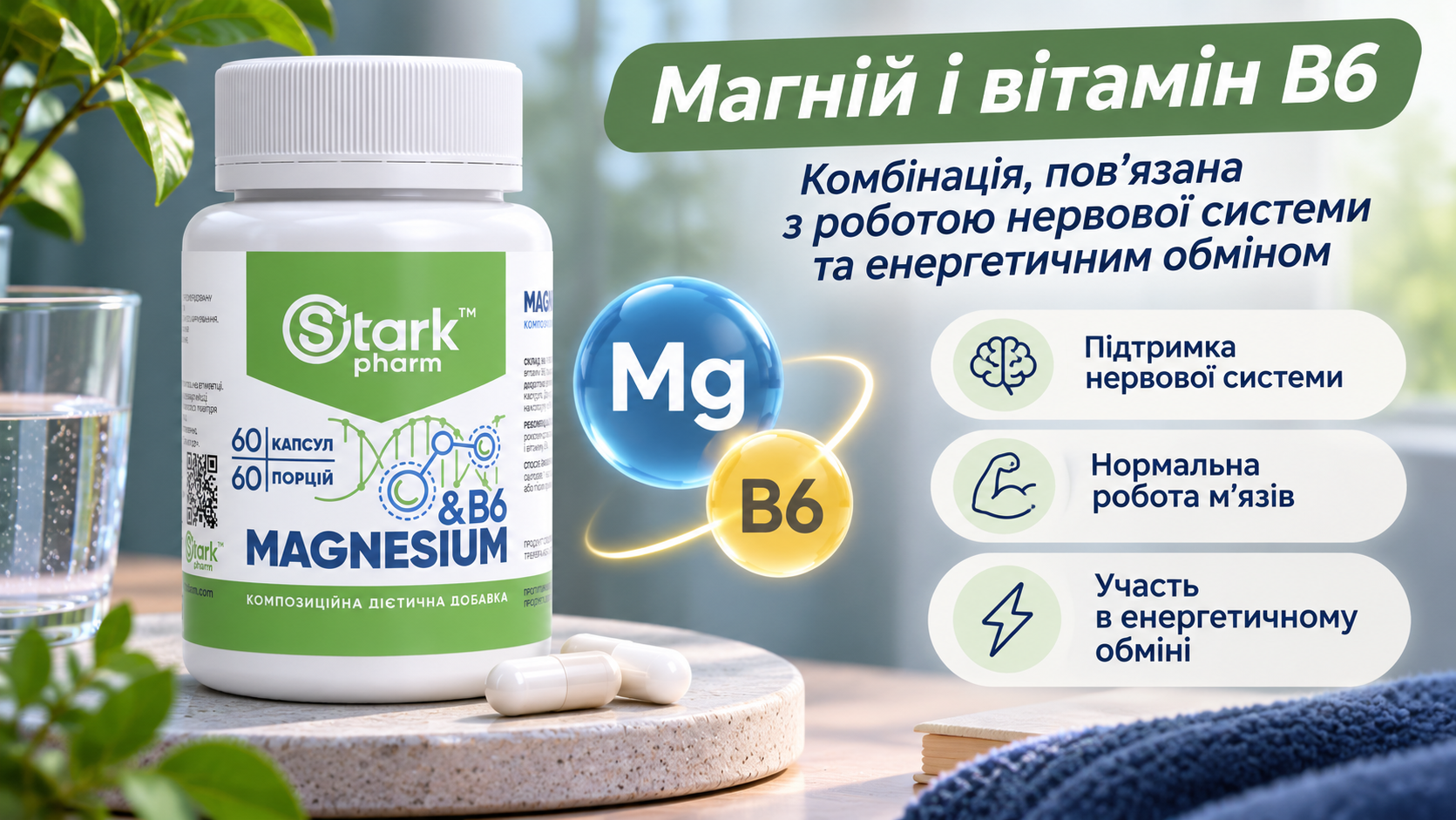
Table: how much elemental magnesium is in different forms
For correct comparison, the table shows specific chemical compounds. The percentages are calculated from their molecular formulas: the mass of all magnesium atoms is divided by the molecular mass of the compound and multiplied by 100. This is the theoretical composition of a pure substance, not the guaranteed content of any powder or capsule with that name.
| Magnesium form | Chemical formula | Mg fraction | In 500 mg of the compound | In 1000 mg of the compound |
|---|---|---|---|---|
| Bisglycinate, anhydrous | C4H8MgN2O4 | 14.1% | 70.5 mg | 141 mg |
| Citrate, anhydrous trimagnesium dicitrate | C12H10Mg3O14 | 16.2% | 80.8 mg | 161.6 mg |
| Malate, anhydrous | C4H4MgO5 | 15.5% | 77.7 mg | 155.4 mg |
| Oxide | MgO | 60.3% | 301.5 mg | 603 mg |
| Lactate, dihydrate | C6H14MgO8 | 10.2% | 51 mg | 102 mg |
Values are rounded. For example, for anhydrous bisglycinate, PubChem gives the formula C4H8MgN2O4 and a molecular weight of about 172.42 g/mol; for MgO, it is 40.305 g/mol. The molecular weight of Mg itself is about 24.305 g/mol. This is where the percentages given are derived.
Important note: The name "magnesium citrate", "magnesium malate" or "magnesium glycinate" in the commercial description sometimes does not provide complete information about the ratio of ingredients, the hydrated form or the presence of other salts. If the exact composition is unknown, the percentage from the table cannot be mechanically applied.
What is elemental magnesium and why is it not a mass of salt?
Elemental magnesium is the amount of the chemical element Mg itself in a particular compound. In supplements, magnesium is usually present in the form of salts or complexes: oxide, citrate, bisglycinate, malate, and other forms. Their total mass includes not only Mg, but also oxygen, carbon, hydrogen, nitrogen, or other elements.
Let's imagine a conventional serving consisting of 1000 mg of pure anhydrous magnesium bisglycinate. In this thousand milligrams, about 141 mg is Mg, and the rest of the mass is made up of the two glycinate parts of the molecule. In 1000 mg of magnesium oxide, on the contrary, the proportion of Mg is much higher, since the MgO molecule contains only magnesium and oxygen.
Thus, 1000 mg of a compound and 1000 mg of elemental magnesium are fundamentally different quantities. The error is especially noticeable when comparing several products based only on the large number on the front of the package. This number may indicate the mass of the ingredient, not the amount of Mg.
The NIH Office of Dietary Supplements scientific reference material clarifies that the standardized American Supplement Facts block declares the amount of elemental magnesium, not the mass of the entire magnesium compound. However, the design and way of presenting information in different markets may vary, so you should read carefully to which indicator the value in milligrams belongs.
How much magnesium is in bisglycinate: calculation examples
Magnesium bisglycinate is also called magnesium diglycinate or magnesium glycinate. For the chemically defined anhydrous compound C4H8MgN2O4, the molecular weight is about 172.42 g/mol. It contains one magnesium atom with a mass of about 24.305 g/mol.
Calculation: 24.305 ÷ 172.42 × 100 = approximately 14.1% . This means that in one gram of pure anhydrous substance there is theoretically about 0.141 g of magnesium.
| Mass of pure anhydrous bisglycinate | Calculation | Elemental Mg |
|---|---|---|
| 250 mg | 250 × 0.141 | ≈35.3 mg |
| 500 mg | 500 × 0.141 | ≈70.5 mg |
| 750 mg | 750 × 0.141 | ≈105.8 mg |
| 1000 mg | 1000 × 0.141 | ≈141 mg |
| 1500 mg | 1500 × 0.141 | ≈211.5 mg |
These are arithmetic examples, not recommendations for servings. They are valid only for the specified chemical form with approximately 14.1% Mg. If the raw material contains water of crystallization mixed with oxide or other substances, the calculation changes.
For example, PubChem separately describes magnesium glycinate dihydrate with two water molecules in the formula. For the same mass, this substance contains a smaller fraction of Mg than the anhydrous form. The reason is not "worse quality": the total mass additionally takes into account the water associated with the crystal structure.
How to calculate elemental magnesium yourself
There are two different cases. In the first, the mass of a particular compound and its exact formula are known. In the second, the manufacturer has already stated the amount of elemental Mg on the label. These situations should not be mixed.
Formula 1 - when the mass of the compound is known:
Elemental magnesium (mg) = mass of compound (mg) × fraction Mg / 100.
Example for 800 mg of pure anhydrous bisglycinate: 800 × 14.1 / 100 = approximately 112.8 mg Mg.
Formula 2 - when you need to find the mass of a compound for a given amount of Mg:
For example, the theoretical mass of pure anhydrous bisglycinate containing 100 mg of Mg is: 100 × 100 / 14.1 = approximately 709 mg of compound. The result is only a conversion of mass units, not a recommendation for use.
If the label directly says “Magnesium — 100 mg (in the form of bisglycinate),” the number 100 mg already refers to Mg. There is no need to multiply it again by 14.1%: this will lead to double counting and an incorrect result.
It is also useful to check whether the value refers to one capsule, one serving, or the recommended daily amount of capsules. Even a correctly calculated Mg fraction will not help if the serving unit is confused.
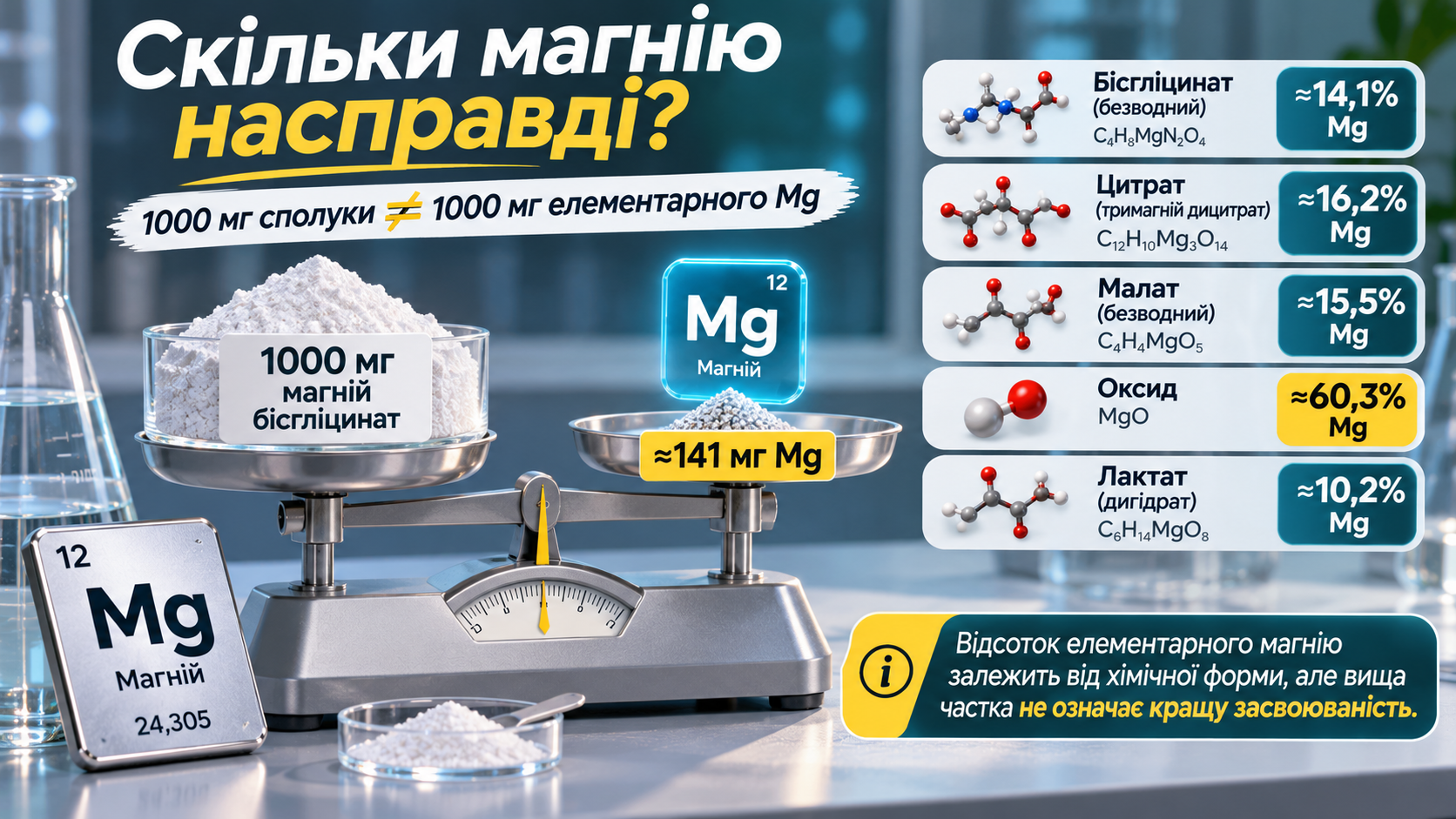
How to get percentages from molecular formulas
The mass fraction of an element in a compound is calculated from its chemical formula. To do this, you need to know the number of Mg atoms in the formula unit and the total molecular weight of the substance. The calculation does not depend on the trade name, capsule size, or powder color.
Consider bisglycinate: C4H8MgN2O4. There is one Mg atom in the formula. The molecular weight of the entire compound is about 172.42 g/mol, and that of magnesium is 24.305 g/mol. The fraction is 24.305 / 172.42 = 0.14097, or about 14.1%. This is the coefficient used in the table.
For magnesium oxide, MgO, the molecular weight is approximately 40.305 g/mol. The fraction of Mg is 24.305 / 40.305 = 0.603, or 60.3%. The percentage is higher because the oxygen atom is relatively light and there are no other components. This is a mathematical property of the formula, not a quality assessment.
For anhydrous trimagnesium dicitrate C12H10Mg3O14, the formula already has three Mg atoms. Therefore, in the numerator, we need to take the mass of three atoms: 3 × 24.305 = 72.915 g/mol. Dividing by the molecular mass of about 451.11 g/mol, we get 0.1616, or about 16.2%.
Magnesium malate C4H4MgO5 has one Mg atom and a molecular weight of about 156.38 g/mol. Its calculated fraction is: 24.305 / 156.38 = 15.54%. And for lactate dihydrate with a molecular weight of about 238.48 g/mol it is 24.305 / 238.48 = 10.19%.
Results should be rounded to a reasonable degree of accuracy. For example, 14.097% in a study table can be shown as 14.1%. The notation “141 mg in 1000 mg” is also an approximation, because real raw materials have characteristics of purity and moisture. Too many decimal places would give the false impression of laboratory accuracy.
Why might two labels with the same shape name show different numbers?
Let's imagine two conventional products labeled "magnesium bisglycinate." One lists the mass of pure anhydrous bisglycinate, the other lists the mass of an ingredient that includes another magnesium salt. Formally, both labels may use the word "bisglycinate," but the proportion of elemental Mg in the respective materials may be different.
This is why the statement "any bisglycinate always has exactly 14.1% magnesium" is incorrect. The value of 14.1% is tied to the specific formula of the pure anhydrous compound. For a dihydrate, buffered mixture, or material with a different description, your own source data is required.
The situation is similar with citrate. The table shows anhydrous trimagnesium dicitrate with three Mg atoms per formula unit. If a substance has a different amount of water of crystallization, its total molecular weight increases and the proportion of Mg decreases. This difference can be significant even with the same common name "magnesium citrate".
The most informative information for verification is the line with elemental Mg on the label, the exact name of the chemical form, its specification and, if necessary, a document with the results of the analysis. Marketing formulations such as “highly concentrated” or “chelated form” do not by themselves replace this information.
The task of comparison is also different. If a person only wants to understand the chemical mass fraction, the formula and molecular weight are enough. If he compares ready-made capsules, the amount of Mg per serving, the number of capsules in a serving, the composition of all Mg sources and the accuracy of labeling are important. And if the question is about absorption, percentages alone are not enough - other studies are needed.
Why the actual magnesium content may differ from the table
Hydrated form. Some salts contain water in their crystal structure. It adds mass but does not add magnesium atoms. Therefore, the same salt name with the qualifiers "anhydrous", "dihydrate" or "nonahydrate" may correspond to different proportions of elemental Mg.
Different stoichiometric forms. For some organic acids, compounds with different ratios of metal to acid residues are possible. Therefore, the percentage for a particular anhydrous citrate should not be transferred without clarification to any material labeled "magnesium citrate."
Mixtures of magnesium salts. An ingredient may consist of several sources of Mg. If magnesium oxide is added to the bisglycinate, the total Mg content in the mixture will be higher than 14.1%. This does not prove that all magnesium atoms are in chelated form. A specification of the raw material is required for an accurate conclusion.
Auxiliary components. Capsule, shell, flavors, sweeteners and carriers increase the total weight of the product, but do not necessarily contain Mg themselves. You cannot take the weight of the entire capsule contents and multiply it by the percentage calculated for pure salt.
Does a higher percentage of magnesium mean better absorption?
No. Mass fraction shows how many Mg atoms there are per mass of the compound. Bioavailability describes how much of the substance can be absorbed and made available for use by the body. These are different characteristics.
The most obvious example is magnesium oxide. Its theoretical elemental Mg content is about 60.3%, significantly higher than that of citrate or bisglycinate. However, the oxide has different solubility properties. The NIH Office of Dietary Supplements reports that some highly soluble forms, including citrate, lactate, chloride, and aspartate, have shown higher bioavailability compared to the oxide in small studies.
It should not be concluded that any form is necessarily "best" for each person. The result depends on the conditions of the study, the amount of substance, the characteristics of the diet and the physiological state. A separate assessment is also required for tolerability: magnesium compounds in significant quantities can cause loose stools and abdominal discomfort.
Another common logical fallacy is to confuse the amount of Mg with claims of effects for sleep, stress, or seizures. A high percentage in a chemical formula is not proof of a specific physiological result. Questions of effect require separate clinical studies, not just chemical calculations.
How to read the information on the label correctly
Before comparing two products, look for the full ingredients list, not the largest number on the front. There are three important questions: what form of magnesium is used, what the exact amount is in milligrams, and how many servings it is designed for.
| Conditional inscription | What can it mean? | How to check |
|---|---|---|
| "Magnesium Bisglycinate - 1000 mg" | The mass of the bisglycinate compound is given, but without additional data the amount of Mg may be unknown. | Look for a separate line "Magnesium" or a raw material specification. |
| "Magnesium - 140 mg (as bisglycinate)" | 140 mg of elemental Mg from the named source is indicated. | Specify whether the value is per capsule or per serving. |
| "Buffered magnesium bisglycinate" | A mixture of magnesium compounds can be used. | Check the list of ingredients and data on the actual Mg content. |
| "Magnesium citrate" without the amount of Mg | The form is named, but the elemental magnesium content cannot be determined from the name. | The exact formula, hydrated state, or Mg value on the label is required. |
The example of 1000 mg of pure anhydrous bisglycinate and approximately 141 mg of Mg only makes sense if this is indeed the compound in question. If the manufacturer explicitly declares a different confirmed elemental magnesium content for a particular mixture, arithmetic for the pure substance should not automatically override the labeling.

Common Mistakes When Comparing Magnesium
- Compare the mass of different compounds as the same amount of Mg. 500 mg of oxide and 500 mg of bisglycinate contain different theoretical amounts of magnesium.
- Recalculate elemental Mg. If its amount is already listed on a separate line, it is not necessary to multiply it by the percentage of salt.
- Ignore water of crystallization. For hydrated and anhydrous forms, the percentages can differ significantly.
- Don't overlook the buffered blend. The ingredient name doesn't guarantee that all the magnesium comes from a single salt.
- Confusing mass fraction and absorption. A high concentration of Mg in a compound does not prove higher bioavailability.
- Confusing one capsule and a serving. Even the correct number may refer to multiple tablets or capsules.
- Evaluate only the front label. Large numbers in advertising without context are difficult to interpret correctly.
All calculations given describe the composition of the substances. They do not establish a personal need for magnesium, a daily portion, or the need to take supplements. If you have kidney disease, take regular medications, are pregnant, or have other special circumstances, the decision about supplements should be coordinated with your doctor.
Frequently asked questions
How much elemental magnesium is in 1000 mg of bisglycinate?
1000 mg of pure anhydrous magnesium bisglycinate theoretically contains approximately 141 mg of Mg. For hydrated forms or mixtures, the value may be different.
Why does magnesium bisglycinate only contain about 14% Mg?
The remaining mass of the compound is mainly due to the two glycinate parts of the molecule. The percentage is determined by its chemical formula.
How much magnesium is in 500 mg of citrate?
For 500 mg of anhydrous trimagnesium dicitrate, the theoretical value is about 80.8 mg Mg. For other forms of citrate, the composition must be specified.
Which form of magnesium contains the highest percentage of Mg in the table?
Among the above forms, the oxide has the largest theoretical proportion — about 60.3%. This does not mean the best absorption.
Are magnesium glycinate and bisglycinate the same?
The names are often applied to a magnesium compound with two glycinate moieties. But for a specific raw material, the exact composition and presence of other salts must be checked.
What does buffered magnesium bisglycinate mean?
This can be used to indicate a buffered ingredient, which may contain another magnesium compound, such as oxide. The exact proportions should be found in the specification.
Should the label "Magnesium 100 mg" be multiplied by 14.1%?
No, if 100 mg already represents elemental Mg. The percentage is only needed to convert from the mass of a clearly defined compound.
Does the water in the salt affect the percentage of magnesium?
Yes. Water of crystallization increases the mass of the compound, but not the number of Mg atoms, so the mass fraction decreases.
Does more Mg mean better absorption?
No. Mass fraction and bioavailability describe different properties. They are evaluated using different data.
What is the best indicator to compare on labels?
Compare the claimed elemental Mg for the same serving by checking the form and number of units per serving. If data is missing, an accurate comparison is not possible.
Sources
- NIH Office of Dietary Supplements. Magnesium — Fact Sheet for Health Professionals. Information on elemental magnesium labeling, form properties, absorption, and precautions. NIH ODS
- PubChem, National Library of Medicine. Magnesium glycinate, CID 84645 (C4H8MgN2O4; 172.42 g/mol); magnesium glycinate dihydrate, CID 75593361. PubChem
- PubChem, National Library of Medicine. Magnesium oxide, CID 14792; magnesium malate, CID 164748; magnesium lactate dihydrate, CID 71587589. PubChem
- EFSA NDA Panel (2018). Magnesium citrate malate as a source of magnesium added for nutritional purposes to food supplements. EFSA Journal. DOI
- European Commission (2024). Commission Regulation (EU) 2024/346: chemical identity and assay specification for trimagnesium dicitrate. EUR-Lex
Dietary supplement. Not a medicine. Consult a doctor before use.
Products related to this post
Related Posts
Comments
Information
Customer Service
Extras
My Account


Sports nutrition manufacturer in Ukraine StarkPharm © 2026


