Your shopping cart is empty!

Magnesium bisglycinate: taste, bitterness and sediment in water - what does it mean?
Published: 01/11/2026
Times Read: 84
Comments : 0
Magnesium bisglycinate is a chelate in which one magnesium ion is bound to two glycine molecules. This is one of the known chelated forms of magnesium, and it is around it that there is the most confusion: the pure powder is bitter, dissolves more slowly than citrate and can give a slight cloudiness. Buyers often interpret this as a sign of "the wrong form", although in fact it is the opposite - the taste and clarity of the solution depend on the composition of the raw materials, concentration and preparation conditions.
This article explains the chemistry of taste and solubility of bisglycinate in simple terms: where the bitterness comes from, why citrate and malate seem "softer," what normal dissolution looks like, what a precipitate actually means, and a simple test you can do at home.

What is magnesium bisglycinate and how is it different from salts?
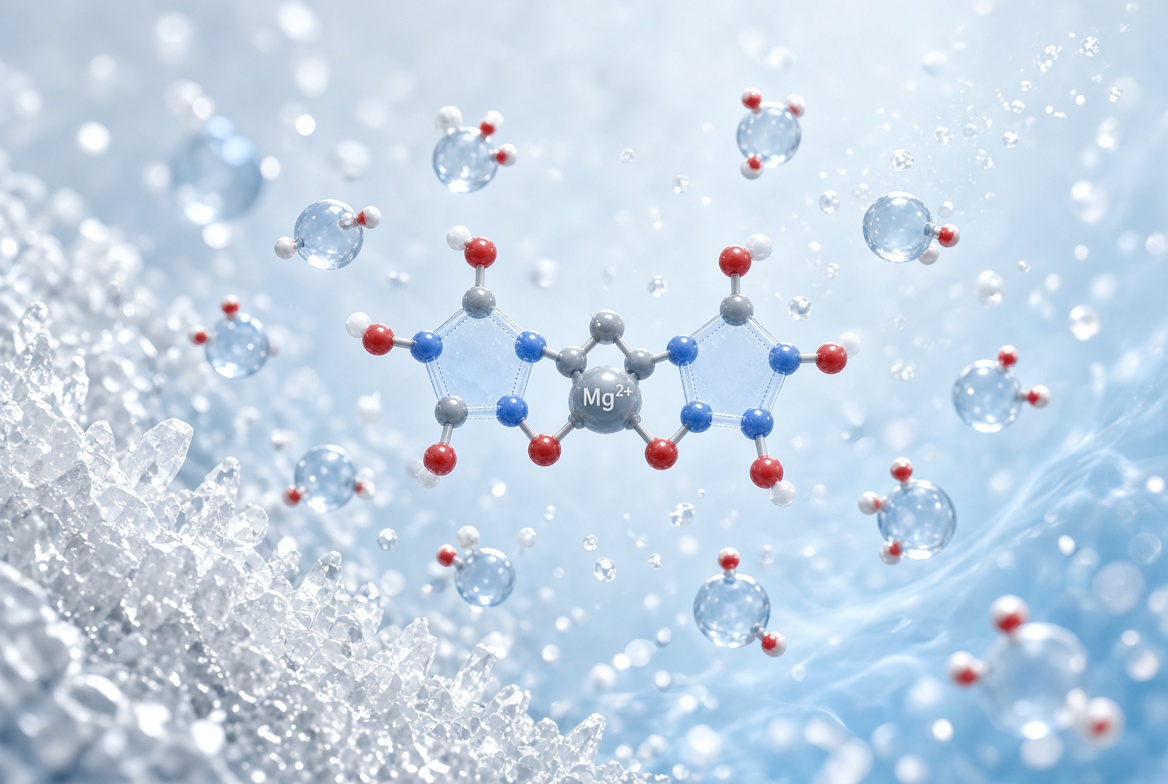
Oxide, citrate, malate, sulfate are salts: magnesium is held electrostatically and can dissociate in water, with the degree of dissociation and solubility depending on the specific compound and conditions. Bisglycinate is a chelate: glycine binds magnesium at two points, through the carboxyl group and the amino group, forming a ring structure. Both complex particles and dissociated ions are possible in solution; their ratio depends on the pH, concentration, and composition of the medium.
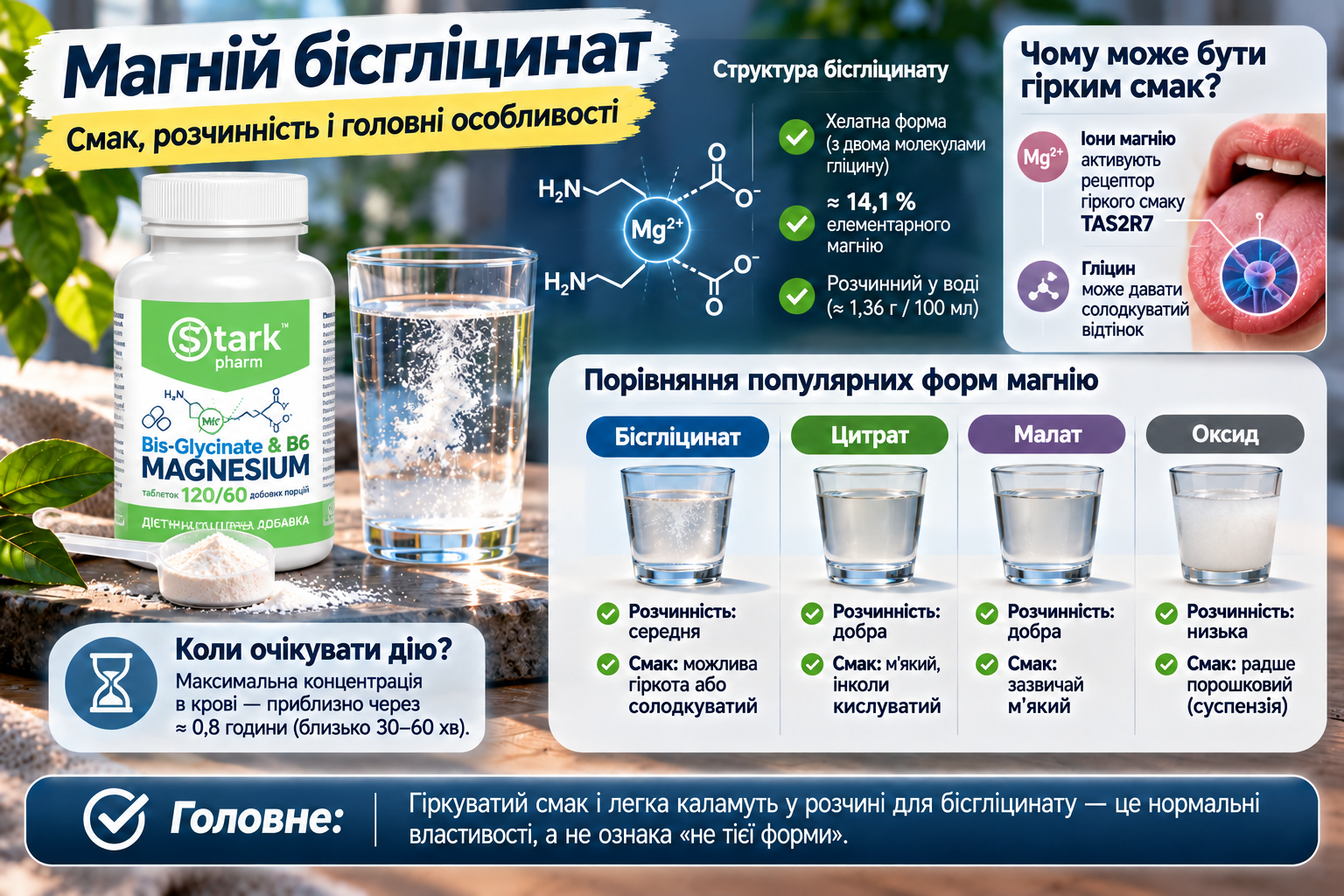
In fully reacted magnesium bisglycinate (Mg(C₂H₄NO₂)₂, molecular weight 172.4), the theoretical elemental magnesium content is approximately 14.1%, assuming an anhydrous pure compound. This is an important figure: if the raw material is declared as “bisglycinate 18%” or “20% magnesium”, this is not consistent with the formula of anhydrous pure bisglycinate and requires clarification of the composition of the raw material. One possible option is a buffered mixture in which magnesium oxide is present alongside the chelate. The oxide contains significantly more elemental magnesium by weight and is poorly soluble in water. But the percentage on the label alone, without the specification of the raw material, does not allow us to establish either the proportion of oxide or the completeness of chelation.
Where does bitterness come from: the magnesium ion and the bitter taste receptor
In water, the chelate partially dissociates: some of the molecules break down into a Mg²⁺ ion and two glycinates. Complexation does not mean the complete disappearance of free magnesium ions. Their proportion varies depending on the conditions of the solution, which can affect taste perception.
Magnesium ion is classically bitter. Wang et al., 2019 ( Chemical Senses ) showed that divalent cations—Mg²⁺, Ca²⁺, Zn²⁺, Mn²⁺—activate the bitter taste receptor TAS2R7 on the tongue. Therefore, magnesium salts can have a bitter or metallic taste. However, the study of the receptor does not allow us to accurately predict the bitterness strength of a particular finished powder: it is also affected by concentration, other components, and individual sensitivity.
The second flavor component is glycine. This is an amino acid with a sweet taste (which can give a sweetish tinge), and affects the overall taste perception. Therefore, the profile of pure bisglycinate is sweet-bitter, with a viscous, slightly chalky aftertaste. Therefore, a sweet-bitter or slightly mineral profile is possible and does not in itself indicate a defect.
Why do citrate and malate appear neutral?
Citrate and malate are salts of organic acids. Acidity sometimes alters the perception of bitterness, but citrate or malate itself does not necessarily have a distinctly sour taste: it depends on the pH of the solution, the specific salt, and the formulation. Therefore, the taste of the different forms cannot be predicted by the name of the anion alone.
Magnesium oxide is poorly soluble in neutral water, so its suspension may give a powdery feel rather than the taste of a clear solution.
In bisglycinate, the amino acid glycine acts as the ligand, not an organic acid residue. Therefore, the taste profile may differ from citrate or malate. Hence the practical conclusion: if a powder declared as pure bisglycinate without flavors and sweeteners tastes neutral, this is a reason to check the full composition, but not evidence of substitution.
| Form | Solubility in water | Taste of the solution | Why is that? |
|---|---|---|---|
| Bisglycinate | Depends on composition and concentration | Possible bitterness or a sweetish tinge | Chelation and equilibrium of complexes in water |
| Citrate | Depends on hydration and salt form | May have a sour or mineral note | Acidity and recipe change the taste |
| Malate | Depends on the specific salt | Taste varies | Malate Salt Properties and pH |
| Sulfate/Chloride | Usually well soluble | Often bitter or mineral | The solution contains hydrated magnesium ions. |
| Oxide | Slightly soluble in neutral water | Powdery feel | Particles may remain in suspension |
How does bisglycinate dissolve in water?
A typical picture when pouring powder into cold water: the particles are wetted unevenly, the powder can clump together due to uneven wetting. This results in local areas of turbidity in the liquid column - agglomerates. Small particles can remain suspended for some time. Stirring and moderately warm water often help wetting, but the time to transparency depends on the amount of powder and the formulation. Slight turbidity can be a consequence of suspended particles; without analysis it is impossible to determine its composition.
The key feature is the bottom of the beaker. A persistent sediment means that some of the substance did not go into solution under these conditions. Possible causes are excess solubility, properties of the raw material, or poorly soluble components, such as magnesium oxide in buffered mixtures. The appearance of the bottom alone does not allow conclusions to be drawn about the exact composition or quality of the product.
Simple home shape test
Only a laboratory can fully confirm the form of magnesium, but three signs are available to anyone:
- Precipitation. Stir a portion in warm water, let stand for 10–15 minutes. Precipitation can occur for various reasons; it does not in itself confirm oxide impurities.
- Taste. The presence of a sweetish note or bitterness is possible, but the intensity of the taste does not prove the identity or purity of the raw material.
- Magnesium content in the raw material. For the anhydrous pure compound, the theoretical value is about 14.1%. A higher declared percentage requires checking the specification: mixtures or another form of composition accounting are possible.
What a home test won’t tell you: the actual amount of magnesium in a serving and the purity of the chelate. This can only be verified by analyzing the raw material or finished product—complexonometry or atomic absorption spectroscopy—and a combination of methods, including IR spectroscopy and other analytical approaches, are used to confirm the chemical structure.
Tolerability: osmotic effect and dose
No form of magnesium is “zero” for the intestine. The mechanism is the same for all salts and chelates: the part of magnesium that is not absorbed in the small intestine retains water in the lumen of the intestine osmotically - hence loose stools, bloating or discomfort. Tolerance depends on the amount of elemental magnesium, the specific form and the characteristics of the person.
This mechanism underlies the tolerability of the different forms. In a study by Schuette et al., 1994 ( Journal of Parenteral and Enteral Nutrition ), absorption was not statistically different between diglycinate and oxide in a total group of 12 participants. The advantage of diglycinate was found in a subgroup of four people with the most severe absorption disorders; tolerability was also better within this small sample. Therefore, it is incorrect to call it definitely the most digestible or the mildest for all people.
The second factor is dosage. The European guideline of 250 mg of magnesium per day from supplements is associated with the risk of laxative effects and does not apply to magnesium that naturally comes from food. The actual response of the body is individual. For powdered products, where the portion is taken with a spoon, this is a practical point: using an unmeasured spoon can significantly change the amount of powder. Stark Magnesium Bis-Glycinate Powder contains a daily dose of 220 mg of magnesium - that is, a portion within this guideline.
A practical rule is to follow the portion and method of use indicated on the package. If discomfort occurs, it is worth stopping the intake and discussing further actions with a specialist; there is no universal scheme that eliminates gastrointestinal reactions for everyone.
Precautions
Magnesium is excreted by the kidneys, so in case of impaired kidney function, any magnesium supplements should be taken only after consulting a doctor. Magnesium may affect the absorption of some medications (including tetracycline and fluoroquinolone antibiotics, thyroid drugs, bisphosphonates) - an interval is required between doses, which should be agreed with a doctor or pharmacist. During pregnancy and lactation, in case of chronic diseases, as well as in case of individual hypersensitivity, consult a doctor before use. Persistent discomfort in the gastrointestinal tract that does not go away after reducing the dose and taking with food is a reason to stop taking and consult a specialist.
Frequently asked questions
Is the bitter taste of magnesium bisglycinate a sign of counterfeiting?
Not necessarily. Magnesium salts can have a bitter or metallic taste; the TAS2R7 study explains one mechanism. But taste is not a test of authenticity.
Why wasn't my magnesium citrate bitter?
The taste depends on the specific salt, the acidity of the solution, the concentration, and additional ingredients. Citrate and malate do not necessarily have the same sourness.
Can bisglycinate be dissolved in cold water?
Yes, if it is in accordance with the product instructions. Cold water may increase the wetting and mixing time; the result depends on the specific powder.
Why is the solution a little cloudy?
This may be a suspended fine phase or incomplete dissolution. Turbidity alone cannot confirm composition and purity.
What does sediment at the bottom after stirring mean?
Precipitation may be due to limited solubility or the presence of poorly soluble components. It is impossible to determine whether magnesium oxide is present without laboratory analysis.
Can bisglycinate cause abdominal discomfort?
Yes. Unabsorbed magnesium may contribute to osmotic intestinal reactions. The frequency depends on dose, individual sensitivity, and other factors; the universal advantage of this form has not been proven.
Is it better to take bisglycinate with food?
The time and method of administration should be checked with the instructions for the specific product. There is no convincing evidence for a universally best time to administer.
How much magnesium is in one serving of bisglycinate powder?
It depends on the product: anhydrous pure bis-glycinate theoretically contains about 14.1% elemental magnesium. Stark Magnesium Bis-Glycinate Powder is labeled as having 220 mg of magnesium per 2 g serving.
Sources
- Case DR, Zubieta J, Doyle RP (2020). The Coordination Chemistry of Bio-Relevant Ligands and Their Magnesium Complexes. Molecules. 25(14):3172. PubMed
- Case DR, Zubieta J, Gonzalez R, Doyle RP (2021). Synthesis and Chemical and Biological Evaluation of a Glycine Tripeptide Chelate of Magnesium. Molecules. 26(9):2419. PubMed
- Wang Y. et al. (2019). Metal Ions Activate the Human Taste Receptor TAS2R7. Chemical Senses. 44(5):339–347. PubMed
- Schuette SA, Lashner BA, Janghorbani M. (1994). Bioavailability of Magnesium Diglycinate vs Magnesium Oxide in Patients with Ileal Resection. JPEN Journal of Parenteral and Enteral Nutrition. 18(5):430–435. PubMed
- Henriksen C., Aaseth JO (2023). Magnesium: a scoping review for Nordic Nutrition Recommendations 2023. Food & Nutrition Research. 67:10314. PubMed
- Perspective: Call for Re-evaluation of the Tolerable Upper Intake Level for Magnesium Supplementation in Adults. (2023). Advances in Nutrition. PubMed
Dietary supplement. Not a medicine. Consult a doctor before use.
Products related to this post

Related Posts
Comments
Information
Customer Service
Extras
My Account


Sports nutrition manufacturer in Ukraine StarkPharm © 2026


