Your shopping cart is empty!

How much elemental magnesium is in threonate: why is the dose in grams so large?
Published: 28/10/2026
Times Read: 50
Comments : 0
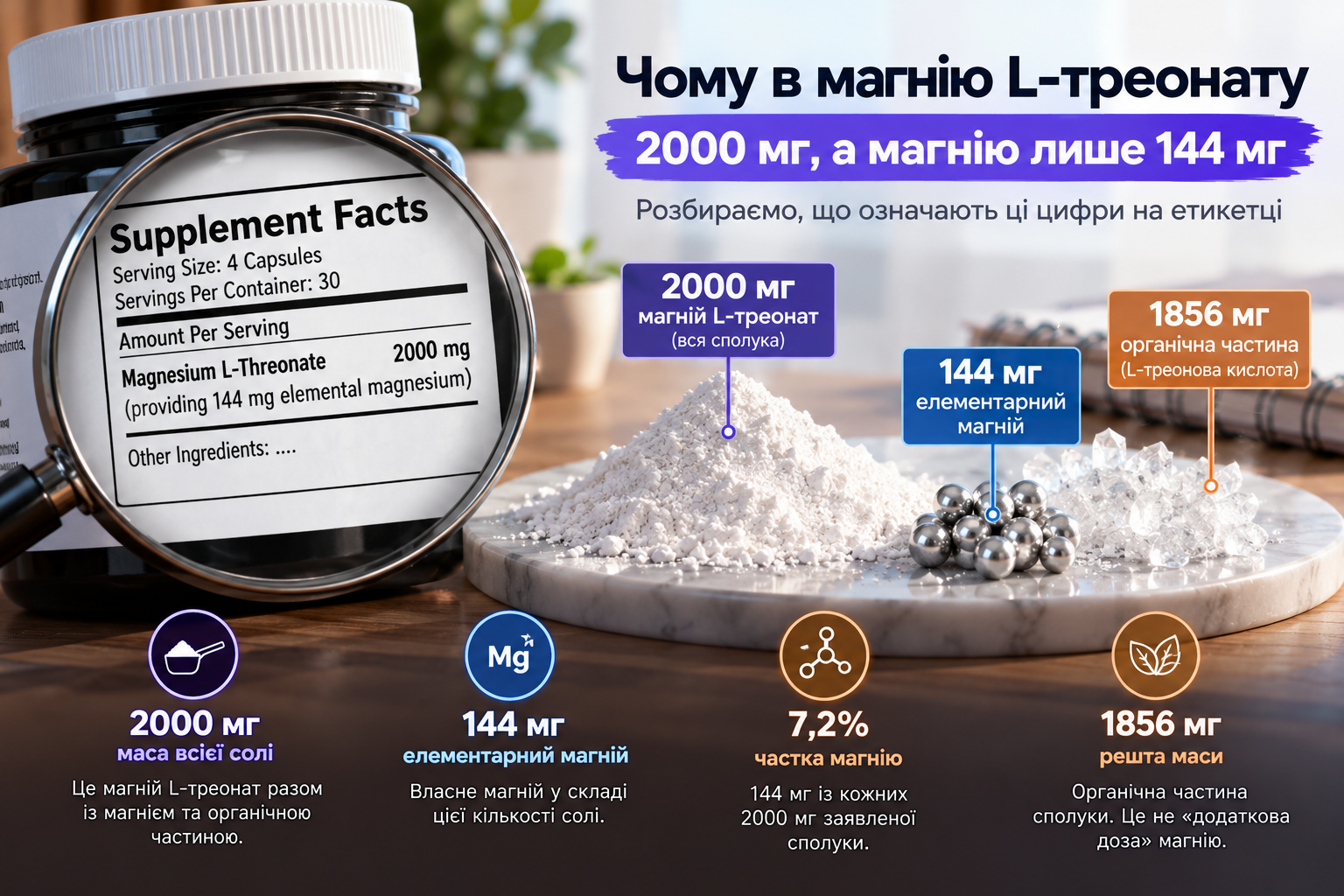
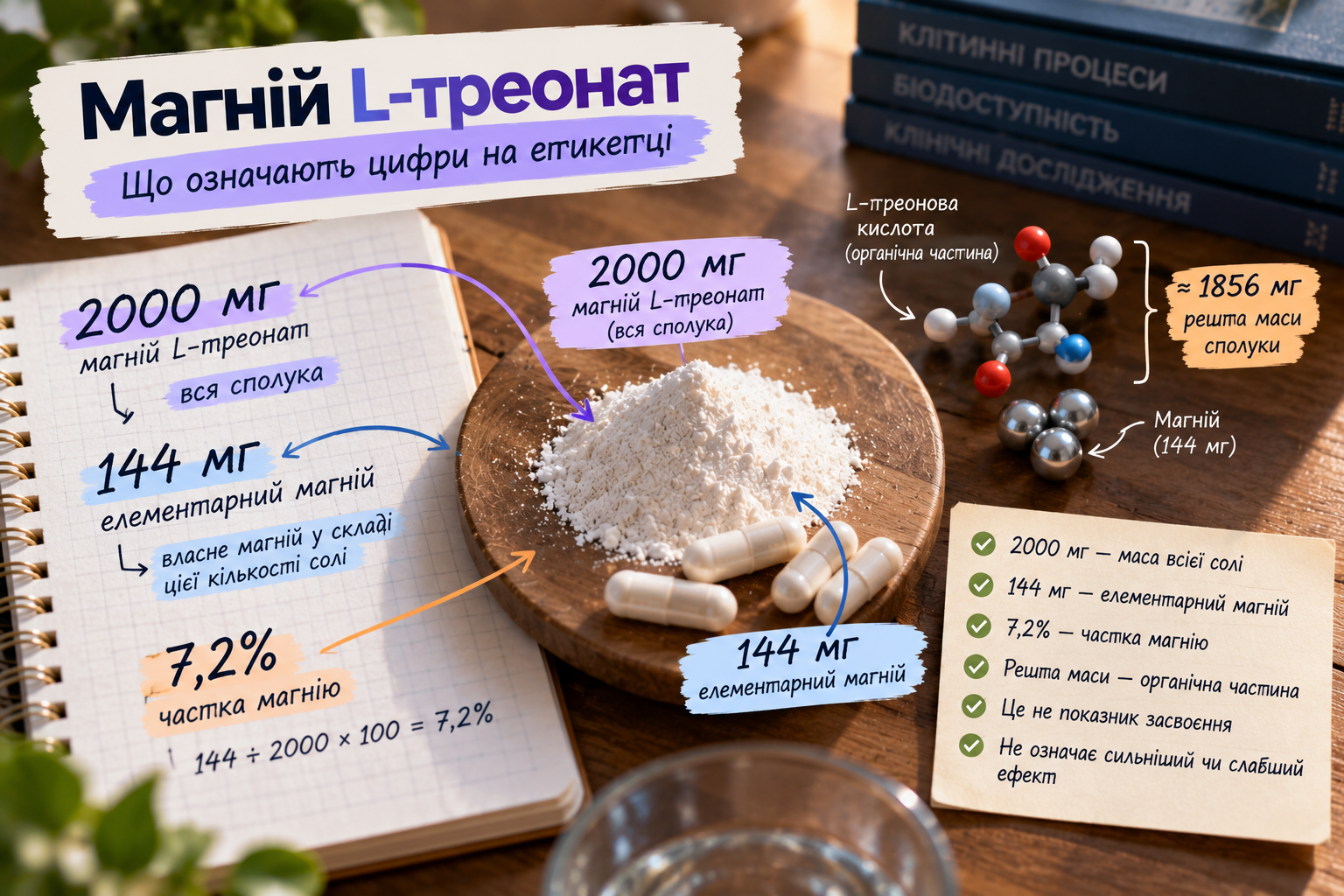
The label for magnesium L-threonate may show two numbers at once: 2000 mg of the compound and only 144 mg of magnesium. This is not an error and does not indicate that the rest of the substance has “disappeared”. 2000 mg of magnesium L-threonate is the mass of the entire salt, and 144 mg is the amount of elemental magnesium that is included in it. In this example, the proportion of magnesium is 7.2%. Without understanding this difference, it is easy to misjudge both the serving size of the supplement and the amount of the mineral it provides.
Let's consider where the large numbers on the packaging come from, how to check the arithmetic, and why the value in grams does not indicate either the degree of absorption or the expected effect on memory or sleep.
What does 2000 mg of Magnesium L-Threonate mean?
Magnesium L-threonate is a compound of magnesium with L-threonic acid. The name of the salt refers to the entire substance together with the magnesium and the organic part. Unlike the pure element, which is not listed as a metal in conventional food supplements, the mass of the salt includes both components. Therefore, the number before the name "magnesium L-threonate" should not be read as the amount of magnesium alone.
Standardized Magtein formulas often list 2 g of salt, of which approximately 144–145 mg is elemental magnesium. This ratio is shown in both the NIH Dietary Supplement Label Database and the clinical trial intervention description by Lopresti and Smith (2026). The difference between 144 and 145 mg may reflect specific specifications and rounding; it should not be automatically applied to all products labeled “L-threonate.”
Elemental magnesium: what it is and how to calculate it
Elemental magnesium is the mass of magnesium atoms in a compound. This is the number used to estimate how much of a mineral a supplement contains. According to the NIH Office of Dietary Supplements, the Supplement Facts table on U.S. supplements lists the amount of elemental magnesium, not the total mass of the salt. In practice, the name of the form and the amount of its compound may also be listed alongside.
For example, with 2000 mg of salt and 144 mg of elemental magnesium, the calculation is simple: 144 ÷ 2000 × 100 = 7.2%. It is important that the percentage here indicates the mass fraction of magnesium in the claimed compound, and not its absorption by the body. From this number it is impossible to know how much magnesium will be absorbed by a particular person.
| What is indicated | Example | How to read this |
|---|---|---|
| Mass of salt | 2000 mg | All magnesium L-threonate together with the organic part |
| Elemental magnesium | 144 mg | Actually, magnesium is in this amount of salt |
| Magnesium content | 7.2% | 144 mg out of every 2000 mg of the claimed compound |
| The rest of the mass | 1856 mg | The rest of the salt mass; this is not a separate "extra dose" of magnesium |
The table shows the arithmetic of a specific example, not a universal formula for any label. If the manufacturer uses a different raw material specification, combines multiple magnesium sources, or specifies a different serving size, the numbers should be taken directly from the appropriate labeling.

Why is L-threonate low in magnesium by mass?
Most of the mass of this compound is not magnesium, but the organic part - the remains of L-threonic acid. This is a common property of chemical salts: the percentage of the element is determined by the mass ratio of the components, and not by the marketing positioning of the supplement. In different forms of magnesium, this ratio is different, since the molecular masses of the accompanying components differ.
A low percentage of magnesium does not automatically mean a “weak” or “strong” form. The amount of magnesium in a serving is one parameter; solubility, tolerability, metabolism, and clinical trial results are others. Nor should the converse conclusion be drawn that a higher mass of salt necessarily provides a better effect. When comparing forms, the elemental magnesium content and the quality of evidence for a particular purpose should be evaluated separately.
Does 144 mg of magnesium mean that the remaining 1856 mg are useless?
No. The rest of the mass is part of the chemical compound itself. It is not a filler that can be automatically subtracted from the dose, and it is not proof that the body “received only seven percent of the supplement.” The calculation of the mass fraction answers a narrow question: how much magnesium is in a given mass of salt. It says nothing about what processes occur with its components after ingestion.
At the same time, it would be wrong to draw a separate conclusion from the organic part about the benefits for the nervous system. The discussed cellular mechanisms and studies of L-threonate should not be confused with simple label arithmetic. The issues of penetration through the blood-brain barrier and the results of cognitive tests require separate evaluation, and not assumptions based on the number "2000 mg".
How to read the serving size on the label correctly
The first thing to determine is how many capsules or powder the numbers are for. The “per serving” figure may mean several capsules, not one. If a serving contains four identical capsules, and the full serving claims 2,000 mg of salt and 144 mg of magnesium, arithmetically one capsule accounts for 500 mg of salt and 36 mg of elemental magnesium. But this conversion is only correct for the specific claimed serving and uniform composition of the capsules.
To check the marking, three steps are enough:
The percentage of the reference intake, if given, refers to elemental magnesium, not total salt. The numbers on the front label and in the ingredients table can serve different purposes: one identifies the amount of an ingredient, the other the content of a nutrient.
How does the salt dose in the study differ from the recommendation?
In a trial by Lopresti and Smith (2026), one hundred healthy adults with poor sleep quality were given 2 g of Magtein daily for six weeks. The authors specified that this amount provided approximately 145 mg of elemental magnesium. Some cognitive measures differed from placebo, but others, including the Raven's 2 test and objective sleep measures, did not show a between-group advantage.
Here, 2 g is a research amount of a specific ingredient , not a general recommendation to take any L-threonate in that amount. It is important to distinguish between dose, duration, composition, and participant population. A similar number on the label of another supplement does not make it clinically equivalent to the researched formula.
Can 2000 mg of threonate be compared to 2000 mg of another magnesium salt?
This comparison based only on the mass of the compounds is incorrect. Salts contain different proportions of elemental magnesium. Two products with the same 2000 mg in the form name line may provide different amounts of the element itself. For nutritional accounting, the elemental magnesium in a serving is compared first, and to assess potential effects, the characteristics of the specific ingredient and clinical data are also compared.
According to the NIH Office of Dietary Supplements, magnesium absorption depends on its form and other factors. However, the percentage of elemental magnesium does not necessarily indicate bioavailability. A high percentage of an element does not automatically indicate an advantage in absorption, and a low percentage does not necessarily indicate a lack of efficacy.
What to consider regarding safety
Magnesium is an essential mineral, but supplements should not be taken as a way to increase your daily intake without control. When calculating your elemental magnesium intake, you should consider all magnesium-containing supplements and medications, as well as your doctor's recommendations. Excess magnesium from supplements can cause diarrhea, nausea, and abdominal cramps; the risks increase if you have impaired kidney function.
Magnesium may interact with some medications, including affecting the absorption of certain antibiotics and bone-building drugs. Pregnant women, lactating women, people with chronic diseases, or people taking regular medications should discuss the use of supplements with a specialist. For a specific supplement, follow the instructions on the package.
So, the large number “2000 mg” characterizes the amount of salt, not pure magnesium. For example, with 144 mg of elemental magnesium, this means a share of 7.2%. It is the separation of these values that allows you to read the label without confusion and not replace scientific data with beautiful numbers on the packaging.
Frequently asked questions
Is 2000 mg of Magnesium L-Threonate 2000 mg of magnesium?
No. This is the mass of the entire salt. In the example given, out of 2000 mg of the compound, only 144 mg is elemental magnesium.
Why do 2000 mg of threonate yield 144 mg of magnesium?
Because magnesium makes up only a portion of the mass of the compound, the rest being its organic component. The ratio of 144 to 2000 corresponds to 7.2%.
What does "elemental magnesium" mean on the label?
This is the mass of magnesium itself in the salt. It is used to estimate the mineral intake from a serving.
Does 7.2% mean that only 7.2% of the supplement is absorbed?
No. This is the mass fraction of an element, not an indicator of absorption or bioavailability.
How much magnesium will be in one capsule?
This depends on the serving size and the product's composition. If 144 mg of elemental magnesium is found in four identical capsules, mathematically one capsule contains 36 mg.
Can I add 2000 mg of salt to 144 mg of magnesium?
No. 144 mg is already included in the 2000 mg of compound. Adding these numbers would be double counting.
Is it possible to determine the effectiveness of a form by the amount of elemental magnesium?
No. The amount of a mineral is an important characteristic, but it does not replace data on tolerability, absorption, and clinical trial results.
Sources
- NIH Office of Dietary Supplements. Magnesium - Fact Sheet for Health Professionals. NIH ODS.
- NIH Office of Dietary Supplements. Dietary Supplement Label Database: Magnesium L-Threonate 2000 mg (Magtein), label record 315679. NIH DSLD.
- Lopresti AL, Smith SJ (2026). The effects of magnesium L-threonate (Magtein®) on cognitive performance and sleep quality in adults: a randomized, double-blind, placebo-controlled trial. Frontiers in Nutrition. PubMed.
Dietary supplement. Not a medicine. Consult a doctor before use.
Products related to this post

Related Posts
Comments
Information
Customer Service
Extras
My Account


Sports nutrition manufacturer in Ukraine StarkPharm © 2026


