Your shopping cart is empty!

Magnesium threonate and sleep: what has been studied and what we still don't know
Published: 27/10/2026
Times Read: 15
Comments : 0
Magnesium L-threonate has been studied not only in relation to cognitive function, but also in the context of sleep. Clinical trials in 2024 and 2026 assessed participants’ complaints, daytime well-being scores, and wearable data. The results were mixed: individual scores improved, but there was no convincing evidence of a consistent effect on sleep duration or quality. So the question is not whether this form of magnesium is called “for sleep,” but rather what the researchers measured and how reliable these measurements were.
Magnesium is involved in many cellular processes, but the biological role of the element is not equal to the proven effect of a single supplement. When evaluating L-threonate, it is important not to extrapolate the results of animal experiments to humans and not to confuse sleep data with memory studies.
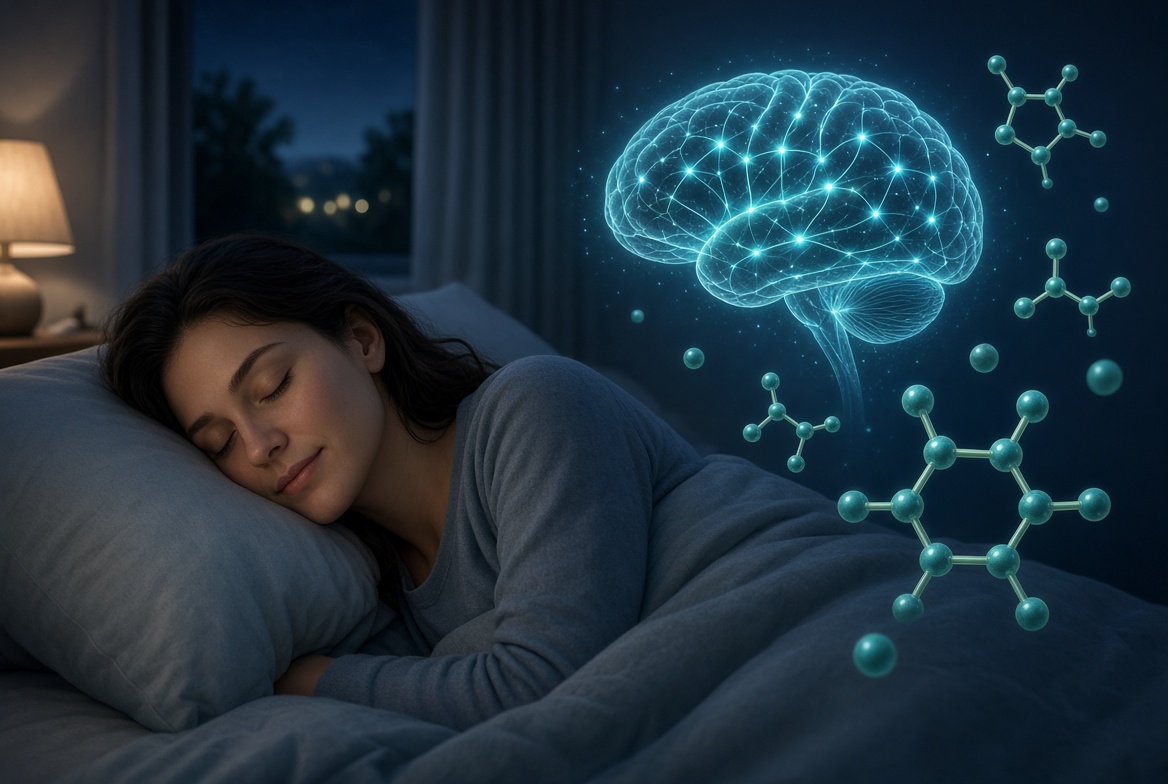
Why Magnesium L-Threonate Was First Studied in Relation to Sleep
Interest in this salt arose primarily from studies of the nervous system. Experimental models examined how changes in magnesium metabolism are related to neural processes. However, sleep is a complex state that is influenced by circadian rhythms, lighting, stress, work schedule, disease, and other factors. Even if a substance is involved in neural regulation, it does not follow that its additional use shortens the time it takes to fall asleep or increases deep sleep.
Two direct human trials of magnesium L-threonate provide some insight into the implications of this finding. However, both investigated short-term use in adults who self-reported sleep problems, rather than as an established treatment for a diagnosed disorder.
What the 2024 study by Hausenblas et al. showed
In a randomized, double-blind, placebo-controlled trial by Hausenblas et al. (2024), 80 people aged 35–55 years with sleep complaints participated. The researchers compared 1 g of magnesium L-threonate per day with placebo for 21 days. This is the amount of the salt being studied, not 1 g of elemental magnesium.
Participants completed standardized questionnaires regarding sleep, wakefulness, and daytime activity. Additionally, they used the Oura ring, which measures sleep-related measures using proprietary algorithms. In the L-threonate group, the authors reported benefits over placebo for individual sleep stage measures measured by the ring, wakefulness, and daytime energy.
However, this does not mean that all indicators improved. In particular, for the insomnia severity index (ISI), the interaction “group × time” was not statistically significant. Therefore, even in one study, the results of different scales are not identical. The short observation period and small sample size also do not provide grounds for concluding about a long-term effect.
What the 2026 Lopresti and Smith trial added
In a study by Lopresti and Smith (2026), 100 adults aged 18–45 years who were dissatisfied with their sleep participated. For six weeks, one group received 2 g of magnesium L-threonate per day, the other a placebo. In addition to cognitive tests and questionnaires, the researchers used the Oura ring to assess nocturnal physiological parameters.
On one self-reported measure of sleep-related daytime dysfunction, the L-threonate group showed a statistically significant advantage. However, overall scores on sleep disturbance and restorative sleep did not differ significantly between groups. Objective sleep scores on the ring also did not show a significant between-group advantage. However, the authors reported changes in nocturnal heart rate and heart rate variability; these measures cannot automatically be equated with improved sleep.
An official correction to the description of the statistical analysis was issued prior to this publication on October 15, 2026. The corrected version should be considered when interpreting the results. A key practical limitation remains: individual subjective results were not confirmed by consistent changes in objective sleep measures.
Two tests: where the results match and where they don't
| Parameter | Hausenblas et al., 2024 | Lopresti and Smith, 2026 |
|---|---|---|
| Participants | 80 adults, 35–55 years old, with sleep complaints | 100 adults, 18–45 years old, dissatisfied with sleep |
| Researched quantity | 1 g of salt per day | 2 g of salt per day |
| Duration | 21 days | 6 weeks |
| Self-esteem | Benefits in individual indicators of morning and daytime well-being | Advantage in one measure of daytime consequences of sleep problems; not in all scales |
| Oura Ring Reviews | Advantages in terms of algorithmic sleep assessments | No significant between-group advantage in sleep scores |
| Conclusion limit | Short observation, heterogeneous scale results | Discrepancy between self-reports and wearable data |
The doses in the table are given only as characteristics of specific experiments. They do not constitute a dosage regimen for the reader or a recommendation for any commercial product.
Wearables are useful for long-term trend tracking, but they are not a complete replacement for polysomnography, a laboratory study that records electrophysiological signals. The ring estimates sleep stages using indirect signals and an algorithm. Therefore, a change in its “deep sleep score” is not the same as direct EEG confirmation of changes in sleep patterns.
Self-reports are also important: a person may actually feel more energetic even if the technical metrics have barely changed. But questionnaires are sensitive to expectations, everyday circumstances, and natural fluctuations in state. Independent studies with a sufficient sample, predetermined main outcomes, and consistent subjective and objective measures would be most convincing.
What broader reviews of magnesium and sleep research say
A systematic review by Lopresti, Smith, and Drummond (2026) included 12 randomized trials of magnesium supplementation for sleep, and considered three more studies separately for specific sleep movement disorders. The studies varied in magnesium forms, populations, duration, and measurement methods, so the authors did not consider the results to be consistent. The overall certainty of the evidence was low to very low.
This is a review of different forms of magnesium, not just L-threonate. It adds context, but it can neither prove nor disprove the specific effects of one form without a sufficient number of high-quality head-to-head comparisons.

What we still don't know about magnesium L-threonate and sleep
The available work does not yet establish whether possible changes are maintained after many months, whether they are repeatable in independent samples, and whether the result differs from other magnesium salts with the same amount of elemental magnesium. There is also no universally accepted “best time” for use specifically for sleep. For people with diagnosed sleep disorders, these studies are not a substitute for assessing the causes of the problem.
If sleep is systematically disturbed, it is important to consider the regimen, caffeine, medications, possible sleep apnea and other factors. In the presence of kidney disease, during pregnancy or concomitant medication, the issue of magnesium supplements should be agreed with a doctor. Individual positive results do not provide grounds for independently transferring research doses to daily use.
So, magnesium L-threonate has a limited but interesting clinical basis for sleep. The most cautious formulation is that some changes in well-being and individual measurements have been observed in short studies, but consistent improvements in objective sleep parameters have not been confirmed across trials.
Frequently asked questions
Is Magnesium L-Threonate proven to improve sleep?
No, there is not yet a sufficient, consistent evidence base. In short studies, some measures improved, but others were no different from placebo.
How long have the studies on magnesium threonate and sleep been going on?
Two head-to-head trials followed participants for 21 days and six weeks, respectively.
Has magnesium threonate been shown to increase deep sleep?
One study reported changes in algorithmic sleep stage estimates based on ring data. Another trial found no between-group differences in sleep scores from the wearable device.
Is the Oura Ring equivalent to polysomnography?
No. The ring assesses sleep based on indirect signals, while polysomnography involves electrophysiological measurements.
Can the doses from the studies be considered recommended?
No. The published amounts describe research protocols and are not a recommendation for personal intake.
Is it known when it is best to take magnesium threonate for sleep?
There are not enough reliable comparative studies that would establish the advantage of a specific time of day.
Does magnesium threonate replace testing for long-term sleep problems?
No. Recurrent sleep disorders require evaluation of the cause, and the supplement is not a substitute for medical diagnosis.
Sources
- Hausenblas HA and others. (2024). Magnesium-L-threonate improves sleep quality and daytime functioning in adults with self-reported sleep problems: A randomized controlled trial. Sleep Medicine: X, 8, 100121. PubMed.
- Lopresti AL, Smith SJ (2026). The effects of magnesium L-threonate (Magtein®) on cognitive performance and sleep quality in adults: a randomized, double-blind, placebo-controlled trial. Frontiers in Nutrition, 12, 1729164. PubMed.
- Lopresti AL, Smith SJ (2026). Correction: The effects of magnesium L-threonate (Magtein®) on cognitive performance and sleep quality in adults: a randomized, double-blind, placebo-controlled trial. Frontiers in Nutrition, 13, 2010644. DOI.
- Lopresti AL, Smith SJ, Drummond PD (2026). Magnesium Supplementation for Sleep in Adults: A Systematic Review of Randomized Controlled Trials. Journal of Dietary Supplements, 23(5), 553–581. PubMed.
Dietary supplement. Not a medicine. Consult a doctor before use.
Products related to this post
Related Posts
Comments
Information
Customer Service
Extras
My Account


Sports nutrition manufacturer in Ukraine StarkPharm © 2026


