Your shopping cart is empty!

Magnesium and B6: why they are combined in one formula
Published: 17/11/2026
Times Read: 96
Comments : 0
Magnesium and vitamin B6 are often found in the same formula of dietary supplements. The reason is not that one component does not work without the other: both have their own physiological functions, but are involved in processes related to the nervous system and energy metabolism. At the same time, the mere presence of two substances in one capsule does not prove that such a combination is more effective than magnesium alone.
To understand why magnesium is combined with B6, you need to distinguish between three questions: what each nutrient does, what clinical studies show about their combined use, and how to correctly read the composition of the supplement.
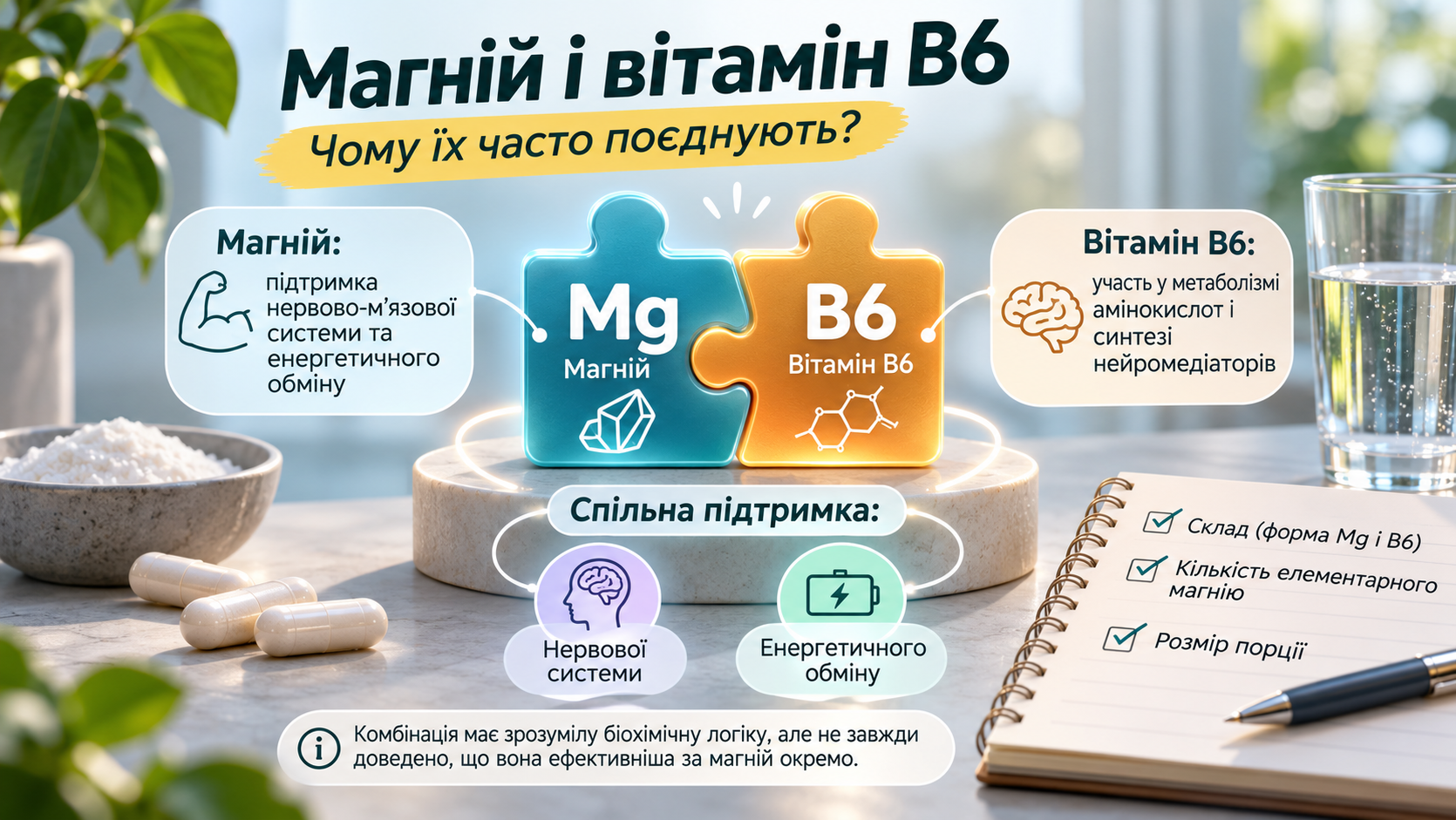
Magnesium and B6: What is the difference between their functions?
| Parameter | Magnesium | Vitamin B6 |
|---|---|---|
| What is it | Mineral | Water-soluble vitamin |
| Main functions | Participation in the work of numerous enzymes, neuromuscular transmission and energy metabolism | Participation in amino acid metabolism and synthesis of a number of neurotransmitters |
| Does it replace another component? | No | No |
| What is indicated on the label | Amount of elemental magnesium and its chemical form | Amount of B6 and form, e.g. pyridoxine hydrochloride |
Magnesium is necessary for the normal functioning of the nervous and muscular systems. It also participates in reactions involving adenosine triphosphate (ATP), the universal energy carrier in cells. Vitamin B6, in its coenzyme form, pyridoxal-5'-phosphate, participates in the conversion of amino acids and the formation of biologically active compounds. These functions are described in scientific reviews of nutrient metabolism.
So, their combination has a clear biochemical logic. However, biochemical logic is not yet proof of a specific clinical outcome, such as reducing stress in all people.
Why is magnesium combined with vitamin B6?
Magnesium formulas often include B6 as a separate nutrient associated with normal nervous system function. Sometimes, this combination is explained by the statement that B6 “necessarily improves magnesium absorption.” This is a very broad statement: different forms of magnesium, different groups of people, and different endpoints do not automatically produce the same results.
It is more accurate to talk about joint participation in physiological processes and about the existence of separate clinical studies of combined formulas. Studies should evaluate not only the theoretical mechanism, but also the real difference between the magnesium group with B6 and the magnesium group without B6.
What a clinical study of magnesium with B6 for stress showed
In a randomized trial by Pouteau et al. (2018), 264 generally healthy adults with elevated subjective stress and low blood magnesium levels were randomized to receive either 300 mg of magnesium and 30 mg of vitamin B6 per day for 8 weeks, or 300 mg of magnesium without B6 per day for 8 weeks. The amounts listed describe the protocol of the specific study only and are not a recommendation for intake.
Both groups improved on the stress scale. No statistically significant advantage was found for the combination over magnesium alone in the overall sample. However, in a pre-specified subgroup analysis of participants with severe or very severe stress, the combination was associated with greater improvement at week 8. The authors reported a relatively greater improvement of approximately 24% in this subgroup; this does not mean that everyone will experience this effect.
Important limitations: This study studied a specific formula, specific nutrient amounts, and a specifically selected group of participants. Its results cannot be directly extrapolated to all people, any doses of magnesium with B6, or other forms of magnesium. In addition, the study was funded by the manufacturer of the formula studied, which should be considered when evaluating the evidence.
In a secondary analysis, Noah et al. (2020) assessed other measures from the same eight-week trial, including markers of magnesium status and stress. This is not an independent confirmatory study, but a reanalysis of previously collected data. A later analysis by Noah et al. (2021) also looked at the same sample and measures of mental well-being and quality of life.
Is the combination better than magnesium without B6?
There is no universal “yes” answer. The most relevant conclusion from the available direct comparison is that in the overall study group, there was no clear additional benefit of B6, while in the highly stressed subgroup, there was a signal in favor of the combination. Independent replicates are needed to understand how robust this result is.
A separate question is whether a person has insufficient intake of magnesium or B6 with food. If the diet provides the necessary amounts of both substances, the mere fact of combining them in a supplement does not guarantee a noticeable difference in well-being.
Does the form of magnesium matter in combination with B6?
Yes, because the name “magnesium” on the packaging does not fully describe the raw material. Citrate, oxide, bisglycinate, malate and other salts or complexes can be used. They differ in the proportion of elemental magnesium, solubility and tolerability. But the name of the form itself does not prove the benefits of a particular combination with B6 in relation to stress.
You also need to check vitamin B6: it can be represented by pyridoxine hydrochloride or pyridoxal-5'-phosphate. The presence of a certain form in the composition is not independent evidence of a better result for a particular person.

How to read the composition of a magnesium and B6 supplement
- Find the serving size: one capsule, two tablets, or another quantity.
- Check how much elemental magnesium is contained in this particular serving.
- Look at the chemical form of magnesium.
- Read the amount and form of vitamin B6 separately.
- Consider other vitamin complexes if they are already in your diet: B6 can be repeated in several products.
- Do not equate numbers from a clinical study with instructions for using a dietary supplement.
Dietary supplements should be used according to the instructions on the package. The need for additional nutrients depends on the diet, health status and individual circumstances.
When caution is needed
Excessive intake of magnesium from supplements can cause diarrhea and other adverse digestive reactions. The risks increase if you have impaired kidney function, so you should not experiment with magnesium supplements on your own. Magnesium can also affect the absorption of certain medications, including some antibiotics; time intervals should be agreed with your doctor or pharmacist.
Long-term excessive intake of vitamin B6 is associated with the risk of peripheral neuropathy. It is especially important to sum up B6 from different supplements and not rely solely on the names of complexes. If you are pregnant, breastfeeding, have chronic diseases or are taking regular medications, the issue of additional use should be discussed with your doctor in advance.
Frequently asked questions
Why combine magnesium and vitamin B6?
These substances perform different, but related functions in the nervous system and metabolism. At the same time, the combination does not always have a proven advantage over magnesium alone.
Does B6 help you absorb magnesium better?
This claim is often made in advertising, but it cannot be considered universally proven for all forms and doses. Appropriate studies are needed for specific conclusions.
Is magnesium better with B6 for stress?
In one eight-week study, an additional benefit was found in a subgroup with significant stress, but not in the entire sample. The result needs independent confirmation.
Can I take magnesium without B6?
Yes, they are separate nutrients. The need for additional B6 does not automatically follow from the need for magnesium.
What is more important on a label: the mass of salt or elemental magnesium?
When comparing magnesium amounts, it is the elemental magnesium content per serving that is important. The weight of citrate or bisglycinate is not equal to the weight of magnesium itself.
Are all forms of magnesium equally tolerated?
No. Solubility and tolerability vary, and individual response also depends on the amount and regimen of use.
Can you have too much vitamin B6?
Yes. It is especially important to consider its total intake from several supplements, as prolonged excess is associated with the risk of peripheral nerve damage.
Does magnesium complex with B6 replace a varied diet?
No. The supplement does not replace a complete diet and is not a way to independently determine the cause of symptoms.
Sources
- Pouteau E. et al. (2018). Superiority of magnesium and vitamin B6 over magnesium alone on severe stress in healthy adults with low magnesium: A randomized, single-blind clinical trial. PLOS ONE. PubMed.
- Noah L. et al. (2020). Impact of magnesium supplementation, in combination with vitamin B6, on stress and magnesium status: secondary data from a randomized controlled trial. Magnesium Research. PubMed.
- Noah L. et al. (2021). Effect of magnesium and vitamin B6 supplementation on mental health and quality of life in stressed healthy adults: Post-hoc analysis of a randomized controlled trial. Stress and Health. PubMed.
Dietary supplement. Not a medicine. Consult a doctor before use.
Products related to this post



Related Posts
Comments
Information
Customer Service
Extras
My Account


Sports nutrition manufacturer in Ukraine StarkPharm © 2026


