Your shopping cart is empty!

Magnesium and cramps: where the data is strong and where it isn't
Published: 17/11/2026
Times Read: 98
Comments : 0
Magnesium and cramps are often mentioned together: if your calf cramps at night or your muscle contracts after a workout, the first piece of advice is often to “take magnesium.” However, cramps do not equal magnesium deficiency. This mineral is indeed involved in the functioning of nerves and muscles, but the results of studies depend on the cause of the cramps and the group of people studied.
Let's examine where the connection with magnesium has a physiological and clinical basis, where studies have not found a convincing benefit from supplements, and what steps are appropriate for recurring spasms.
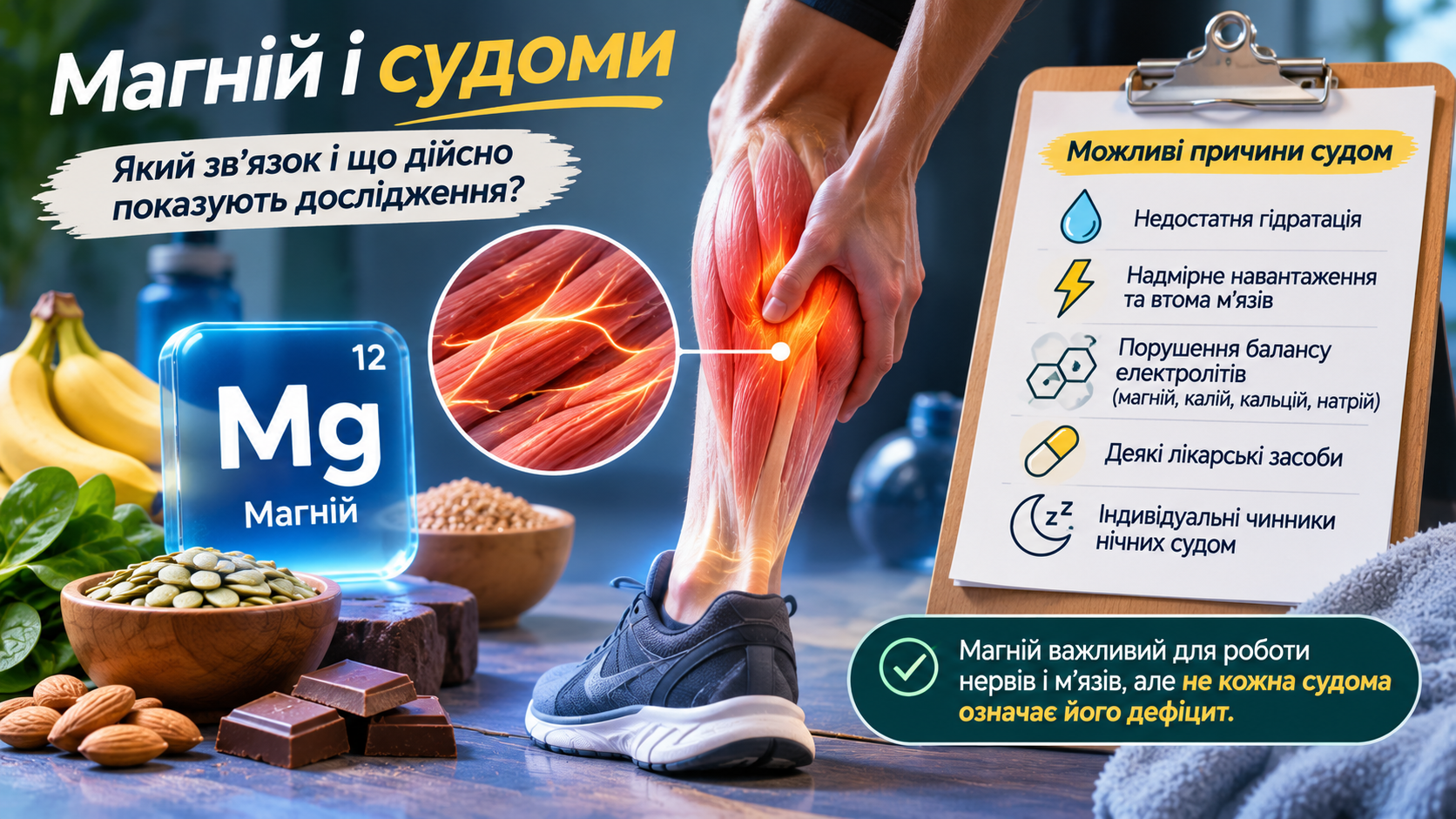
Magnesium and cramps: a brief look at the strength of the evidence
| Situation | What is known | Practical conclusion |
|---|---|---|
| Confirmed magnesium deficiency | Severe deficiency may be accompanied by muscle contractions and cramps. | It is necessary to establish the cause of the deficiency and discuss its correction with a doctor. |
| Common nocturnal cramps in adults | A systematic review did not show a clinically significant reduction in seizures with magnesium supplementation, especially in older age groups. | The mere fact of night cramps is not an argument for regular magnesium intake. |
| Cramps during or after exercise | The causes are multifactorial; fatigue and neuromuscular regulation may play an important role. | You shouldn't automatically attribute every cramp to electrolyte loss. |
| Cramps during pregnancy | Trial results are conflicting, and the quality of evidence is limited. | Decisions about supplements and examinations are coordinated with the doctor. |
Why do muscle cramps occur?
A muscle cramp is a sudden, involuntary contraction of a muscle, often painful. The most common locations are the calves and feet. A cramp can occur at rest, during sleep, after intense exercise, or in the context of certain illnesses.
There is no single cause for all cases. Muscle fatigue, neuromuscular regulation, certain medications, metabolic and water-electrolyte imbalances may play a role. However, in many people with nocturnal cramps, no specific factor can be identified.
Magnesium is necessary for normal nervous system function and muscle contraction. However, this physiological fact does not imply that supplemental magnesium will reduce the number of seizures in a person without an established deficiency.
To understand where a cramp comes from, it's helpful to think about the interaction between a muscle and a nerve. The nervous system sends a signal to the muscle fibers, which contract and then have to relax. Under certain conditions, the excitation of the motor nerve units can become excessive, causing the contraction to occur suddenly and last longer than necessary. This is a simplified model, not an explanation for every single case.
Magnesium is involved in many enzymatic reactions, energy metabolism and regulation of cell excitability. However, normal neuromuscular processes depend not only on it. It is also affected by calcium, potassium, sodium, the state of nerves, blood supply and physical activity. Therefore, it is incorrect to look for one universal substance "for all cramps".
Nighttime cramp, restless legs syndrome, or another symptom?
In everyday life, the word "cramp" is sometimes used to refer to any discomfort in the legs. But magnesium research focuses on specific types of muscle contractions. If you confuse them with another condition, the results of the scientific work will be applied to the wrong problem.
| Sign | What does this look more like? | What is the difference? |
|---|---|---|
| Suddenly contracts the calf, the muscle becomes hard and painful | Typical muscle cramp | There is a palpable or noticeable contraction; often relieved by stretching. |
| In the evening, there is an irresistible desire to move your legs. | Restless legs syndrome | The unpleasant feeling and the need to move dominate, rather than a short, strong muscle contraction. |
| Aching pain in the calf while walking that goes away after stopping | Possible vascular pain during exertion | The connection with a certain walking distance requires a separate assessment of blood circulation. |
| Burning, tingling, or numbness in the feet | Possible damage to peripheral nerves | Sensitive disorders come to the fore, not just spasm. |
In a systematic review of criteria for nocturnal leg cramps, Hallegraeff et al. (2017) described the importance of a sudden painful contraction and distinguishing it from other nocturnal leg sensations. The table above is a guide to understanding symptoms, not a way to diagnose yourself.
Does magnesium help with night cramps?
The most important source for the answer is a Cochrane systematic review published by Garrison et al. in 2020. The authors analyzed 11 randomized trials involving 735 people. Most of the data were in adults, mostly older adults, with idiopathic seizures, meaning those for which no specific cause has been identified.
The trials used different forms, doses, and routes of administration of magnesium. Therefore, the conclusion applies to the regimens studied and not to every possible dose or all causes of seizures. In particular, it does not eliminate the need to correct laboratory and clinically confirmed deficiencies.
What does “no clinically significant benefit” mean? Statistical measures are only meaningful in relation to how much a person’s well-being changes. In a Cochrane review, the mean difference between magnesium and control in the number of seizures per week after four weeks was approximately −0.18 episodes (95% confidence interval −0.84 to 0.49; five studies). This result does not demonstrate a reliable practical benefit.
The authors also assessed how many participants achieved at least a 25% reduction in seizures. The difference between magnesium and control was not conclusive: relative risk 1.04 (95% confidence interval 0.84–1.29; three studies). In other words, there was no clear advantage for the magnesium group on this measure.
The trials included in the review used varying amounts of elemental magnesium orally, ranging from approximately 100–520 mg per day; one trial used it intravenously. This is a description of the study conditions, not a recommended dose for self-administration. Increasing the amount of supplement is not a proven way to achieve a result that has not been shown in controlled trials.
An important limitation: the bulk of the qualitative data concerns idiopathic seizures in older people. Therefore, it would be wrong to draw a categorical conclusion from these results about all seizures in athletes, children, or pregnant women. Separate studies are needed for these groups.

Post-workout cramps: it's not just electrolytes
Sports cramps usually occur during or shortly after physical activity. They are often attributed to salt loss through sweat, but the scientific picture is more complex.
A 2022 evidence review by Miller et al. highlights the role of changes in neuromuscular control and fatigue. Dehydration and electrolyte imbalances may be important in some situations, but do not explain all cases. Therefore, a blanket statement of “cramps after exercise, therefore magnesium deficiency” does not fit the body of evidence.
In the case of an acute post-exercise cramp, it is usually advised to stop the exercise and gently stretch the affected muscle. In the future, it is worth reviewing the gradual increase in loads, recovery and hydration regimen according to the conditions of the training. Excessive drinking "in reserve" or uncontrolled salt intake is also not a safe universal strategy.
In athletes, cramps are often localized to the muscle that has been working for a long time: for example, in the calf of a runner or the back of the thigh after intense exercise. This localization is one of the arguments in favor of the role of neuromuscular fatigue. If the main cause were always a general lack of salts in the blood, the mechanism would require an explanation of why only a specific overworked muscle contracts.
However, one should not go to the other extreme: fluid and electrolyte losses can be significant for some people, especially during heat, prolonged exercise, or heavy sweating. Scientific evidence suggests that the cause is often a combination of factors, rather than a single, universal cause.
It is a practical mistake to extrapolate the results of studies on nocturnal cramps to athletes without qualification. The review by Garrison et al. did not provide sufficient evidence to draw a separate conclusion about magnesium for exercise-related cramps. Therefore, the statement “magnesium has been shown to help athletes with cramps” would be an exaggeration.
Magnesium for cramps during pregnancy
Leg cramps in pregnancy are a distinct clinical situation. Some small studies have reported possible benefits of magnesium, while others have found no clear difference. The Cochrane review “Interventions for leg cramps during pregnancy” (2020) notes that due to heterogeneity of methods and limited quality of data, it is difficult to draw a reliable conclusion about the effectiveness and safety of interventions.
Therefore, the results for pregnant women cannot be automatically transferred to other adults, and vice versa. It is not worth choosing high doses of magnesium during pregnancy on your own: any supplements and unusual or frequent cramps should be discussed with the doctor managing the pregnancy.
An additional meta-analysis of randomized trials published in 2021 also found no conclusive benefit of oral magnesium for leg cramps during pregnancy. The discrepancies between studies may be due to different assessment criteria, small sample sizes, and differences in baseline status of participants. This is another reason not to translate a single positive finding into general advice for everyone.
When magnesium levels really matter
The risk of magnesium deficiency is higher in certain gastrointestinal diseases with malabsorption or prolonged diarrhea, type 2 diabetes, excessive alcohol consumption, and certain medications. Some diuretics and drugs that suppress stomach acid can also affect magnesium status.
If necessary, the doctor evaluates symptoms, medication list, nutrition, kidney function, and tests. It is important to note that serum magnesium does not always fully reflect its reserves in the body, so independent interpretation of one indicator may be incorrect.
Why doesn’t one test always tell the whole story? According to the NIH, less than 1% of the body’s total magnesium is in the serum. Its concentration is maintained within a relatively narrow range. However, blood testing remains an available and useful tool in appropriate clinical circumstances; it simply needs to be evaluated in conjunction with other data.
For recurrent seizures, a healthcare professional may ask if there is vomiting or persistent diarrhea, if medications have changed, or if there is weakness, numbness, or other neurological symptoms. Depending on the examination, laboratory tests for magnesium, potassium, calcium, kidney function, or other tests may be needed. There is no one-size-fits-all list of tests for all people with seizures.
Magnesium in nutrition: what's more important than choosing a supplement
Magnesium is naturally found in legumes, seeds, nuts, whole grains, and green leafy vegetables. In a varied diet, these foods also provide fiber, protein, and other nutrients. Adding them to your diet is beneficial for overall nutritional value, but by itself is not a proven remedy for nighttime cramps.
Sometimes the amount of magnesium compound is confused with the amount of the mineral itself. For example, the mass of citrate or other magnesium salt is not equal to the mass of elemental magnesium in it. In studies and on labels, it is important to understand what exactly the value is given. Comparing only the inscription "500 mg" without specifying the substance can be misleading.
Forms of magnesium vary in solubility and absorption. According to the NIH Office of Dietary Supplements, some highly soluble forms are more completely absorbed than magnesium oxide. However, better absorption does not equal proven benefit against seizures: such a conclusion requires clinical studies with the appropriate results.
Another nuance is tolerability. Many magnesium salts in significant quantities can cause loose stools, nausea, or abdominal cramps. With reduced kidney function, the risks of excess magnesium intake from supplements and medications increase, so independent experiments with dosage are especially undesirable.

What to do if your leg is swollen
- Stop the movement or exercise that caused the cramp.
- Gently stretch the contracted muscle without jerking. If the calf is contracted, you can gently pull the toe of the foot towards you.
- Give the muscle a rest; return to activity gradually when the contraction has subsided.
- If seizures recur, note their frequency, time of onset, relationship to exertion, and medication.
Further actions depend on the cause of the seizures. Regular moderate physical activity, adequate recovery from exercise, and a varied diet make sense for overall health, but do not guarantee the complete disappearance of seizures.
If the cramp occurred at night, after it stops, pay attention to whether there is persistent pain, swelling, or other unusual symptoms. It is convenient to record repeated episodes in a simple diary: date, duration, which muscle contracted, what preceded the episode, and whether gentle stretching helped. Such records can be useful during a consultation.
Common errors in court interpretation
- “If your leg is twitching, magnesium is definitely low.” Cramps are not a specific sign of deficiency. You need the context of your symptoms and health condition to draw conclusions.
- “Magnesium is involved in muscle function, so a supplement will work.” The biological role of a substance and the effectiveness of supplemental intake are different issues.
- “A positive result from one trial overrides all others.” Systematic reviews take into account different studies, their quality, and the reproducibility of the results.
- "In athletes, cramps are always due to a lack of salts." The mechanism is often related to exertion and neuromuscular fatigue; the role of fluids and electrolytes depends on the situation.
- “If a small amount doesn’t help, you just have to increase it.” There is no automatic guarantee of effect for larger amounts, and adverse reactions may increase.
When to see a doctor
Schedule a consultation if your seizures become frequent, disrupt your sleep, get worse, occur with muscle weakness, numbness, or other new symptoms. It is especially important not to delay an evaluation if you have a chronic medical condition or have started taking new medications.
Uncontrolled increases in magnesium intake are no substitute for finding out the cause: supplements can cause diarrhea and abdominal discomfort, and impaired kidney function increases the risk of magnesium accumulation. Interactions with certain medications are also possible.
It is especially important to tell your doctor about any medications you are taking on a regular basis. Some diuretics can alter magnesium excretion, long-term use of proton pump inhibitors is sometimes associated with decreased magnesium levels, and magnesium supplements themselves can affect the absorption of certain antibiotics. You should not stop taking your prescribed medication because of cramps.
Frequently asked questions
Do night cramps mean that the body lacks magnesium?
No. There are many possible causes of night cramps, and magnesium deficiency is just one of them. It cannot be diagnosed based on symptoms alone.
Is there evidence that magnesium helps with calf cramps?
For common nocturnal seizures in adults, primarily older adults, a systematic review found no clinically meaningful benefit of the magnesium regimens studied.
Why is magnesium associated with muscle function?
It is involved in neuromuscular processes. However, participation in normal physiology does not mean that additional amounts of the mineral will help in the absence of a deficiency.
Should athletes take magnesium for cramps?
Cramps after exercise may be related to fatigue and neuromuscular regulation. The mere fact of their occurrence does not prove the need for magnesium.
Is magnesium proven to be beneficial for cramps during pregnancy?
No, research results are conflicting and the certainty of the evidence is limited. Supplements during pregnancy should be discussed with a doctor.
How to quickly relieve a calf cramp?
Stop the exercise and try to stretch the muscle gently, in particular, gently pull the toe of the foot towards you. Do not make sudden movements due to pain.
What foods contain magnesium?
Legumes, nuts, seeds, whole grains, and green leafy vegetables. A varied diet helps you get magnesium from food.
When do seizures require investigation?
If they are frequent, severe, disrupt sleep, or are accompanied by weakness or numbness, unilateral leg swelling or shortness of breath requires urgent evaluation.
Sources
- Garrison SR et al. (2020). Magnesium for skeletal muscle cramps. Cochrane Database of Systematic Reviews. DOI
- Miller KC et al. (2022). An Evidence-Based Review of the Pathophysiology, Treatment, and Prevention of Exercise-Associated Muscle Cramps. Journal of Athletic Training. PubMed
- Interventions for leg cramps during pregnancy (2020). Cochrane Database of Systematic Reviews. DOI
- Hallegraeff JM et al. (2017). Criteria in diagnosing nocturnal leg cramps: a systematic review. BMC Family Practice. PubMed
- Effect of oral magnesium supplementation for relieving leg cramps during pregnancy: A meta-analysis of randomized controlled trials (2021). PubMed
- NIH Office of Dietary Supplements. Magnesium: Fact Sheet for Health Professionals. NIH ODS
Dietary supplement. Not a medicine. Consult a doctor before use.
Products related to this post



Related Posts
Comments
Information
Customer Service
Extras
My Account


Sports nutrition manufacturer in Ukraine StarkPharm © 2026


