Your shopping cart is empty!

When to take lactase: before, during or after meals?
Published: 21/11/2026
Times Read: 61
Comments : 0
Lactase is an enzyme that breaks down lactose, the natural sugar in milk, into glucose and galactose. If your small intestine doesn't have enough lactase, some of the lactose will pass into your large intestine, where it can be used by microorganisms. Some people experience bloating, gas, or discomfort. Supplemental enzyme doesn't work on a calendar schedule: it's only needed when you eat a specific food that contains lactose.
For most oral forms, the general rule is to take it with or just before food. However, the exact timing and method of use will depend on the formulation and instructions for the specific product. If the enzyme is added to the milk beforehand, this is a completely different scenario than swallowing a pill.

Lactase before, during or after meals: a brief comparison
| When to use | What is important to know | How to evaluate |
|---|---|---|
| Immediately before a dairy meal | A common method for tablets or capsules, if so specified by the manufacturer. | The enzyme arrives at about the same time as lactose. |
| With the first servings of food | Also a common option for oral forms. | You need to check the instructions for the specific form. |
| Much earlier than food | Conditions in the stomach change even before milk arrives. | You should not postpone the application time by tens of minutes on your own. |
| After finishing eating | The data are insufficient for a universal statement of equivalent effect. | Late administration should not be considered a replacement for the method indicated on the package. |
| Drops added to milk | The enzyme can break down lactose in the product itself before drinking. | Contact time, temperature, and quantity are determined by the instructions for the drops. |
The comparison concerns the principles of use, not the individual purpose. Even in products with the same purpose, enzyme activity, auxiliary components, and production technology may differ.
Why does reception time matter at all?
The enzyme needs contact with the substrate - milk sugar. Lactase is not a substance that, after a single consumption, creates a long-term supply of the enzyme in the intestine. Its practical role is associated with the breakdown of lactose, which comes with a specific portion of food. Therefore, two conditions are important at the same time: how much lactose is in the dish and how available the enzyme is at the time of its passage through the digestive tract.
The stomach environment also does not remain constant. After the milk enters the stomach, the acidity of the contents may temporarily change. Different lactase preparations differ in the properties of the enzyme raw material, so the same formulations on the label do not automatically equate their behavior in the digestive tract.
In a small experiment by Gao et al. (2002), ten participants with lactase deficiency were given two enzyme preparations with an activity of 10,000 FCC at the same time as 300 ml of milk or 30 minutes before it. When used simultaneously, the researchers recorded enzymatic activity in gastric contents and a different pattern of hydrogen in exhaled air than when used alone. This is the result of a specific study, and not a universal instruction for all forms of lactase.
Do I need to take lactase in a course for a month?
Intrinsic lactase is produced in the cells of the small intestine mucosa. An external enzyme from a food supplement does not change the genetic characteristics of maintaining lactase activity after childhood. There is also no reason to consider a few weeks of use as a way to "teach" the body to produce more of its own lactase.
If a person does not consume lactose, the usual need for the enzyme specifically for its breakdown is absent. With regular consumption of dairy products, situations with the use of the enzyme may be repeated frequently, but this does not make them a course with a cumulative effect. Another thing is cases of temporary reduction in the activity of one's own lactase after intestinal diseases: here it is important to find out the cause of the symptoms together with a specialist.
Do I need lactase every day if dairy is not always available?
The relationship is simple: the enzyme is needed specifically to digest lactose in a particular diet. For example, if breakfast does not contain milk sugar, there is no biochemical sense in adding lactase just because it was used yesterday. If a dairy dish is planned for the evening, the decision to use the enzyme depends on its composition, individual tolerance, and the instructions for the product.
In addition, not every dairy product contains the same amount of lactose. In regular milk, it is much higher than in many hard, aged cheeses. In fermented products, the content varies depending on the starter culture and technology. Therefore, judging only by the word “dairy” is too rough.

In a clinical trial by Gao et al. (2002), enzymes administered 30 minutes before milk behaved differently than when administered simultaneously: the authors found no enzyme activity in gastric samples taken from the early group. This result shows why it is not advisable to arbitrarily set a long interval before a meal. However, the small sample size and the specific enzyme preparations do not allow for a single, precise interval for each consumer.
Another study, by Ramirez et al. (1994), compared three preparations in ten volunteers after a dairy dessert containing 18 g of lactose. Despite being administered before the test meal, the different preparations produced different results in terms of breath hydrogen and subjective discomfort. Thus, it is not just the minutes that matter, but also the characteristics of the enzyme form itself.
Drops in milk are not the same as a capsule with food
There are two fundamentally different ways to use lactase: the enzyme is ingested with lactose-containing food or added to the dairy product first. In the second case, some of the milk sugar can be broken down before consumption; this requires certain conditions of contact, temperature, and duration. These are specified by the manufacturer of the milk treatment.
In a 2005 study, the enzyme from Kluyveromyces lactis was added to milk either five minutes or ten hours before consumption. This was a study of the enzyme's behavior in milk itself. It is not correct to conclude from this that the capsule should be taken five minutes or ten hours before a meal.
A long dinner or several dairy dishes: what to consider
If the dairy food is not consumed all at once but rather over a long dinner, the amount and duration of contact with the enzyme may be important. However, there is not enough good-quality universal data to recommend a repeat dose after a specific number of minutes. Different instructions may require different conditions of use depending on the enzymatic activity and form of the product.
The best way to avoid making a mistake is to estimate what exactly contains lactose and follow the instructions on the packaging of a specific form. Do not independently increase the number of capsules based on the duration of the feast without assessing the total amount of enzyme.
How much lactase is needed: activity is more important than mass
On the labels you can see the units FCC or ALU. This is a designation of enzymatic activity, not milligrams. Two preparations containing the same mass of enzyme raw material may have different declared activity. At the same time, the activity indicator per gram of raw material is not identical to the indicator per capsule or recommended serving.
In a 1992 study, 24 participants completed a randomized crossover trial in which a single dose of three chewable tablets provided a total of 9,900 FCC units. These values should be taken as a characteristic of the study protocol and not as individual advice. Other trials have used different products and different lactose loading conditions.
| On the label | What does this mean | What can't be done with this? |
|---|---|---|
| Mass of enzyme raw material (mg) | Physical mass of the ingredient | Identify activity without additional data |
| Activity (FCC or ALU) | The result of the determination according to a certain method | Automatically equate all methods and forms |
| Units per capsule | Activity of a single product unit | Determine the amount of lactose in a dish |
| Units per serving | Total activity in the specified portion | Promise the same result for every person |
Why results vary between people
The sensation after eating dairy depends not only on the amount of lactase. The dose of lactose, the composition of the entire meal, the speed of food passage, the characteristics of the intestinal microbiota and the sensitivity to intestinal distension can all be important. This is why two people can react differently to the same portion of milk.
A 2010 systematic review analyzed 36 randomized trials of different approaches to lactose intolerance. The authors noted the heterogeneity of participants, symptom definitions, and methods of administration of the studied agents. Some adults can tolerate moderate amounts of lactose without significant symptoms, while others experience discomfort after smaller portions. This is an argument against a one-size-fits-all approach.
What to do if the enzyme did not give the expected result
First of all, it is worth checking whether the dish really contained lactose and how much it could have been, whether the method of use corresponded to the instructions and whether other components of the diet have not changed. Similar manifestations can occur due to other food components or diseases of the digestive tract. The lack of the expected effect is not a sufficient reason to increase the amount of the enzyme at random.
- Pay attention to the product composition: milk, milk powder, whey, and some desserts may contain lactose.
- Compare the enzyme activity specifically for the recommended serving, not just the weight of the drug.
- Do not use lactase as a remedy for reactions to milk proteins: with allergies, the mechanism is completely different.
- If symptoms recur, worsen, or are accompanied by unusual symptoms, discuss them with your doctor.
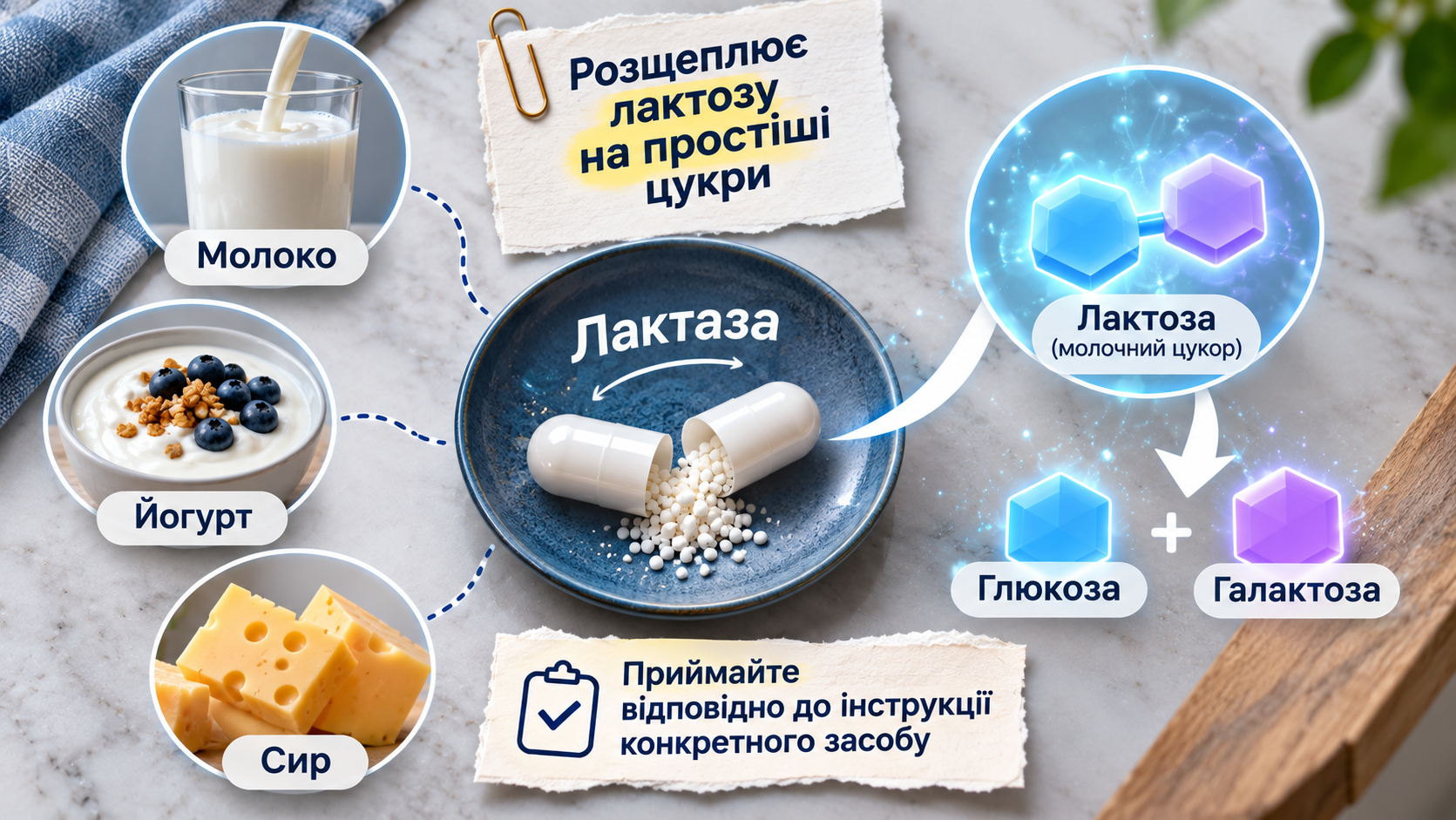
If you experience a rash, swelling, difficulty breathing, or sudden, severe systemic reaction after consuming dairy products, this is not typical of a lactose-only reaction; immediate medical evaluation is necessary. Lactase does not break down the proteins that cause milk allergies. Prolonged abdominal pain, weight loss, blood in the stool, or other persistent changes also require professional evaluation.
During pregnancy, breastfeeding, childhood, and in the presence of concomitant diseases, it is advisable to coordinate the use of enzyme supplements with a medical professional. Do not transfer instructions from one product to another: different enzymes and release forms may require different methods of use.
Quick summary: three rules that are really worth remembering
- Timing: For many oral formulations, the starting point is the lactose-containing meal; final instructions are on the packaging.
- Purpose: Lactase interacts with the lactose of a specific food, rather than accumulating as a monthly course.
- Accuracy: Pay attention to enzyme activity, release form, and individual tolerability.
Frequently asked questions
When to take lactase - before or during meals?
Many oral formulations are directed to be taken immediately before or with the first serving of lactose-containing food. Refer to the product's package insert.
Can I take lactase 30 minutes before milk?
This is not a one-size-fits-all option: in one small study, simultaneous use with milk had better laboratory results than use 30 minutes later. Do not change the recommended time yourself.
Does lactase work if taken after meals?
There is no reason to promise the same results for taking after meals as for the method indicated on the label. Use the enzyme according to the instructions.
Do I need to take lactase every day?
Its use is tied to foods containing lactose. If lactose is not present in the diet, there is usually no suitable substrate for the enzyme to function.
Do I need to take lactase for a month?
The enzyme supplement does not create a reserve of its own lactase. The frequency of use is determined by the diet and needs of a particular person, not a typical course.
How are drops different from capsules?
Drops can be added to milk to break down the lactose before drinking, while oral forms are used with food. Timing requirements vary depending on the instructions.
Why does the package say FCC or ALU and not just mg?
FCC and ALU are used to describe enzymatic activity according to specific methods. Milligrams alone do not indicate how active a particular raw material is.
Is the same amount of enzyme needed for milk and hard cheese?
The lactose content of these products often varies significantly. The exact ratio depends on the serving size, type of product, and enzyme instructions.
Does lactase help if you have a milk allergy?
No: Lactase works on milk sugar, but it does not eliminate milk proteins that the immune system may react to. Suspected allergies require a separate medical evaluation.
Why does discomfort sometimes persist after taking lactase?
Causes may include the amount of lactose, the enzyme form, the method of use, or other food components. If symptoms persist, they should be discussed with a specialist.
Sources
- National Institute of Diabetes and Digestive and Kidney Diseases. Treatment for Lactose Intolerance. NIDDK.
- Health Canada. Lactase Monograph. Health Canada.
- Gao KP et al. (2002). Effect of lactase preparations in asymptomatic individuals with lactase deficiency—gastric digestion of lactose and breath hydrogen analysis. Nagoya Journal of Medical Science. PubMed.
- Ramirez FC et al. (1994). All lactase preparations are not the same: results of a prospective, randomized, placebo-controlled trial. American Journal of Gastroenterology. PubMed.
- Effect of a single dose of lactase on symptoms and expired hydrogen after lactose challenge in lactose-intolerant subjects (1992). Clinical trial. PubMed.
- Comparative effects of exogenous lactase (beta-galactosidase) preparations on in vivo lactose digestion (1993). Clinical trial. PubMed.
- Effect of exogenous beta-galactosidase in patients with lactose malabsorption and intolerance: a crossover double-blind placebo-controlled study (2005). Clinical trial. PubMed.
- Systematic review: effective management strategies for lactose intolerance (2010). Systematic review. PubMed.
- Mayo Clinic. Lactose intolerance: Diagnosis and treatment. Mayo Clinic.
- National Institute of Diabetes and Digestive and Kidney Diseases. Eating, Diet, & Nutrition for Lactose Intolerance. NIDDK.
Dietary supplement. Not a medicine. Consult a doctor before use.
Products related to this post
Related Posts
Comments
Information
Customer Service
Extras
My Account


Sports nutrition manufacturer in Ukraine StarkPharm © 2026


