Your shopping cart is empty!

What exactly is allowed to be said about lactase and under what conditions?
Published: 18/11/2026
Times Read: 68
Comments : 0
Lactase is an enzyme that breaks down the milk sugar lactose into glucose and galactose. This mechanism is well established in digestive physiology, but there is a fundamental difference between saying “lactase breaks down lactose” and “a supplement eliminates lactose intolerance.” The first describes a biochemical function; the second attributes an inappropriate medical effect to a food product.
A specific authorised health claim exists for lactase, but it may only be used under established conditions. Not only the wording matters, but also the product category, verified enzyme activity, consumer information and presentation of the claim. Below we examine these requirements through examples, without equating scientific evidence with proof concerning any particular product.

Lactase claims: the essentials at a glance
| Question | Short answer | What to check |
|---|---|---|
| What effect may be claimed? | Improved lactose digestion in individuals who have difficulty digesting it | The claim concerns lactose digestion, not elimination of the underlying cause |
| Which products may carry the claim? | Food supplements | Simply containing lactase does not make every product eligible |
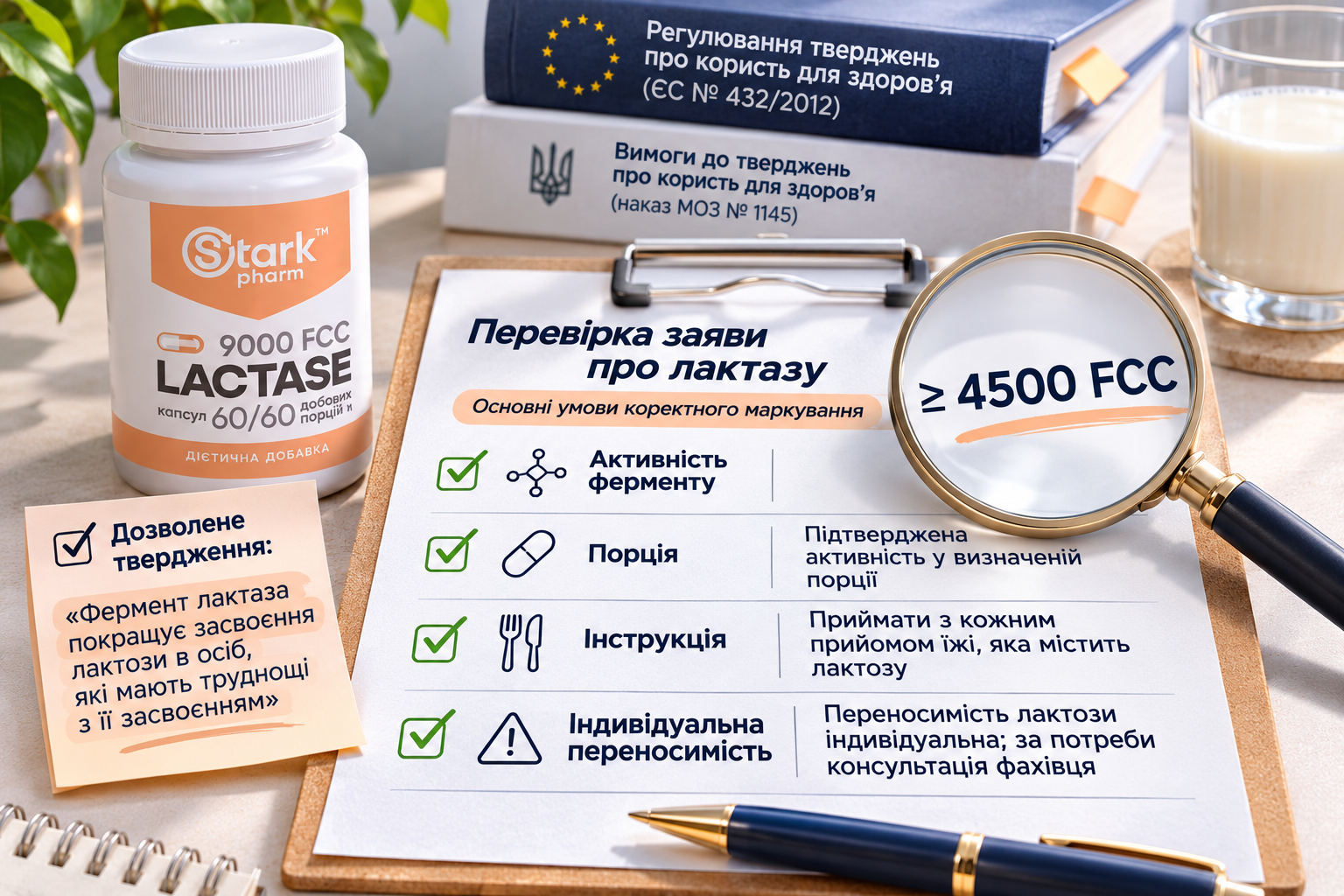
| What activity threshold applies? | At least 4,500 FCC units | Documentary evidence of activity in the specified serving is needed |
| What usage information is required? | Instructions to consume the supplement with every lactose-containing meal | Wording must comply with the authorised claim and label |
| What caution is required? | Lactose tolerance varies individually; advice on the role of lactose in the diet should be sought | The same effect must not be promised to everyone |
This overview reflects the conditions for the lactase enzyme claim in EU Regulation No 432/2012. The Ukrainian list of health claims also contains a corresponding entry. However, whether a specific supplement may legally use the claim depends on the full set of applicable requirements, not merely one number on the package.
What is a health claim?
Food information may simply identify an ingredient, describe its properties or assert a relationship between consuming a product and health. The last category is particularly closely regulated. Because it influences purchasing decisions, it must be scientifically substantiated and meet established rules.
For example, “contains the enzyme lactase” describes composition. “Lactase breaks down lactose into glucose and galactose” explains a known mechanism. By contrast, a claim about improved lactose digestion links an ingredient to a specific physiological outcome. Scientific plausibility alone is not enough: legally defined conditions also apply.
Context matters just as much. Even neutral wording in an advertisement can create a misleading impression if it appears alongside promises to eliminate pain, diarrhoea or other symptoms completely. The entire message must be assessed, not just an isolated sentence.
What lactase wording appears in the official list?
European Commission Regulation No 432/2012 contains a claim that can be rendered as follows: “Lactase enzyme improves lactose digestion in individuals who have difficulty digesting lactose.” An equivalent entry appears in the Ukrainian health claim requirements approved by Ministry of Health Order No. 1145.
This claim has a clearly defined target group: people who have difficulty digesting milk sugar. It does not concern allergy to milk proteins, promise the elimination of all digestive symptoms or imply that the enzyme permanently changes the small intestine's ability to produce its own lactase.
For commercial use, simply copying the claim from the official list is insufficient. It is necessary to establish that the supplement actually meets every condition. If enzyme activity is unverified or the label is incomplete, it is appropriate to refrain from making that particular health claim until the facts are clarified.
Why exactly 4,500 FCC units?
An enzyme catalyses a reaction. Its quantity can be expressed by mass, but mass does not directly indicate how actively it breaks down lactose. Enzyme activity units, defined under specified laboratory conditions, are used for this purpose.
The European list of authorised lactase claims specifies a minimum of 4,500 FCC (Food Chemicals Codex) units and appropriate instructions for the target group. This is a condition for using the claim, not universal advice on how much enzyme every person should take.
The scientific basis was examined by the EFSA expert panel in a 2009 opinion. The experts assessed studies of enzyme-assisted lactose hydrolysis, noted the established mechanism and concluded that a cause-and-effect relationship exists between lactase consumption and lactose breakdown in people with the relevant digestive difficulties. The scientific materials also identify limitations of some available studies, including small samples.
A legally defined threshold does not mean that everyone needs the same amount of enzyme. Lactose content in food and individual digestion vary, which is why the authorised claim must be accompanied by information about individual tolerance.
FCC, ALU and milligrams: can these labels be treated as equivalent?
Different labels may show FCC, ALU and the weight of an enzyme preparation in milligrams. Consumers sometimes compare only the numbers without examining what they measure. With enzymes, this can lead to incorrect conclusions.
| Designation | What it measures | What must not be assumed |
|---|---|---|
| FCC units | Enzyme activity according to the relevant Food Chemicals Codex method | That these units equal the enzyme's weight in mg |
| ALU | Lactase activity units; their exact definition depends on the specification and method | That “4,500 ALU” proves “4,500 FCC” without documentation |
| mg | Weight of the ingredient or enzyme complex | That activity can be established from weight alone |
Some technical documents use ALU in connection with lactase activity measurement methods. However, the name of a unit on a label, without identification of the method, is not sufficient grounds for a legal conclusion that a particular FCC threshold has been met. The decisive information includes raw-material specifications, test results, the conversion method where applicable, and the activity provided by one serving.
If a manufacturer includes only “9000” or another number in a product name, this does not replace technical data. Likewise, “lactase 100 mg” alone does not establish whether the required enzyme activity is present. Comparisons require the same measurement system or a substantiated relationship between methods.

Why does the claim mention every meal containing lactose?
Lactase acts on a specific substrate—lactose consumed with food. This is an enzymatic reaction, not a cumulative change in the body. That explains the link between taking the enzyme and a particular meal containing milk sugar.
European rules tie use of the claim to instructions telling the target group to consume the supplement with every lactose-containing meal. This condition must be distinguished from an individual prescription: actual use of a specific supplement should follow its approved label and personal advice from a healthcare professional.
The established condition must not be applied to an unverified product as a ready-made dosing regimen. First, check that product's enzyme activity and recommended serving.
Why must consumers be warned about differences in lactose tolerance?
Two people consuming the same amount of lactose may experience very different effects. Relevant factors include their own lactase levels, lactose quantity per meal, the composition of other foods, intestinal transit time, gut microbiota and digestive sensitivity.
Lactose malabsorption does not always cause symptoms. Conversely, discomfort after dairy products can have other causes. A review by Misselwitz and colleagues (2019) specifically emphasises distinguishing lactose malabsorption from lactose intolerance, which involves symptoms.
That is why the authorised claim must be accompanied by information about individual tolerance and advice to seek guidance on the enzyme's role in the diet. This is a meaningful part of the communication, not a minor legal note in small print.
Permitted, conditionally acceptable and risky phrases
The following table is editorial guidance. A final assessment of advertising must consider current legislation, labelling, product documentation and the overall context of the page.
| Wording | Editorial assessment | Explanation |
|---|---|---|
| “Lactase enzyme breaks down lactose into glucose and galactose” | Scientific description | Explains a mechanism without promising identical supplement results for everyone |
| “Lactase enzyme improves lactose digestion in individuals who have difficulty digesting lactose” | Authorised under conditions | Requires the appropriate product category, activity, instructions and cautions |
| “Supports digestion of milk sugar” | Requires separate assessment | May convey the claim's meaning, but rewording does not remove its conditions |
| “Suitable for anyone who cannot tolerate dairy” | Risky generalisation | Reactions to dairy have different causes, including milk-protein allergy |
| “Completely eliminates bloating and diarrhoea after milk” | Unacceptable guarantee | Exceeds the substantiated claim and promises symptom relief |
| “Eliminates the cause of lactose intolerance” | Unacceptable medical promise | A food supplement must not be credited with eliminating diseases |
| “Restores the body's own lactase production” | Not scientifically substantiated as a general claim | Taking an external enzyme does not demonstrate a lasting increase in small-intestinal enzyme activity |
Particular caution is required with promises such as “eliminates symptoms,” “restores your own enzyme for life” and “works for everyone.” Even alongside a correct statement about lactose digestion, such wording can make the overall message misleading.
Does an authorised claim mean lactase works equally for everyone?
No. An authorised claim supports a specific relationship between the enzyme and lactose digestion under defined conditions. It does not guarantee that consuming any amount of milk will never cause gas, pain or other sensations. Still less does it verify the effectiveness of every supplement bearing the enzyme's name.
Label compliance is a separate issue from consumers' individual experiences. The enzyme activity in a serving can be tested and documented; food tolerance also depends on the person and their diet. It is incorrect to mix these two levels of evidence.
Lactase and milk allergy: why they are different topics
Lactose intolerance concerns digestion of milk sugar. Milk allergy is an immune response to proteins in dairy products. Lactase does not break down milk proteins or make a dairy product safe for someone with a confirmed allergy.
This distinction should be clear both in educational articles and ingredient descriptions. “For people who have difficulty digesting lactose” does not mean “for everyone who cannot eat dairy.” If an allergic reaction is suspected, consultation with the appropriate physician is important, rather than replacing medical assessment with an enzyme.
What documents are needed to verify enzyme activity?
Checking eligibility for the claim begins by identifying the raw material and enzyme preparation. Documentation should establish which enzyme is used, which method measures its activity and how many activity units are delivered by a defined serving of the finished product.
- Ingredient specification. Enzyme name, activity units and assay method.
- Quality-control data. Documentation of actual activity in the relevant raw material or finished product.
- Formulation and serving weight. Calculation of activity based on ingredient quantity per serving.
- Current label. Consistency of stated activity, directions and warnings with the actual packaging.
- Unit confirmation. Explanation of the standard used and any relationship between units when different documents use different designations.
If documentation cannot substantiate an established condition, assumptions should not be made from an advertising name, customer reviews or general descriptions of lactase as an enzyme. Claim requirements apply to the specific product being advertised.
What matters for Ukrainian labelling and advertising?
In Ukraine, food health claims are regulated, among other instruments, by requirements approved under Ministry of Health Order No 1145 of 15 May 2020. Special rules on composition, labelling, consumer information and avoiding therapeutic promises also apply to food supplements. Requirements change, so the current versions of the relevant legislation should be checked before approving a label or advertisement.
Two questions must be distinguished: “Is there an authorised claim for this enzyme?” and “May this particular product use it on this particular label?” A positive answer to the first does not replace verification of the second.
For an informational article, describing the lactase mechanism and established claim conditions is appropriate. Advertising a particular supplement also requires evidence of product compliance, documentation and the full context of the message. Without verified enzyme activity data, the product must not automatically be associated with the authorised wording.
How can readers evaluate lactase information without exaggerated promises?
Start not with the biggest number on the package but with its meaning. Does it describe enzyme activity? Which measurement system was used? What serving does it refer to? Are there clear instructions for use with lactose-containing food? Is individual tolerance acknowledged?
Next, consider the promises. The enzymatic breakdown of lactose is a specific biochemical action. Claims of eliminating all symptoms completely, allowing unlimited dairy consumption or restoring the body's own enzyme go far beyond it.
Finally, do not confuse information about lactase with diagnosis. If reactions to dairy are new, severe or accompanied by unusual symptoms, seek medical advice about the cause. Not every discomfort after dairy is due to lactose.
Conclusion: when is a lactase claim justified?
An authorised claim exists for the lactase enzyme concerning improved lactose digestion in people who have difficulty digesting it. The right to use this claim, however, is subject to specific conditions: classification as a food supplement, verified activity of at least 4,500 FCC, appropriate directions for use and a warning about individual tolerance.
The most important rule: the scientific fact of enzyme action, the regulatory authorisation of wording and the compliance of a particular supplement are three different levels of verification. Only by checking them in sequence can accurate information be presented without exaggeration.
Frequently asked questions
What lactase claim is authorised?
A claim concerning improved lactose digestion in people who have difficulty digesting it is authorised. A specific supplement must meet established conditions to use it.
What do 4,500 FCC mean for lactase?
They represent the minimum enzyme activity specified among the conditions for using the relevant food supplement claim, not a universal individual dosing recommendation.
Are FCC and ALU the same?
Do not automatically regard them as identical based on packaging alone. Unit definitions, assay methods and manufacturer documentation are needed.
Does a large number in an enzyme product's name prove effectiveness?
No. Activity units, serving size, a standardised assay and verification of manufacturer data matter.
Can it be claimed that lactase eliminates the cause of lactose intolerance?
No. The authorised claim concerns lactose digestion and does not justify attributing the ability to eliminate the cause of the condition to a food supplement.
Why is the claim linked to lactose-containing meals?
The enzyme acts on lactose consumed with food. The authorised claim's conditions require corresponding consumer instructions.
Why must individual tolerance be mentioned on the label?
People respond differently to the same amount of milk sugar. Information must not imply that everyone will have the same outcome.
Can lactase make milk safe for someone with an allergy?
No. Lactase breaks down milk sugar but does not eliminate milk proteins that can trigger allergic reactions.
Is listing lactase as an ingredient enough for a health claim?
No. Ingredient presence and compliance with the claim's established conditions are separate issues.
Can authorised wording be shortened in advertising?
Any adaptation must be assessed for meaning and context: it must not expand the promised effect or conceal the conditions. An authorised phrase does not justify other unsupported promises.
Sources
- European Commission (2012). Commission Regulation (EU) No 432/2012, Annex: Lactase enzyme — permitted health claim and conditions of use. EUR-Lex.
- Ministry of Health of Ukraine (2020). Order No 1145 of 15 May 2020: Requirements for Nutrition and Health Claims Made on Foods. Verkhovna Rada of Ukraine.
- Ministry of Health of Ukraine (2026). Order No 203 of 19 February 2026: Amendments to Certain Regulations Concerning Food Supplements. Verkhovna Rada of Ukraine.
- EFSA Panel on Dietetic Products, Nutrition and Allergies (2009). Scientific Opinion on the substantiation of health claims related to lactase enzyme and breaking down lactose (ID 1697, 1818). EFSA Journal, 7(9), 1236. DOI.
- Misselwitz B. et al. (2019). Update on lactose malabsorption and intolerance: pathogenesis, diagnosis and clinical management. Gut, 68, 2080–2091. DOI.
Dietary supplement. Not a medicinal product. Consult your doctor before use.
Products related to this post
Related Posts
Comments
Information
Customer Service
Extras
My Account


Sports nutrition manufacturer in Ukraine StarkPharm © 2026


