Your shopping cart is empty!

Lactose and lactase: why some people can't digest dairy
Published: 18/11/2026
Times Read: 67
Comments : 0
A glass of milk can cause bloating, rumbling, or stomach discomfort, while hard cheese or yogurt sometimes cause no noticeable effects. This difference may be due to the way the body digests lactose, the natural milk sugar. It requires the enzyme lactase, the activity of which varies from person to person.
Lactose intolerance is the occurrence of digestive symptoms after consuming lactose that has not been fully digested. However, not every person with reduced lactase activity experiences discomfort, and complaints after consuming dairy products do not always mean intolerance. Let's analyze the mechanism, causes, diagnosis, and practical ways to choose a diet without unnecessary restrictions.

Lactose and lactase: what's the difference?
| Concept | What is it | What role does it play? |
|---|---|---|
| Lactose | A disaccharide consisting of glucose and galactose | A natural carbohydrate in milk and many dairy products |
| Lactase | Digestive enzyme on the surface of small intestine cells | Breaks down lactose into two simple sugars that can be absorbed |
| Lactose malabsorption | Some of the lactose was not broken down and reached the large intestine. | Not necessarily accompanied by symptoms |
| Lactose intolerance | Digestive symptoms due to lactose malabsorption | It depends not only on the enzyme, but also on the amount of lactose and individual sensitivity. |
Lactase works on the brush border of the small intestine, the surface of the cells that come into contact with the contents of the intestine. When there is enough of the enzyme, the lactose molecule is split into glucose and galactose. These simple sugars are then absorbed. Lactose itself is poorly digested without this prior cleavage.
If there is not enough enzymatic activity for the amount of lactose eaten, some of the sugar moves further down the digestive tract. This explains why the same portion of milk can be tolerated very differently by two people.
What happens to undigested lactose?
In the colon, undigested lactose becomes a substrate for intestinal bacteria. During its fermentation, gases and other metabolic products are formed. In addition, undigested carbohydrates retain water in the intestinal lumen. The combination of these processes can cause bloating, excessive gas, rumbling, cramps, and loose stools.
The intensity of symptoms is determined not only by lactase activity. The amount of lactose in a single meal, the speed of food passage through the intestine, the composition of the intestinal microbiota, and the sensitivity to intestinal distension by gases are also important. Therefore, laboratory-confirmed lactose malabsorption and true intolerance are not identical concepts.
A scientific review by Misselwitz et al. (2019) emphasizes this distinction: the presence of lactose in the colon does not necessarily mean that it will cause noticeable complaints.
Why lactase activity may decrease with age
In infants, lactase is usually active, as milk is the main source of nutrition. In many people, after early childhood, the enzyme activity gradually decreases. This is called primary lactase deficiency or lactase nonpersistence. This change is largely determined genetically and is not a disease in itself.
Genetic variants that maintain lactase activity into adulthood are common in certain populations. This phenomenon is called lactase persistence. The differences in the frequency of these variants between regions of the world explain why fresh milk tolerance varies significantly among adults.
An important nuance: a genetic predisposition to lactase deficiency does not allow one result to predict how severe the symptoms will be. The reaction to food remains individual.
Primary, secondary and congenital lactase deficiency
| Type | Possible cause | What is important to understand |
|---|---|---|
| Primary | Physiological genetically determined decrease in enzyme activity after childhood | Usually develops gradually; tolerance of different portions varies |
| Secondary | Damage to the lining of the small intestine, for example after an intestinal infection or in celiac disease | May be temporary; it is important to determine the cause of the bowel changes |
| Congenital | A rare hereditary condition with very low lactase activity from birth | Occurs in infants after breastfeeding and requires specialized medical attention |
The secondary form deserves special attention. Lactase is located on the surface of the cells of the small intestine, so after damage to the mucosa, its activity may temporarily decrease. In some cases, when the mucosa is restored, lactose tolerance improves. You should not automatically consider all new symptoms after milk as a lifelong feature.
Rare congenital lactase deficiency is a separate condition. It should not be confused with the usual decrease in lactase activity in adults or with temporary digestive discomfort after an infection.
The most common complaints are bloating, gas, rumbling, abdominal pain or cramps, nausea, and diarrhea. They can occur within a few hours of eating or drinking lactose, but the timing and severity of symptoms vary greatly.
- Bloating and a feeling of distension. May be related to gases produced during bacterial fermentation.
- Rumbling and gas. Often worsens after a large single serving of milk.
- Cramps or discomfort. The sensations do not always correspond to the amount of gas: the individual sensitivity of the intestine matters.
- Loose stools. Undigested lactose can retain water in the intestines.
- Nausea: Possible, although less specific to intolerance than bloating or diarrhea.
None of these symptoms alone confirm the diagnosis. Irritable bowel syndrome, celiac disease, other malabsorption disorders, and intestinal diseases can create a similar picture. If discomfort occurs regularly, not only dietary observations but also a doctor's evaluation are important.
Lactose intolerance and milk allergy are not the same thing
These conditions are often lumped together under the phrase "I don't like dairy," although the mechanisms are fundamentally different. Intolerance is a problem with sugar digestion, while in allergies, the immune system reacts to milk proteins.
| Sign | Lactose intolerance | Milk protein allergy |
|---|---|---|
| Reason | Insufficient breakdown of milk sugar | Immune response to milk protein components |
| Typical manifestations | Bloating, gas, cramps, diarrhea | Possible skin, digestive, respiratory and systemic reactions |
| Dependence on quantity | Often depends on the portion of lactose | Even a small amount of an allergen can be dangerous |
| Lactose-free milk | Could be an alternative for portability | Not suitable as a safe substitute because it contains milk proteins |
If you experience hives, swelling of the lips or tongue, wheezing, or difficulty breathing after eating, this should not be attributed solely to lactose: urgent medical evaluation is required. The normal enzyme lactase does not remove milk proteins from the product.
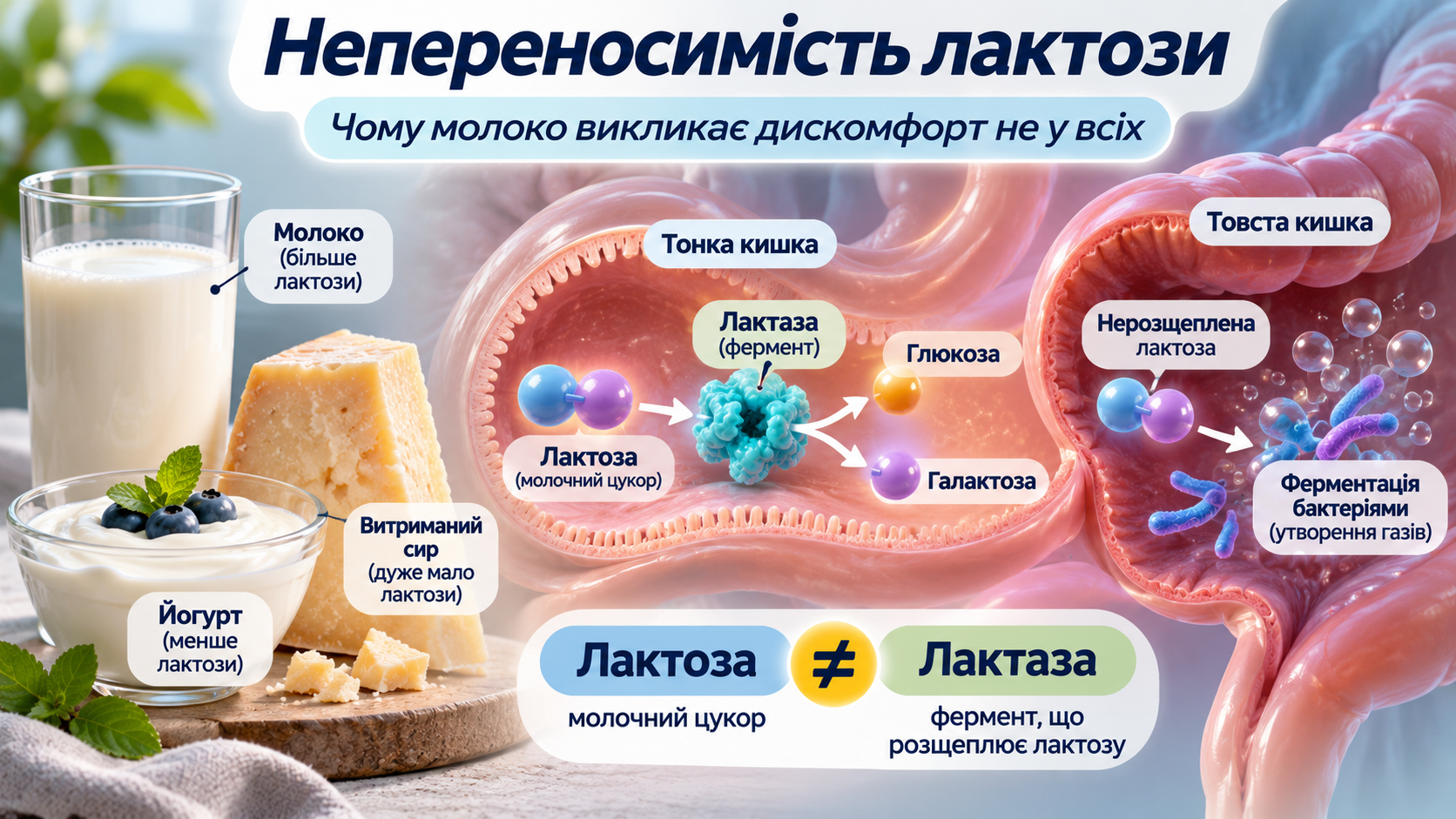
How much lactose do different dairy products contain?
The amount of lactose depends on the product, the recipe and the production technology. Therefore, the statement “all dairy is not the same” is inaccurate. It is especially important to distinguish between fresh dairy drinks, fermented products and aged cheeses.
| Product | General characteristics of lactose content | Practical nuance |
|---|---|---|
| Regular cow's milk | Approximately 12 g per glass of about 240 ml | A large single serving may cause more symptoms |
| Yogurt with live cultures | Content varies; some of the lactose changes during fermentation | Some people tolerate it better than milk, but it is not guaranteed |
| Hard aged cheeses | Usually much less than in milk | Some of the lactose is removed with the whey, the rest changes during ripening. |
| Soft fresh cheeses | A noticeable amount may remain | The content depends heavily on the technology and portion |
| Ice cream, dairy desserts | Depends on the proportion of milk and dry milk ingredients | You need to look at the composition, not just the name. |
| Lactose-free milk | Lactose has been technologically broken down or its content has been significantly reduced | Milk proteins remain; composition varies by manufacturer |
This is a qualitative comparison, not a table of laboratory values for specific brands. If you need an exact amount of lactose, you should use the manufacturer's specifications. In ready-to-eat foods, lactose can also come from milk powder, whey, and other dairy ingredients.
Why yogurt and aged cheese are sometimes better tolerated
During the production of yogurt, lactic acid cultures partially change the composition of the milk. Some live cultures also contain enzymes involved in the breakdown of lactose. This is why the tolerance of natural yogurt in some people may differ from the tolerance of the same amount of regular milk.
Another important technological feature for hard cheese is that a significant part of the lactose leaves the curd with the whey, while the rest can be gradually processed during ripening. However, “hard” does not automatically mean “zero lactose”, and “yogurt” does not always mean “well tolerated”.
It is helpful to evaluate a specific product, its serving size, and your own reaction. The choice is often broader than completely eliminating all dairy products.
Does everyone need to give up milk completely?
The method of consumption also matters. Smaller amounts of lactose at a time or with other food are sometimes better tolerated than a large glass of milk on an empty stomach. However, if symptoms are severe, you should not experiment too much.
Eliminating dairy completely without thoughtful substitutions can reduce calcium intake and sometimes vitamin D and protein intake. If dairy products must be significantly restricted, the diet should be reviewed with a doctor or dietitian, especially for children, adolescents, pregnant women, and people with other dietary restrictions.
How the lactase enzyme works in food
Lactase is an enzyme that breaks down lactose into glucose and galactose. This same biochemical principle is used in the production of lactose-free dairy products and in enzyme preparations for consumption with foods containing milk sugar.
External lactase does not restore the genetically determined activity of the small intestine's own enzyme. Its role is to work with lactose in a specific food situation. The result depends on the composition of the food, the amount of lactose, the characteristics of the enzyme and individual digestive characteristics. Therefore, even with the same enzyme activity, the experience of different people may differ.
Scientific reviews describe the enzyme lactase as one approach to dietary management of intolerance, along with selecting portions and foods with reduced lactose content. It is not a substitute for diagnosis if symptoms are new, persistent, or atypical.
What do lactase activity units on the label mean?
For enzymes, not only the mass of the powder in milligrams is important, but also the enzymatic activity - the ability to catalyze a certain reaction under the specified test conditions. Therefore, the packages may be marked with activity units, for example, FCC or ALU, depending on the method and standard used by the manufacturer.
The number next to the enzyme name does not by itself tell you how much milk a person is guaranteed to tolerate. You need to know what serving the activity is for, what method was used to determine it, and what recommendations the manufacturer has made. Units from different methods should not be considered interchangeable without confirmation.
If the package states the mass of the enzyme complex, it does not automatically equal the amount of active lactase. It is incorrect to compare different products only by milligrams or the largest number in the name.
How doctors test for lactose intolerance
The doctor begins by describing the symptoms, their relationship to foods, the time of onset, and possible comorbidities. A food diary can help you spot patterns, but it does not, in itself, establish a diagnosis.
One method is the hydrogen breath test. After ingesting a certain amount of lactose under controlled conditions, the hydrogen content in the exhaled air is measured; sometimes methane is also assessed. An increase in these indicators may indicate bacterial fermentation of undigested lactose. To draw a conclusion, the doctor compares the test results with the complaints and clinical picture.
The test has limitations: the result can be affected by preparation, antibiotics, individual microbiota characteristics and other intestinal conditions. It is not necessary to independently undergo a lactose challenge if symptoms are severe. Genetic tests can help assess the predisposition to primary lactase deficiency, but do not directly measure the severity of symptoms.
What to do if you regularly experience discomfort after dairy
The first practical step is not to jump to the conclusion that any dairy food is to blame. It is helpful to write down what food was eaten, how much, what else was in the meal, and when the symptoms occurred. This helps the doctor separate the suspected lactose reaction from other possible causes.
- Pay attention to portions. The reaction to a small amount may be different from the reaction to a large amount of a dairy drink.
- Compare different types of dairy. Regular milk, yogurt, aged cheese, and lactose-free options all have different compositions.
- Read the ingredient list. Milk powder, whey, and other ingredients can add lactose to finished products.
- Don't eliminate entire food groups without a replacement plan. You need to maintain an adequate intake of key nutrients.
- Discuss persistent symptoms with your doctor, especially if they appear suddenly or are not related to the amount of milk you drink.
Blood in the stool, unintentional weight loss, severe or increasing pain, persistent diarrhea, fever, or symptoms of dehydration are of particular concern. They are not typical explanations for simple lactose intolerance and require medical evaluation.

Common myths about lactose
“Lactose is harmful to all adults.” No. For people with sufficient lactase activity, lactose is a normal dietary carbohydrate. Even with reduced enzyme activity, symptoms do not occur in everyone.
“If milk is not good, any cheese is not good.” Wrong. The proportion of whey, the degree of fermentation, and the actual amount of residual lactose vary significantly between products.
"Lactose-free milk contains no sugar." Not necessarily. When lactose is broken down by an enzyme, glucose and galactose are formed. This can make it taste sweeter, even though there is no added sugar. For people who need to control their total carbohydrate intake, the nutritional value on the label is important.“If you drink more milk, your body will learn to produce lactase.” Regular consumption of lactose does not guarantee the restoration of genetically reduced enzyme activity. Studies of intestinal microbiota adaptation do not provide any reason to promise such a restoration.
“A reaction to milk always means an allergy.” No. Milk protein allergy and lactose malabsorption have different mechanisms and require different approaches.
The main thing about lactose intolerance
Lactose is milk sugar, and lactase is the enzyme needed to break it down. When there is not enough enzyme activity, some of the lactose passes into the large intestine, where it can cause gas and other digestive symptoms. However, reduced enzyme activity does not always equal severe intolerance.
The most practical approach is to find out the cause of the symptoms, consider the portion size and actual composition of the product, do not confuse intolerance with allergy, and do not restrict the diet more than necessary. If the reactions recur or are accompanied by alarming signs, it is worth consulting a doctor.
Frequently asked questions
What is the difference between lactose and lactase?
Lactose is milk sugar, and lactase is the digestive enzyme that breaks it down into glucose and galactose. Their names are similar, but their functions are completely different.
Can lactose intolerance occur in adulthood?
Yes. Lactase activity gradually decreases in many people after childhood. New symptoms may also be related to a condition in the small intestine, so it is advisable to clarify the cause.
Does bloating after milk mean lactose intolerance?
Not necessarily. Bloating can have various causes; assess the recurrence of symptoms, the amount of lactose, and, if necessary, the results of examinations.
Is there lactose in goat and sheep milk?
Yes, the milk of these animals also contains lactose. Switching from cow's milk to goat's milk does not in itself guarantee better tolerability.
Can I eat yogurt if I am lactose intolerant?
Some people tolerate yogurt better than milk, partly due to fermentation. However, the actual lactose content and individual response vary.
Why does aged cheese often contain less lactose?
Some of the lactose is removed with the whey during production, and the remainder can change during the ripening process. The exact content depends on the type of cheese and the technology.
Is lactose-free milk safe for people with a milk protein allergy?
No. Lactose-free milk usually still contains milk proteins. Allergy sufferers will need other dietary solutions as recommended by their doctor.
What does the hydrogen breath test show?
It helps detect signs of bacterial fermentation of undigested lactose. The result is evaluated in conjunction with symptoms, as the test itself has limitations.
Is it possible to permanently increase your own lactase through nutrition?
There is no convincing evidence that regular milk consumption restores genetically reduced lactase activity. In secondary reductions, tolerance sometimes improves after the intestinal mucosa recovers.
Do I need to completely eliminate dairy products?
Not always. Tolerance varies by person, portion size, and type of food; excessive restrictions can make it difficult to get calcium and other nutrients.
Sources
- National Institute of Diabetes and Digestive and Kidney Diseases (NIDDK). Symptoms & Causes of Lactose Intolerance. NIH/NIDDK.
- National Institute of Diabetes and Digestive and Kidney Diseases (NIDDK). Diagnosis of Lactose Intolerance. NIH/NIDDK.
- National Institute of Diabetes and Digestive and Kidney Diseases (NIDDK). Eating, Diet, & Nutrition for Lactose Intolerance. NIH/NIDDK.
- National Institute of Diabetes and Digestive and Kidney Diseases (NIDDK). Treatment for Lactose Intolerance. NIH/NIDDK.
- Misselwitz B. et al. (2019). Update on lactose malabsorption and intolerance: pathogenesis, diagnosis and clinical management. Gut , 68, 2080–2091. DOI.
- Fassio F. et al. (2018). Lactose Maldigestion, Malabsorption, and Intolerance: A Comprehensive Review with a Focus on Current Management and Future Perspectives. Nutrients, 10(11), 1599. DOI.
- National Institute of Diabetes and Digestive and Kidney Diseases (NIDDK). Definition & Facts for Lactose Intolerance. NIH/NIDDK.
Dietary supplement. Not a medicine. Consult a doctor before use.
Products related to this post

Comments
Information
Customer Service
Extras
My Account


Sports nutrition manufacturer in Ukraine StarkPharm © 2026


