Your shopping cart is empty!

Lactose intolerance and milk protein allergy: two different things
Published: 19/11/2026
Times Read: 39
Comments : 0
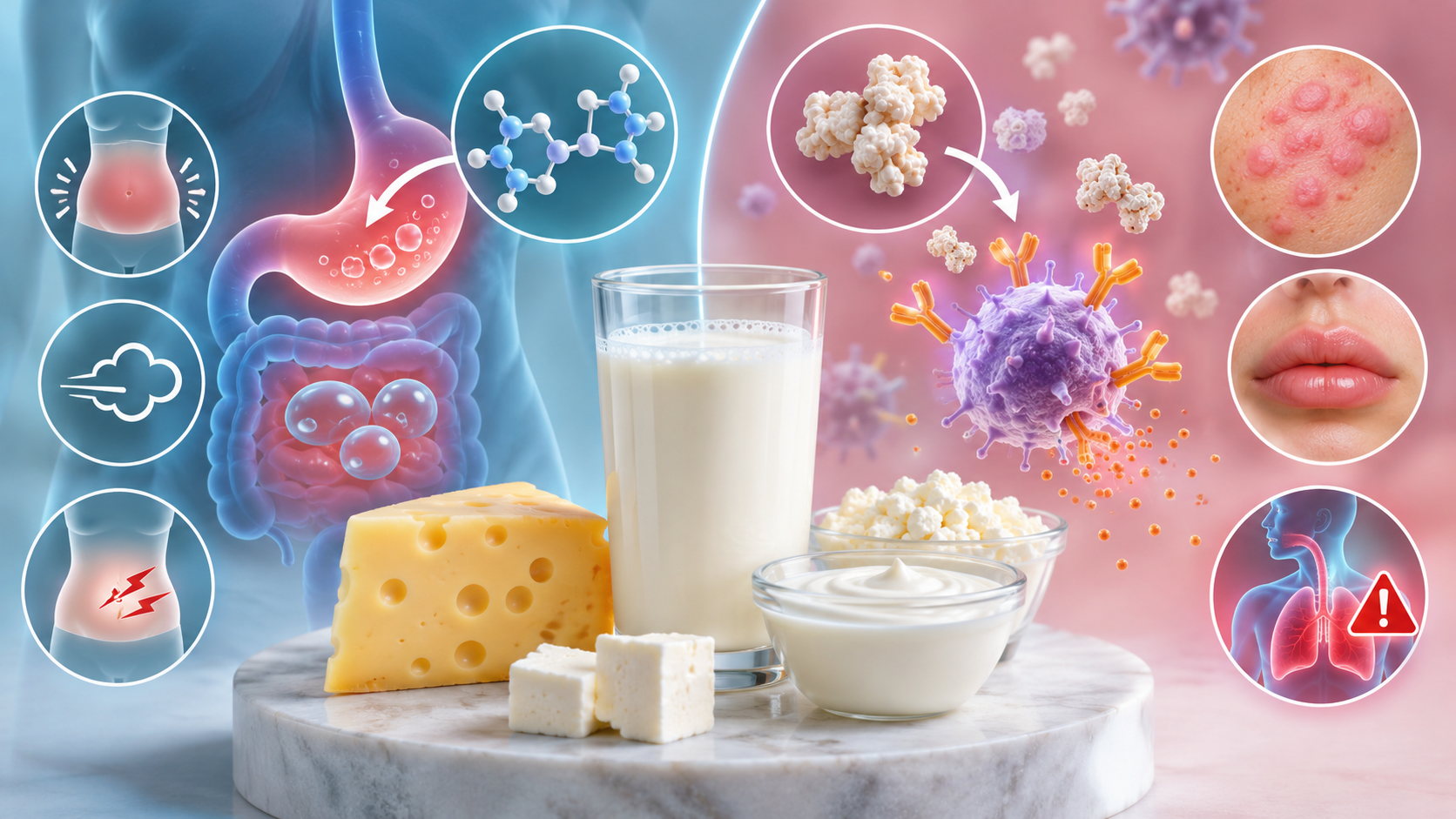
Lactose intolerance and cow's milk protein allergy can both cause discomfort after consuming dairy products. But the cause of these conditions is different: in intolerance, the problem is related to the digestion of milk sugar - lactose, while in allergy, the immune system reacts to certain milk proteins. This distinction is important to understand, as the approaches to nutrition and risk assessment differ significantly.
Bloating, rumbling, and diarrhea after milk may suggest lactose intolerance. On the other hand, hives, lip swelling, or difficulty breathing after a dairy product require attention to a possible allergic reaction. At the same time, a single symptom does not allow for an accurate determination of the cause: sometimes the manifestations overlap, and in children, allergies may have predominantly digestive symptoms.

Lactose intolerance and milk allergy: comparison
| Criterion | Lactose intolerance | Milk protein allergy |
|---|---|---|
| What does the body react to? | Lactose is a carbohydrate that is not completely broken down in the small intestine. | Milk proteins, in particular the casein and whey fractions. |
| Basic mechanism | Insufficient activity of the lactase enzyme and the entry of undigested lactose into the colon. | An immune response that may be IgE-mediated or occur through other mechanisms. |
| Typical manifestations | Bloating, gas, abdominal pain, diarrhea. | Hives, swelling, vomiting, respiratory distress; sometimes prolonged digestive symptoms. |
| Appearance time | More often some time after eating; depends on portion and other circumstances. | For a rapid IgE reaction, it is usually minutes or the first few hours; for other forms, a delay is possible. |
| Effect of product quantity | Symptoms often depend on the amount of lactose ingested and individual tolerance. | Even a small amount of protein can be significant for a sensitive person. |
| Lactose-free cow's milk | May be better tolerated because the lactose is already broken down. | It doesn't automatically become safe: the milk proteins remain. |
| Potential danger | Mostly digestive discomfort. | Some people may experience a severe systemic reaction, including anaphylaxis. |
According to the National Institute of Diabetes and Digestive and Kidney Diseases (NIDDK), lactose intolerance is caused by a problem with the absorption of this sugar, while a milk allergy is an immune system reaction. So the words “milk intolerance” don’t really tell you what’s going on.
What is lactose and why is lactase needed for it?
Lactose is a disaccharide consisting of glucose and galactose. In order for these components to be absorbed in the small intestine, the enzyme lactase breaks down the bond between them. Lactase works on the surface of the cells lining the small intestine. If its activity is not sufficient for the amount of lactose received with food, some of the sugar passes on undigested.
In the colon, lactose becomes a substrate for bacteria. During its fermentation, gases are formed, and the change in osmotic load promotes the entry of water into the intestinal contents. This explains the typical complaints: bloating, flatulence, rumbling, cramps and loose stools. The severity depends not only on the activity of lactase, but also on the composition of the food, the speed of its passage and the individual sensitivity of the intestine.
An important distinction: lactose malabsorption and symptomatic intolerance are not entirely identical concepts. Some people with lactose intolerance do not experience noticeable discomfort after regular portions of dairy products. Therefore, the result of the study and well-being are evaluated together, and not in isolation.
Why lactase activity may be lower
Many people naturally experience a decrease in lactase activity after childhood. This is called lactase insensitivity. Its prevalence varies between populations and is linked to genetic factors. This enzyme activity variant alone does not mean that a person must avoid all dairy products.
Another mechanism is a temporary or prolonged decrease in lactase activity after damage to the small intestinal mucosa. It may accompany some intestinal infections or diseases that affect the mucosa. In this case, intolerance may be secondary, and its dynamics depend on the state of the intestine. Rare congenital disorders of lactase activity are distinguished, which manifest very early.
Hence the practical conclusion: the same complaint after milk does not mean the same cause in different people. A self-conclusion based only on an episode of bloating may miss another digestive problem.
What causes cow's milk protein allergy?
IgE-mediated allergies often manifest rapidly: itching, hives, redness, swelling of the mucous membranes, coughing, wheezing or vomiting may occur after contact with the product. However, there are non-IgE-mediated forms that are more likely to manifest with delayed gastrointestinal manifestations. This is especially important when assessing symptoms in infants and young children.
The World Allergy Organization (WAO) review guidelines emphasize that symptoms, history, and, if necessary, examination should be considered in a comprehensive manner. Not every reaction to a dairy product is an allergy, and a positive laboratory test without a corresponding clinical picture does not in itself establish its presence.
Can an allergy look like lactose intolerance?
Yes, especially if the complaints from the digestive system come to the fore. Abdominal pain, nausea, vomiting or changes in bowel habits can accompany both conditions. Therefore, the rule “there is a rash - an allergy, there is abdominal pain - lactose” is too simplistic. Some allergic reactions are not accompanied by noticeable skin changes, and some non-allergic conditions give a variety of symptoms.
Age is also important. Cow's milk protein allergy is especially relevant in childhood, especially in infants. The initial decrease in lactase activity with age usually becomes noticeable later. However, age patterns are not a sufficient way to distinguish one from the other.
The sequence of events plays a big role: what product was consumed, in what quantity, how long it took for symptoms to appear, whether the situation recurred, and whether there were additional symptoms outside the digestive system. This information helps the doctor choose further steps.
Lactose-free milk does not mean allergen-free milk
To produce lactose-free milk, the manufacturer usually uses enzymatic cleavage of lactose into simpler sugars or technological methods to reduce its content. However, casein and other proteins in cow's milk do not automatically disappear. That is why lactose-free cow's milk should not be considered an alternative for a person with a confirmed allergy to milk proteins.
Similarly, the labels “lactose-free” and “milk-free” convey different information. The first refers to carbohydrates, the second to the presence of dairy ingredients. The composition should be read in full, especially when it comes to feeding a person with allergies.
| Product or label | What is important to know |
|---|---|
| Lactose-free cow's milk | There is little or no lactose, but cow's milk proteins are usually present. |
| Regular cow's milk | Contains both lactose and milk proteins. |
| Goat or sheep milk | Also contains lactose; proteins may cross-react with cow's milk proteins. |
| Cheese and fermented foods | The amount of lactose varies greatly depending on the technology, but the milk proteins remain. |
| Herbal drinks | Not cow's milk, but composition, nutritional value, and potential allergens are different; label check required. |
The professional society ASCIA separately warns that lactose-free dairy products, as well as milk from other animals, cannot be considered a safe automatic replacement for cow's milk allergy. For children's diets, the issue of milk replacement is particularly important due to the need for sufficient energy, protein and micronutrients.
Does the enzyme lactase help with milk protein allergies?
No, these mechanisms should not be confused. Lactase breaks down lactose, a carbohydrate. It does not break down milk proteins to a state that would make them safe for people with allergies. Even complete breakdown of milk sugar does not change the fact that potential protein allergens are present.
It is also important not to transfer one person's individual experience to another. If someone feels more comfortable after a dairy product with less lactose, this does not prove that the same approach is suitable for someone with a different reaction mechanism. If you suspect an allergy, you should not independently test milk tolerance through repeated tests.
How experts determine the cause of symptoms
The evaluation usually begins with a discussion of symptoms, previous reactions, food composition, time interval after eating, and other possible factors. The doctor takes into account the person's age, comorbid conditions, weight changes, and eating behavior. The same symptom may be associated with different causes, so the examination is tailored to the clinical situation.
When lactose malabsorption is suspected, one method is a hydrogen breath test after a defined lactose load. It provides information about the fermentation of sugar that has not been fully absorbed. Interpretation requires consideration of the symptoms themselves and the conditions under which the test is performed. Not every bloating after eating indicates lactase deficiency.
If IgE-mediated allergy is suspected, skin prick tests or specific IgE blood tests may be used. They assess sensitization, but without a history of characteristic reactions, they do not automatically confirm clinical allergy. In difficult cases, the doctor may consider a controlled food challenge. This should only be performed under medical supervision and not at home.
| What can a specialist assess? | Important limitation | |
|---|---|---|
| Lactose intolerance | Relationship of symptoms to the amount of lactose, medical history, and hydrogen breath test if necessary. | The result should be correlated with clinical manifestations and possible other causes. |
| IgE-mediated allergy | The nature of the reaction, skin prick test, specific IgE, sometimes a controlled food challenge. | A positive test indicates sensitization, not always clinical allergy. |
| Possible delayed allergy | Symptoms, dietary history, physician assessment; in certain situations, controlled exclusion and return of the product. | Conventional IgE tests do not cover all mechanisms of such reactions. |
The NIAID guidelines emphasize that food allergy evaluation should not be based solely on test results without clinical context. Self-exclusion of large food groups for a long period of time can complicate the diet and fail to answer the question of the true cause of symptoms.
When a reaction after a dairy product requires emergency care
Sudden shortness of breath, wheezing, a feeling of tightness in the throat, swelling of the tongue or throat, sudden weakness, dizziness, or loss of consciousness after eating may be signs of a severe allergic reaction. In such a situation, emergency medical attention is required. You should not wait for the symptoms to pass or try to explain them only by lactose intolerance.
If the person has previously been prescribed an adrenaline auto-injector and has been given an anaphylaxis action plan, it is necessary to act according to this plan and call emergency services. The information in the article is not a substitute for personal instructions from a doctor. The absence of a rash does not exclude a serious systemic reaction if there is respiratory or circulatory failure.
What to consider in your daily diet
With confirmed lactose intolerance, the dietary options are often wider than they seem. Different dairy products differ in the amount of lactose, and its tolerance is individual. Some people tolerate small portions with meals or individual fermented foods normally, while others need more significant restrictions. Such decisions depend on the established cause and the recommendations of a specialist.
In the case of a confirmed milk protein allergy, the approach is different: it is not the amount of lactose that is important, but the avoidance of the relevant protein allergens according to individual medical recommendations. It cannot be assumed that heat treatment, fermentation or labeling "lactose-free" automatically eliminates the risk.
If the dairy group is restricted for a long time, care should be taken to ensure that calcium, protein, vitamin D, and other important nutrients are being provided from alternative sources. This planning is especially important for children. Substituting a plant-based drink for regular milk one-for-one without nutritional assessment does not always provide a similar diet composition.

Five common mistakes in conclusions about milk
1. “Lactose intolerance is a mild form of allergy.” No. One condition involves carbohydrate digestion, the other involves an immune response to proteins.
2. “If there is no rash, there is definitely no allergy.” Not necessarily. Some forms of food allergy may have predominantly digestive symptoms.
3. “Lactose-free milk is suitable for anyone who reacts to regular milk.” No. It may still contain cow’s milk proteins.
4. “The absence of discomfort after a small portion rules out a problem.” Not always. With intolerance, symptoms often depend on the amount of lactose and the accompanying food, while with an allergy, the personal reaction threshold matters.
5. “One test is enough for a final conclusion.” Test results are only meaningful when combined with a history of symptoms and a doctor’s assessment.
Thus, the most useful question after a reaction to milk is not simply “can I eat dairy?” but “to which component and by what mechanism might the body react?” The choice of products, the appropriateness of the examination, and the level of caution depend on this.
Frequently asked questions
Are lactose intolerance and milk allergy the same thing?
No. Intolerance is related to the breakdown of milk sugar, while allergy is related to an immune response to milk proteins.
Is it possible to be allergic to lactose-free milk?
Yes. Lactose-free cow's milk usually contains milk proteins that can cause an allergic reaction.
Does lactase help if you have a casein allergy?
No. Lactase acts on lactose, not casein or other milk proteins.
Is a milk allergy necessarily accompanied by a rash?
No. Symptoms may involve the digestive, respiratory, or other body systems; they should be evaluated by a specialist.
Why is it more comfortable after cheese than after milk?
The amount of lactose in different dairy products varies. This can affect how you feel if you are intolerant to it, but it is not a safety criterion for allergies.
Is goat milk safer for people with cow's milk allergies?
Not necessarily. Milk proteins from different animals can cross-react, so such a substitution is not automatically considered safe.
Can lactose intolerance develop in adulthood?
Yes. Lactase activity in many people decreases after childhood; sometimes it also changes due to the condition of the small intestinal mucosa.
Does a positive IgE test mean that milk should be eliminated?
Not by itself. The doctor correlates the result with symptoms and medical history, as sensitization does not always mean clinical allergy.
Can I test for allergies myself by drinking some milk?
This should not be done if you suspect an allergy. Food tests, when necessary, are carried out according to medical rules.
When should you seek emergency help after consuming a dairy product?
If you experience difficulty breathing, swelling of the tongue or throat, fainting, or other signs of a severe systemic reaction, seek emergency medical attention immediately.
Sources
- National Institute of Diabetes and Digestive and Kidney Diseases (NIDDK). Symptoms & Causes of Lactose Intolerance. NIDDK.
- National Institute of Diabetes and Digestive and Kidney Diseases (NIDDK). Definition & Facts for Lactose Intolerance. NIDDK.
- Boyce J.A. et al. (2010). Guidelines for the Diagnosis and Management of Food Allergy in the United States: Report of the NIAID-Sponsored Expert Panel. Journal of Allergy and Clinical Immunology. PMC.
- World Allergy Organization (WAO). Diagnosis and Rationale for Action against Cow's Milk Allergy (DRACMA) Guidelines. PMC.
- Australasian Society of Clinical Immunology and Allergy (ASCIA). Cow's Milk (Dairy) Allergy. ASCIA.
Dietary supplement. Not a medicine. Consult a doctor before use.
Products related to this post
Related Posts
Comments
Information
Customer Service
Extras
My Account


Sports nutrition manufacturer in Ukraine StarkPharm © 2026


