Your shopping cart is empty!

FCC and ALU: what do lactase enzyme activity units mean?
Published: 18/11/2026
Times Read: 58
Comments : 0
On lactase labels, you may see FCC, ALU, activity units or a number such as 9000. However, these details do not always mean what they seem to at first glance. In particular, 9000 units of enzyme activity do not mean 9000 mg of enzyme, and FCC and ALU labels should not be compared without checking the laboratory method used.
Lactase is the enzyme β-galactosidase, which breaks down the milk sugar lactose into glucose and galactose. When comparing enzyme preparations, their measured activity is often more important than their weight. Let's examine how it is determined, how standards and unit names differ, what package numbers mean and why identical-looking labels do not always support identical conclusions.

FCC, ALU and milligrams: key differences
| Designation | Meaning | Correct interpretation |
|---|---|---|
| FCC | Food Chemicals Codex — a collection of standards and methods for food ingredients | Usually refers to a standardised activity assay, not one universal enzyme unit |
| ALU | Acid Lactase Unit — a unit of acid lactase activity | The number must be read alongside the measurement method's definition |
| FCC units | Enzyme activity described using the relevant Food Chemicals Codex method | For lactase, clarify exactly which method was used |
| mg | Weight of an ingredient or enzyme preparation | Does not establish enzyme activity without a specification |
| units/g | Activity per gram of raw material | Does not equal activity per serving without accounting for the mass of raw material |
The key takeaway is that FCC and ALU are not necessarily two mutually exclusive systems. The Food Chemicals Codex method for measuring acid lactase activity may report results in ALU. However, “ALU” alone, without technical specifications, does not prove that every manufacturer used identical laboratory conditions.
What is enzyme activity, and why is it measured?
Enzymes accelerate specific chemical reactions. For lactase, that reaction is lactose breakdown. Two powders of equal weight may contain different proportions of active enzyme, differ in purity or be made using different processes. Powder weight alone therefore does not describe functional properties.
Enzyme activity measures how quickly a sample catalyses a defined reaction under strictly controlled conditions. The laboratory controls temperature, pH, reaction time and the substance acted upon by the enzyme. Changing even one of these parameters may change the numerical result.
Thus, “twice as many units” can indicate higher activity under a comparable laboratory method, but it does not automatically mean that a person will experience twice the effect after eating dairy products.
What is the Food Chemicals Codex?
Food Chemicals Codex (FCC) is a reference collection of quality, identity and testing requirements for food ingredients. It includes activity measurement methods for different enzymes. “FCC” alongside an enzyme is therefore best understood as a reference to a system of standardised assays.
There is no single universal “FCC unit” for every enzyme: enzymes break down different substances, so assays for lactase, protease, amylase and lipase are not interchangeable. Adding their activities into a single “total enzyme strength” figure is incorrect.
FCC indexes list methods for acid and neutral lactase separately. This matters because the conditions under which enzyme preparations work depend on their origin and the pH of their environment.
What does ALU mean for lactase?
ALU stands for Acid Lactase Unit. Health Canada's official monograph defines ALU in terms of the rate at which o-nitrophenol is generated during a standardised laboratory assay: one unit corresponds to the release of one micromole of this substance per minute under specified test conditions.
This assay uses a model substrate to measure the speed of the enzyme reaction. It is useful for testing raw-material quality, but the laboratory value does not directly indicate how many grams of lactose a person will digest after a particular meal.
Technical descriptions of the FCC acid lactase method specify controlled conditions using ONPG (o-nitrophenyl-β-D-galactopyranoside) as substrate. The described methods use a temperature of 37 °C and an acidic environment of approximately pH 4.5. These values refer to laboratory assay conditions, not universal digestive conditions for everyone.
How does the laboratory activity assay work?
During analysis, an enzyme sample reacts with a specially selected substrate. The reaction produces a measurable substance. Activity is calculated from changes in its quantity over a defined period.
- Sample preparation. Weigh the sample and prepare a solution of the required concentration.
- Setting conditions. Maintain temperature and pH according to the method.
- Starting the reaction. Add a suitable substrate to the enzyme.
- Measurement. Determine the amount of product formed over a specified time.
- Calculation. Express activity in defined units per mass or volume of sample.
- Quality control. Compare the result with reference material or the method's criteria.
To understand a label, you do not need to reproduce this test at home. What matters is knowing that every activity number must be based on a particular analytical method. Without documentation identifying the method, comparisons between two labels are limited.
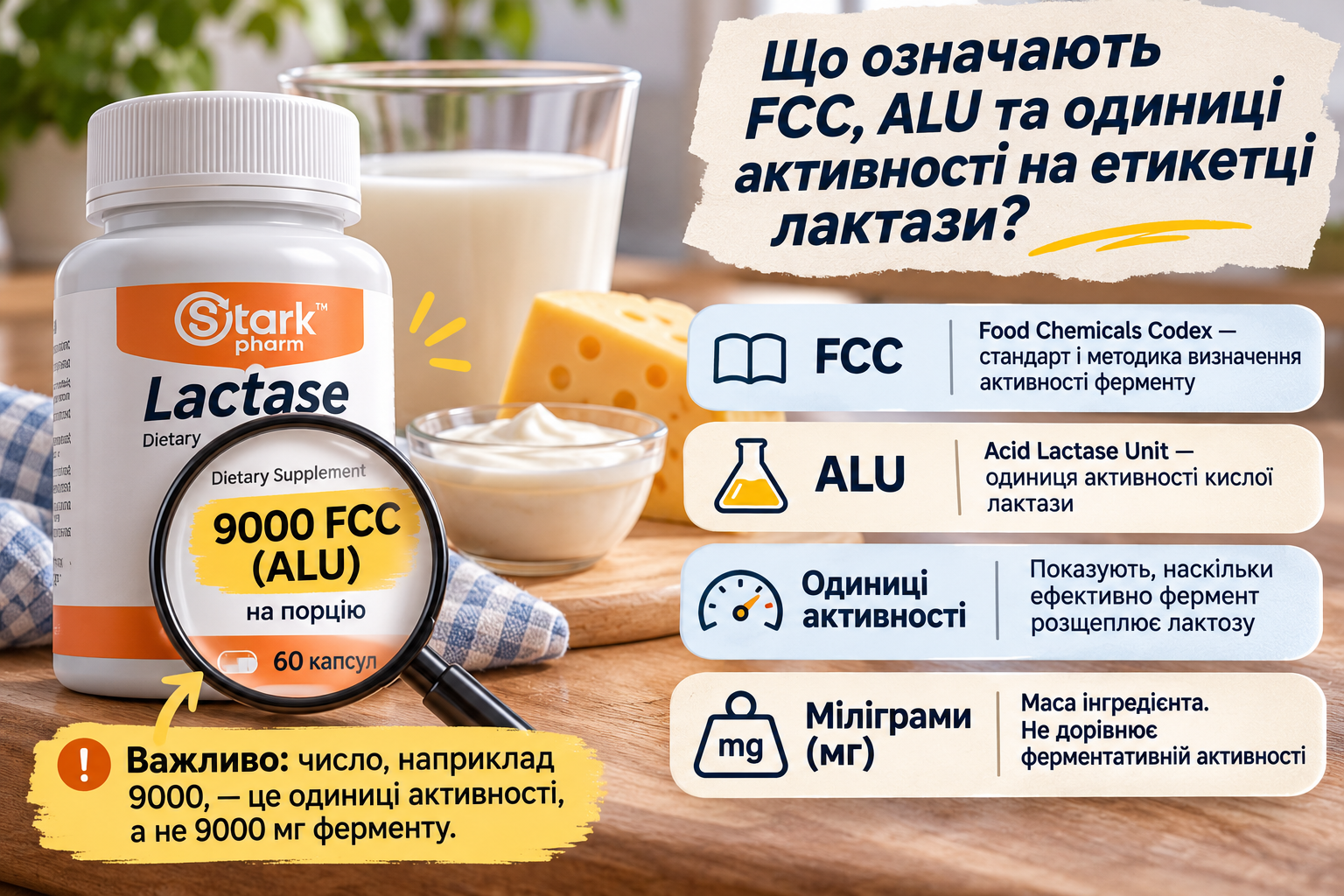
Are 9000 ALU and 9000 FCC equivalent?
The answer depends on what the manufacturer means by each designation. For acid lactase, ALU may be defined by an FCC method, so technical documents sometimes use wording such as “FCC acid lactase activity — ALU.” If the same method is used, the labels may describe the same activity measure.
However, the number 9000 alone on a package does not establish compliance with any particular standard. Check the full unit designation, the source of the assay method, the activity per serving and documents confirming the declared activity. If one supplier uses an acid lactase assay and another uses a different method, the results cannot be compared mechanically.
| Situation | What can be said | What remains unverified |
|---|---|---|
| 9000 ALU specified by the FCC acid lactase method | The number may reasonably be regarded as activity according to the stated method | Actual batch activity has not been verified without quality-control data |
| Only “9000” is shown | Only the number on the label is known | The unit, method and serving are unknown |
| 9000 units from another method | Activity may have been assessed under that method's own conditions | Direct comparison is unjustified without methodological evidence |
| 9000 ALU per gram of raw material | The raw material's activity is known | Activity per serving is unknown without the raw material's weight |
Two levels matter here: the correct unit and the actual value in the finished serving. Neither replaces the other.
Acid and neutral lactase: why the assay method matters
Lactase may come from different microorganisms. Enzyme preparations differ in the pH range at which they are most active. Food processing uses preparations that are more active near neutral pH, among others, while acid lactases are used for other purposes.
Different testing conditions may be required to measure these preparations. Comparing two numbers without identifying their activity type is like comparing measurements made with different rulers: both may be correct within their own systems without being directly comparable.
Laboratory pH should not be used to draw a direct conclusion about a supplement's effectiveness in the body. Acidity changes during digestion, while meal composition and volume, contact time between enzyme and lactose, and individual characteristics also influence the outcome.
Why does 100 mg of enzyme not represent a fixed number of ALU?
Imagine two hypothetical enzyme powders. The first has an activity of 50,000 ALU per gram and the second 100,000 ALU per gram under the same method. A 100 mg sample of the first would provide 5,000 ALU and the second 10,000 ALU. The weights are equal, but the laboratory results differ.
This is a hypothetical arithmetic example, not specifications of any product, a recommended serving or an indicator of effectiveness for an individual. It only illustrates that raw-material activity per gram and the mass used together determine calculated activity per serving.
The calculation is simple: multiply activity per gram by the enzyme preparation's mass in grams. If the mass is given in milligrams, convert it to grams first. However, the calculation is valid only when the actual properties of the raw material and the activity measurement method are known.
Activity per gram, capsule and serving: three different measures
| Label | What it tells you | What to verify |
|---|---|---|
| ALU/g | Activity per mass unit of the enzyme raw material | How much raw material the finished product contains |
| ALU/capsule | Activity of one capsule under the stated conditions | Whether one capsule equals the labelled serving |
| ALU/serving | Activity of the amount defined as one serving | How many product units make up a serving |
| mg/serving | Mass of enzyme preparation in one serving | Its activity in the relevant unit system |
For example, an activity value for two capsules must not be silently applied to one. Similarly, activity per gram of raw material is not the activity of the finished product unless the enzyme mass is known. These distinctions cause many of the most common errors when reading ingredient information.
What else should be clear from the label?
To compare enzyme supplements sensibly, look beyond the lactase name. Identify the unit used, the product quantity to which the activity applies and the manufacturer's recommendations. Missing information may make precise comparisons impossible.
- Full enzyme name. Lactase or β-galactosidase specifically, not merely “enzyme blend.”
- Numerical value. Activity accompanied by its unit of measurement.
- Serving size. How many capsules, tablets or grams of powder correspond to that value.
- Assay method. Ideally a reference to a standardised method in the manufacturer's specification.
- Directions for use. Guidance linked to consuming lactose-containing foods.
- Cautions. Information on individual tolerance and seeking professional advice when appropriate.
If a package shows only a number without units, the correct answer to “how much is that?” is that the information is insufficient. A large number cannot replace the method.
Why activity units cannot be converted into glasses of milk
It may be tempting to create a simple chart: a certain ALU amount equals one glass of milk, and twice that amount equals two glasses. Such an approach ignores the amount of lactose in the particular product, food composition, enzyme-substrate contact time and individual sensitivity.
A laboratory assay measures reaction speed under controlled conditions, whereas digestion takes place in a complex environment. Activity shown on a label is therefore not a direct measure of how much milk someone can drink without discomfort. Real-world tolerance varies individually.
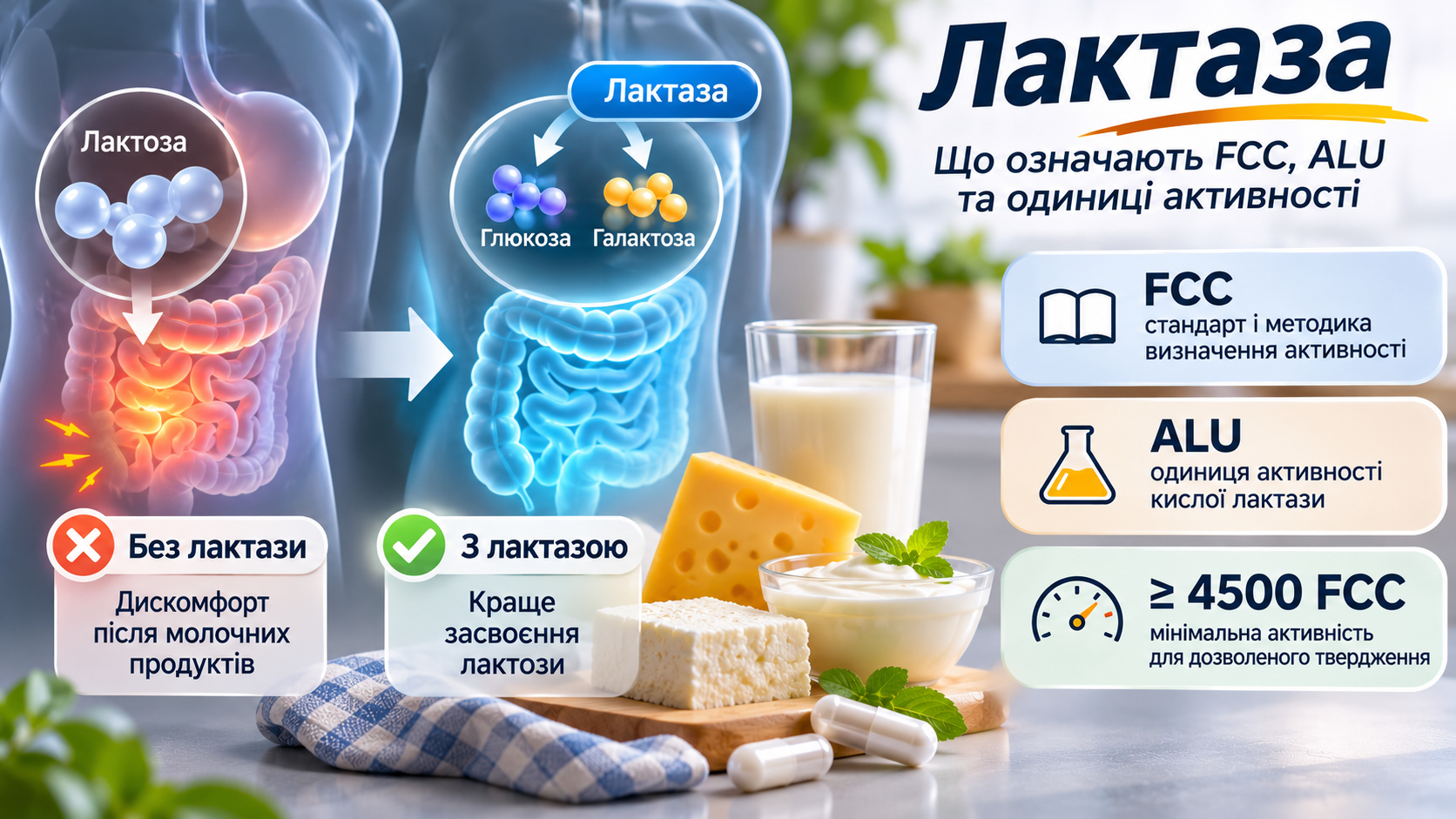
What does the 4,500 FCC threshold mean in lactase documents?
One of the authorised EU health claims for lactase requires at least 4,500 FCC activity units. This figure is a condition for making a specific claim about improving lactose digestion. It does not establish one enzyme requirement for every individual.
Accompanying consumer-information and individual-tolerance conditions are equally important. Thus, even exceeding 4,500 mathematically does not prove that any wording on a label or advertising banner is appropriate. Activity must first be verified in the specified units, and the complete context of the claim must be checked.
Common misconceptions about FCC and ALU
Misconception 1: “FCC is one universal unit for all enzymes.” FCC contains different methods; activity for each enzyme is measured under the appropriate conditions.
Misconception 2: “ALU is never connected with FCC.” The FCC method for acid lactase may report activity in ALU. The specification matters more than treating the abbreviations as opposites.
Misconception 3: “9000 units means 9000 mg.” Activity units and weight measure different physical quantities.
Misconception 4: “Twice the ALU means twice the milk tolerance.” This does not account for meal composition or individual factors.
Misconception 5: “ALU can be added to the units of other enzymes.” Measures of different reactions cannot be combined into a meaningful total.
Misconception 6: “Activity per gram is activity per capsule.” This comparison is incomplete without knowing the raw-material mass in a capsule.
Misconception 7: “Any FCC mention verifies batch quality.” Referencing a method cannot replace test results for the specific raw material or finished product.
How to check the figures step by step
First identify whether the number represents mass, activity per gram or activity per serving. Next find the unit name. If it is ALU, determine which method was used. Then verify the quantity of product to which the figure refers. Only then compare different labels.
For an accurate comparison, the two enzyme preparations must be described in comparable units and measured using comparable methods. Without documentation, acknowledging uncertainty is better than inventing a conversion factor.
Conclusions: what FCC and ALU really mean
FCC denotes a system of standards and methods, ALU is a unit of acid lactase activity, and mg measures mass. For certain acid lactase assays, these concepts are connected: an FCC method may express activity in ALU. However, universal equivalence between all labels cannot be assumed without identifying the method.
The most reliable basis for comparison is the complete unit designation, measurement method, actual activity per serving and technical documentation. Those are what give a label's numbers meaning.
Frequently asked questions
What does FCC mean on lactase packaging?
FCC stands for Food Chemicals Codex, a system of food-ingredient standards. For enzymes, it can refer to an activity measurement method.
What does ALU mean?
ALU means Acid Lactase Unit, a unit of acid lactase activity defined under specified laboratory conditions.
Does 9000 ALU equal 9000 FCC?
For acid lactase, ALU may be a unit defined by an FCC method. However, the two labels should not be assumed fully comparable without the manufacturer's specification.
Can ALU be converted into milligrams?
There is no universal conversion: milligrams measure weight, while ALU measure activity. The specific raw material's activity per mass unit is needed.
Does more ALU mean a stronger effect in the body?
Under the same method, more ALU indicates higher measured activity. Dairy tolerance also depends on many other factors.
Why do labels give units per gram?
This describes the activity of the raw enzyme preparation. Activity per serving must account for its mass in that serving.
How do acid and neutral lactase differ?
They may be most active under different conditions. This matters when selecting the laboratory assay.
Does 4,500 FCC mean lactase suits everyone?
No. This figure is part of the conditions for a particular health claim, while lactose tolerance varies individually.
Why can two supplements containing equal mg have different activities?
Enzyme preparations may differ in concentration and other properties. Weight cannot replace activity measurement.
What is needed to compare two enzyme preparations correctly?
The activity units, assay method, enzyme amount per serving and manufacturer verification of the stated values.
Sources
- United States Pharmacopeia. Food Chemicals Codex: Enzyme Assays; Lactase (Acid) Activity and Lactase (Neutral) Activity. FCC official index.
- Health Canada. Multi-enzyme Products Monograph, Appendix I: Definitions of Enzyme Activity Units (ALU). Health Canada.
- EFSA Panel on Dietetic Products, Nutrition and Allergies (2009). Scientific Opinion on the substantiation of health claims related to lactase enzyme and breaking down lactose. EFSA Journal, 7(9), 1236. DOI.
- European Commission (2012). Commission Regulation (EU) No 432/2012, Annex: Lactase enzyme. EUR-Lex.
- Misselwitz B. et al. (2019). Update on lactose malabsorption and intolerance: pathogenesis, diagnosis and clinical management. Gut, 68, 2080–2091. DOI.
Dietary supplement. Not a medicinal product. Consult your doctor before use.
Products related to this post
Related Posts
Comments
Information
Customer Service
Extras
My Account


Sports nutrition manufacturer in Ukraine StarkPharm © 2026


