Your shopping cart is empty!

How much lactose is in milk, hard cheese, yogurt and butter?
Published: 19/11/2026
Times Read: 33
Comments : 0
Milk, yogurt, hard cheese, and butter are all made from dairy products, but the amount of lactose they contain varies greatly. Regular cow's milk contains about 4.5–5 g per 100 ml, while many aged hard cheeses contain only trace amounts. Natural yogurt and butter fall somewhere in between, with their levels varying depending on the recipe and technology.
Exact values cannot be determined from the product name alone. “Yogurt” can refer to a variety of products, and “cheese” can refer to both aged Parmesan and fresh curd cheese. Therefore, below are approximate numbers from scientific reviews and ingredient tables, as well as an explanation of how to convert from per 100g to an actual serving.
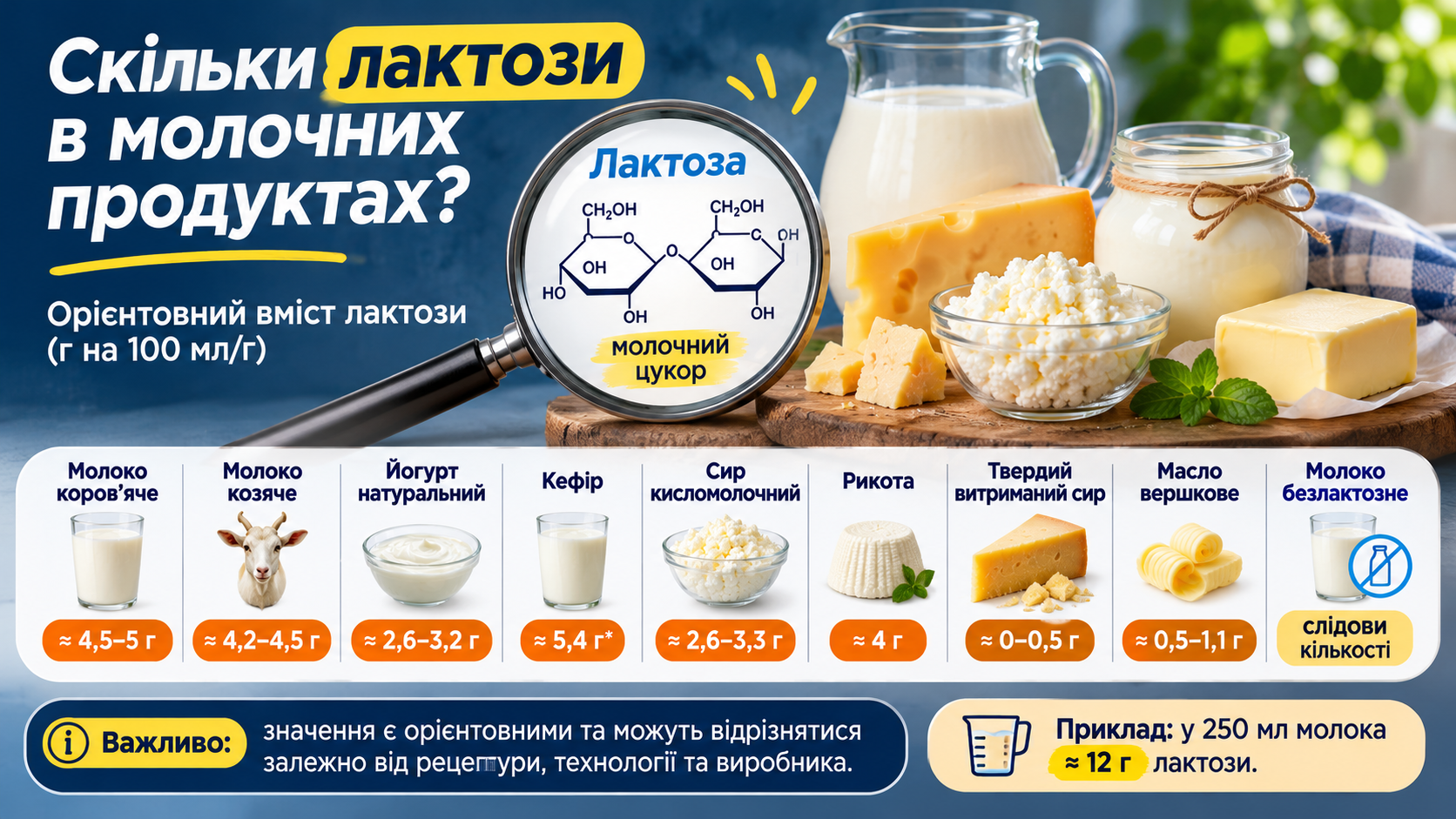
Table: how much lactose is in dairy products
The table contains representative values, not mandatory for each manufacturer. The ranges take into account differences between published nutritional composition tables. For milk, we use g/100 ml; for other products, g/100 g. Lactose content should not be automatically equated with the total amount of sugars or carbohydrates on the label.
| Product | Approximate lactose | What affects the value |
|---|---|---|
| Regular cow's milk | About 4.5–5 g/100 ml | Natural composition of milk, technological processing, concentration of dry matter. |
| Goat milk | About 4.2–4.5 g/100 g | Raw material composition; goat milk is not lactose-free. |
| Natural yogurt | About 2.6–3.2 g/100 g in the above reviews; other samples may have more | Sourdough, fermentation, filtration, addition of dairy components. |
| Kefir | Depends on the product; one published table states 5.4 g per 150 g serving | Fermentation method, composition and duration of the process. |
| Hard aged cheese | Often 0–0.5 g/100 g; for some cheeses around 0.1 g/100 g | Whey removal, ripening, fermentation of residual lactose. |
| Cottage cheese | Approximately 2.6–3.3 g/100 g in the above tables | Moisture, amount of whey, added dairy ingredients. |
| Ricotta | In some composition tables about 4 g/100 g | Composition of the original serum and technology. |
| Butter | Approximately 0.5–1.1 g/100 g in a number of tables | Residual aqueous phase, production technology and formulation. |
| Lactose-free milk | Typically trace amounts within product specification | Method of reducing or enzymatically breaking down lactose. |
For example, the review table by Misselwitz et al. (2019) gives 4.7–4.8 g per 100 g for regular milk, 3 g for fresh yoghurt, about 0.1 g for hard cheese and 0.5 g for butter. Another scientific review gives 2.6 g for natural yoghurt, 1.1 g for butter and 0.5 g for cheddar cheese per 100 g. The Australian Food Database also includes a sample of natural yoghurt with 5.1 g lactose per 100 ml. The value per 100 ml should not be mechanically interpreted as the exact value per 100 g: the units are different. These differences do not mean that one table is necessarily wrong: different samples and methods of tabulating data are being compared.
How much lactose is in a glass of milk
Lactose is the main natural sugar in cow's milk. It is present in the aqueous phase and is not lost by conventional pasteurization or fat content changes. Therefore, whole, semi-skimmed and skimmed milk can have similar lactose values per unit volume. The label "0% fat" does not mean "0% lactose".
If we take approximately 4.8 g of lactose per 100 ml, then in 200 ml there will be about 9.6 g, and in 250 ml - about 12 g. This is an example of arithmetic conversion, not an individual tolerance limit. The actual product may differ slightly in composition, and the body's reaction depends on a much larger number of factors than the volume of milk itself.
The American NIDDK describes that some people with lactose intolerance can consume about 12 g of lactose at a time without symptoms or with only minor manifestations. This is a generalization of research, not a recommendation of the same portion for every person. For some, the comfortable amount may be less.
Powdered milk and condensed milk products are a special case. When water is removed, the concentration of milk components changes, so the mass of the powder is not equivalent to the same mass of liquid milk. For dry mixes, desserts and ready-made meals, you need to focus on the specific composition.
Why hard cheese usually contains little lactose
Cheese production changes the composition of the milk. During curdling, a large portion of the water phase separates as whey, and with it comes a large amount of dissolved lactose. Then, the starter bacteria use some of the remaining sugar during fermentation. In long-aged cheeses, very little lactose may remain.
It is important to distinguish between hard aged cheese and soft or fresh cheese. The latter often contains more moisture and may retain a significant amount of lactose. Processed cheeses should be evaluated separately: they can be made with the addition of milk, milk powders, whey and other components, so transferring the figure for aged hard cheese to a processed product is incorrect.
| Cheese group | General trend | What to check |
|---|---|---|
| Hard-wearing | Often minimal amount of lactose | Degree of maturity, composition, manufacturer's data. |
| Semi-solid | Indicators vary between varieties | Fermentation technology and duration. |
| Soft fresh | May contain significantly more lactose | Moisture, whey, added milk. |
| Processed and cheese products | Depends on the recipe | Milk powder, whey, added sugars. |
How much lactose remains in natural yogurt
During the production of yogurt, lactic acid bacteria use some of the lactose and convert it into fermentation products. Because of this, yogurt can contain less initial sugar than milk. However, the degree of change depends on the composition of the milk base, cultures, fermentation conditions and further processing. It cannot be said that any yogurt is automatically low in lactose.
Scientific tables clearly show the difference: for natural yogurt, for example, 2.6–3.2 g per 100 g is given, while in a separate entry in the Australian database it is approximately 5.1 g per 100 ml. This value cannot be rewritten as an indicator per 100 g without specifying the density. Additionally, the result is affected by milk powder and concentrated milk components, which are sometimes used for density and texture stability.
Greek yogurt and other strained products can have excellent results because some of the water-soluble components are removed with the whey. However, filtration varies, and some thick yogurts achieve their consistency through other technological processes. Therefore, the label “Greek” or “thick” does not replace information about a specific product.
Information about live yogurt cultures should also not be confused with the actual amount of lactose in a serving. The starter culture, the serving size, and the composition of the dish can all be important for individual tolerance. But it is impossible to draw an accurate conclusion about the amount of lactose based on the word “organic” or “live” alone.
Kefir, fermented baked milk and other fermented milk drinks
Kefir and other fermented milk drinks also undergo processes in which microorganisms use up some of the lactose. However, this is not the same as completely eliminating the milk sugar. Values can vary depending on the type of starter, fermentation time, temperature, starting materials, and recipe.
One of the tables published in the NCBI Bookshelf medical library gives kefir as about 5.4 g of lactose per 150 g serving. This is a specific table example, not a norm for every kefir. For fermented baked milk and other local products without a confirmed laboratory value, you should not mechanically use the number from the table for yogurt or kefir.
If the drink is made with added milk concentrates, its composition may differ from the traditional one. Similarly, sweet drinking yogurts often contain added sugar: an increase in the total carbohydrate content on the label does not mean that all of this amount is lactose.
Why is butter low in lactose?
Butter is made up mostly of milk fat, while lactose is found in the watery part of milk. During the production of butter, a significant portion of the water phase is separated. As a result, the amount of lactose in the finished product is usually small compared to milk. But “little” does not mean “absolutely none.”
For butter, scientific tables may show about 0.5 or 1.1 g of lactose per 100 g. At first glance, the discrepancy is large, but it is worth considering the size of a typical serving. If we use 10 g of butter as an example, then with these two guidelines we get about 0.05 or 0.11 g of lactose. When assessing the diet, the amount of the product is often more important than the difference between the given tabular values.
Butter should be distinguished from butter blends, spreads and products with added dairy ingredients. Their formulation may change the lactose content. Purified milk fat should also not be considered equivalent to regular butter without checking the specification.
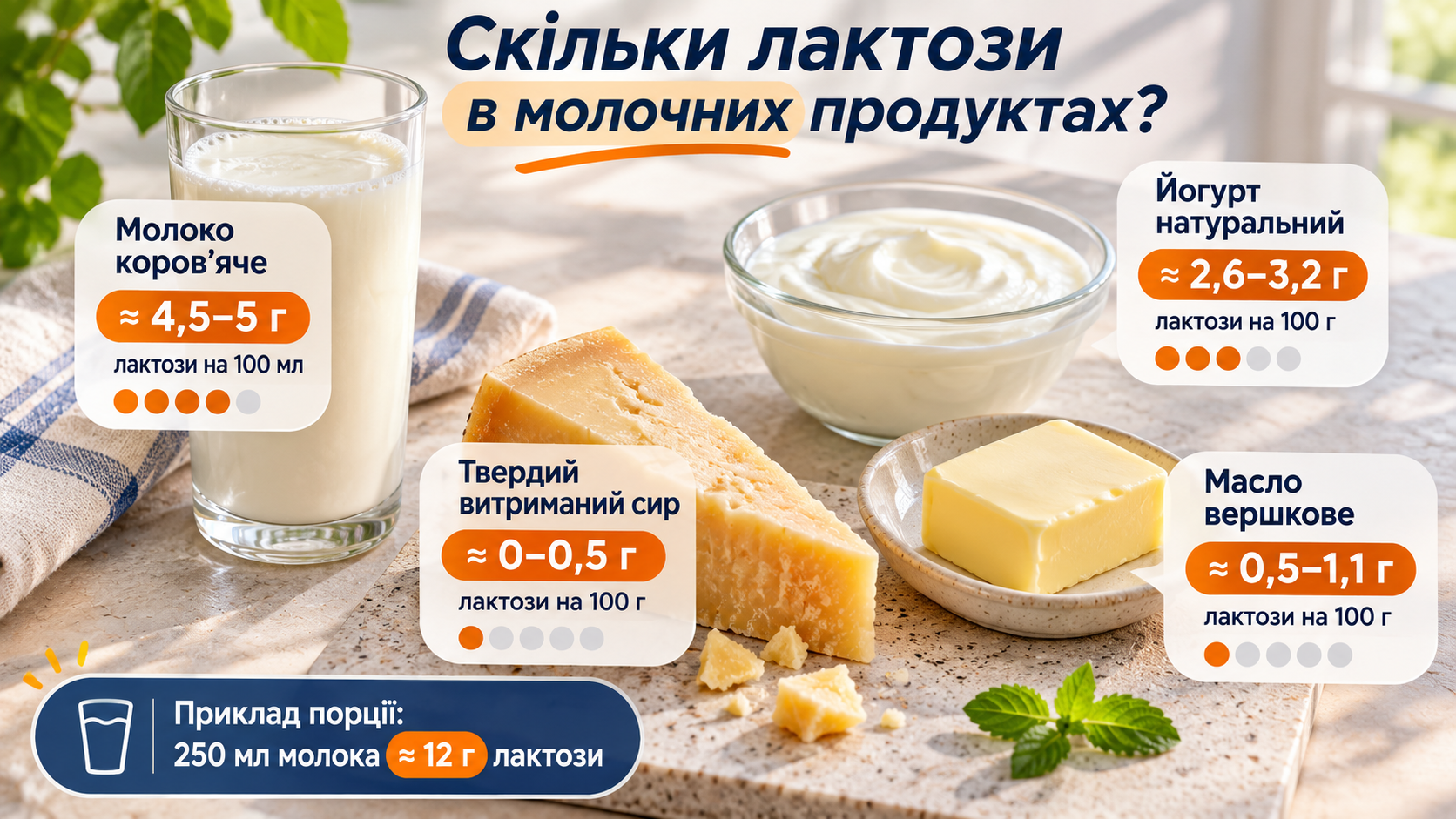
How to calculate lactose in your serving
Table data is usually given per 100 g or 100 ml. To get an approximate amount of lactose in a serving, multiply the value from the table by the mass or volume of the serving and divide by 100. It is important not to mix grams and milliliters without clarification: for milk in household examples, the difference is small, but they are different units.
Formula: lactose per serving = lactose per 100 g × serving weight / 100. For the volume value per 100 ml, the serving volume in milliliters is used.
| Example | Portion | Initial reference point | Estimated quantity |
|---|---|---|---|
| Regular milk | 250 ml | 4.8 g/100 ml | 12 g |
| Natural yogurt | 150 g | 3 g/100 g | 4.5 g |
| Aged hard cheese | 30 g | 0.1 g/100 g | 0.03 g |
| Butter | 10 g | 0.5 g/100 g | 0.05 g |
| Sour milk cheese | 100 g | 2.6 g/100 g | 2.6 g |
These calculations demonstrate arithmetic. They are not a laboratory passport for the product and do not establish a personal tolerance limit. For products with a specific recipe, the manufacturer's confirmed lactose indicator takes priority, if available.
Can you find out the amount of lactose from the label?
A regular label will often list carbohydrates and sugars in total, rather than a separate line for “lactose.” If a product contains natural milk sugars, some of that number may be lactose. But in sweet yogurt, the total sugars may also include sucrose, fructose, and other components. So the “all sugars are lactose” rule doesn’t work.
Similarly, the label "no added sugar" does not mean "lactose-free": the natural milk sugar may remain. In contrast, a specially processed lactose-free product may retain a certain amount of carbohydrates because the lactose is broken down into glucose and galactose and not necessarily physically removed.
It's useful to look not only at the name, but also at the composition: powdered milk, whey, milk powder, and other dairy components can affect the final amount of lactose. However, the list of ingredients alone without laboratory data usually does not allow you to calculate an exact figure.
Why a small amount of lactose does not mean the same tolerance
The value in the table characterizes the product, not the reaction of a particular person. Intolerance is related to how much lactose is broken down in the small intestine and what happens to its residues later. The sensation can be influenced by lactase activity, the amount of food, accompanying carbohydrates, the speed of passage of contents through the intestine and sensitivity to gas formation.
Sometimes a person feels discomfort after a large portion of milk, but tolerates a small amount of hard cheese normally. This is consistent with the difference in lactose content, but is not a universal rule. If symptoms recur or occur after very different foods, it is advisable to consult a specialist to find out the cause.
It is especially important to remember about allergies to milk proteins. Aged cheese with a minimum of lactose still contains milk proteins. Similarly, lactose-free milk remains a dairy product. The lactose table cannot be used as a safety table for allergies.
How to use a spreadsheet without unnecessary restrictions
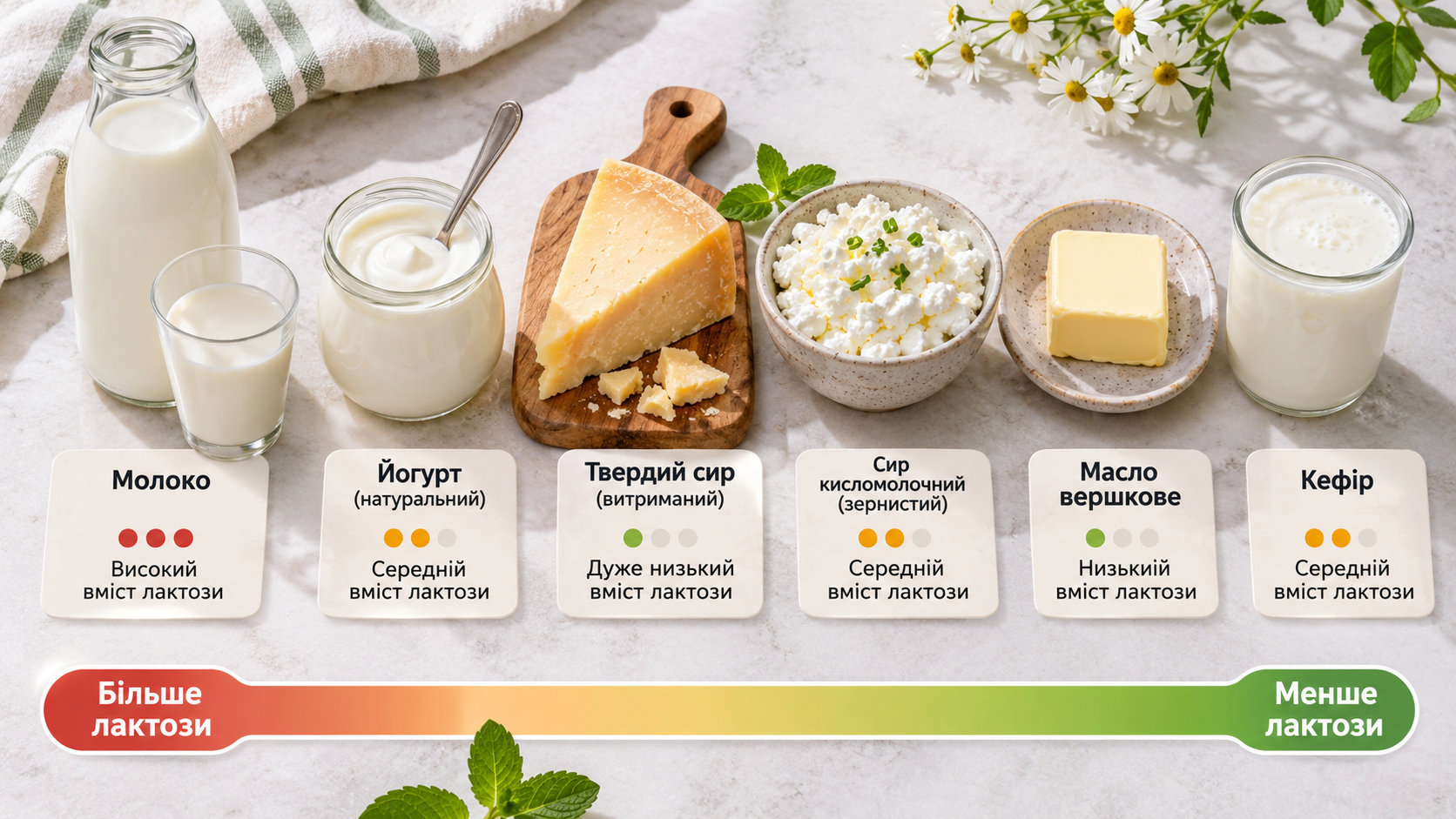
The most useful approach is to compare not abstract names, but the amount of lactose in an actual serving and the characteristics of a specific product. For milk, the values are usually quite close, for natural and thick yogurts the spread is larger, and for cheeses, moisture and ripening become key.
It is not necessary to completely eliminate all dairy products just because some of them contain a lot of lactose. This approach can unnecessarily narrow the diet and reduce the intake of calcium, protein and other nutrients. When restricting nutrition, it is important to maintain its fullness; especially careful individual assessment is required for children, pregnant women and people with comorbid conditions.
The bottom line is simple: the type of product, technology, portion size, and individual response matter most. Milk and most plain yogurts typically contain more lactose than aged hard cheese and butter, but the exact number depends on the product.
Frequently asked questions
How much lactose is in 250 ml of regular milk?
With a guideline of 4.8g per 100ml, there will be around 12g of lactose in 250ml. The figure for a particular milk may vary slightly.
Which cheese has the least lactose?
In many hard, long-aged cheeses, very little of it remains. The specific amount depends on the variety and technology.
Does Parmesan contain lactose?
According to published nutritional information, aged Parmesan may contain only trace amounts. For a specific brand, the manufacturer's information is important.
Is there lactose in butter?
Yes, there may be small residual amounts. A regular serving of butter usually has much less of them than a glass of milk.
Why might yogurt contain less lactose than milk?
During fermentation, microorganisms use some of the lactose. But the actual remainder depends on the recipe, starter, and technology.
Is the amount of lactose in different brands of yogurt the same?
No. The composition of the milk base, concentration, added ingredients, and manufacturing process can significantly change the indicator.
Does kefir contain lactose?
Yes, regular kefir may contain residual lactose. Fermentation does not mean it is completely removed.
Does the label "no added sugar" mean that the product is lactose-free?
No. Lactose can be naturally present in dairy products even without added sugar.
Can lactose be identified by the “sugar” line on the label?
Not always. This line may include different sugars, so it is not the same as a separate lactose analysis.
Is hard cheese suitable for a person with a milk protein allergy?
Low lactose content does not mean the absence of milk proteins. If you have an allergy, you cannot rely solely on the lactose table.
Sources
- Misselwitz B., Butter M., Verbeke K., Fox M.R. (2019). Update on lactose malabsorption and intolerance: pathogenesis, diagnosis and clinical management. Gut. PMC.
- Nutritional management of lactose intolerance: the importance of diet and food labelling (2020). PMC.
- Food Standards Australia New Zealand. Australian Food Composition Database: Natural Yoghurt. FSANZ.
- National Institute of Diabetes and Digestive and Kidney Diseases. Eating, Diet, & Nutrition for Lactose Intolerance. NIDDK.
- Institute for Quality and Efficiency in Health Care (IQWiG). Shopping tips for lactose-intolerant people. InformedHealth.org. NCBI Bookshelf.
Dietary supplement. Not a medicine. Consult a doctor before use.
Products related to this post
Related Posts
Comments
Information
Customer Service
Extras
My Account


Sports nutrition manufacturer in Ukraine StarkPharm © 2026


