Your shopping cart is empty!

Why aged cheeses are easier to tolerate
Published: 19/11/2026
Times Read: 33
Comments : 0
Aged hard cheese can contain significantly less lactose than the milk from which it is made. This is not because the milk sugar “disappears” on its own. During production, most of the lactose is converted into whey, which is separated from the curd. The leftovers are used by the starter microorganisms. As a result of these processes, the amount of lactose in many ripened cheeses becomes very low.
That's why some people with lactose intolerance may tolerate a small portion of aged cheddar, Gouda, or Parmesan better than a glass of milk. But this isn't a universal rule: how well you feel depends on the specific cheese, the serving size, your individual tolerance, and other food components. Also, low lactose doesn't mean that there are no milk proteins.
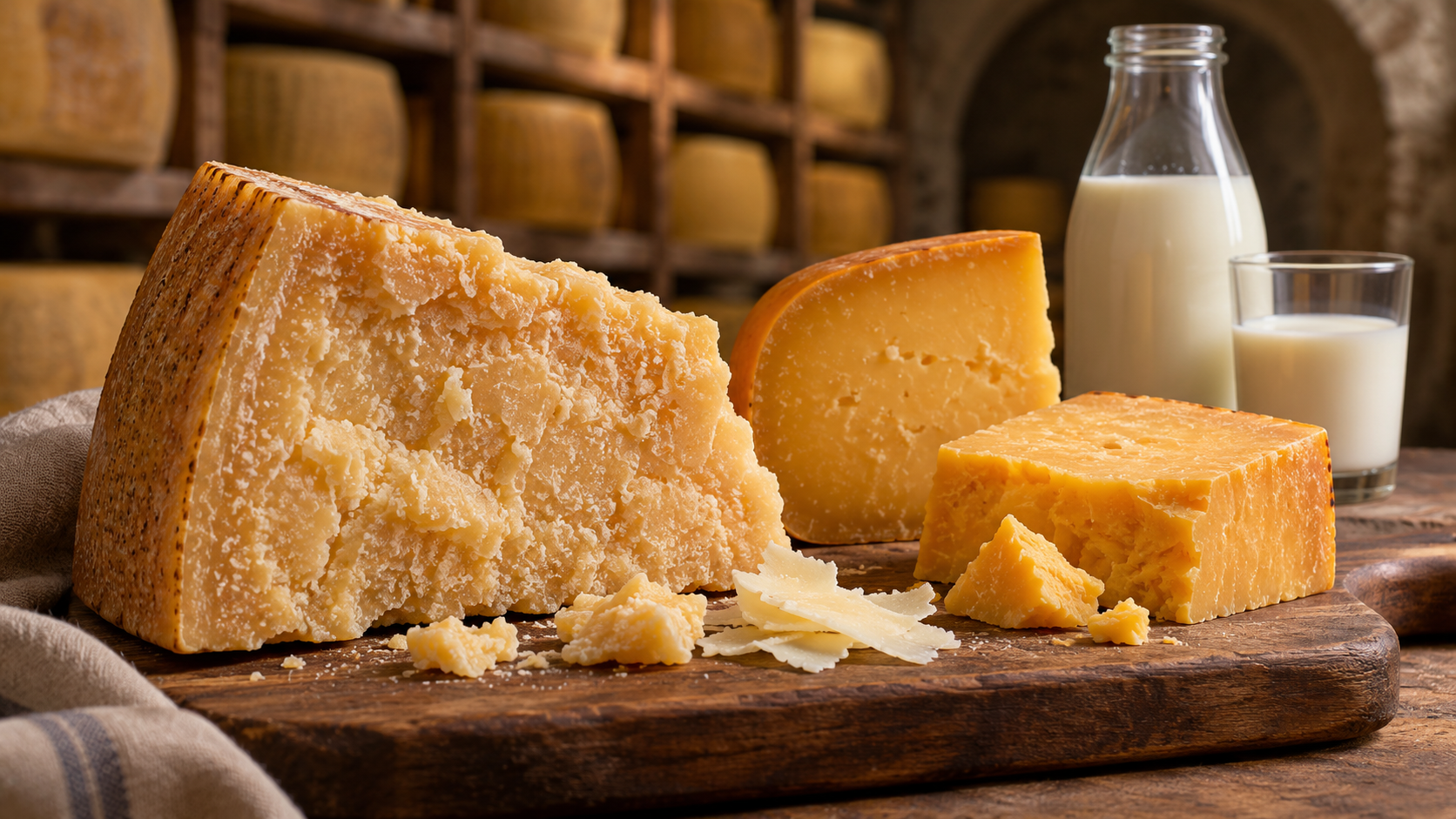
Why do cheese and milk differ in the amount of lactose?
Lactose is the main natural carbohydrate in milk. In regular cow's milk, it is approximately 4.5–5 g per 100 ml. It is dissolved in the water phase of the milk, and is not bound to fat or casein. When milk is made into cheese, the ratio of components changes: the milk proteins form a dense curd, and a significant part of the water, along with dissolved substances, is released into the whey.
Whey contains water, lactose, some proteins and minerals. The more water phase is separated by a particular technology, the less of the original lactose potentially remains in the cheese mass. But some of the liquid is still retained inside the curd. At this stage, sourdough bacteria become important, which can use the residual carbohydrates.
A scientific paper on the determination of lactose and galactose in food products separately describes two main ways to reduce lactose and galactose in cheese: whey removal and bacterial fermentation. This technological explanation is much more accurate than the common phrase “the older the cheese, the better.”
Three steps that reduce lactose in hard cheese
| Stage | What's happening? | Effect on lactose |
|---|---|---|
| Clot formation | The casein fraction forms the curd mass, which is separated from the whey. | Some of the lactose remains in the liquid around the clot. |
| Serum removal | The curd is cut, mixed, sometimes heated, and pressed. | A significant portion of dissolved milk sugar is removed with the separated liquid. |
| Fermentation and maturation | Fermentative microorganisms convert residual carbohydrates into metabolic products. | Residual lactose may decrease to very low or undetectable levels. |
These processes partially overlap in time. Fermentation begins before the cheese head is finished, not just after it is transferred to the ripening chamber. For some varieties, a significant portion of the residual lactose is used up in the early stages. Therefore, it is not possible to calculate the amount of lactose based solely on the number of months indicated on the packaging.
What exactly do sourdough bacteria do?
Lactic acid bacteria use lactose as a source of energy. Enzymatic systems of microorganisms help to break it down into simpler components, after which organic acids are formed, primarily lactic acid. Changes in acidity affect the structure of the cheese mass, its microbiological processes and future taste properties.
However, different starter cultures behave differently. Producers use cultures with different technological characteristics; temperature, humidity, salinity and nutrient availability are important. Some bacteria actively utilize lactose early in production, while later maturation is more concerned with protein and fat conversion, texture and flavor development.
This is an important distinction. Longer maturation does not necessarily mean that lactose has decreased evenly over the entire period. In some cheeses, it may remain in trace amounts even at an early stage. This is why the degree of aging should not be converted into a formula such as “one month minus a certain number of grams.”
Does longer aging always mean less lactose?
Not always. For many hard cheeses, long ripening is associated with low residual lactose content, but there is no direct linear relationship with the number of months. A significant role is played by how much lactose has already been removed with the whey and used by the starter in the initial stages.
In a study of residual lactose in Italian cheeses with a protected designation of origin, different types and stages of maturation were analyzed. Most samples showed values below the limit of quantification of the method used, but individual samples of Pecorino Toscano at early ripening stages differed. This illustrates why technology and actual measurement should be given priority over the generic name of the variety.
The phrase "below the limit of quantification" is not synonymous with the absolute absence of a substance. A laboratory method has a defined sensitivity. If the result is below its established threshold, it means that the exact amount cannot be reliably measured by that method, rather than a mathematical zero for all possible methods.
Many traditional hard aged cheeses are characterized by intensive whey removal and active fermentation. As a result, they often contain very little lactose compared to milk. The table in the scientific review by Misselwitz et al. (2019) gives an estimate of 0.1 g lactose per 100 g for hard cheeses such as cheddar and gruyere. This is a representative value for comparison and does not promise the same composition for all cheeses.
Parmesan and related long-aged cheeses also often have very low residual lactose. Gouda can vary considerably depending on the ripening period and specific technology. For other varieties, the term "hard" describes mainly the texture and properties of the product, but is not a separate laboratory confirmation of lactose content.
| Cheese or group | Typical technological feature | How to estimate lactose content |
|---|---|---|
| Parmesan and similar aged cheeses | Long maturation, whey removal, fermentation. | Often trace levels; check specific product. |
| Cheddar | Formation of a dense cheese mass and fermentation of residual sugars. | Scientific tables usually have low values. |
| Gruyere | Hard cheese with technological moisture removal and ripening. | Often very little lactose; the exact amount depends on the product. |
| Gouda | Different aging times, depending on the variety and manufacturer. | Do not derive a numerical value from the name alone. |
| Fresh sour milk cheese | More moisture and possible serum residue. | May have significantly more lactose than hard aged. |
| Processed cheese product | May contain added dairy ingredients. | You need to read the full sentence, not just the word "cheese." |
Why fresh cheese can be different from aged cheese
Fresh cheeses often contain more water and may contain a significant amount of whey. However, their production does not always involve the same long maturation and fermentation process as hard cheeses. Therefore, cottage cheese, ricotta, some soft cheeses, and cheese spreads may contain more lactose.
The exact result depends on the recipe. Even among fresh cheeses, the amount of lactose varies significantly. Adding cream, milk, milk powder, or other ingredients can change its concentration. For this reason, you should not extrapolate data from aged cheddar to ricotta or cream cheese.
It is also worth distinguishing between "soft" and "fresh". Some soft cheeses are ripened and have very low lactose content. Texture depends not only on carbohydrate composition, but also on moisture, fat, protein structure and technology. Therefore, softness alone does not provide sufficient information about lactose.
Why processed cheese needs special attention
Processed cheese is not always just a melted piece of hard cheese. Depending on the recipe, the production may use a mixture of cheeses, milk, cream, dry dairy ingredients, whey components and technological additives. If there are sources of additional lactose among the ingredients, its amount may differ from the indicator of the original aged cheese.
Therefore, the statement “processed cheese is made from hard cheese — therefore, there is practically no lactose” is not reliable. Similar caution is needed with cheese sauces, creams, spreads, and ready-made dishes with cheese. In such cases, the entire recipe is important, not just the main cheese component.
How to estimate lactose on a cheese label
It is best if the manufacturer directly states the amount of lactose or provides confirmed data on its residual content. However, often the packaging only contains values for carbohydrates and sugars in general. Low carbohydrate content can be an additional clue, but this line is not always a separate analysis for lactose.
Pay attention to the full composition and product name. If milk powder, whey or added dairy ingredients are present, their contribution to the overall carbohydrate profile should be taken into account. In the absence of a specific numerical indicator, it is usually impossible to determine the exact amount of lactose from the list of ingredients.

| Information on the packaging | What does it report? | What it doesn't prove |
|---|---|---|
| Exposure time | Describes part of the technological process. | Does not specify the exact amount of lactose in grams. |
| "Hard cheese" | Describes the type and properties of the product. | Not a laboratory confirmation of zero content. |
| "Sugars" per 100 g | Displays the total value of this carbohydrate group. | Not always identical to a separate lactose indicator. |
| List of ingredients | Helps to spot added dairy ingredients. | By itself, it does not allow you to accurately calculate grams of lactose. |
| Confirmed lactose indicator | Provides specific information about the product being researched. | Does not establish individual tolerance of a person. |
Lactose intolerance is caused by insufficient breakdown of milk sugar in the small intestine. The undigested part can reach the large intestine, where bacteria use it to produce gas. The intensity of the symptoms depends on the amount of lactose, the characteristics of digestion and the sensitivity of a particular person. Therefore, low sugar content usually reduces the potential load, but does not give a universal prognosis for well-being.
In addition, a reaction to cheese is not necessarily related to lactose. Cheeses differ in fat content, saltiness, degree of fermentation, other ingredients, and accompanying food. If symptoms regularly occur after cheese, you should not assume that the cause is only lactose without examination.
A separate issue is allergy to milk proteins. Aged cheese with a minimum of lactose still contains milk proteins, in particular casein. For a person with an allergy, a low amount of lactose is not an indicator of safety. If an allergic reaction is suspected, a specialist consultation is required, and in case of difficulty breathing, swelling of the throat or severe weakness, emergency care is required.
What does a serving mean: 20, 30 or 100 grams
When estimating the amount of lactose, the actual mass of cheese in the dish is important. If a value of 0.1 g of lactose per 100 g is used for a conventional hard cheese, then 20 g will have approximately 0.02 g, 30 g - 0.03 g, and 100 g - 0.1 g. This is just an example of an arithmetic conversion based on one published guideline.
For comparison, a 250 ml glass of regular cow's milk might contain about 12 g of lactose. The difference between these examples is large, but it does not make every hard cheese a product with exactly the intended composition. If the cheese has a different recipe, a different starting number is used.
Portion size should also be considered in complex dishes: pizza, pasta, casseroles and sandwiches. In addition to cheese, the recipe may contain milk, cream, sauce or other ingredients with lactose. Therefore, estimating the amount of hard cheese alone does not always reflect the entire lactose content of the food.
Should you avoid all cheeses if you are lactose intolerant?
No, a blanket rejection of all dairy products is not a must-have conclusion based on lactose intolerance alone. According to the NIDDK, some people tolerate yogurt and hard cheeses like cheddar or Swiss better because they may contain less lactose than other dairy products. But the specific dietary decision depends on the confirmed cause of your symptoms and your individual response.
Eliminating dairy completely can unnecessarily reduce calcium, protein, and other important nutrients. If your diet is changing for a long time, it’s a good idea to consider what these nutrients are being replaced with. This is especially important for children and people with additional dietary restrictions.
Thus, the better tolerability of many aged cheeses has a clear technological basis: whey takes away some of the lactose, and the starter uses the rest. At the same time, the word “aged” does not replace information about a specific cheese, and individual well-being is not determined by only one indicator of nutritional composition.
Frequently asked questions
Why might hard cheese contain less lactose than milk?
Some of the lactose is removed with the whey during production, and the remaining amount can be used by fermenting microorganisms.
Does cheese become lactose-free only through long aging?
Not necessarily. The result depends on the entire technology and the actual lactose residue, not just the number of months.
Does Parmesan contain lactose?
Many aged cheeses of this type have very low lactose levels. The exact amount should be checked with the manufacturer.
Is the amount of lactose in young and aged Gouda the same?
Not necessarily. Different ripening times and production characteristics may affect the residual content.
Does cheddar have less lactose than cottage cheese?
Aged cheddar typically has significantly less lactose than many fresh cheeses, but the exact values depend on the products being compared.
Why might fresh cheese contain more lactose?
It may contain more whey and not undergo the same lengthy fermentation as aged hard cheeses.
Is it possible to focus only on the "sugar" line?
This indicator helps to assess the composition, but is not always a separate laboratory value for lactose itself.
Does processed cheese contain as much lactose as hard cheese?
Not necessarily. The processed product may contain additional dairy ingredients that change the carbohydrate composition.
Does a zero in the table mean that there is absolutely no lactose?
Not always. There are limits to sensitivity in different measurements, and a rounded value can hide a very small amount.
Is aged cheese safe for people with a milk protein allergy?
Low lactose content does not mean the absence of casein and other milk proteins. For allergies, separate recommendations from a specialist are required.
Sources
- Determination of the lactose and galactose content of common foods: Relevance to galactosemia (2022). PMC.
- Lactose Residual Content in PDO Cheeses: Novel Inclusions for Consumers with Lactose Intolerance (2021). PMC.
- Lactose-Free Dairy Products: Market Developments, Production, Nutrition and Health Benefits (2019). PMC.
- Misselwitz B. et al. (2019). Update on lactose malabsorption and intolerance: pathogenesis, diagnosis and clinical management. Gut. PMC.
- National Institute of Diabetes and Digestive and Kidney Diseases. Eating, Diet, & Nutrition for Lactose Intolerance. NIDDK.
Dietary supplement. Not a medicine. Consult a doctor before use.
Products related to this post

Related Posts
Comments
Information
Customer Service
Extras
My Account


Sports nutrition manufacturer in Ukraine StarkPharm © 2026


