Your shopping cart is empty!

Collagen - a useless supplement or not? What really happens after taking it
Published: 03/09/2026
Times Read: 296
Comments : 0
The collagen debate is a strange one: both sides cite real research, and both are right to the extent that they are. Skeptics cite digestive biochemistry, proponents cite clinical trials, and the conversation is muddled because they discuss different levels of evidence. The only way to understand it is to break it down into three questions: does something get into the bloodstream, does it get into cells, and does it show up in people? The answers to these questions vary in reliability—and that’s where the confusion comes from.
.jpg)
The Skeptics' Argument — and Why It's Almost Right
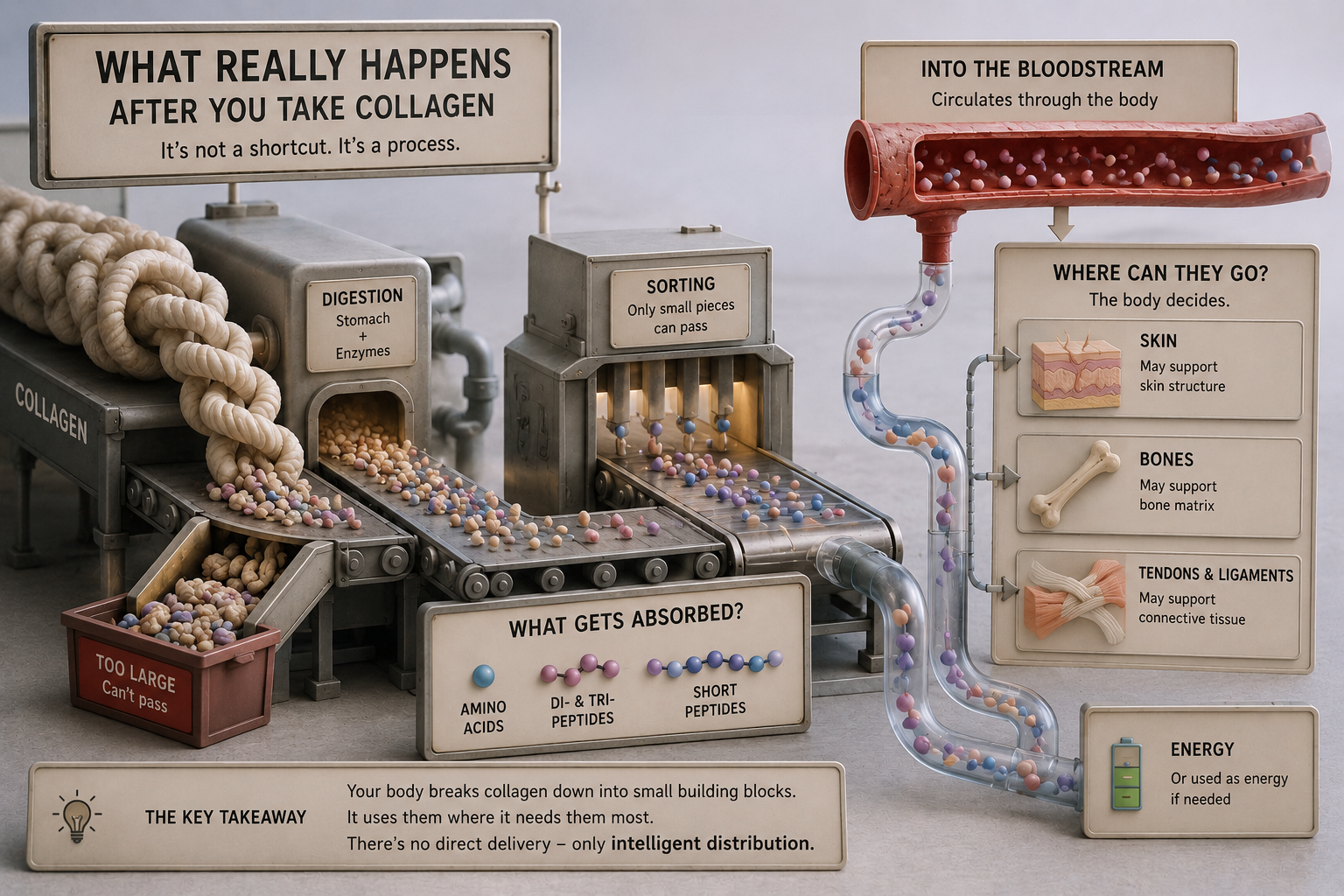
The position of collagen opponents sounds convincing, and it is worth stating it honestly. Collagen is an ordinary food protein. In the digestive tract, proteins are broken down by enzymes into amino acids and short fragments, absorbed and enter the general pool from which the body builds what it needs, and not what is written on the can. Therefore, the idea of "ate collagen - got collagen in the skin" is truly naive, and in this part the skeptics are completely right.
The word “almost” refers to the next step. Accurate measurements have shown that the cleavage is not absolute: some of the collagen fragments undergo digestion and enter the blood in the form of short peptides. This does not refute biochemistry, but clarifies it - and this is where the substantive conversation begins. This mechanism is analyzed in detail in the material on whether all collagen is cleaved to amino acids.
Three levels of evidence
The key to the whole topic is to understand that the statement “collagen works” can mean three different things, tested by different methods and with different levels of reliability.
| Level | What question does it answer? | How is it checked? | State of the evidence |
|---|---|---|---|
| Pharmacokinetics | Do collagen fragments enter the bloodstream? | Human plasma mass spectrometry | Confirmed by direct measurements |
| Cellular mechanism | Do cells respond to these fragments? | Cell cultures, animal models | The signal is there, but it is received mainly outside the living organism. |
| Clinical outcome | Does the condition of the tissue change in humans? | Randomized trials, meta-analyses | Depends on the area - and a lot |
Most of the controversy on the internet arises from mixing these levels. An article that proves the presence of peptides in the blood does not prove the benefit for the skin. A meta-analysis that found no effect for the skin does not disprove the presence of peptides in the blood. Both can be correct at the same time.
Level one: what reaches the bloodstream
Strongest level of evidence: Short peptides containing hydroxyproline, an amino acid that is almost absent in other dietary proteins, are consistently detected in human plasma after ingestion of hydrolyzed collagen. This has been replicated by multiple independent laboratories using targeted methods.
What this means: Hydrolyzed collagen is truly different from any other protein in the molecules that appear in the bloodstream after you take it. What this doesn't mean: that these molecules do anything.
Level two: do the cells respond?
Here the evidence base is noticeably weaker, although it looks impressive. In cultures of dermal fibroblasts, collagen peptides increase proliferation and the activity of genes associated with the construction of the extracellular matrix. Similar results are found for cartilage cells and bone progenitor cells.
The problem is that the concentrations at which these effects were obtained are higher than the actual levels in human blood, and most of the results come from a petri dish, not a living organism. The hypothesis is plausible, but remains a hypothesis - a detailed analysis with the limits of the evidence is in the material on Pro-Hyp, Hyp-Gly and Gly-Pro-Hyp.
.jpg)
Level three: skin
The most controversial part of the topic. Meta-analyses of clinical trials show positive results for skin hydration and elasticity. But when the studies are separated by funding source and methodological quality, the signal in the independent and highest-quality studies disappears.
Therefore, the answer to the question “does collagen help the skin” is not “yes” or “no,” but “there is not enough evidence yet, and this is not the same as a proven lack of effect.” Why meta-analyses of the same literature have reached opposite conclusions is discussed separately in the article on why some studies show an effect and others do not.
Level three: joints and tendons
With tendons, the situation is intermediate: markers of collagen synthesis in the blood increase after administration, but direct measurement of the rate of synthesis in the tissue showed no increase. There is no data on a decrease in the frequency of injuries. This discrepancy between the marker and the tissue is analyzed in the article about collagen for tendons before training.
Are all collagens the same?
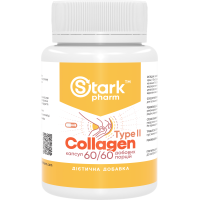
No — and this is a separate layer of the question that is usually missed, although it influences the choice more strongly than all the previous ones. The source of raw materials — fish, pork, cattle — affects the profile of peptides in the blood, although the overall absorption is similar. The molecular weight, which is put on the label as the main advantage, has much less influence within the limits of typical hydrolysates than the advertising claims. Undenatured collagen type II does not belong in this conversation at all: it is taken in milligrams, and it works through the immune mechanism, and not as a building material.
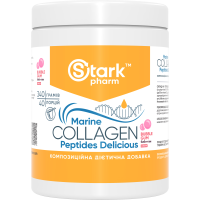
A separate question is whether hydrolysis is needed at all, because regular gelatin also produces collagen peptides in the blood, just less and more slowly. A comparison of the two forms with numbers is in the material on what to choose — hydrolyzed collagen or gelatin.
What follows from this?
The realistic position lies between the two extremes, and neither of them holds up to scrutiny. The thesis “collagen is completely useless because it is digested” is too simplistic: targeted measurements show that some of the fragments reach the blood in an unchanged form, and no other source of protein provides such molecules. The thesis “collagen restores skin, cartilage, and ligaments” also does not hold up: clinical data are uneven, stronger for joints, contradictory for skin, fragmentary for tendons, and structural changes in the tissue are nowhere shown.
In practical terms, this means that it is wise to view collagen as a supplement with a possible small effect and incomplete evidence base, rather than as a building block for your own connective tissue. Expectations should be calibrated to the timescale of the studies—months, not weeks—and to remember that factors with an incomparably stronger evidence base lie outside the supplements: for skin, these are sun protection, sleep, and smoking cessation; for joints, these are physical activity and weight management.
Finally, about precautions. The first thing to look at is what a particular product is made of: the raw materials are fish, pork, cattle or chicken cartilage, and in the presence of food allergies, this is a determining criterion. The second applies to situations when the body already works with an increased protein load: in case of kidney diseases, the appropriateness of any protein powder is determined by a doctor. The same applies to pregnancy, lactation and constant use of medications.
Frequently asked questions
Is it true that collagen is simply digested into amino acids?
Mostly yes, but not completely. Some of the fragments reach the blood in the form of short peptides, which has been confirmed by targeted measurements in humans.
Why do some sources say collagen works and others say it doesn't?
They talk about different levels of evidence. The presence of peptides in the blood, the response of cells in culture, and the clinical outcome in humans are three different questions with different levels of certainty of answers.
What is the strongest evidence base for?
For joints. There, generalizations cover thousands of patients, and the certainty of the evidence for function is rated as high, although the effect itself is small.
And for the skin?
Controversial. Pooled analyses yield a positive result, but it is not confirmed in independent and methodologically high-quality studies.
Does collagen restore cartilage or skin structure?
This has not been shown. The studies measured symptoms, function, and instrumental measures of skin condition, not tissue structure.
Does it make a difference which collagen to buy?
E. The source of the raw material affects the peptide profile in the blood, and undenatured type II collagen generally works by a different mechanism and in milligram quantities.
How long does it take to evaluate the result?
Studies on this topic lasted from several months to six months. It is premature to assess the effect after two to three weeks of use.
Sources
- Ohara H. and others. (2010). Collagen-derived dipeptide, proline-hydroxyproline, stimulates cell proliferation and hyaluronic acid synthesis in cultured human dermal fibroblasts. The Journal of Dermatology. https://pubmed.ncbi.nlm.nih.gov/20507402/
- Iwasaki Y. and others. (2022). Comparison of gelatin and low-molecular weight gelatin hydrolysate ingestion on hydroxyproline (Hyp), Pro-Hyp and Hyp-Gly concentrations in human blood. Food Chemistry. https://pubmed.ncbi.nlm.nih.gov/34461513/
- Liang C.-W. etc. (2024). Efficacy and safety of collagen derivatives for osteoarthritis: a trial sequential meta-analysis. Osteoarthritis and Cartilage. https://pubmed.ncbi.nlm.nih.gov/38218227/
- Virgilio N. and others. (2024). Absorption of bioactive peptides following collagen hydrolysate intake: a randomized, double-blind crossover study in healthy individuals. Frontiers in Nutrition. https://pmc.ncbi.nlm.nih.gov/articles/PMC11325589/
- Myung S.-K., Park Y. (2025). Effects of collagen supplements on skin aging: a systematic review and meta-analysis of randomized controlled trials. The American Journal of Medicine. https://pubmed.ncbi.nlm.nih.gov/40324552/
Dietary supplement. Not a medicine. Consult a doctor before use.
Products related to this post
516.00грн
Add to Cart
Related Posts
Comments
Information
Customer Service
Extras
My Account


Sports nutrition manufacturer in Ukraine StarkPharm © 2026