Your shopping cart is empty!

Collagen for skin: why some studies show an effect and others don't
Published: 01/09/2026
Times Read: 551
Comments : 0
A search for “collagen for skin” yields two opposing answers with equally confident tones. Some sources cite meta-analyses that confirm improved hydration and elasticity. Others cite meta-analyses that conclude that there is no clinical evidence. The interesting thing here is that both sides are right and both cite correctly: they rely on works that analyzed virtually the same literature, but stopped at different depths. Let’s analyze what exactly the difference is, because it explains the entire controversy.
Three meta-analyses, three different answers
Over the past five years, several reviews of clinical studies on collagen for skin have been published, three of which are the largest and most frequently cited.
| Work | Amount | What did it show? |
|---|---|---|
| de Miranda et al., 2021 Int J Dermatol | 19 studies, 1125 participants aged 20–70 years, 95% women | Positive results for hydration, elasticity, and wrinkles; conclusion: 90 days of use reduces signs of skin aging |
| Pu et al., 2023 Nutrients | 26 randomized trials, 1721 participants | Significant improvement in hydration and elasticity versus placebo; however, the authors noted several types of bias in the included studies and called for larger studies |
| Myung and Park, 2025 Am J Med | 23 randomized trials, 1474 participants | In the pooled analysis, there is a significant improvement in all three indicators. After dividing the works into subgroups, the effect disappears. |
Note: there is no dispute about the data here. All three papers see the same positive signal in the combined analysis. The difference comes in the next step—when one of them asks whose research is generating the signal.
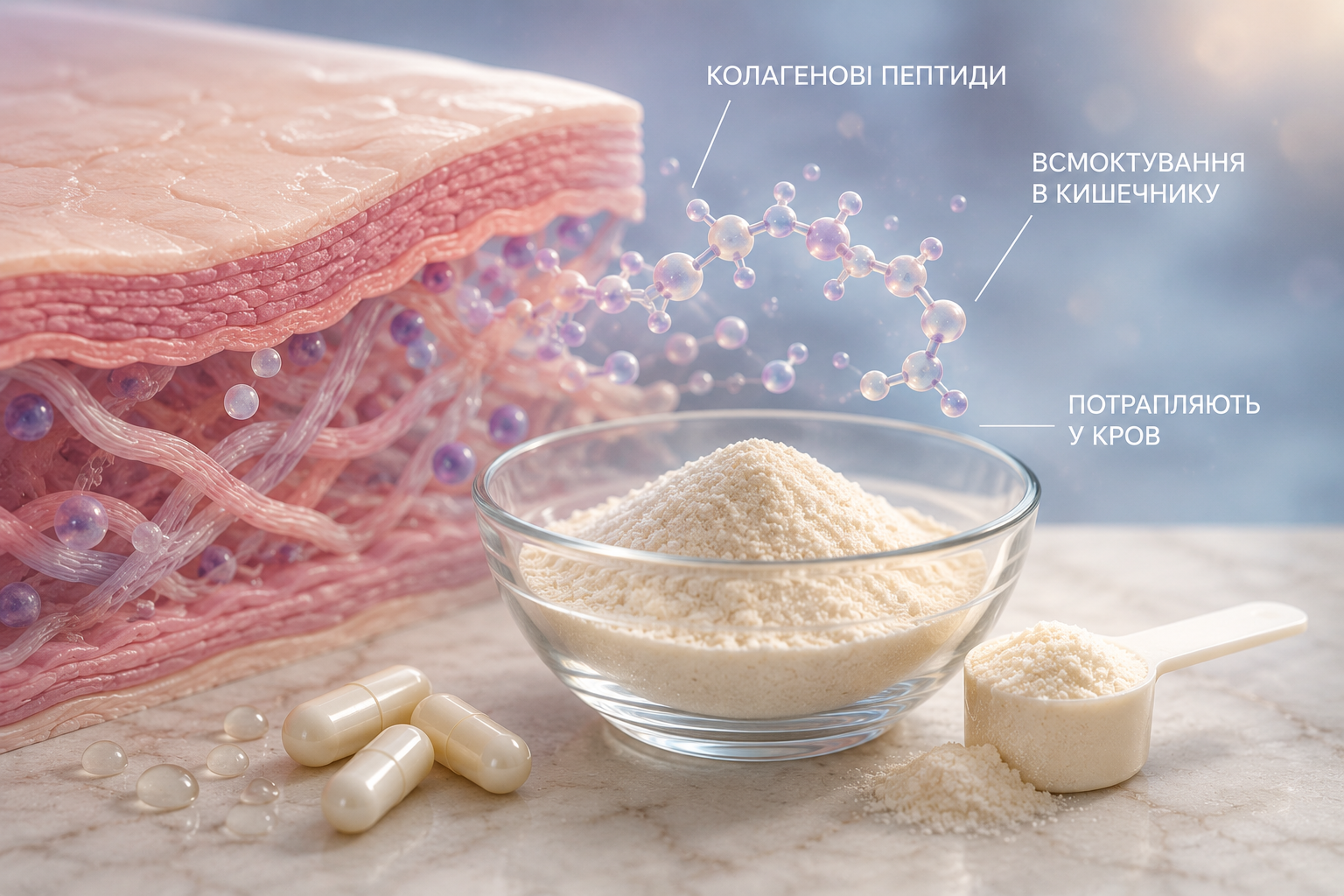
What does the combined signal show?
First, about what was actually found, because the article is not about denying the results. The most stable indicator is skin hydration: it turns out to be significant in all three meta-analyses, and the statistical power here is the greatest. The second most stable is elasticity. Both are measured with devices: hydration - with a corneometer, elasticity - with a cuitometer, that is, this is not a self-assessment of the participants, but instrumental data.
It's more complicated with wrinkles. There is a positive result, but it is less consistent between studies and depends more on the measurement method - the depth of wrinkles is assessed using different profilometry and photoanalysis systems, which are not standardized between studies.
Mechanistically, the signal is not unfounded: collagen peptides do enter the blood and affect the behavior of fibroblasts in cell models. How far these data can be transferred to living skin is a separate question, discussed in the material on the signaling role of Pro-Hyp, Hyp-Gly and Gly-Pro-Hyp. That is, the effect is plausible. The only question is its size and reliability.
What does stratification change?
The key difference in the 2025 work is that its authors did not stop at a combined indicator, but divided the study into subgroups and listed the results separately for each.
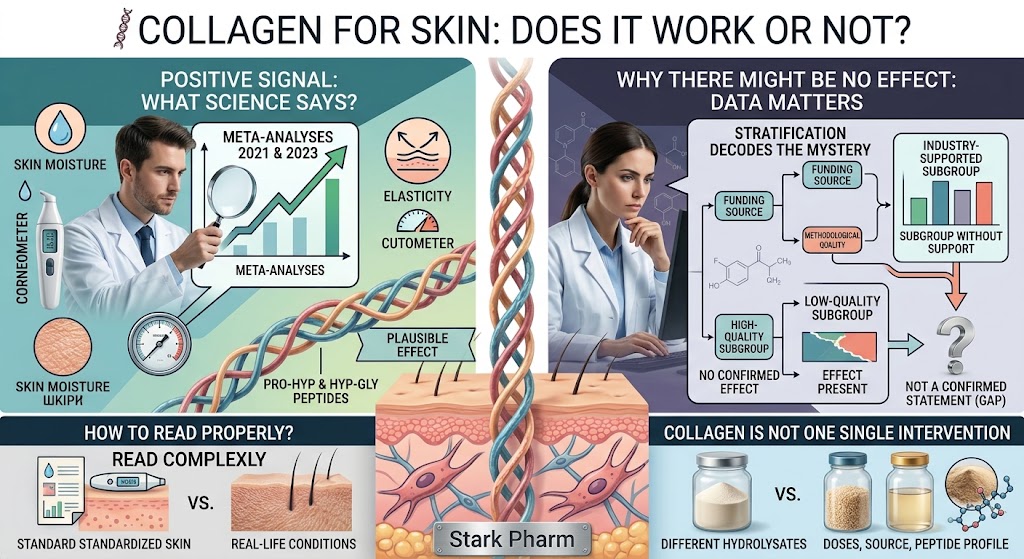
The first division was by funding source. In the subgroup of studies that received support from pharmaceutical or food companies, the effect was maintained. In the subgroup of studies without such support, there was no significant effect in any of the three categories—neither hydration, nor elasticity, nor wrinkles.
The second division is by methodological quality, assessed by standard tools: the Jadad scale and the updated RoB 2 risk of bias assessment method. The picture was repeated: no significant effect was found among high-quality works, while it was found among lower-quality works.
The authors conclude that the available clinical evidence is currently insufficient to support the use of collagen supplements for anti-aging skin. The work itself was carried out without industry funding, and the authors declare no conflicts of interest — which is of particular importance in this topic.
Why this happens: the mechanics of bias
The result above seems revealing, but it actually describes structural problems common to the industry, not malicious intent. There are several underlying factors.
- Publication bias: Studies with null results are less likely to be published—they are less likely to be peer-reviewed, less likely to be submitted by authors, and rarely have a sponsor interested in them. The literature base is therefore initially biased toward positive findings.
- Freedom in design. The study sponsor chooses the dose, duration, age of participants, and most importantly, which endpoints to measure. If there are multiple endpoints, the probability that at least one will yield a significant result increases mechanically.
- Small sample sizes. A typical study in this field has between thirty and seventy participants. With such a large sample size, it is easy to mistake random fluctuations for effects and miss truly small effects.
- Sensitivity of measurements. Corneometer readings depend on room humidity and temperature, time of day, recent washing and use of cosmetics. This is difficult to standardize, and residual variability works in favor of the expected result.
- Varying durations. In a 2023 meta-analysis, intervention durations ranged from two to twelve weeks. Combining a two-week study with a three-month study into a single measure is inherently questionable.
None of these factors indicate fraud. They mean that the combined result from the heterogeneous literature is systematically biased upwards—and that separating by quality provides a fairer assessment.
Why “collagen” is not a single intervention at all
There is another problem that goes deeper than funding, and it is rarely discussed. Clinical studies do not test “collagen” but specific drugs: a specific hydrolysate with a specific peptide composition, in a specific dose, for a specific duration. The doses in the studies vary by an order of magnitude — from one gram per day to ten. The sources of raw materials are different. The peptide profile is different, and it really affects the result: in a direct comparison of two hydrolysates that differed in the content of Pro-Hyp and Hyp-Gly, the one with more of these peptides gave the best result.
The extent of this heterogeneity is evident from the details of a 2023 meta-analysis: of the twenty-six included studies, fourteen used fish raw materials, one each from beef and chicken, two from pork, and nine did not specify the source at all. Combining such studies into a single indicator is roughly the same as calculating the average effectiveness of "pills."
The practical consequence for the reader is important: a positive meta-analysis does not imply that any collagen off the shelf will work, and a negative one does not imply that none will. The question of how exactly the products differ and what can be tested from this is discussed separately in the material on the peptide profile of collagen.
What follows from this?
The most important distinction in the whole topic is this: “insufficient evidence of an effect” and “proven to have no effect” are fundamentally different statements. The 2025 meta-analysis established the former, not the latter. It showed that when considering only methodologically sound and independent studies, the available data are insufficient to draw a confident conclusion. This is not a refutation, but rather a statement of a gap.
The realistic picture today looks like this. The effect is possible and mechanistically plausible. The most stable signal is for skin hydration, weaker for elasticity, and least reliable for wrinkles. The effect size is rather small, and the increase measured by devices does not necessarily coincide with what a person will see in the mirror. The time frame over which it makes sense to evaluate the result is months, not weeks: both positive meta-analyses speak of 90 days and twelve weeks, respectively.
And a separate tip for reading sources. If you come across a confident statement that “collagen has been proven to work” or an equally confident statement that “collagen is useless” — both statements indicate that the author did not look beyond the combined indicator. An honest answer to this question sounds more complicated today.
A few words about precautions. Collagen supplements are a dietary protein, and the warnings primarily concern the origin of the raw materials in the presence of allergies. In case of kidney diseases, additional protein load requires medical supervision, and pregnancy, lactation period and regular medication are situations when the decision should be made together with a doctor. And the main thing for this topic: the condition of the skin depends on sleep, nutrition, smoking and sun protection much more than on any individual supplement.
Frequently asked questions
Does collagen for skin work or not?
The evidence base does not provide a clear answer. In pooled analyses, there is an effect, but in independent and methodologically stronger studies, it is not confirmed.
Why did the meta-analyses reach different conclusions?
They analyzed virtually the same literature, but at different depths. Two limited themselves to a combined indicator, the third additionally divided the works by funding and quality.
Which indicator is the most reliable?
Skin hydration is significant in all three meta-analyses. Elasticity is less consistent, and results for wrinkles are the least consistent.
Does this mean that research is being falsified?
No. It's about the structural features of the industry: null results are less likely to be published, the sponsor influences the design, the samples are small, and the measurements are sensitive to conditions.
Can the results of one study be transferred to any collagen?
No. The robots test specific drugs with a specific peptide composition and dose, and they vary by an order of magnitude between products.
How long does it take to evaluate the result?
Both positive meta-analyses operate with time frames of about 90 days and twelve weeks. It is premature to assess the effect after two to three weeks of use.
What affects skin condition more than supplements?
Sleep, nutrition, smoking cessation, and UV protection are factors with an incomparably stronger evidence base.
Sources
- Proksch E. and others. (2014). Oral supplementation of specific collagen peptides has beneficial effects on human skin physiology: a double-blind, placebo-controlled study. Skin Pharmacology and Physiology. https://pubmed.ncbi.nlm.nih.gov/23949208/
- Inoue N., Sugihara F., Wang X. (2016). Ingestion of bioactive collagen hydrolysates enhances facial skin moisture and elasticity and reduces facial aging signs in a randomized double-blind placebo-controlled clinical study. Journal of the Science of Food and Agriculture. https://pubmed.ncbi.nlm.nih.gov/26840887/
- Kim DU et al. (2018). Oral intake of low-molecular-weight collagen peptide improves hydration, elasticity, and wrinkling in human skin: a randomized, double-blind, placebo-controlled study. Nutrients. https://pmc.ncbi.nlm.nih.gov/articles/PMC6073484/
- de Miranda RB, Weimer P., Rossi RC (2021). Effects of hydrolyzed collagen supplementation on skin aging: a systematic review and meta-analysis. International Journal of Dermatology. https://pubmed.ncbi.nlm.nih.gov/33742704/
- Pu S.-Y. etc. (2023). Effects of oral collagen for skin anti-aging: a systematic review and meta-analysis. Nutrients. https://pmc.ncbi.nlm.nih.gov/articles/PMC10180699/
- Myung S.-K., Park Y. (2025). Effects of collagen supplements on skin aging: a systematic review and meta-analysis of randomized controlled trials. The American Journal of Medicine. https://pubmed.ncbi.nlm.nih.gov/40324552/
Dietary supplement. Not a medicine. Consult a doctor before use.
Products related to this post
Related Posts
Comments
Information
Customer Service
Extras
My Account


Sports nutrition manufacturer in Ukraine StarkPharm © 2026