Your shopping cart is empty!

Collagen Peptide Profile: Why Not All Hydrolysates Are the Same Despite the Same 10g
Published: 31/08/2026
Times Read: 359
Comments : 0
Two hydrolyzed collagen powders can have the same daily serving, the same protein content, and the same total hydroxyproline—and yet be made up of different molecules. The mass of the raw material describes how much collagen material is in the jar; it says nothing about the exact fragments into which that material is cut. The set of such fragments is called a peptide profile, or peptide fingerprint, and enough data has accumulated around it in recent years to make the question of “are all hydrolysates the same” no longer rhetorical. The short answer is no. The more difficult question is whether this provides a criterion for selection. Here, the answer is more cautious.
Why the number "10 g" only half describes the product
Collagen hydrolysate is not a single substance, but a mixture of several thousand different peptides. The manufacturing process determines which sequences will be included in this mixture and in what proportion. Two products with identical protein labels can differ in this composition as much as two piles of bricks of the same weight, from which different structures are built, differ.
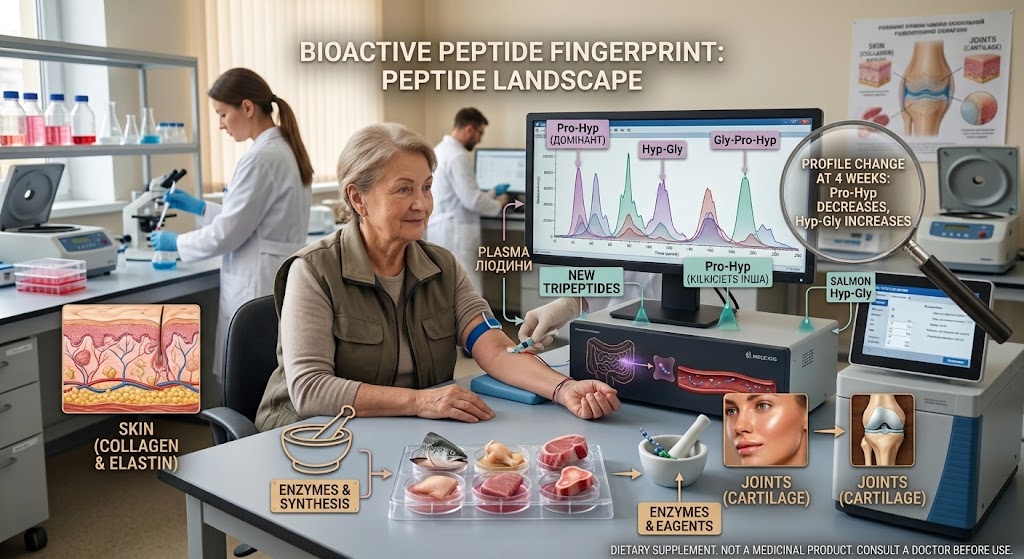
Comparison of different hydrolysates in humans confirms this. Ohara et al. (2007) gave participants hydrolysates from fish scales, fish skin and pig skin and obtained not only different areas under the curve, but also a different set of peptides in plasma: some tripeptides appeared in the blood only after fish raw materials. In the 2024 work, four commercial hydrolysates also gave markedly different ratios of the main peptides to each other.

What shapes the profile: raw materials, enzymes and depth of digestion
There are essentially three variables that determine the final composition, and the first of these is the source. Fish, pork, and bovine raw materials differ in the primary sequence of collagen and the ratio of its types. These differences are small but systematic: they change which fragments are formed when the chain is cut.
Protease selection. Each enzyme recognizes its own sites and cuts at specific bonds. Different enzyme systems produce different final fragments from the same raw material. This is a key variable that the manufacturer consciously controls, and at the same time one that is almost never mentioned on labels.
Depth of hydrolysis. The longer and more aggressive the cleavage, the shorter the chains become. Here is an important nuance: the result is described not by a single number, but by a molecular weight distribution curve. The average value on the label collapses this curve to a point. Two products with the declared “2000 Da” may have a different fraction of the fraction below a thousand daltons - and it is this fraction, and not the average, that is closer to what determines the behavior of the product in the digestive tract.
That the depth of cleavage does matter is shown in an extreme case. In a direct comparison of gelatin with an enzymatically cleaved product, Iwasaki et al. (2022) found approximately half the level of free hydroxyproline in the blood after the undecomposed form. The only question is to what extent this effect persists on a smaller scale - between two products that have both already undergone hydrolysis.
What indicators are generally used to describe hydrolysate?
To navigate the specifications, it is useful to understand what each indicator measures and where the limit of its informativeness is.
| Indicator | What does it show? | What it doesn't show |
|---|---|---|
| Protein content | The proportion of collagen material in the powder; in high-quality hydrolysates it exceeds 90% | Nothing about fragment structure |
| Average molecular weight | Approximate depth of hydrolysis in one digit | The shape of the distribution: the same mean can correspond to different curves |
| Molecular weight distribution | Which fractions and in what proportion are actually present? | What specific sequences are included in each faction? |
| Amino acid profile | Composition after complete digestion; confirms collagen origin by glycine and hydroxyproline content | The order of amino acids, i.e. peptides themselves |
| Peptide profile | Specific di- and tripeptides and their quantity, method - chromatography with mass spectrometry | What from this set will reach the blood? |
| Source and type of collagen | Origin of raw materials and predominant type of protein | Processing parameters for specific production |
The last line of the table is fundamental and brings us back to the main limitation of the whole topic. The list of peptides in the powder is not equal to the list of peptides in plasma: how this difference looks in practice is discussed in detail in the material on 2000 Da hydrolysate and peptides in blood . Methodologically, the composition of the mixture can be described by combining non-targeted and targeted analysis - an approach that Kleinnijenhuis et al. (2020) used to track the change in composition during digestion.
Does the profile affect the result: the only direct comparison
There is one such study, and it is one so far. Inoue et al. (2016) conducted a randomized, double-blind, placebo-controlled trial comparing two collagen hydrolysates with different Pro-Hyp and Hyp-Gly contents, as well as placebo. Skin parameters—moisture, elasticity, wrinkles, and roughness—were assessed at baseline, four weeks, and eight weeks. The authors report that the group with the higher content of these peptides showed greater improvement than the group with the lower content and the placebo group; no adverse events were observed during the trial.
The work is published in a peer-reviewed journal, and the design is strong for this field. But the weight of the result is not only determined by the design: the study was carried out by the peptide division of a gelatin manufacturer in collaboration with a clinical institution, and this is the only direct comparison of its kind. In scientific terminology, such a result is called hypothesis-generating — it formulates a hypothesis worth testing, and is not its confirmation.
Why “more Pro-Hyp is a better product” is still a premature conclusion
The temptation to turn Inoue's result into a simple rule is understandable. There are at least four arguments against this, none of which boil down to caution for caution's sake.
First and most important: the amount of peptide in the powder is a poor predictor of its level in the blood. In a comparison of four commercial hydrolysates, the dipeptide most abundant in the raw material gave a plasma increase that was about a hundred times lower than the peptide that was least abundant in the powder. The reason is that short fragments are mainly formed during digestion, cleaved from longer chains, and are not carried over ready-made from the product. So the indicator “Pro-Hyp content in the powder” does not measure what it seems.
Second: the very fact of the biological activity of these peptides has been established mainly in cell cultures, at concentrations higher than those achieved in human blood. How strong this part of the chain is is discussed separately in the material on Pro-Hyp, Hyp-Gly and Gly-Pro-Hyp .
Third: individual differences in absorption are large. At the same dose, the area under the curve in different participants varies so much that some of the inter-product differences may be explained by them.
Fourth: the profile is not a constant value even for one person. Shigemura et al. (2018) showed that after four weeks of daily intake, the composition of peptides in the blood shifts - the proportion of Hyp-Gly increases, the proportion of Pro-Hyp decreases. A criterion that changes depending on how long a person uses the product does not work well as a static indicator of quality on the label.
What can you really rely on when choosing?
From a purely practical point of view, the picture is as follows: most of the characteristics that truly describe the hydrolysate are not published in retail. Here is what is most often available to the buyer from the list and what it provides:
- Protein content. The most accessible indicator. A value below 90% for pure hydrolysate means that the powder has a noticeable amount of moisture, ash, or excipients.
- The source of raw materials and the type of collagen. They are almost always indicated. This is not an indicator of quality, but it is what allows you to consciously choose between fish, pork, and beef options based on your own considerations - allergies, dietary restrictions, religious norms.
- Declared molecular weight. Gives a rough idea of the depth of hydrolysis. The difference between a hydrolysate and gelatin in this parameter is significant; a difference between two hydrolysates within a few thousand daltons is probably not.
- No-nonsense ingredients. In a pure powder, there is no reason for a long list of ingredients; each additional item reduces the proportion of active ingredient per serving.
- Molecular weight distribution and amino acid profile. This is already the content of the certificate of analysis. It is rare in retail, but some manufacturers publish such data for individual batches - and it is a meaningful sign of openness.
- Peptide profile. Currently, this is more of a research-based feature than a commercial one. If a vendor cites it as evidence of superiority, it is worth remembering that there is no clinical validation of this criterion yet.
What follows from this?
Peptide profile is a real physical difference between products, not a marketing construct. Hydrolysates are indeed different, and this difference is measurable. At the same time, there is no basis for turning it into a selection criterion: the only direct clinical comparison was performed by the raw material manufacturer, and the indicator that is proposed to be used is measured in powder, while what is formed in the digestive tract should be important.
A few words about precautions. Collagen hydrolysate is a food protein, and the main caveat concerns the origin: the fish base is not suitable for fish allergies, pork has restrictions for some consumers for religious reasons. In the presence of chronic conditions, impaired kidney function, during pregnancy and lactation, or when constantly taking medications, the decision about any protein supplement should be agreed with a doctor.
Frequently asked questions
What is the peptide profile of collagen?
This is a set of specific short peptides in the hydrolysate and their proportions. It is determined by chromatography with mass spectrometry and is different from the amino acid profile, which only shows the composition without order.
Why can two products with the same dosage be different?
The same protein mass does not mean the same fragment structure. The source of the raw material, the enzymes chosen, and the depth of cleavage produce a different set of peptides from the same starting material.
What does the molecular weight number on the label mean?
This is the average for the mixture. It collapses the entire distribution to a single point, so two products with the same average can have different fractions of the shortest fractions.
Does higher Pro-Hyp content mean a better product?
This conclusion cannot be drawn at this time. The peptide content in the powder is a poor predictor of its level in the blood, and the only direct clinical comparison has been performed by the raw material manufacturer.
Does the source of the raw material affect the profile?
Yes, and this has been shown in humans: after fish hydrolysates, peptides appeared in the blood that were not present after pork, and the ratio of the main fragments differed between sources.
What is a certificate of analysis?
This is a manufacturer's document with the results of laboratory testing of a specific batch — protein content, moisture, safety indicators, sometimes molecular weight distribution. It is not often published in retail.
Is there a single quality standard for collagen hydrolysates?
There is no universally accepted criterion that would link peptide composition to outcome. The available indicators describe the raw materials and processing, but do not predict the effect.
Sources
- Ohara H. and others. (2007). Comparison of quantity and structures of hydroxyproline-containing peptides in human blood after oral ingestion of gelatin hydrolysates from different sources. Journal of Agricultural and Food Chemistry. https://pubmed.ncbi.nlm.nih.gov/17253720/
- Inoue N., Sugihara F., Wang X. (2016). Ingestion of bioactive collagen hydrolysates enhances facial skin moisture and elasticity and reduces facial aging signs in a randomized double-blind placebo-controlled clinical study. Journal of the Science of Food and Agriculture. https://pubmed.ncbi.nlm.nih.gov/26840887/
- Shigemura Y. and others. (2018). Changes in composition and content of food-derived peptide in human blood after daily ingestion of collagen hydrolysate for 4 weeks. Journal of the Science of Food and Agriculture. https://pubmed.ncbi.nlm.nih.gov/28914450/
- Kleinnijenhuis AJ and others. (2020). Non-targeted and targeted analysis of collagen hydrolysates during the course of digestion and absorption. Analytical and Bioanalytical Chemistry. https://pubmed.ncbi.nlm.nih.gov/31872275/
- Iwasaki Y. and others. (2022). Comparison of gelatin and low-molecular weight gelatin hydrolysate ingestion on hydroxyproline (Hyp), Pro-Hyp and Hyp-Gly concentrations in human blood. Food Chemistry. https://pubmed.ncbi.nlm.nih.gov/34461513/
- Virgilio N. and others. (2024). Absorption of bioactive peptides following collagen hydrolysate intake: a randomized, double-blind crossover study in healthy individuals. Frontiers in Nutrition. https://pmc.ncbi.nlm.nih.gov/articles/PMC11325589/
Dietary supplement. Not a medicine. Consult a doctor before use.
Products related to this post
Comments
Information
Customer Service
Extras
My Account


Sports nutrition manufacturer in Ukraine StarkPharm © 2026