Your shopping cart is empty!

Pro-Hyp, Hyp-Gly and Gly-Pro-Hyp: can collagen peptides stimulate the synthesis of their own matrix?
Published: 30/08/2026
Times Read: 547
Comments : 0
When hydrolyzed collagen is discussed seriously, the conversation sooner or later comes to three names: Pro-Hyp, Hyp-Gly and Gly-Pro-Hyp. This is not a building material - two or three amino acids against the background of tens of grams of protein from the diet do not have independent nutritional value. The interest in them is different: it is assumed that these fragments work as a signal for the cell, forcing the fibroblast to build the extracellular matrix more actively. The hypothesis is beautiful, the evidence base behind it is heterogeneous, and the difference between what is shown in cell culture and what is shown in humans is fundamental here. Let's analyze both levels separately.
Three peptides that are usually listed with commas
The first thing to get out of your head: Pro-Hyp, Hyp-Gly, and Gly-Pro-Hyp are not an equivalent trinity. They appear in the blood in different ways, in different amounts, and have been studied to very different depths.
| Peptide | Presence in human blood | Relative level | What is shown in the experiments | Model type |
|---|---|---|---|---|
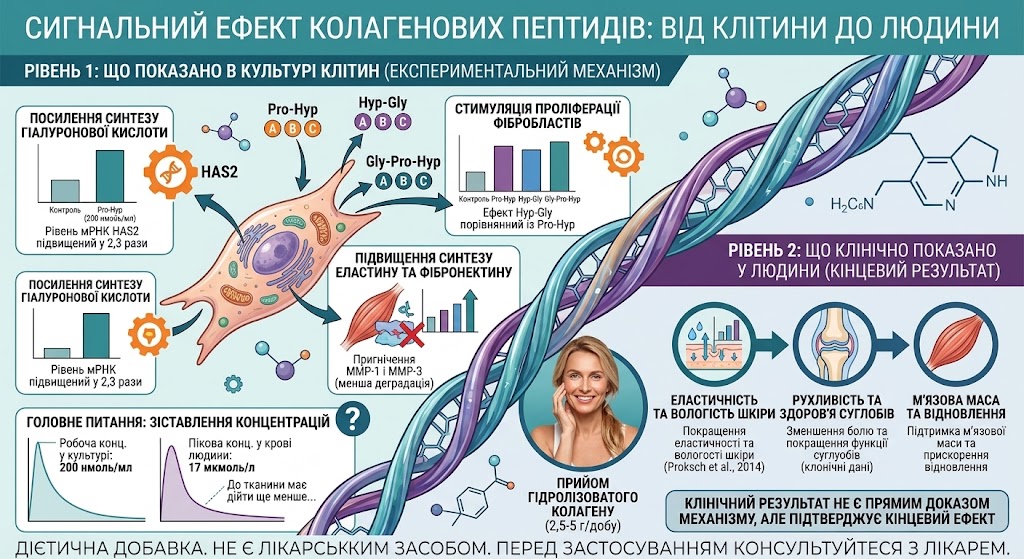
| Pro-Hyp | It proves stable in all works | Highest; maximum concentration around 60 nmol/ml (Ichikawa et al., 2010) | Fibroblast proliferation, hyaluronic acid synthesis, increase in HAS2 mRNA | Human cell culture |
| Hyp-Gly | It turns out to be stable | Significantly lower; ratio to Pro-Hyp in the range of 0.063–0.221 (Shigemura et al., 2011) | Fibroblast growth comparable to Pro-Hyp | Cell culture, mouse |
| Gly-Pro-Hyp | Depends on the raw material: increases noticeably mainly after hydrolysates with a high tripeptide content | Significantly lower than Pro-Hyp (Virgilio et al., 2024) | Attenuation of signs of fibroblast aging caused by hydrogen peroxide | Cell culture |
There is another nuance that complicates the picture. Gly-Pro-Hyp in the bloodstream is partially hydrolyzed to Pro-Hyp — this was shown by Yazaki et al. (2017), who tracked both molecules after taking a hydrolysate with a high content of tripeptides. That is, it is difficult to separate the “Gly-Pro-Hyp effect” and the “Pro-Hyp effect” in a living organism, even theoretically: the first is converted into the second.
Where did the signal hypothesis come from in the first place?
The logic here is this. Collagen di- and tripeptides do indeed enter human blood — this has been confirmed by targeted mass spectrometry in dozens of studies, and is discussed in detail in a separate article on whether all collagen is broken down into amino acids . But the quantities are meager by nutritional standards: the body receives from them fractions of a percent of the daily amino acid requirement.
So, if these peptides mean anything at all, it's not as raw materials. There remains a variant, well-known in biology: a short molecule as a signal that the cell recognizes and changes its behavior. It is this hypothesis that has begun to be tested - mainly in cell cultures.
What Pro-Hyp does to cells in culture
Reference work: Ohara et al. (2010). Researchers added various collagen peptides to human dermal fibroblast cultures and measured the response. Pro-Hyp at a concentration of 200 nmol/ml increased cell proliferation by 1.5-fold, hyaluronic acid synthesis by 3.8-fold, and hyaluronan synthase 2 (HAS2) mRNA levels by 2.3-fold.
The last number is the most interesting from a mechanistic point of view. HAS2 is the gene for the enzyme that actually synthesizes hyaluronic acid. Increasing its transcription means that the cell did not just “turn on”, but changed the expression of the gene in response to the presence of the dipeptide. This already looks like a signal, not a random metabolic effect.
Outside the skin, there is Nakatani et al. (2009): Pro-Hyp showed chondroprotective effects on mouse articular cartilage. Even further, Taga et al. (2018), where tripeptides of the X-Hyp-Gly type affected the differentiation of osteoblast precursor cells. All three results were obtained in cell culture or in rodents.
Collagen, elastin, fibronectin: what exactly was measured
“Stimulates collagen production” is the most common phrase on this topic and at the same time the least supported by specific measurements, so it’s worth looking at which matrix proteins were evaluated in the studies and what happened to them.
Edgar et al. (2018) worked with normal primary human dermal fibroblasts in a model close to the physiological density of the matrix. Collagen peptides significantly increased elastin synthesis, and also suppressed the release of matrix metalloproteinases MMP-1 and MMP-3 and reduced elastin degradation. Two clarifications, without which the result is read incorrectly. First: they tested not pure Pro-Hyp, but a mixture of peptides together with antioxidants from the finished product, and the effect on proliferation was enhanced precisely in the presence of antioxidants. Second: MMP inhibition is a “less is destroyed” mechanism, not “more is synthesized”. In marketing texts, these two things are usually merged into one, although biologically they are different.
The main question: how much peptide does the cell need and how much is in the blood?
That is, the working concentrations in the culture are approximately 3–12 times higher than the peak concentrations in the blood. And this is still an optimistic estimate: the cells in the dish are washed with the solution directly, while the peptide has yet to reach the dermis or cartilage, and how much of it ends up there is a separate, poorly studied question.
There is a second problem, which is much less well known. Asai et al. (2020) found that fetal calf serum—a standard component of the medium for such cultures—itself contains hydroxyprolyl peptides, including Pro-Hyp, at concentrations of about 70–100 μmol/L. In their experiments, fibroblasts initially did not respond at all to the addition of Pro-Hyp and Hyp-Gly, because the medium was already saturated with them. The effect appeared only after the low-molecular-weight fraction was chromatographically removed from the serum. The authors explicitly note that this calls into question the conclusions of some previous work—and at the same time confirms that, with proper control, the effect does exist.

From mechanism to clinical issue
Let's put the entire chain together and see what supports each link:
- Intake and digestion - the hydrolysate is broken down, some of the di- and tripeptides survive the digestive tract. Confirmed by direct measurements in humans.
- Appearance in blood — Pro-Hyp, Hyp-Gly and other fragments are measured in plasma, kinetics described. Confirmed by direct measurements in humans.
- Signal to the cell - fibroblasts and chondrocytes respond by changing proliferation and gene expression. Shown mainly in cell culture, at concentrations higher than physiological.
- Delivery to target tissue has been studied fragmentarily, mostly in animal models.
- Clinical outcome in humans is verified by separate studies that measure endpoints, not mechanism.
An example of the latter link: Proksch et al. (2014) conducted a double-blind, placebo-controlled study in 69 women aged 35–55 years who took 2.5 or 5 g of collagen hydrolysate or placebo daily for eight weeks, with instrumental measurements of skin elasticity and moisture. This is a different type of evidence—it answers the question of “does it change?” rather than “by what mechanism?”
The presence of evidence at the first and last levels does not mean that the chain between them is closed. Mechanistic work explains how the effect could be realized, and this is a valid scientific hypothesis - but not confirmation that collagen intake stimulates the synthesis of its own matrix in humans. The authors of the 2024 work formulate the problem directly: the threshold concentrations of metabolites required for a physiological response in the target tissue have not yet been determined.
Another detail that the reader should be aware of: much of the key work in this topic has been done by researchers affiliated with collagen raw material manufacturers or cosmetic companies, and the authors openly declare this. This does not make the data wrong — peer review and transparent methods are not going anywhere — but it does explain why there is so much mechanistic work in this field and so little independent clinical work.
What does this mean in practice?
The practical conclusion is more restrained than the manufacturers would like, and more honest than they usually write. Collagen peptides are not inert proteins that are simply digested: they have measurable biological activity in cell models and confirmed presence in the blood. But the path from this activity to a visible result in the skin or joint has not yet been fully described, and the decision to take it is reasonable to make with this level of confidence. Hydrolyzed collagen in powder format is available, in particular, in the Stark Pharm assortment — Stark Collagen Hydrolyzed Pure Powder ; the portion and method of application should be taken according to the instructions on the package.
Precautions are standard for protein supplements: consider the source of the raw material if you have a food allergy, and pregnant and lactating women, people with chronic diseases, kidney dysfunction, or those taking medications should consult a doctor beforehand. Collagen is inferior in amino acid composition and does not replace the main sources of protein in the diet.
Frequently asked questions
What is a signal peptide and how does it differ from a building material?
The cell breaks down the building material into amino acids and uses them for synthesis. A signal peptide acts differently: it is recognized by the cell and changes its behavior, remaining in negligible quantities.
Does Pro-Hyp stimulate the production of a person's own collagen?
There is currently no such evidence. In human dermal fibroblast culture, Pro-Hyp increased proliferation and hyaluronic acid synthesis, but this cannot be directly transferred to a living organism.
What is HAS2 and what does hyaluronic acid have to do with it?
HAS2 is a gene for the enzyme that synthesizes hyaluronic acid. In Ohara et al. (2010), the addition of Pro-Hyp to cell culture increased its mRNA level by 2.3-fold.
Are Pro-Hyp, Hyp-Gly, and Gly-Pro-Hyp equally active?
No. Pro-Hyp consistently dominates the blood and is the best studied; Hyp-Gly is present in significantly lower amounts; Gly-Pro-Hyp appears predominantly after hydrolysates with a high tripeptide content.
Why don't test-tube results translate directly to humans?
The concentrations at which the effect was obtained in culture are approximately 3–12 times higher than peak levels in human blood, and the cells in the dish are bathed in solution without barriers to the tissue.
Partial data are mainly from animal models: collagen peptides were detected in the skin of mice after administration of hydrolysate. Quantitative data for human tissues are lacking.
Are there clinical studies, not just cell studies?
Yes, there are placebo-controlled studies measuring skin parameters. But they verify the final result and do not prove that it is realized precisely through the described cellular mechanism.
Sources
- Nakatani S. and others. (2009). Chondroprotective effect of the bioactive peptide prolyl-hydroxyproline in mouse articular cartilage in vitro and in vivo. Osteoarthritis and Cartilage. https://pubmed.ncbi.nlm.nih.gov/19559809/
- Ohara H. and others. (2010). Collagen-derived dipeptide, proline-hydroxyproline, stimulates cell proliferation and hyaluronic acid synthesis in cultured human dermal fibroblasts. The Journal of Dermatology. https://pubmed.ncbi.nlm.nih.gov/20507402/
- Ichikawa S. and others. (2010). Hydroxyproline-containing dipeptides and tripeptides quantified at high concentration in human blood after oral administration of gelatin hydrolysate. International Journal of Food Sciences and Nutrition. https://pubmed.ncbi.nlm.nih.gov/19961355/
- Shigemura Y. and others. (2011). Identification of a novel food-derived collagen peptide, hydroxyprolyl-glycine, in human peripheral blood by pre-column derivatisation with phenyl isothiocyanate. Food Chemistry. https://pubmed.ncbi.nlm.nih.gov/25212331/
- Proksch E. and others. (2014). Oral supplementation of specific collagen peptides has beneficial effects on human skin physiology: a double-blind, placebo-controlled study. Skin Pharmacology and Physiology. https://pubmed.ncbi.nlm.nih.gov/23949208/
- Yazaki M. and others. (2017). Oral ingestion of collagen hydrolysate leads to the transportation of highly concentrated Gly-Pro-Hyp and its hydrolyzed form of Pro-Hyp into the bloodstream and skin. Journal of Agricultural and Food Chemistry. https://pubmed.ncbi.nlm.nih.gov/28244315/
- Edgar S. and others. (2018). Effects of collagen-derived bioactive peptides and natural antioxidant compounds on proliferation and matrix protein synthesis by cultured normal human dermal fibroblasts. Scientific Reports. https://pubmed.ncbi.nlm.nih.gov/29992983/
- Taga Y. and others. (2018). Collagen-derived X-Hyp-Gly-type tripeptides promote differentiation of MC3T3-E1 pre-osteoblasts. Journal of Functional Foods. https://doi.org/10.1016/j.jff.2018.05.017
- Asai TT and others. (2020). Food-derived collagen peptides, prolyl-hydroxyproline (Pro-Hyp), and hydroxyprolyl-glycine (Hyp-Gly) enhance growth of primary cultured mouse skin fibroblast using fetal bovine serum free from hydroxyprolyl peptide. International Journal of Molecular Sciences. https://doi.org/10.3390/ijms21010229
- Chae M. and others. (2023). Oral ingestion of AP collagen peptide leads to systemic absorption of Gly-Pro-Hyp, alleviating H2O2-induced dermal fibroblast aging. Journal of Medicinal Food. https://pubmed.ncbi.nlm.nih.gov/37074675/
- Virgilio N. and others. (2024). Absorption of bioactive peptides following collagen hydrolysate intake: a randomized, double-blind crossover study in healthy individuals. Frontiers in Nutrition. https://pmc.ncbi.nlm.nih.gov/articles/PMC11325589/
Dietary supplement. Not a medicine. Consult a doctor before use.
Products related to this post
Comments
Information
Customer Service
Extras
My Account


Sports nutrition manufacturer in Ukraine StarkPharm © 2026