Your shopping cart is empty!

Hydrolyzed Collagen or Gelatin: Is There a Biological Difference Between Them?
Published: 01/09/2026
Times Read: 324
Comments : 0
The question “why buy hydrolysate when you can get gelatin for a penny” is heard in every discussion of collagen supplements — and it is rarely answered honestly. Usually, either gelatin is declared useless, or hydrolysate is declared marketing. Both answers are wrong: it is the same protein at different stages of processing, and the same peptides are detected in the blood after each of them. The difference exists, it is measured, but it is not where it is usually looked for, and gelatin, oddly enough, has its own human evidence base, obtained by independent researchers.
One protein, three states
The confusion begins with the fact that gelatin and hydrolysate are presented as different substances. In fact, they are successive stages of collagen processing, and each subsequent state is obtained from the previous one.
Collagen in tissue is a triple helix of three intertwined chains. Heating unravels the helix: the bonds between the chains are broken, the chains separate, and the protein becomes soluble in hot water. This is denaturation, and its product is called gelatin. Chemically, the chains remain intact—it is the structure that has broken down, not the chain itself. The next step is enzymatic cleavage, when proteases cut the chains into shorter fragments. This is hydrolysis, and its product is a hydrolysate.
| Parameter | Collagen | Gelatin | Hydrolysate |
|---|---|---|---|
| What did they do? | Nothing | Heated | Heated and broken down by enzymes |
| Structure | Triple helix | Whole chains are untied | Short snippets |
| Molecular weight | About 300,000 Da | Tens and hundreds of thousands Yes | Thousands Yes |
| Solubility | Insoluble | Only in hot water | In cold water |
| Forms a gel | No | Yes | No |
| Taste and smell | — | Pronounced meaty | Weak or neutral |
The table shows the main point: there is no difference in origin or chemical composition between gelatin and hydrolysate - there is a difference in how far the processing has gone.
Why are they the same in amino acid composition?
Enzymatic cleavage cuts the chain but does not change the amino acids it is made of. Therefore, gelatin and hydrolysate have an almost identical amino acid profile: the same high proportion of glycine, the same proline, the same hydroxyproline.
The practical consequence of this is clear. If the goal is simply to get collagen amino acids from food, there is no difference between the two products at all. Both are completely digestible, both provide the same building blocks. The whole argument only makes sense if we assume that it is not the amino acids that matter, but the short peptides that survive digestion. This is where the meaningful part begins.
What does blood show after regular gelatin?
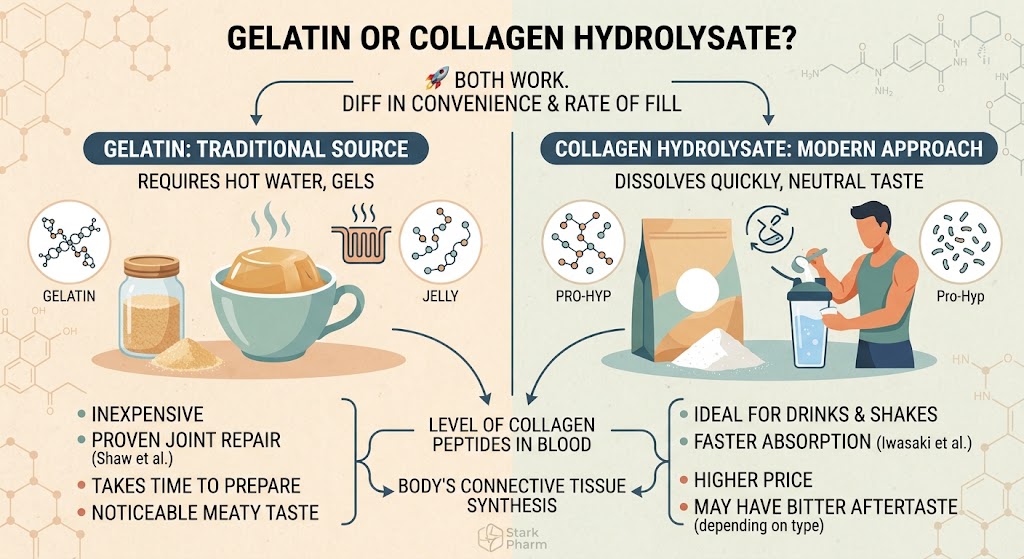
The claim that “gelatin does not provide any peptides” has been directly tested. Iwasaki et al. (2022) measured the plasma concentration of collagen fragments in nine participants after ingesting regular gelatin with a molecular weight of about one hundred thousand daltons.
The peptides were found. Pro-Hyp reached a maximum of 15.5 ± 3.0 nmol/ml in the second hour after administration, Hyp-Gly - 2.3 ± 0.5 nmol/ml in the first. These are not traces at the limit of detection, but quite measurable micromolar concentrations of the same molecules that are considered to be carriers of the hydrolysate activity.
The explanation is simple: digestive enzymes work the same way regardless of whether someone has broken down the protein beforehand or not. Pepsin and pancreatic proteases cut gelatin chains in the same way they cut hydrolysate fragments — they just have more work to do. What exactly goes through this process and in what quantities is shown in a separate article — is all collagen broken down into amino acids .
Where hydrolysate really has an advantage
In the same work, gelatin was compared with a low-molecular-weight hydrolysate in which 89% of the components were lighter than 3,000 daltons. The difference was evident, but selective.
- Free hydroxyproline — here the advantage of the hydrolysate is most noticeable: 169.1 ± 32.5 versus 94.4 ± 16.4 nmol/ml. That is, preliminary cleavage really accelerates the release of the amino acid.
- Pro-Hyp hydrolysate increased it in plasma more effectively than gelatin.
- Hyp-Gly — but here there was no difference in molecular weight at all. The second most important collagen peptide appeared in the blood equally regardless of how deeply the protein was processed.
So, the advantage of hydrolysate is real, but partial: it concerns the speed and amount of intake, and not the ability of the protein itself to give bioactive fragments. Gelatin works slower and gives less, but does not give zero. For more information on how molecular weight affects absorption within the hydrolysate category itself, see the material on the comparison of 2000 and 5000 daltons.
Gelatin's own evidence base
Shaw et al. (2017) conducted a randomized, double-blind, crossover study in eight healthy men. Participants received placebo, 5 g, or 15 g of vitamin C-fortified gelatin one hour before a short jump rope exercise. Four hours after the exercise, the 15 g group had approximately twice the levels of N-terminal propeptide of procollagen type I, a marker that is cleaved during the maturation of new collagen, compared to controls. Blood levels of glycine, proline, hydroxyproline, and hydroxylysine increased in a dose-dependent manner, peaking one hour after ingestion.
The researchers also treated artificially grown ligaments in culture with the participants' serum and observed an increase in collagen content and improved mechanical properties.
This result should be read with caution. The N-terminal propeptide is a biochemical marker of synthesis, not a clinical outcome: the study showed neither fewer injuries nor faster recovery. The vitamin C in the composition also matters, as it is required for enzymes that hydroxylate proline. But the fact remains: gelatin has human data from independent researchers, while most of the work on hydrolysate is funded by manufacturers of collagen raw materials.
How much collagen does regular food provide?
Household sources of gelatin include jellied meat, bone broth, and dishes with cartilage and skin. How comparable this is to the supplement was also measured.
Asai et al. (2019) determined the collagen content of typical dishes: a single serving of most of them contains between 0.2 and 2.5 g of collagen, with only a few items—beef tendon, eel with skin, shark tail—providing between 7.6 and 13.3 g. The researchers then gave participants cooked meat with a high collagen content and found nine collagen di- and tripeptides in their plasma. The area under the curve for most of these was about 30% of that given by a hydrolysate with an equivalent amount of collagen. A similar figure was obtained in a laboratory digestion model: enzymes released about a third of the collagen present from the meat.
The conclusion is practical. Collagen-containing foods really increase the level of collagen peptides in the blood - this is not a myth. But to get from jellied meat an amount comparable to a portion of the supplement, the portion of the dish must be large, and along with the collagen, an appropriate amount of fat and salt will be added. The supplement here wins not with the uniqueness of the substance, but with its concentration and predictability.
What does this mean in practice?
The evidence base does not provide a direct answer to the question "which is better", because no study has been conducted in which gelatin and hydrolysate would be compared in terms of end points - skin condition, joint function. There is only a comparison of pharmacokinetics, and it is clear from it that the hydrolysate gives more and faster, but gelatin also gives.
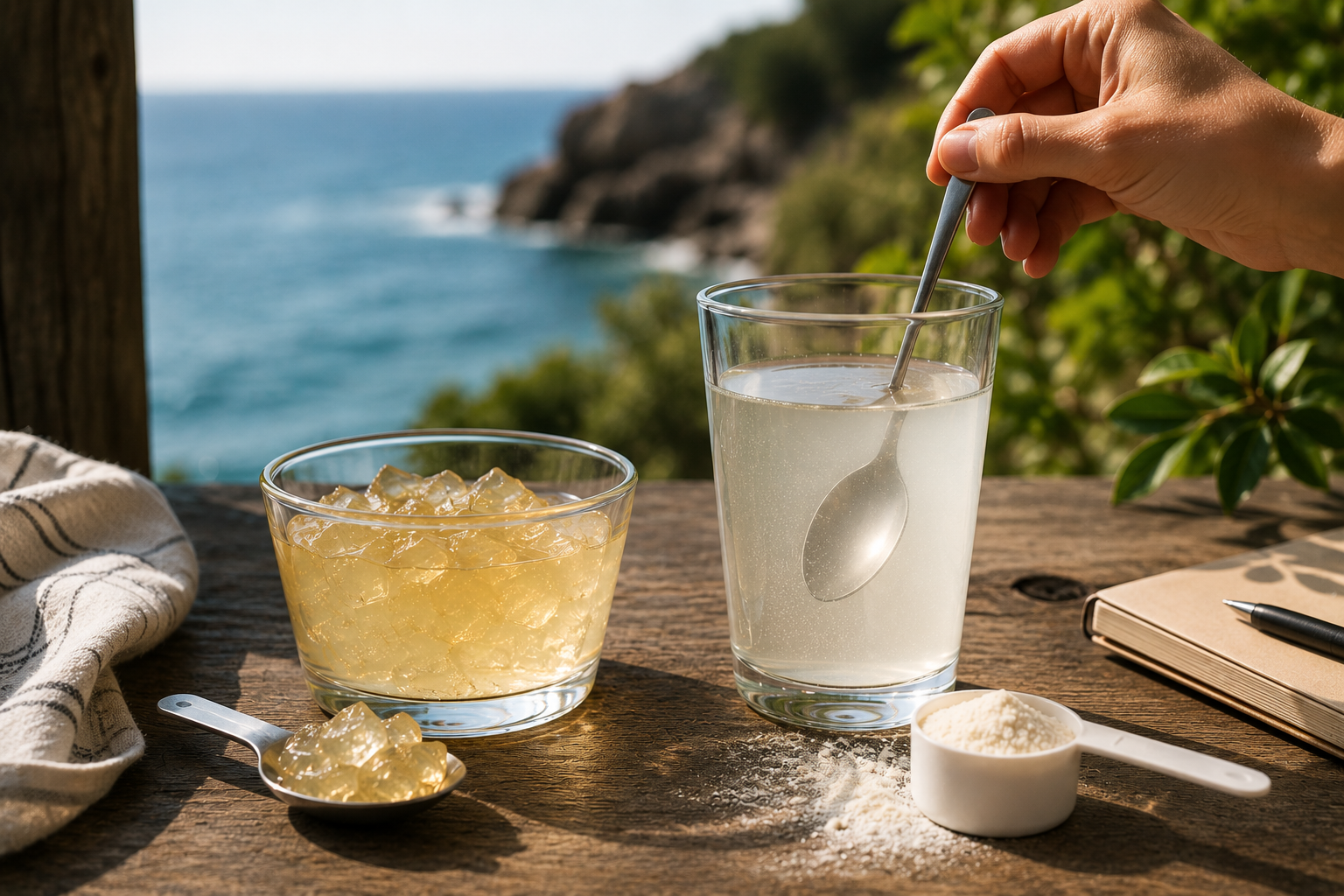
Therefore, the choice is mostly determined not by biochemistry, but by convenience. The hydrolysate dissolves in cold water, does not gel, and has almost no taste — it can be added to any drink. Gelatin requires hot water, solidifies when cooled, and has a pronounced aftertaste, which makes it inconvenient to use outside of cooking. It is this difference, not hundreds of nanograms of peptides, that usually decides in practice. Among the powder forms without foreign components — Stark Collagen Hydrolyzed Pure Powder; as a guide for the amount and method of use, the instructions on the package serve as a guideline.
A few notes on caution. Both products are ordinary food protein of animal origin, so the restrictions relate more to the origin of the raw material: the pork base is unsuitable due to religious restrictions, the fish base - due to allergies to fish. Situations when the protein load requires medical control are also the same for gelatin and hydrolysate: this is primarily impaired kidney function. During pregnancy, lactation and when taking medications regularly, the appropriateness of any supplement is determined by a doctor.
Frequently asked questions
How is gelatin different from hydrolyzed collagen?
By the degree of processing. Gelatin is heated collagen with an unwound spiral, hydrolysate is the same gelatin, additionally cut by enzymes into shorter fragments.
Do they have the same amino acid composition?
Practically yes. Enzymatic cleavage changes the length of the chains, but not the amino acids themselves, because the source of glycine, proline, and hydroxyproline are both equivalent.
Do peptides appear in the blood after gelatin?
Yes. In a study of nine people, after taking gelatin, Pro-Hyp reached 15.5 nmol/mL and Hyp-Gly reached 2.3 nmol/mL.
How much better is hydrolysate absorbed?
For free hydroxyproline, it is about twice as good. But for the Hyp-Gly peptide, no difference was found between gelatin and hydrolysate at all.
Are there any clinical studies on gelatin itself?
E. In a study with eight participants, 15 g of gelatin with vitamin C an hour before exercise approximately doubled a marker of collagen synthesis in the blood.
Can I replace the supplement with jelly?
Partially. Collagen-containing foods increase the level of peptides in the blood, but the area under the curve is about a third of that given by a hydrolysate with an equivalent collagen content.
What to choose if the difference is small?
It's mostly a matter of convenience: hydrolysate dissolves in cold water and has no taste, while gelatin requires hot water and hardens, so it's more difficult to use outside of cooking.
Sources
Dietary supplement. Not a medicine. Consult a doctor before use.
Products related to this post
Related Posts
Comments
Information
Customer Service
Extras
My Account


Sports nutrition manufacturer in Ukraine StarkPharm © 2026