Your shopping cart is empty!

Collagen 2000 Da vs 5000 Da: Does Lower Molecular Weight Mean Better Absorption?
Published: 01/09/2026
Times Read: 432
Comments : 0
The molecular weight number has become the main argument in the hydrolyzed collagen category. The logic seems impeccable: smaller fragments are more easily absorbed, so 2,000 daltons should work better than 5,000. The problem is that almost no one follows this logic to the end - and if you do, it turns out that both numbers describe molecules that do not enter the bloodstream unchanged at all. Let's figure out what is behind the number on the label, what the only direct comparison of the two masses showed, and why there is still no clinical answer to this question.
What exactly does the number on the label mean?
The molecular weight of a hydrolysate is the arithmetic average of a mixture in which fragments of very different lengths are simultaneously present: from individual amino acids to chains of several dozen residues. The manufacturer measures the distribution and derives a single number, convenient for labeling.
The problem with the average is that it has no physical carrier of its own. In a powder labeled "2000 Da," there is no single molecule necessarily weighing exactly 2000 daltons—there is a set whose average gives that value. Two batches with the same average may have different distributions: one dominated by a narrow range around the average, the other by a mixture of very short and noticeably longer fragments that give the same number on average.
The second property of the average is that it is weighted by mass, not by the number of molecules. One long chain of 10,000 daltons contributes on average as much as forty dipeptides. Therefore, a product can have a “high” average and still contain many short fragments, and vice versa.
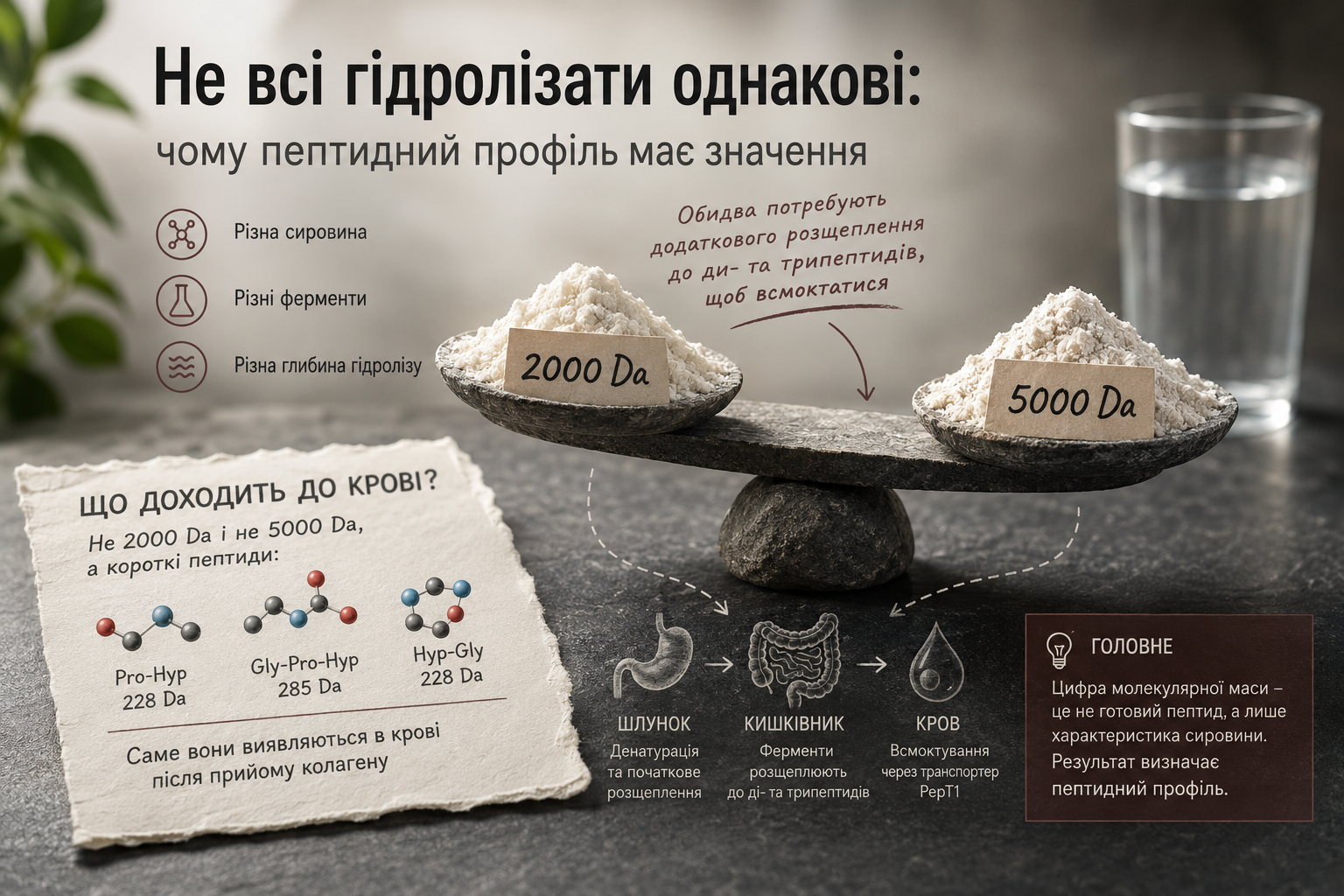
How many amino acids are behind the number 2000?
This is the most useful calculation in the whole topic, and anyone can do it. The average mass of a single amino acid residue in collagen is about 90 daltons—collagen is extremely rich in glycine, the lightest of the amino acids. Dividing the mass of the fragment by this number gives us an approximate chain length.
| Object | Approximate molecular weight | Approximate length |
|---|---|---|
| Glycine (free amino acid) | 75 Yes | 1 remainder |
| Pro-Hyp (dipeptide) | 228 Yes | 2 leftovers |
| Gly-Pro-Hyp (tripeptide) | 285 Yes | 3 leftovers |
| Hydrolysate "2000 Da" | about 2000 Da | about 20 remains |
| Hydrolysate "5000 Da" | about 5000 Da | about 55 remains |
| Gelatin | tens and hundreds of thousands Yes | hundreds of remains |
| Collagen molecule | about 300,000 Da | about 3000 remains |
Now the scale is visible. The peptides that are actually detected in human blood after taking collagen weigh 228–285 daltons. The hydrolysate labeled “2000 Da” consists mainly of fragments that are about ten times longer. That is, even the most “low-molecular” product on the shelf is not yet a set of ready-made bioactive peptides, but raw materials from which the digestive tract has to cut them.
Why there is a ceiling in mass absorption
There is a limitation here that the advertising doesn't mention. Short peptides enter the bloodstream from the gut via the PepT1 transporter, and it works exclusively with di- and tripeptides—molecules of two or three residues. A twenty-residue fragment won't make it through this route; a fifty-five-residue fragment won't either.
So both 2,000 and 5,000 dalton products require the same amount of further enzymatic work: both must be cut down to two- or three-letter fragments or free amino acids before anything can be absorbed. The difference between the two is how many cuts are left to be made, not whether cuts are needed at all. This explains why the intuitive logic of “less is better” does not scale linearly: it would make sense if smaller mass meant a size ready for absorption, but in the thousands of dalton range it does not.
What a direct comparison of the two masses showed
The only experiment in which mass was the only variable is the only one. In a cross-sectional study by Virgilio et al. (2024), six volunteers were given, among other things, two bovine hydrolysates, with an average mass of about 2,000 and about 5,000 daltons. The raw material is the same, only the depth of cleavage differs, so any difference in the results can be attributed to mass.
There was one difference: the area under the total hydroxyproline concentration curve was 1.2 times larger after the lighter product. It is worth understanding what this means. This is the total amount of collagen material that entered the blood in six hours, and the advantage is twenty percent — a real value, but not such that it would turn one product into a fundamentally different one. No differences were found in the content of specific peptides — the same Pro-Hyp, Hyp-Gly, Gly-Pro-Hyp — at all. A detailed analysis of this entire study, along with figures for each peptide, is in a separate material about the 2000 Da hydrolysate and peptides in the blood.
For contrast, here is a case where mass really does matter. Iwasaki et al. (2022) compared hydrolysate with regular gelatin, which is two orders of magnitude heavier, and found an almost twofold difference in the absorption of free hydroxyproline. That is, it is not the small mass per se that is at work, but the fact that the protein has been pre-digested at all. The difference between “undigested” and “digested” is large; between “digested” and “digested a little more” is insignificant.
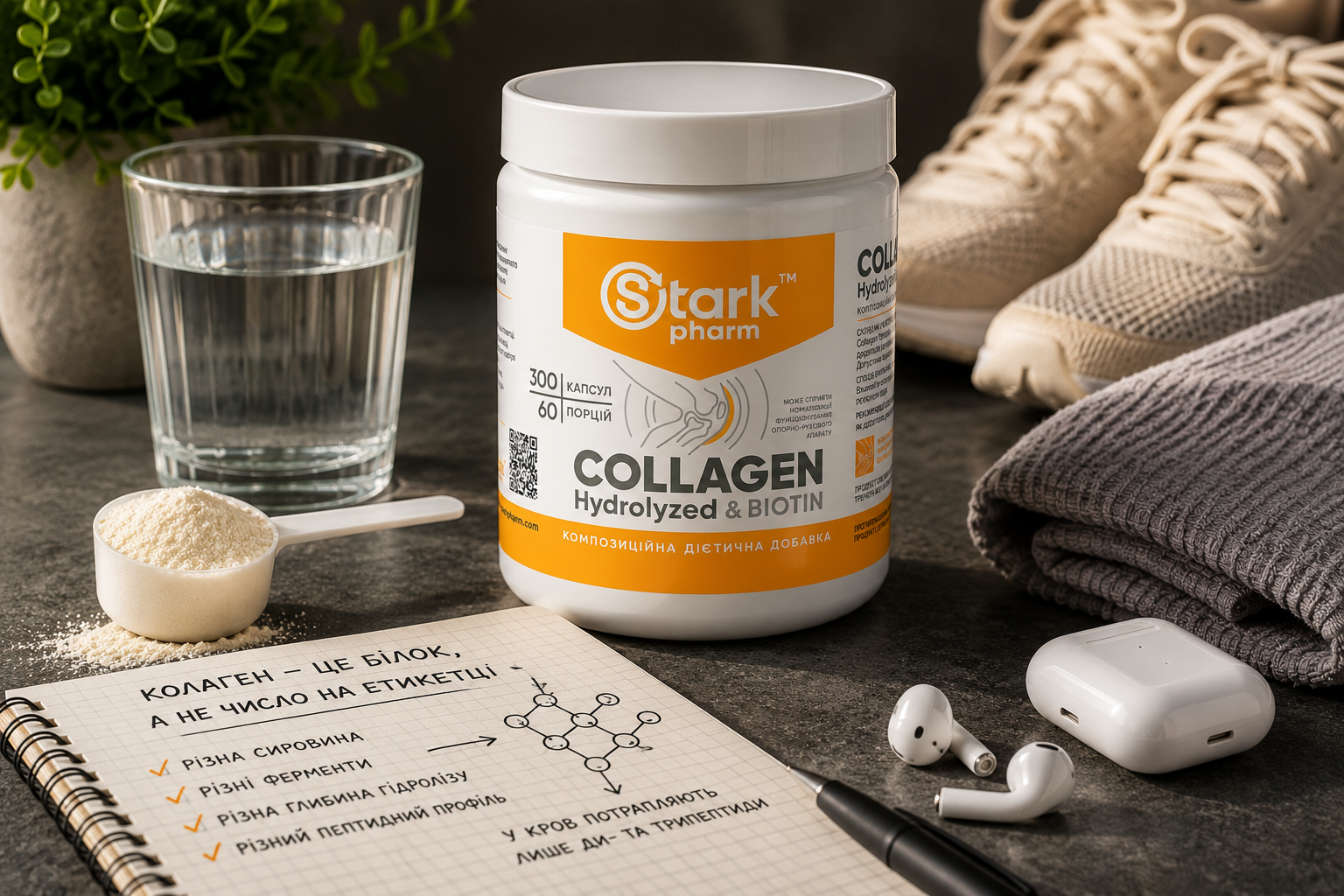
Three different questions that come together into one
The argument about mass has no solution because the word "assimilation" covers three different things that are measured by different methods.
| Question | What is measured? | What is known about mass |
|---|---|---|
| Digestion speed | How quickly the mixture breaks down into absorbable fragments | Fragment distribution changes during digestion; deeper hydrolysis reduces enzyme work |
| Pharmacokinetics | Plasma concentrations of specific peptides and hydroxyproline | Between 2000 and 5000 Da — 1.2-fold difference in total Hyp, no differences in individual peptides |
| Clinical outcome | Condition of skin, joints, bones according to instrumental indicators | No direct comparisons by mass were made. |
Marketing usually takes the answer to the second question and presents it as the answer to the third. There is a huge gap between them, and that is what we will talk about later.
Why there is no clinical weight-to-weight comparison
There have been many clinical trials of low-molecular-weight collagen peptides. But the design is always the same: product versus placebo. For example, in Kim et al. (2018), 64 participants received 1000 mg of low-molecular-weight peptides or placebo for twelve weeks, with measurements of hydration, elasticity, and wrinkles. The study showed differences from placebo—but it says nothing about whether a heavier hydrolysate would have produced worse results, because a heavier hydrolysate was simply not included in the design.
This is a fundamental gap. The claim that “low-molecular-weight collagen is more effective” would require a study in which two groups receive hydrolysates of different weights and are compared. There are no such studies. All that is available is a comparison with nothing, from which no advantage can be deduced over the alternative.
There is a broader context to be aware of. Myung and Park (2025) conducted a meta-analysis of 23 randomized controlled trials involving 1,474 people—an independent, industry-funded meta-analysis. In the overall analysis, collagen showed significant improvements in hydration, elasticity, and wrinkles. But when the studies were divided by funding source, the studies without manufacturer support showed no effect in any of the categories, while the company-funded studies did. The same division by methodological quality gave a similar picture: there was no significant effect in the high-quality studies. The authors conclude that the available clinical evidence is currently insufficient.
This does not mean that collagen “doesn’t work”—the meta-analysis captures the state of the evidence base, not the absence of a phenomenon. But it does mean that it is premature to base product selection on differences in molecular weight: the debate about the two values within a category is at the level of details, while the question of the category effect itself is still open.
Why did this particular figure become an argument?
The reason is not scientific, but communication. Molecular weight is the only characteristic of a hydrolysate that can be easily reduced to a single number and printed on the can. It can be compared between brands, it looks technical and does not need explanation. An amino acid profile, fraction distribution or list of peptides will not fit on the label, but a number will.
Then the usual mechanism worked: as soon as one manufacturer began to indicate mass as an advantage, the rest had to answer with a smaller number. The question of whether this difference has biological meaning in the range from two to five thousand daltons was not raised in this race. A wider set of characteristics by which hydrolysates really differ is analyzed separately - in the material on the peptide profile of collagen.
What follows from this?
The short answer to the title question is that lower molecular weight does not automatically mean better absorption, at least in the range in which real products compete. The threshold at which weight ceases to have an effect is much higher—between the undigested protein and any hydrolysate, not between two hydrolysates.
In practice, this means that the number on the label is a correct technical specification, not an indicator of quality. It describes how deeply the protein is broken down, and nothing more. A product labeled 5000 Da is not a “worse version” of a product with 2000 Da, and a 1.2-fold difference in the total amount of material entering the blood, obtained in six people after a single dose, is too shaky a basis for choice.
- The mass number is an average of the mixture, not the size of the molecules in it.
- Fragments of both typical masses equally require further digestion with enzymes before absorption.
- The only direct comparison yielded a difference in only one of several indicators.
- No clinical comparisons by weight were made at all.
- Spanier B., Rohm F. (2018). Proton coupled oligopeptide transporter 1 (PepT1) function, regulation, and influence on intestinal homeostasis. Comprehensive Physiology. https://pubmed.ncbi.nlm.nih.gov/29687907/
- Kim DU et al. (2018). Oral intake of low-molecular-weight collagen peptide improves hydration, elasticity, and wrinkling in human skin: a randomized, double-blind, placebo-controlled study. Nutrients. https://pmc.ncbi.nlm.nih.gov/articles/PMC6073484/
- Kleinnijenhuis AJ and others. (2020). Non-targeted and targeted analysis of collagen hydrolysates during the course of digestion and absorption. Analytical and Bioanalytical Chemistry. https://pubmed.ncbi.nlm.nih.gov/31872275/
- Iwasaki Y. and others. (2022). Comparison of gelatin and low-molecular weight gelatin hydrolysate ingestion on hydroxyproline (Hyp), Pro-Hyp and Hyp-Gly concentrations in human blood. Food Chemistry. https://pubmed.ncbi.nlm.nih.gov/34461513/
- Virgilio N. and others. (2024). Absorption of bioactive peptides following collagen hydrolysate intake: a randomized, double-blind crossover study in healthy individuals. Frontiers in Nutrition. https://pmc.ncbi.nlm.nih.gov/articles/PMC11325589/
- Myung S.-K., Park Y. (2025). Effects of collagen supplements on skin aging: a systematic review and meta-analysis of randomized controlled trials. The American Journal of Medicine. https://pubmed.ncbi.nlm.nih.gov/40324552/
A few words about precautions. Since we are talking about ordinary food protein, the main practical issue is the origin of the raw material: a fish base will not be suitable for people with fish allergies, pork has religious restrictions. Special attention is required in situations where the body is already working with an increased protein load - in case of kidney diseases, the appropriateness of any protein supplement is determined by a doctor. The same applies to pregnancy, lactation and constant use of medications.
Frequently asked questions
What does 2000 Da mean on collagen packaging?
This is the average molecular weight of the mixture of fragments. There may not be a molecule of exactly that mass in the powder—the number describes the distribution as a whole.
How many amino acids are in a fragment with a mass of 2000 Da?
About twenty. For comparison, peptides detected in the blood after taking collagen consist of two to three amino acids and weigh 228–285 daltons.
Is the 2000 Da fragment absorbed unchanged?
No. The short peptide transporter only carries molecules of two or three residues, so longer fragments are first cut by enzymes.
Is there a difference between 2000 and 5000 Da according to research?
In a direct comparison, only the total amount of hydroxyproline in the blood differed - 1.2 times in favor of the lighter product. No difference was found in the content of individual peptides.
Does this mean that the depth of hydrolysis is not important at all?
Important, but on a different scale. Comparing the hydrolysate with regular gelatin gives an almost twofold difference, while the two hydrolysates differ minimally.
Is it proven that low molecular weight collagen works better?
There have been no clinical studies comparing products of different weights. The available studies compare low molecular weight peptides with placebo.
What then should we look at instead of molecular weight?
Characteristics that describe the product more fully: source of raw materials, type of collagen, protein content, distribution of fractions, availability of analytical data per batch.
Sources
Dietary supplement. Not a medicine. Consult a doctor before use.
Products related to this post
Related Posts
Comments
Information
Customer Service
Extras
My Account


Sports nutrition manufacturer in Ukraine StarkPharm © 2026