Your shopping cart is empty!

Peptan® 2000 Da: what collagen peptides are detected in the blood after administration
Published: 30/08/2026
Times Read: 449
Comments : 0
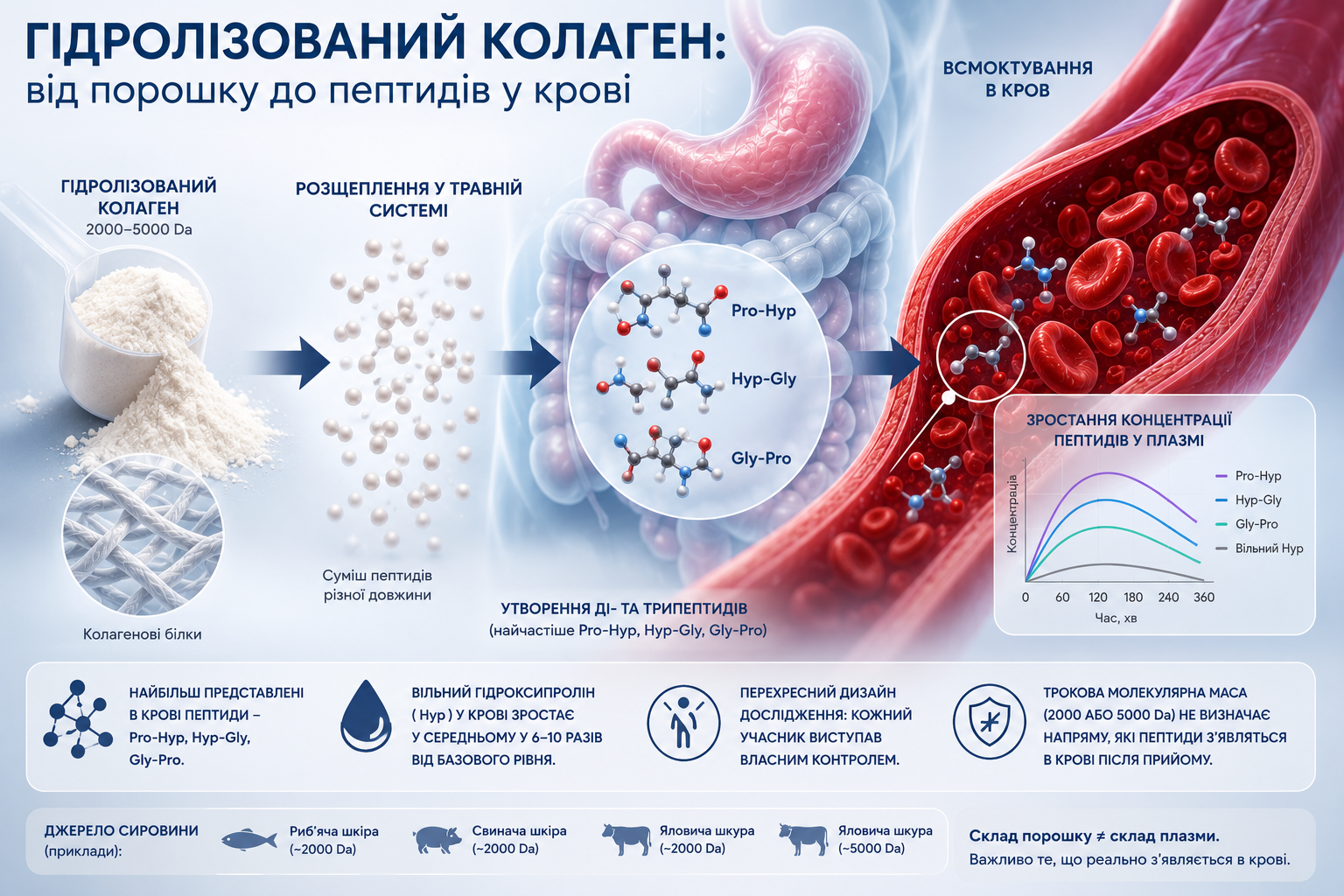
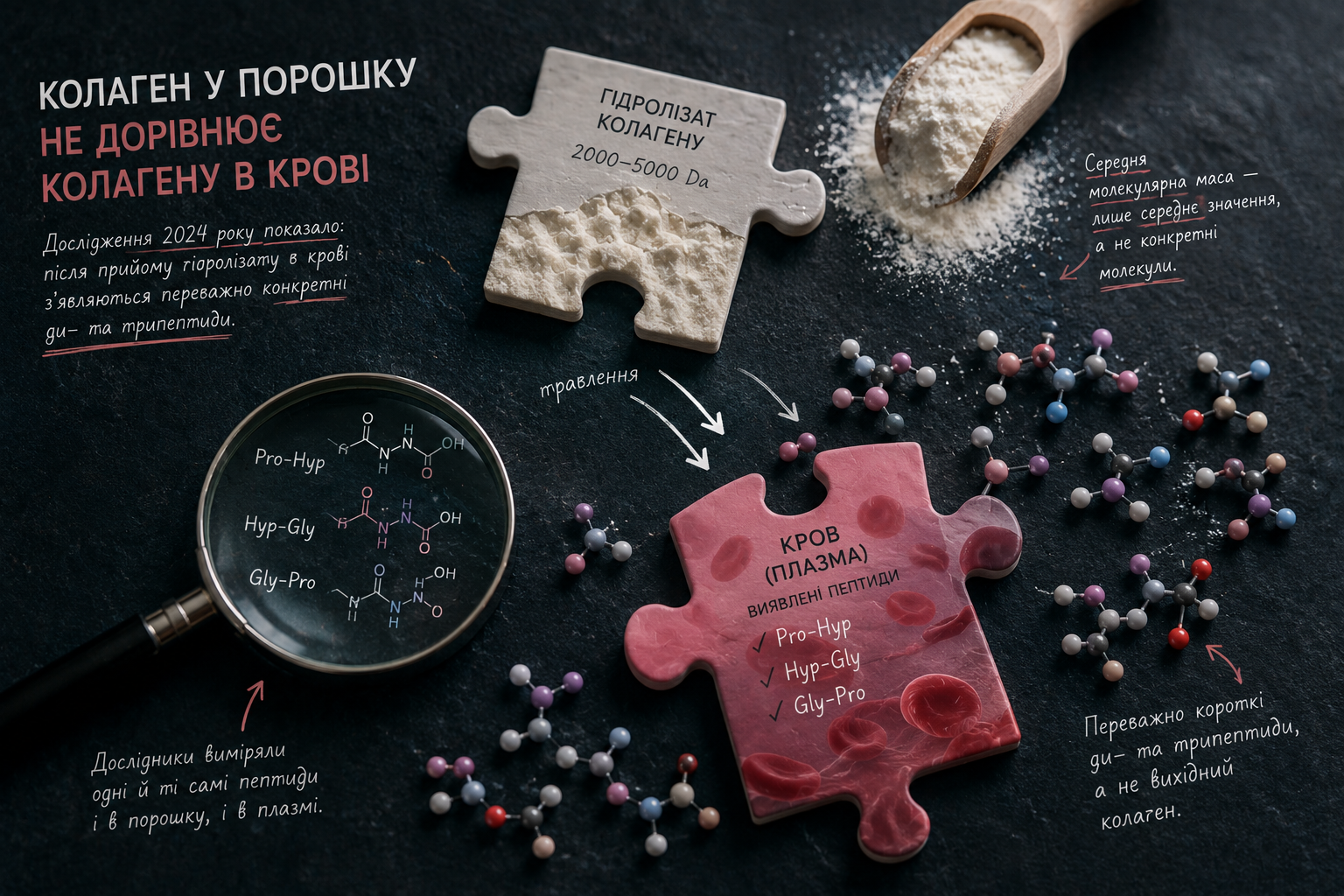
Hydrolyzed collagen labels often list the average molecular weight — 2,000 or 5,000 daltons — and the trade name of the raw material. The question that logically follows from this is: can the composition of the powder predict what exactly will end up in the blood after ingestion? In 2024, a paper was published that provides an almost literal answer: the researchers first measured the content of di- and tripeptides in the hydrolysates themselves, and then the concentrations of the same molecules in the plasma of volunteers. The two lists turned out to be almost mirror images. Let's analyze this study in detail, along with its limitations.
What is 2000 Da hydrolysate and what raw materials were studied?
Collagen hydrolysate is obtained in two stages: first, gelatin is extracted from collagen-rich raw materials (skin, bones, scales), then it is broken down by enzymes into a mixture of shorter fragments. The depth of hydrolysis determines the average chain length, which is expressed in daltons. It is important to understand that this number describes only the average mass of the mixture - it does not say anything about which specific sequences predominate in it.
In the work under consideration, commercial Peptan® hydrolysates produced by Rousselot with a protein content of over 90% were used: from fish skin, pig skin, and cattle skin with a low average mass of about 2000 Da, as well as bovine skin with a high mass of about 5000 Da.
Let's immediately fix the limit of correct generalization, because this is where it is easiest to exaggerate. The publication refers to commercial material of a certain line and nominal molecular weight - specific production batches are not identified there. Therefore, the conclusions apply to raw materials of this type, but are not a check of any individual batch of any finished product. These are different levels of statements, and they should not be confused.
How the study was conducted
The design was a randomized, double-blind, crossover study. Six healthy nonsmokers, three women and three men, aged 19 to 50 years with a body mass index of 19 to 28, participated. After an overnight fast of at least ten hours, a baseline blood sample was taken, then the participant consumed 10 g of one of the hydrolysates dissolved in 200 ml of water. Subsequent samples were taken at 60, 120, 180, 240, and 360 minutes; at 240 minutes, a standardized low-protein meal was served. Seven days of washout were maintained between meals.
The crossover design is the main methodological advantage here: each participant took all four products in turn, i.e. acted as their own control. This removes the influence of genetics, microbiota composition, intestinal motility and digestive enzyme activity - factors that would have to be statistically calculated in parallel groups. The general context of how collagen peptides generally enter the blood is discussed separately in the material on whether all collagen is broken down into amino acids.
What was measured in the powder itself
This is the part of the work that is usually not reported, and for good reason, because it is what makes the main conclusion possible. Before the clinical part, the content of free and total hydroxyproline, as well as five specific peptides, was determined in each product.
| Indicator, μg/g | Fish 2000 Da | Pork 2000 Da | Bullish 2000 Da | Bullish 5000 Da |
|---|---|---|---|---|
| Free Hyp | 26.8 | 33.8 | 21.0 | 13.0 |
| Total Hyp | 104,000 | 120,000 | 108,000 | 103,000 |
| Pro-Hyp | less than 0.8 | 6.11 | 3.91 | 2.08 |
| Hyp-Gly | 14.5 | 24.7 | 9.97 | 15.8 |
| Gly-Pro-Hyp | 5.97 | 8.94 | 2.70 | 1.71 |
| Pro-Gly | less than 8 | 9.04 | 9.68 | 9.61 |
| Gly-Pro | 42.5 | 53.6 | 40.9 | 79.5 |
The first thing that catches your eye is the gap between free and total hydroxyproline of about a thousand times. That is, almost all of the Hyp in the powder is bound in chains, and not present as a separate amino acid. Second: there are very few ready-made short peptides in the raw material. The most represented of them, Gly-Pro, gives about 54 mcg per gram of pork hydrolysate - this is five hundredths of a percent of the product's mass. Third: in terms of total hydroxyproline, all four products are almost the same, that is, as a source of collagen material they are equivalent.
What appeared in the blood
Baseline concentrations of free Hyp in the blood before administration were comparable for all days — from 0.86 to 1.18 μg/ml. After administration, the picture changed noticeably.
- Free hydroxyproline increased on average 9.9-fold from baseline after the pork hydrolysate, 7.2-fold after the fish hydrolysate, and 6.2-fold after both bovine hydrolysates. There were no significant differences between the products in terms of area under the curve.
- Total hydroxyproline gave an area under the curve 47% higher than free for fish and pork products, 43% for bovine lung and 36% for bovine heavy. It is this difference that corresponds to the fraction circulating in the peptide composition.
- Pro-Hyp became the most abundant peptide in plasma after all four products: the maximum concentration increase for the pork hydrolysate was 3.8 μg/mL.
- Hyp-Gly remained significantly lower, ranging from 0.29 to 0.76 μg/ml depending on the product, with the highest value after fish.
- Gly-Pro-Hyp, Pro-Gly and Gly-Pro were detected in significantly lower amounts than the first two.
Main result: powder composition does not predict blood composition
Comparing the two lists—what was in the powder and what appeared in the plasma—gives a mirror image. Gly-Pro was the most abundant short peptide in the raw material—and showed a concentration increase in plasma about a hundred times lower than Pro-Hyp. Mirror image: Pro-Hyp had the lowest average content in the products before taking it—and became dominant in the blood after it. In the fish hydrolysate, it could not be measured above the detection threshold at all, which did not prevent Pro-Hyp from dominating the plasma after this product.
The only explanation for this picture is that short peptides in the bloodstream are mostly not transported ready-made from the product, but are formed along the way - they are cleaved from longer oligopeptides during digestion and absorption. This is consistent with the work of Kleinnijenhuis et al. (2020), who traced how the size distribution of fragments changes during digestion and showed that the main contribution to the increase in hydroxyproline in the blood is made by Pro-Hyp and Hyp-Gly.
A practical implication concerns how to read labels and promotional materials. The claimed content of “bioactive peptides” in a product alone does not predict much about blood concentrations: the molecule that is most abundant in the powder may give the least response, and vice versa.
Molecular weight and source: what makes a difference and what doesn't
Comparison of two bovine hydrolysates gives the clearest answer to the question of mass, because the raw materials in them are the same. A significant difference was found only in the area under the curve for total hydroxyproline - 1.2 times in favor of the lighter product. The profiles of individual peptides - Pro-Hyp, Hyp-Gly, Gly-Pro-Hyp, Pro-Gly, Gly-Pro - did not differ between masses of 2000 and 5000 Da. That is, within the framework of typical hydrolysates, fine-tuning the average mass has practically no effect on the bioavailability of specific peptides.
In comparison, the difference appears on a different scale. When Iwasaki et al. (2022) compared a low molecular weight hydrolysate with a conventional gelatin, whose mass is measured in hundreds of thousands of daltons, the gap in the absorption of free hydroxyproline was almost twofold in favor of the hydrolysate. That is, it is the fact of enzymatic cleavage itself that matters, and not the tenth of a thousand daltons in the already cleaved product.
The source of the raw material has a selective effect. Total hydroxyproline after pork hydrolysate was 1.2 times higher than after fish. In contrast, Hyp-Gly was better absorbed from fish - 2.3 times higher than from bovine lung. Similar differences were previously described by Ohara et al. (2007) for fish scales, fish skin and pork skin. The overall conclusion of the authors of the 2024 work is restrained: the absorption of the three sources is generally very similar, and the differences concern individual peptides.
What this study did not show
The work is of high quality in design, but its boundaries should be clearly outlined:
- A sample of six people. The authors themselves call the study a pilot study and note that the sample size limits the generalizability of the identified differences between products.
- Single dose. Response to a single dose was measured over a period of six hours. Peptide profile changes with daily use: Shigemura et al. (2018) showed that after four weeks of regular use, the proportion of Hyp-Gly increases and Pro-Hyp decreases.
- Noticeable interindividual variation. At the same dose, the area under the curve differed significantly between participants, and the authors suggest that some of the interproduct differences may be explained by this.
- No clinical endpoints. Plasma concentrations were measured—not skin condition, joint function, or bone density. The authors emphasize that it is not even known at this time what level a metabolite must reach in the blood for the target tissue to respond at all.
- Funding and Affiliations: The study was funded by the raw material manufacturer, and most of the authors are its employees or employees of contract laboratories. This is openly declared in the publication.
This last point does not devalue the data: the crossover design, double-blinding, and targeted mass spectrometry remain strengths regardless of the funding source. But it does explain why there is so much work on absorption in this field and so little independent research on the end results.
A few words about general precautions. Collagen hydrolysate is a common food protein, and the main practical caveat concerns the origin of the raw material: fish, pork and beef bases are of varying relevance to people with food allergies or religious restrictions. If you have chronic diseases, impaired kidney function or are taking regular medications, the decision to take any protein supplement should be discussed with your doctor; the same applies to pregnancy and lactation.
Frequently asked questions
What does a molecular weight of 2000 Da on a label mean?
This is the average weight of the peptide mixture after enzymatic digestion of gelatin. It describes the depth of hydrolysis but does not indicate which sequences predominate in the product.
Does the powder contain ready-made bioactive peptides?
In trace amounts. In the study, the most abundant short peptide was about 54 mcg per gram of product, and almost all of the hydroxyproline was bound in longer chains. They are mainly formed during digestion, splitting off from longer fragments. That is why the composition of the powder does not predict the composition of the plasma.
How much hydroxyproline enters the bloodstream in peptide form?
According to the area under the curve, the proportion ranged from 36 to 47%, depending on the raw material — the rest was absorbed as free amino acids.
Is there a difference between pork, fish and bovine hydrolysate?
Overall absorption is very similar. The differences concern individual peptides: Hyp-Gly was better absorbed from fish raw materials, total hydroxyproline from pork.
Is a lower molecular weight better?
When comparing 2000 and 5000 Da, the peptide profile in the blood did not differ. The difference is noticeable only when comparing the hydrolysate with high molecular weight gelatin.
Does this study prove benefits for skin or joints?
No. It only measured plasma concentrations; clinical outcomes were not assessed.
Sources
- Iwai K. and others. (2005). Identification of food-derived collagen peptides in human blood after oral ingestion of gelatin hydrolysates. Journal of Agricultural and Food Chemistry. https://pubmed.ncbi.nlm.nih.gov/16076145/
- Ohara H. and others. (2007). Comparison of quantity and structures of hydroxyproline-containing peptides in human blood after oral ingestion of gelatin hydrolysates from different sources. Journal of Agricultural and Food Chemistry. https://pubmed.ncbi.nlm.nih.gov/17253720/
- Ichikawa S. and others. (2010). Hydroxyproline-containing dipeptides and tripeptides quantified at high concentration in human blood after oral administration of gelatin hydrolysate. International Journal of Food Sciences and Nutrition. https://pubmed.ncbi.nlm.nih.gov/19961355/
- Shigemura Y. and others. (2018). Changes in composition and content of food-derived peptide in human blood after daily ingestion of collagen hydrolysate for 4 weeks. Journal of the Science of Food and Agriculture. https://pubmed.ncbi.nlm.nih.gov/28914450/
- Kleinnijenhuis AJ and others. (2020). Non-targeted and targeted analysis of collagen hydrolysates during the course of digestion and absorption. Analytical and Bioanalytical Chemistry. https://pubmed.ncbi.nlm.nih.gov/31872275/
- Iwasaki Y. and others. (2022). Comparison of gelatin and low-molecular weight gelatin hydrolysate ingestion on hydroxyproline (Hyp), Pro-Hyp and Hyp-Gly concentrations in human blood. Food Chemistry. https://pubmed.ncbi.nlm.nih.gov/34461513/
- Virgilio N. and others. (2024). Absorption of bioactive peptides following collagen hydrolysate intake: a randomized, double-blind crossover study in healthy individuals. Frontiers in Nutrition. https://pmc.ncbi.nlm.nih.gov/articles/PMC11325589/
Dietary supplement. Not a medicine. Consult a doctor before use.
Products related to this post
Comments
Information
Customer Service
Extras
My Account


Sports nutrition manufacturer in Ukraine StarkPharm © 2026