Your shopping cart is empty!

Is all collagen broken down into amino acids: which peptides actually enter the bloodstream?
Published: 30/08/2026
Times Read: 421
Comments : 0
The most common argument against hydrolyzed collagen sounds logical: any protein in the digestive tract breaks down into free amino acids, so collagen is no different from ordinary meat or gelatin. The argument is almost correct - and it is because of this that a separate research direction has appeared "almost" over the past twenty years. Targeted mass spectrometry has shown that some collagen fragments reach the bloodstream intact: in human plasma after taking the hydrolyzate, di- and tripeptides - Pro-Hyp, Hyp-Gly, Gly-Pro-Hyp and several dozen of their analogues - are stably detected. Below - what exactly these works show, how reliable their methods are and, most importantly, what they do not prove.
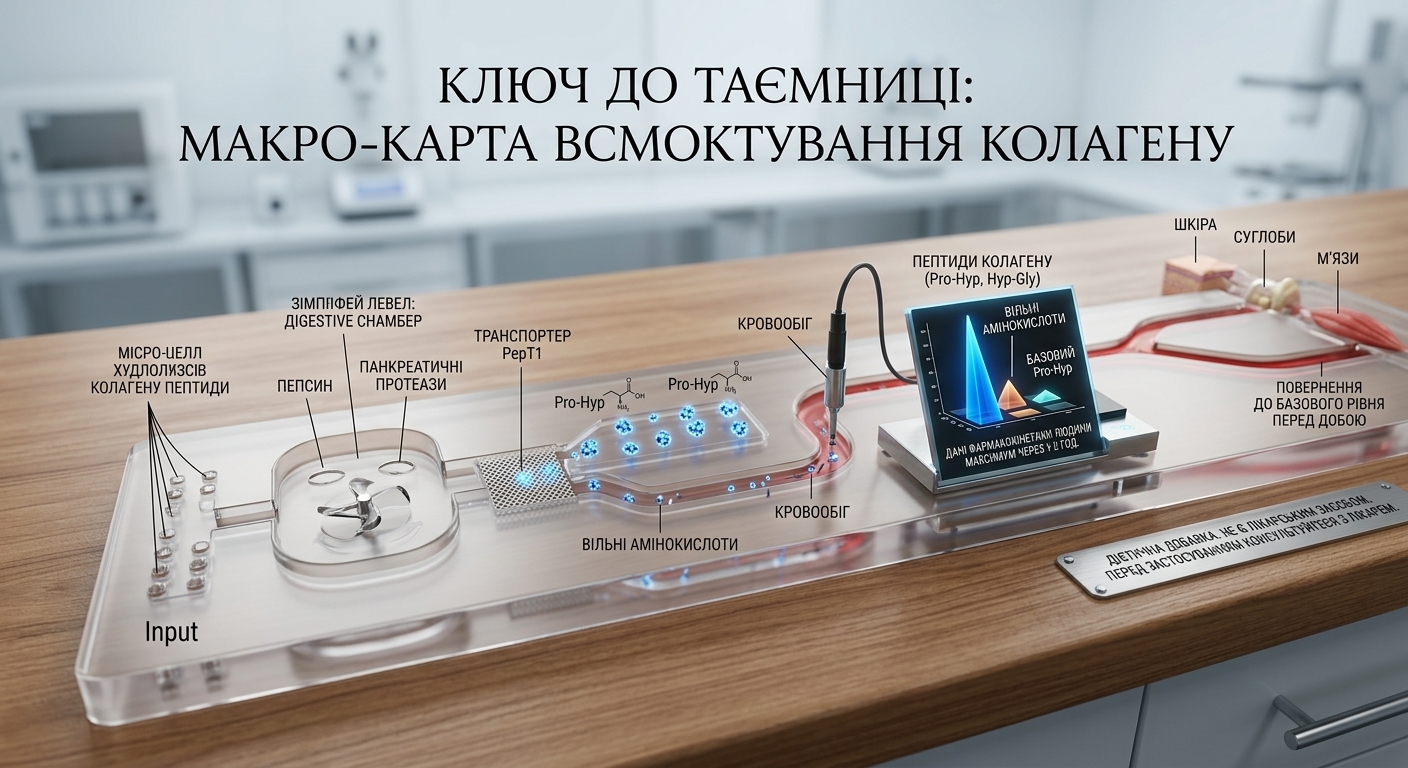
What happens to protein in the digestive tract?
The basic scheme of protein digestion has no exceptions for collagen. Pepsin works in the stomach, pancreatic proteases in the small intestine, then brush border exopeptidases cleave off terminal amino acids from short fragments. The bulk of any dietary protein does indeed reach free amino acids and is absorbed through amino acid transporters.
But there is more than one transporter. In parallel, PepT1 works in the enterocyte membrane — a transporter specialized specifically for di- and tripeptides. It transports short peptides intact, without prior cleavage. That is, the system is initially designed so that part of the protein enters the intestinal cell in peptide form. The question is not whether collagen is cleaved — it is cleaved, and mostly completely. The question is which fragments manage to reach the transporter intact and why.
Why Hydroxyproline "Survives": The Chemistry That Makes Pro-Hyp Possible
Collagen has a rigid sequence: a repeat of (Gly-XY)n, where hydroxyproline (Hyp) is very common in position Y and proline in position X. The Gly-Pro-Hyp triplet is the most common in the collagen molecule, accounting for about a tenth of the entire sequence.
Proline and hydroxyproline have a cyclic side chain structure, and this is not a cosmetic detail. The ring creates a steric hindrance to the active site of peptidases: bonds involving Pro and Hyp are hydrolyzed more slowly than normal ones. That is why fragments like Pro-Hyp go through a full cycle of digestion, while most other dipeptides have time to break down.
The second property of hydroxyproline is useful to researchers: it is almost never found in other animal proteins. This makes it a convenient chemical marker — if Hyp appears in the blood after a meal, its origin is collagen.
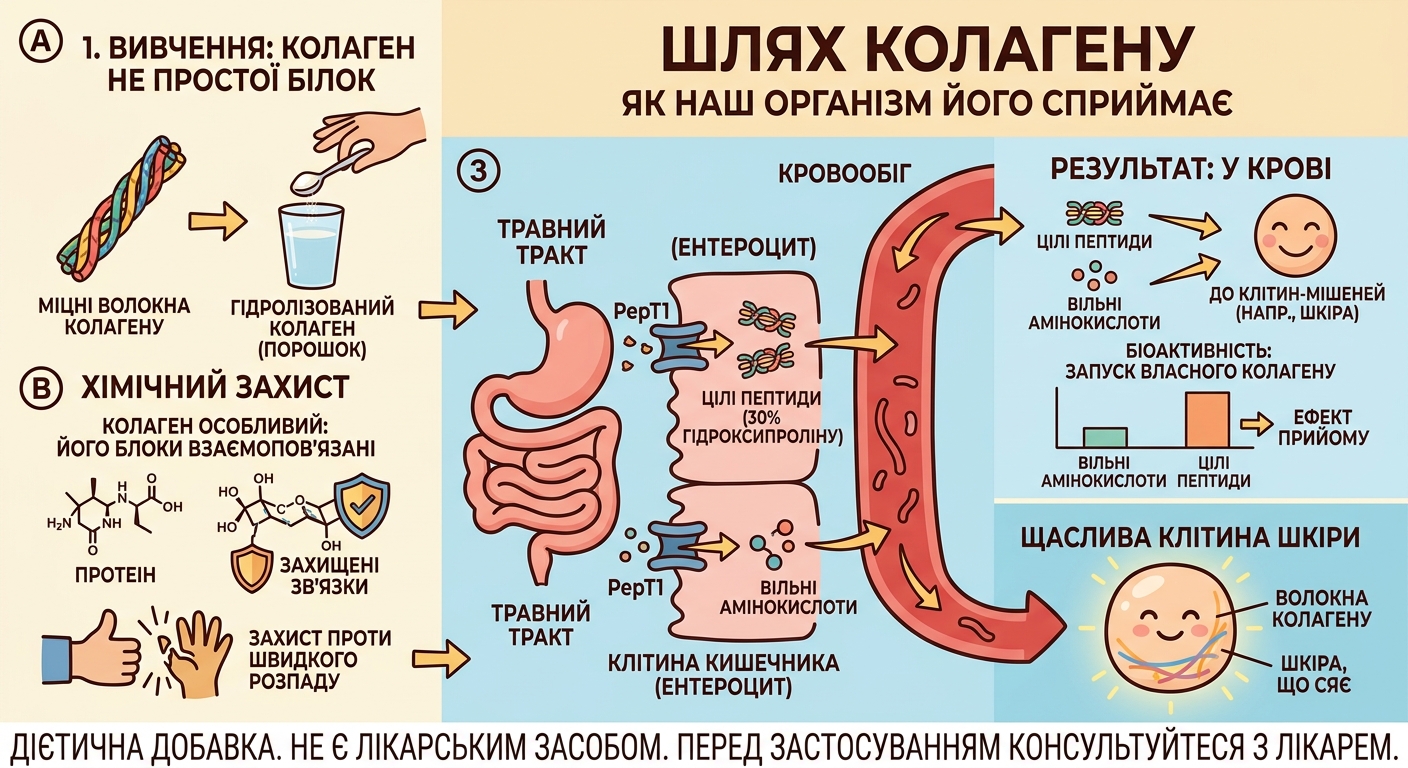
Free and peptide-bound hydroxyproline: what the gap between them shows
The key methodological technique is as follows. A plasma sample is analyzed twice: in its original form (then only free Hyp is visible) and after complete acid hydrolysis, which destroys all peptide bonds (then all Hyp is visible - both free and that which was part of peptides). The difference between the two numbers is the fraction that did not circulate as an amino acid.
The break was found to be stable and reproducible across laboratories. Ohara et al. (2007) estimated the proportion of Hyp-containing peptides to be approximately 30% of the total hydroxyproline detected. Shigemura et al. (2014) obtained approximately 25%. In Virgilio et al. (2024) the incremental area under the curve for total Hyp was 36–47% higher than for free Hyp, depending on the hydrolysate feedstock.
This is the actual answer to the question in the title. Most of the collagen is indeed broken down into free amino acids — but about a quarter to a third of the hydroxyproline enters the bloodstream as part of peptides. The thesis “everything becomes exclusively free amino acids” does not hold up on these data.
What exactly are the peptides found in human blood and how long are they there?
The first systematic description was made by Iwai et al. (2005): volunteers, after a twelve-hour fast, took gelatin hydrolysates from pig skin, chicken feet and cartilage in doses ranging from 9.4 to 23 g. The peptide form of Hyp, which was practically absent in the blood before administration, reached a maximum after 1–2 hours and decreased by half after four hours. The main component was Pro-Hyp, and in smaller quantities - Ala-Hyp, Ala-Hyp-Gly, Pro-Hyp-Gly, Leu-Hyp, Ile-Hyp and Phe-Hyp.
The list continued to grow. Ichikawa et al. (2010) quantified nine Hyp-containing peptides by LC-MS/MS: Pro-Hyp dominated with a maximum concentration of about 60 nmol/ml, with minor components ranging from 24 to 0.7 nmol/ml. Yazaki et al. (2017) identified 17 types of collagen peptides in human plasma after ingestion of a hydrolysate with a high tripeptide content, with a marked enrichment in Gly-Pro-Hyp. Taga et al. (2022) described another stable tripeptide, Gly-3Hyp-4Hyp.
The strength of this work is methodological. It is not about indirect markers, but about targeted quantitative chromatography with tandem mass spectrometry (UPLC-MS/MS) with stably labeled internal standards - a method that identifies a specific molecule by its mass and fragmentation. The kinetics are also consistent between studies: a rise within an hour or two, returning to baseline within a day (Shigemura et al., 2018).
The most interesting result of the seminal work by Virgilio et al. (2024) concerns not the quantity but the origin of the peptides. The researchers first measured the content of di- and tripeptides in the hydrolysates themselves, and then in the plasma of six volunteers after a single intake of 10 g of the product dissolved in 200 ml of water.
The result was the opposite of what was expected. The dipeptide Gly-Pro was the most abundant in the dry raw material — but in the blood its concentration increase was about a hundred times less than that of Pro-Hyp. And Pro-Hyp, on the contrary, had the lowest content in the powder before administration — and became the most abundant peptide in the plasma.
The conclusion from this is straightforward: collagen peptides in the blood are mostly not “transferred ready-made” from the product, but are formed during digestion – they are cleaved from longer oligopeptides already in the digestive tract. The analysis by Kleinnijenhuis et al. (2020) confirms this from another perspective: the size distribution of fragments changes during digestion, and the main contribution to the increase in Hyp in the blood is made by Pro-Hyp and Hyp-Gly.
This also implies a cautious attitude towards marketing “molecular weight”. In the same work, bovine hydrolysates with an average mass of 2000 and 5000 Da gave almost the same peptide profile in plasma. The difference appears only on a different scale: Iwasaki et al. (2022) compared a low molecular weight hydrolysate with regular gelatin (about 100,000 Da) and obtained for free Hyp 169.1 nmol/ml versus 94.4 nmol/ml in favor of the hydrolysate. That is, hydrolysis as such matters, and fine-tuning the average mass within a few thousand daltons mostly does not.
Raw materials, individual differences and long-term use
The source of collagen affects absorption, but selectively. In a cross-sectional study by Ohara et al. (2007), five volunteers ingested hydrolysates from fish scales, fish skin, and pig skin: the total area under the curve for fish scales was significantly higher than for pig skin, and some minor peptides—Ala-Hyp-Gly, Ser-Hyp-Gly—appeared only after the fish raw material. In the 2024 study, free hydroxyproline was absorbed equally from fish, pork, and bovine hydrolysates, but individual peptides differed: Hyp-Gly was highest after the fish product.
It is worth noting the interindividual variation. The authors directly point to it as a significant factor: at the same dose, the area under the curve in different participants differed significantly. The ratio of Pro-Hyp to Hyp-Gly is also not constant - it varies both between raw material sources and between people.
Long-term intake adds another layer. Shigemura et al. (2018) gave participants 4.5 g of hydrolysate daily for four weeks: Pro-Hyp remained the dominant component throughout the period, but the proportion of Hyp-Gly gradually increased and the proportion of Pro-Hyp decreased. The authors suggest that the activity of digestive proteases changes with regular intake of the substrate. This means that data from a single dose cannot be automatically transferred to daily intake.
What this data proves—and what it doesn't prove
It's worth being precise here, because this is where scientific works are most often misquoted.
These pharmacokinetic data prove the presence of collagen di- and tripeptides in the human systemic bloodstream in measurable, rather high concentrations for food peptides. They refute the claim that hydrolyzed collagen is completely reduced to free amino acids.
They do not prove clinical effect. The presence of a molecule in plasma and a biological response in tissue are two different things. The authors of the 2024 paper put it bluntly: the threshold concentrations of metabolites required for a physiological response in the target tissue have not yet been determined, and larger studies are needed to assess them.
There are three other caveats to keep in mind. First, Pro-Hyp is not only produced in food: it also occurs during the natural renewal of the body's own collagen (Sato et al., 2019), so the baseline level in the blood is not zero. Second, the sample sizes in these studies are tiny—four to six people; this is normal for a pharmacokinetic pilot, but this is not the scale of a clinical trial. Third, some of the studies were funded by collagen raw material manufacturers, and the authors openly declare this—in particular, the 2024 study was funded by a hydrolysate manufacturer. This does not make the data flawed, especially given the strong crossover design and double-blinding, but it is a context that the reader should be aware of.
How is hydrolyzed collagen usually used and what to look for?
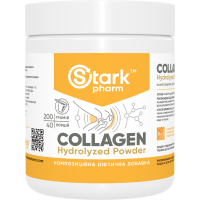
In pharmacokinetic protocols, the hydrolysate is taken on an empty stomach, dissolved in water - this standardizes the measurement conditions, and is not a recommendation for everyday life. In practice, the powder is usually simply stirred into water or another beverage; the protein supplement does not require special conditions for intake. Hydrolyzed collagen in powder format is available, in particular, in the Stark Pharm range - Stark Collagen Hydrolyzed Pure Powder
Precautions are standard for protein supplements. It is worth considering the source of raw materials if you have food allergies - collagen is obtained from the skin and bones of pigs, cattle or fish. Pregnant and lactating women, people with chronic diseases, impaired kidney function or those taking medications should consult a doctor before starting treatment. Collagen is an incomplete protein in terms of amino acid composition, so it does not replace the main sources of protein in the diet and is considered a supplement to it.
Frequently asked questions
Is all collagen broken down into amino acids?
No. Most do, but approximately 25–47% of hydroxyproline (according to various studies) enters the bloodstream as di- and tripeptides, rather than as a free amino acid.
What is Pro-Hyp and where does it come from?
This is a dipeptide of proline and hydroxyproline, the most abundant collagen fragment in plasma after ingestion of hydrolysate. It is mostly formed directly during digestion, cleaved from longer peptides.
How long do collagen peptides stay in the blood?
The maximum concentration occurs approximately 1–2 hours after administration, the level decreases approximately by half within four hours, and returns to baseline within 24 hours.
Does the presence of peptides in the blood mean that they work in the skin?
No, these are different issues. Pharmacokinetics only confirm absorption; the threshold concentrations required for a biological response in tissues have not yet been established.
Is there a difference between fish, pork and beef collagen?
There is practically no difference in the absorption of free hydroxyproline. The profile of individual peptides is somewhat different: after fish raw materials, the level of Hyp-Gly is higher, after pork - some other fractions.
Is collagen with a lower molecular weight better absorbed?
Within the range of typical hydrolysates (around 2000 vs. 5000 Da) no difference in the peptide profile in the blood was shown. The difference is only noticeable when comparing the hydrolysate with high molecular weight gelatin.
Are gelatin and collagen hydrolysate the same thing?
No. Gelatin is denatured collagen with a very high molecular weight, the hydrolysate is obtained by additional enzymatic cleavage. In a direct comparison, the hydrolysate gave a higher concentration of free hydroxyproline in the blood.
Sources
- Iwai K. and others. (2005). Identification of food-derived collagen peptides in human blood after oral ingestion of gelatin hydrolysates. Journal of Agricultural and Food Chemistry. https://pubmed.ncbi.nlm.nih.gov/16076145/
- Ohara H. and others. (2007). Comparison of quantity and structures of hydroxyproline-containing peptides in human blood after oral ingestion of gelatin hydrolysates from different sources. Journal of Agricultural and Food Chemistry. https://pubmed.ncbi.nlm.nih.gov/17253720/
- Ichikawa S. and others. (2010). Hydroxyproline-containing dipeptides and tripeptides quantified at high concentration in human blood after oral administration of gelatin hydrolysate. International Journal of Food Sciences and Nutrition. https://pubmed.ncbi.nlm.nih.gov/19961355/
- Shigemura Y. and others. (2014). Dose-dependent changes in the levels of free and peptide forms of hydroxyproline in human plasma after collagen hydrolysate ingestion. Food Chemistry. https://pubmed.ncbi.nlm.nih.gov/24767063/
- Yazaki M. and others. (2017). Oral ingestion of collagen hydrolysate leads to the transportation of highly concentrated Gly-Pro-Hyp and its hydrolyzed form of Pro-Hyp into the bloodstream and skin. Journal of Agricultural and Food Chemistry. https://pubmed.ncbi.nlm.nih.gov/28244315/
- Shigemura Y. and others. (2018). Changes in composition and content of food-derived peptide in human blood after daily ingestion of collagen hydrolysate for 4 weeks. Journal of the Science of Food and Agriculture. https://pubmed.ncbi.nlm.nih.gov/28914450/
- Spanier B., Rohm F. (2018). Proton coupled oligopeptide transporter 1 (PepT1) function, regulation, and influence on intestinal homeostasis. Comprehensive Physiology. https://pubmed.ncbi.nlm.nih.gov/29687907/
- Sato K., Jimi S., Kusubata M. (2019). Generation of bioactive prolyl-hydroxyproline (Pro-Hyp) by oral administration of collagen hydrolysate and degradation of endogenous collagen. International Journal of Food Science & Technology. https://doi.org/10.1111/ijfs.14145
- Kleinnijenhuis AJ and others. (2020). Non-targeted and targeted analysis of collagen hydrolysates during the course of digestion and absorption. Analytical and Bioanalytical Chemistry. https://pubmed.ncbi.nlm.nih.gov/31872275/
- Iwasaki Y. and others. (2022). Comparison of gelatin and low-molecular weight gelatin hydrolysate ingestion on hydroxyproline (Hyp), Pro-Hyp and Hyp-Gly concentrations in human blood. Food Chemistry. https://pubmed.ncbi.nlm.nih.gov/34461513/
- Taga Y. and others. (2022). Identification of a highly stable bioactive 3-hydroxyproline-containing tripeptide in human blood after collagen hydrolysate ingestion. npj Science of Food. https://pubmed.ncbi.nlm.nih.gov/35662250/
- Virgilio N. and others. (2024). Absorption of bioactive peptides following collagen hydrolysate intake: a randomized, double-blind crossover study in healthy individuals. Frontiers in Nutrition. https://pmc.ncbi.nlm.nih.gov/articles/PMC11325589/
Dietary supplement. Not a medicine. Consult a doctor before use.
Products related to this post
Comments
Information
Customer Service
Extras
My Account


Sports nutrition manufacturer in Ukraine StarkPharm © 2026