Your shopping cart is empty!

Collagen for tendons before training: what biomarkers show and where they lie
Published: 02/09/2026
Times Read: 326
Comments : 0
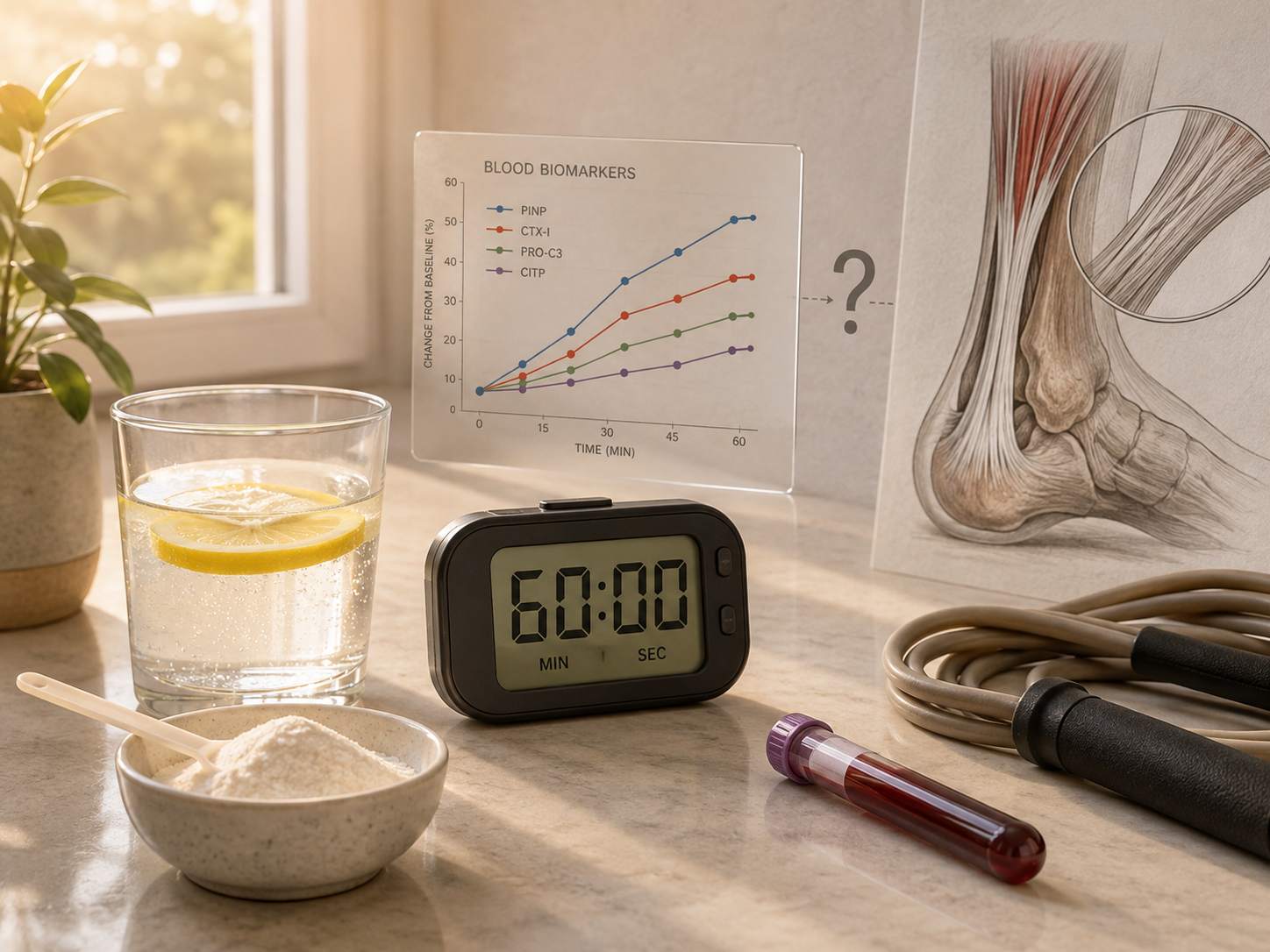
The idea of taking collagen right before a workout, rather than at any time during the day, came not from marketing, but from the laboratory - and has a completely rational explanation. Tendons have a poor blood supply, nutrients reach them slowly, and the concentration of amino acids in the blood after protein intake reaches a peak about an hour later. If you combine this peak with mechanical stress, when the tissue is most actively rebuilding, you can theoretically get more than from each factor separately. The hypothesis is slim. Next - what the researchers did with it and why the results depend on what exactly to measure.
Load as the main stimulus
It is worth starting with the hierarchy, because without it the rest is not read correctly. Tendons and ligaments are rebuilt in response to mechanical stimulus: stretching and tension trigger signaling cascades in cells that change the rate of collagen synthesis and the composition of the extracellular matrix. This is the main driver, and it has no alternatives among nutritional interventions.
This provides a framework for the whole topic. Any supplement here can at most be an additional factor that acts in addition to exercise, not instead of it. Studies testing collagen for connective tissue are almost always designed as “exercise plus supplement vs. exercise plus placebo”—the question is not “does collagen work” but “does it add anything to training.”
It is also worth noting an interesting detail from the work of Nulty et al. (2024): in trained middle-aged men, strength training itself did not increase collagen synthesis - the authors suggest an age-related decrease in the sensitivity of connective tissue to mechanical stimuli. That is, the very base on which the supplement is applied changes with age.
Where did the timing hypothesis come from?
The laboratory model played a key role here. Researchers learned how to grow artificial ligaments from cells in culture and test them for what happens to the connective tissue under different conditions — including treatment with blood serum from people who had eaten something before. It was this model that allowed them to ask the question of timing with precision.
The logic was as follows: the tendon has poor blood flow compared to the muscle, so the window when an increased amount of amino acids reaches it is short. The peak in the blood occurs about an hour after taking it. Therefore, it is worth taking it not after training, as is customary for muscle protein, but before it, so that the peak coincides with the load.
Vitamin C was not included in this scheme by chance: it is needed by enzymes that hydroxylate proline and lysine in the collagen chain, that is, without it, collagen maturation is impossible. Therefore, studies usually used not pure gelatin or hydrolysate, but their combination with vitamin C - and this is worth remembering when reading the results.

What studies with synthesis markers have shown
The first notable work was the study by Shaw et al. (2017). Eight healthy men in a double-blind crossover design were given a placebo or two different amounts of vitamin C-enriched gelatin one hour before a short jump rope workout. Four hours after the workout, a marker of collagen synthesis in the blood was found to be approximately twice as high as control levels in those who received the higher amount. In parallel, artificially grown ligaments were treated with the participants' serum, and their collagen content increased.
Then came dose-dependent studies. Lee et al. (2024) compared three amounts of hydrolyzed collagen before resistance training in trained young men and found the highest increase in the marker with the highest of them. Nulty et al. (2024) repeated the design in trained middle-aged men with the same result: the higher amount gave a greater response, the lower one was intermediate, and without supplementation there was no increase at all.
Dose dependence is an important feature. When the effect systematically increases with the amount of substance, this is an argument in favor of the fact that the relationship is real and not random. So, at the marker level, the signal looks convincing.
What is PINP and what does it not mean?
The marker in question is the N-terminal propeptide of procollagen type I. The mechanism of its appearance is as follows: the cell synthesizes procollagen with additional fragments at both ends, then these fragments are cleaved, the molecule is incorporated into the matrix, and the cleaved ends enter the bloodstream. That is, the increase in the marker indicates that collagen maturation has been activated somewhere in the body.
The word “somewhere” is key here. The marker in the blood does not indicate in which tissue this occurred—tendon, skin, bone, or blood vessel wall—or whether the increased synthesis will translate into stronger tissue. Collagen in the body is constantly being synthesized and broken down; growth on one side of this exchange does not guarantee net gain.
| Level of evidence | What is measured? | Method | What is known about collagen? |
|---|---|---|---|
| Marker in blood | Activation of synthesis somewhere in the body | Serum analysis | Increases, and dose-dependently |
| Synthesis in tissue | How much new protein was formed in a particular tissue | Stable isotopes and biopsy | No growth shown |
| Mechanical properties | Tendon stiffness and size | Ultrasound, dynamometry | Few studies, mixed results |
| Clinical outcome | Frequency of injuries, time to return to activity | Long-term randomized trials | There is no such data. |
The entire database collected to date is concentrated in the top row of this table, which makes the work that attempted to go down to the row below particularly interesting.
Work that measured not the marker, but the synthesis itself
Aussieker et al. (2023) approached the question from a different angle. Forty-five healthy young men and women were given 30 g of whey protein, 30 g of collagen protein, or a placebo after resistance training. Instead of a marker in the blood, the researchers measured the actual rate of protein synthesis in the tissue using stable isotopes—labeled amino acids are injected into the bloodstream, and then the tissue sample is evaluated to see how many of them have been incorporated into new protein.
The results were mixed. Whey protein increased the rate of synthesis of myofibrillar proteins, which are responsible for muscle contraction. However, neither whey protein nor collagen increased the rate of synthesis of connective tissue proteins.
Now about the limits of this conclusion, because it is as easy to exaggerate it as it is to exaggerate the positive results. First, the connective tissue of the muscle was measured, not the tendons - these are related, but not identical structures. Second, the supplement was given after the load, not an hour before it, that is, the timing that was being tested by the hypothesis was not reproduced in this design. Third, the study is acute: it describes a few hours after a single workout, not weeks of regular intake.
So the work does not refute the timing hypothesis. It shows something else, and no less important: the marker in the blood and the actual synthesis in the tissue can diverge. Therefore, it is premature to build confidence on the marker alone.
Tissue Properties and Trauma: Where the Data Ends
The next logical step is to test whether measurable characteristics of the tendon itself change: stiffness, cross-sectional area, ability to transmit force. Such studies exist, usually combining several months of strength training with collagen peptide supplementation and using ultrasound imaging. But they are few in number, the samples are small, and the results are not always consistent across studies.
As for the more practical question of whether it reduces the incidence of tendon and ligament injuries, or speeds up the return to training after injury, the answer is no. It requires long-term studies in large groups with injury as an endpoint, and these have not been conducted on the necessary scale.
This is not a reason to reject the hypothesis. It is a reason to understand at what stage of testing it is currently: there is a signal at the biochemistry level, confirmation at the tissue level is partial and contradictory, confirmation at the practical result level is absent. For comparison, in a related topic, the data is structured differently - there are large meta-analyses with clinical endpoints, and what exactly they showed is analyzed in the material about collagen for joints.
Why a research protocol is not a treatment regimen
And lastly, the most important thing for practice. The quantities and intervals that appear in these works are selected for a specific task: to create conditions under which a possible signal will be as noticeable as possible for the measuring equipment. This is an engineering solution for the experiment, not a recommendation for everyday use.
The difference is fundamental. In a study, participants receive a single, supervised intervention in a well-defined setting, with known health status and a controlled diet. To extrapolate the numbers from such a protocol to your own routine is to make assumptions that the authors themselves do not make. The amount and method of use of any supplement are determined by the manufacturer's instructions, not the design of the research paper.
Regarding precautions: collagen supplements are a dietary protein, and the warnings are typical for this category. The origin of the raw materials is important in the presence of allergies. Kidney pathology is a condition in which additional protein loading is coordinated with a doctor; the same applies to pregnancy, lactation and regular medication. And separately for the sports context: tendon pain during or after exercise is a signal to consult a specialist, not a reason to look for a supplement. Tendinopathy has different causes, and the approach to them depends on which one you have.
Frequently asked questions
Why is collagen recommended to be taken before training?
The hypothesis is that the tendon has a poor blood supply, and that the peak of amino acids in the blood occurs about an hour after ingestion. The idea is to coincide this peak with mechanical stress.
What did the research show?
The marker of collagen synthesis in the blood increases after this combination, and in a dose-dependent manner. This has been shown in several independent studies in small groups.
What is PINP?
This is a fragment that is cleaved from the procollagen molecule during its maturation and enters the blood. Its level indicates the activation of synthesis, but does not indicate in which tissue this occurred.
Does an increase in the marker mean that the tendon has become stronger?
No. These are different levels of evidence. When the synthesis rate was measured directly in the tissue using stable isotopes, no increase in collagen was detected.
It is required for enzymes that hydroxylate proline and lysine in the collagen chain. Without this step, collagen maturation is impossible.
Does collagen reduce the risk of tendon injuries?
There is no data to support this conclusion. Studies with injury as an endpoint have not been conducted at the required scale.
Can we base doses on these studies?
No, they are different things. An experimental protocol is designed to measure a signal under controlled conditions, not as an instruction; the manufacturer's instructions are the guideline for use.
Sources
- Shaw G. and others. (2017). Vitamin C-enriched gelatin supplementation before intermittent activity augments collagen synthesis. The American Journal of Clinical Nutrition. https://doi.org/10.3945/ajcn.116.138594
- Lis DM, Baar K. (2019). Effects of different vitamin C-enriched collagen derivatives on collagen synthesis. International Journal of Sport Nutrition and Exercise Metabolism. https://pubmed.ncbi.nlm.nih.gov/30859848/
- Aussieker T. and others. (2023). Collagen protein ingestion during recovery from exercise does not increase muscle connective protein synthesis rates. Medicine and Science in Sports and Exercise. https://pmc.ncbi.nlm.nih.gov/articles/PMC10487367/
- Lee J. et al. (2024). The collagen synthesis response to an acute bout of resistance exercise is greater when ingesting 30 g of hydrolyzed collagen compared with 15 g and 0 g in resistance-trained young men. The Journal of Nutrition. https://doi.org/10.1016/j.tjnut.2023.10.030
- Nulty CD, etc. (2024). Hydrolyzed collagen supplementation prior to resistance exercise augments collagen synthesis in a dose-response manner in resistance-trained, middle-aged men. American Journal of Physiology: Endocrinology and Metabolism. https://pubmed.ncbi.nlm.nih.gov/39259166/
Dietary supplement. Not a medicine. Consult a doctor before use.
Products related to this post
Related Posts
Comments
Information
Customer Service
Extras
My Account


Sports nutrition manufacturer in Ukraine StarkPharm © 2026