Your shopping cart is empty!

Collagen for joints: what the studies show and where the limits of their conclusions lie
Published: 01/09/2026
Times Read: 405
Comments : 0
The joint topic differs from the skin topic in one important way: the evidence base is larger and methodologically stronger. The largest generalization covers 35 randomized trials and over three thousand patients, and the certainty of the evidence on joint function is rated high on the international GRADE scale - a rarity for dietary supplements. But before reading the numbers, it is necessary to deal with the confusion that makes most of the materials on this topic meaningless: under the name "collagen for joints" two fundamentally different substances are sold with different doses and different mechanisms.
Two different substances under the same name
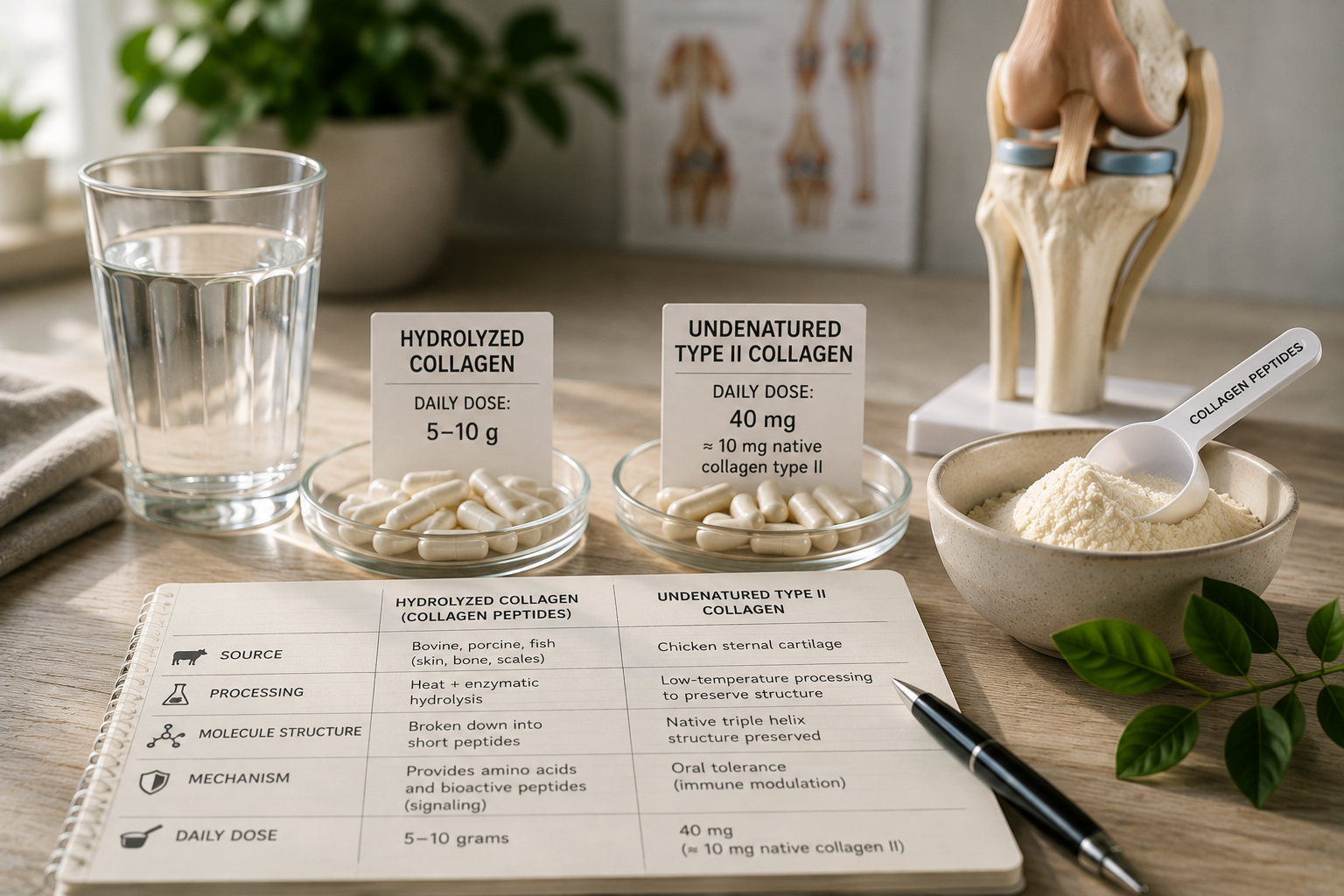
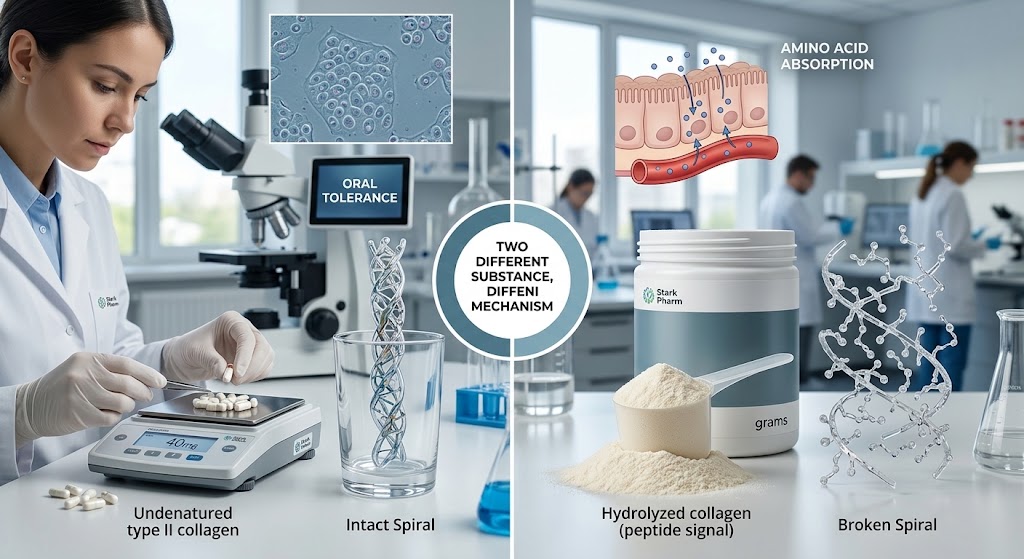
Hydrolyzed collagen and undenatured type II collagen have only the word “collagen” in their names in common. That’s where the differences begin, and they’re not cosmetic.
| Parameter | Hydrolyzed collagen | Undenatured type II collagen |
|---|---|---|
| Raw | Pig and cattle skin and bones, fish skin and scales | Chicken breast cartilage |
| Processing | Heating plus enzymatic digestion | Low-temperature, with preservation of structure |
| State of the molecule | Short fragments, spiral destroyed | Spiral saved |
| Typical daily amount | Grams | 40 mg, of which about 10 mg of native type II collagen |
| Hypothesized mechanism | Supply of amino acids and short peptides that can act as a signal | Oral tolerance is an immune response to the recognition of an intact molecule |
The difference in quantity is most striking: between grams and tens of milligrams there is about two and a half orders of magnitude. This is a reliable sign that it is not about “more or less of one substance”, but about different modes of action. The hydrolysate works as a food protein and a source of peptides - about what exactly reaches the bloodstream from it, there is a separate material on whether all collagen is broken down to amino acids. Undenatured type II acts differently, and its effect depends precisely on the fact that the molecule is not destroyed: cleaved type II collagen ceases to be undenatured and the mechanism does not work.
What the largest meta-analysis showed
The most comprehensive review to date is by Liang et al. (2024) published in Osteoarthritis and Cartilage. The authors selected randomized controlled trials of collagen derivatives in osteoarthritis, assessed the risk of bias using the RoB 2 tool, and assessed the certainty of the evidence using the GRADE system.
The analysis included 35 trials with 3165 patients, and the primary endpoint analysis was performed on 25 trials and 2856 patients. The authors found a small to moderate effect on pain severity, with a standardized mean difference of −0.35 with a confidence interval of −0.48 to −0.22, with moderate certainty of evidence. For joint function, the effect was −0.31 with a confidence interval of −0.41 to −0.22, with high certainty. In terms of safety, collagen derivatives did not differ from controls in terms of adverse events or dropouts.
Two details make this work more compelling than a typical meta-analysis in the field of supplements. First, the authors used a sequential analysis of trials—a method that checks whether there is enough accumulated data to draw a definitive conclusion, and, they say, the required amount was achieved. Second, the study was conducted without dedicated funding—neither government, commercial, nor from non-profit foundations.
What does the number −0.35 actually mean?
The standardized mean difference is a way to compare the results of studies that measured the same thing on different scales. The value is expressed not in points or millimeters, but in fractions of a standard deviation, and is interpreted according to established guidelines: about 0.2 is considered a small effect, about 0.5 is medium, and about 0.8 is large.
So, −0.35 lies between small and medium. This is a real measurable shift, not statistical noise, but also not something that a person will necessarily feel as a striking change. In practice, this means something like this: in a group of participants, the average indicator shifts noticeably, while some people do not notice anything. It is incorrect to compare such an effect with the action of painkillers - these are different orders and different mechanisms.
It is worth remembering about placebos separately. In studies of subjective symptoms, the control group also improves, sometimes significantly, and that is why it is not the absolute change that matters, but the difference from the control - which is what the figure above reflects.
Symptoms are not structures
This distinction is worth a separate section, because it is on it that the most common exaggeration in the category is based.
Therefore, the phrase “collagen restores cartilage,” which is often seen in product descriptions, is not supported by available clinical data. Such a claim requires studies with structural endpoints — MRI imaging or joint space radiography over years — and they are not available on a meta-analysis scale. Data on the chondroprotective effect of Pro-Hyp exist, but they were obtained in animal models and in cell culture.
It is worth keeping the confirmed and unconfirmed separate here. The impact on well-being and function has been recorded with good certainty. The change in the structure of the joint has not been shown at all — it has not been refuted, namely, it has not been studied at the required level.
Undenatured type II: its own evidence base
This substance has a separate line of research, and the most cited of them is the work of Lugo et al. (2016) in Nutrition Journal. The design is multicenter, randomized, double-blind, placebo-controlled: 191 participants in 13 centers, duration 180 days, three groups - 40 mg of undenatured collagen type II, a combination of glucosamine hydrochloride with chondroitin sulfate, and placebo.
On the primary endpoint, the total WOMAC score at day 180, the undenatured collagen group showed a significant reduction compared to placebo and, more interestingly, compared to the combination of glucosamine and chondroitin. Significant changes were recorded on all three WOMAC subscales. The same group of researchers previously tested the substance on healthy volunteers without diagnosed joint diseases, measuring the amplitude of movements in the knee with a goniometer.
The mechanism usually suggested as an explanation is oral tolerance. It is suggested that a small fraction of intact type II collagen reaches the lymphoid tissue of the intestine and, through recognition by immune cells, reduces autoimmune activity against the cartilage's own collagen. This hypothesis is consistent with experimental evidence, but the complete chain has not been traced in humans, and it would be an exaggeration to present it as a proven fact.
What the meta-analysis did not test
The positive result of the meta-analysis does not remove several questions that it could not answer by its design:
- Heterogeneity of preparations. Under "collagen derivatives" hydrolysates of different origins and different doses are combined together with undenatured type II, whose dose is hundreds of times smaller. The combined indicator smooths out the difference between substances with different mechanisms.
- The source of funding was not analyzed separately. Unlike the skin topic, where subgroup analysis by sponsorship dramatically changed the picture, this stratification was not done here. This does not mean that the result is wrong — it means that this specific check was not carried out, and it is impossible to say whether the signal would have stood such a test.
- Predominance of industry sponsorship. In this area, most clinical work has been carried out with the support of manufacturers of raw materials or finished products - this is emphasized by the researchers themselves who conduct independent trials.
- Different durations and populations. Studies range from a few weeks to six months, from healthy individuals with discomfort during exercise to patients with radiographic osteoarthritis. These are different clinical situations.
Comparison with the rest of the topic is useful in itself. In skin studies, the combined signal disappeared as soon as the studies were separated by independence and methodological quality - how exactly this happened is discussed in the article on why some studies show an effect and others do not. In the joint topic, the evidence base currently looks stronger, although it has not yet undergone a similar test of independence.

What follows from this?
The result is modest, but by the standards of the supplement category, quite positive. The effect on well-being and joint function was recorded on a large data set with good methodological certainty, no side effects beyond control were detected. The effect size is small - moderate - it is not a replacement for treatment or painkiller, but a possible additional factor within the overall approach.
It is wise to calibrate expectations by the duration of the studies: most of them lasted from several months to six months, so it makes no sense to evaluate the result in two weeks. And it is worth remembering that the evidence base for physical activity, weight control and therapeutic exercise for joint problems is incomparably stronger than any supplement.
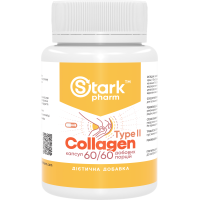
Regarding formats: the hydrolysate is available both as a pure powder without foreign components — for example, Stark Collagen Hydrolyzed Pure Powder — and as part of combined formulas, while undenatured type II is mainly available in capsules due to its small doses. The amount and method of use in each case are determined by the instructions on the package.
A few words of caution. Joint pain, swelling, or limited mobility require a doctor's evaluation, not self-selection of supplements: similar symptoms are caused by different conditions with different approaches. Undenatured type II collagen is obtained from chicken cartilage, so it is not suitable for people with chicken allergies. Kidney pathology is a special case when additional protein load should be coordinated with a doctor, as should any supplement during pregnancy, lactation, or ongoing drug therapy.
Frequently asked questions
These are different substances with different mechanisms. The hydrolysate is taken in grams as a source of peptides, the undenatured type II is taken in tens of milligrams, and its effect depends on the preserved structure of the molecule.
How big an effect did the research find?
In a 2024 meta-analysis, the standardized mean difference was −0.35 for pain and −0.31 for function. By established guidelines, this is between a small and medium effect.
Does collagen restore cartilage?
This has not been shown. The studies measured symptoms and function using the WOMAC, VAS, and Lequena scales, not cartilage thickness or joint space width.
What does "high certainty of evidence" mean?
This is a score according to the international GRADE system, which takes into account risk of bias, consistency of results, and precision of assessments. It is high for joint function and moderate for pain.
How long did the research take?
Mostly from a few months to six months. The most commonly cited study of undenatured type II lasted 180 days.
Are there any weaknesses in this data?
Yes. The drugs and doses in the pooled analysis are very different, and stratification of studies by funding source, unlike the skin topic, was not performed here.
Can it be combined with other joint remedies?
This is a question for your doctor, who knows your diagnosis and your medication list. Joint symptoms have different causes, and the choice of remedies depends on which one is yours.
Sources
- Nakatani S. and others. (2009). Chondroprotective effect of the bioactive peptide prolyl-hydroxyproline in mouse articular cartilage in vitro and in vivo. Osteoarthritis and Cartilage. https://pubmed.ncbi.nlm.nih.gov/19559809/
- Lugo JP and others. (2013). Undenatured type II collagen (UC-II) for joint support: a randomized, double-blind, placebo-controlled study in healthy volunteers. Journal of the International Society of Sports Nutrition. https://pmc.ncbi.nlm.nih.gov/articles/PMC4015808/
- Lugo JP, Saiyed ZM, Lane NE (2016). Efficacy and tolerability of an undenatured type II collagen supplement in modulating knee osteoarthritis symptoms: a multicenter randomized, double-blind, placebo-controlled study. Nutrition Journal. https://pmc.ncbi.nlm.nih.gov/articles/PMC4731911/
- Lin C.-R. etc. (2023). Analgesic efficacy of collagen peptide in knee osteoarthritis: a meta-analysis of randomized controlled trials. Journal of Orthopedic Surgery and Research. https://pmc.ncbi.nlm.nih.gov/articles/PMC10505327/
- Liang C.-W. etc. (2024). Efficacy and safety of collagen derivatives for osteoarthritis: a trial sequential meta-analysis. Osteoarthritis and Cartilage. https://pubmed.ncbi.nlm.nih.gov/38218227/
Dietary supplement. Not a medicine. Consult a doctor before use.
Products related to this post
Related Posts
Comments
Information
Customer Service
Extras
My Account


Sports nutrition manufacturer in Ukraine StarkPharm © 2026