Your shopping cart is empty!

Fat- and water-depleting vitamins: what is the difference and why is it important?
Published: 27/11/2026
Times Read: 57
Comments : 0
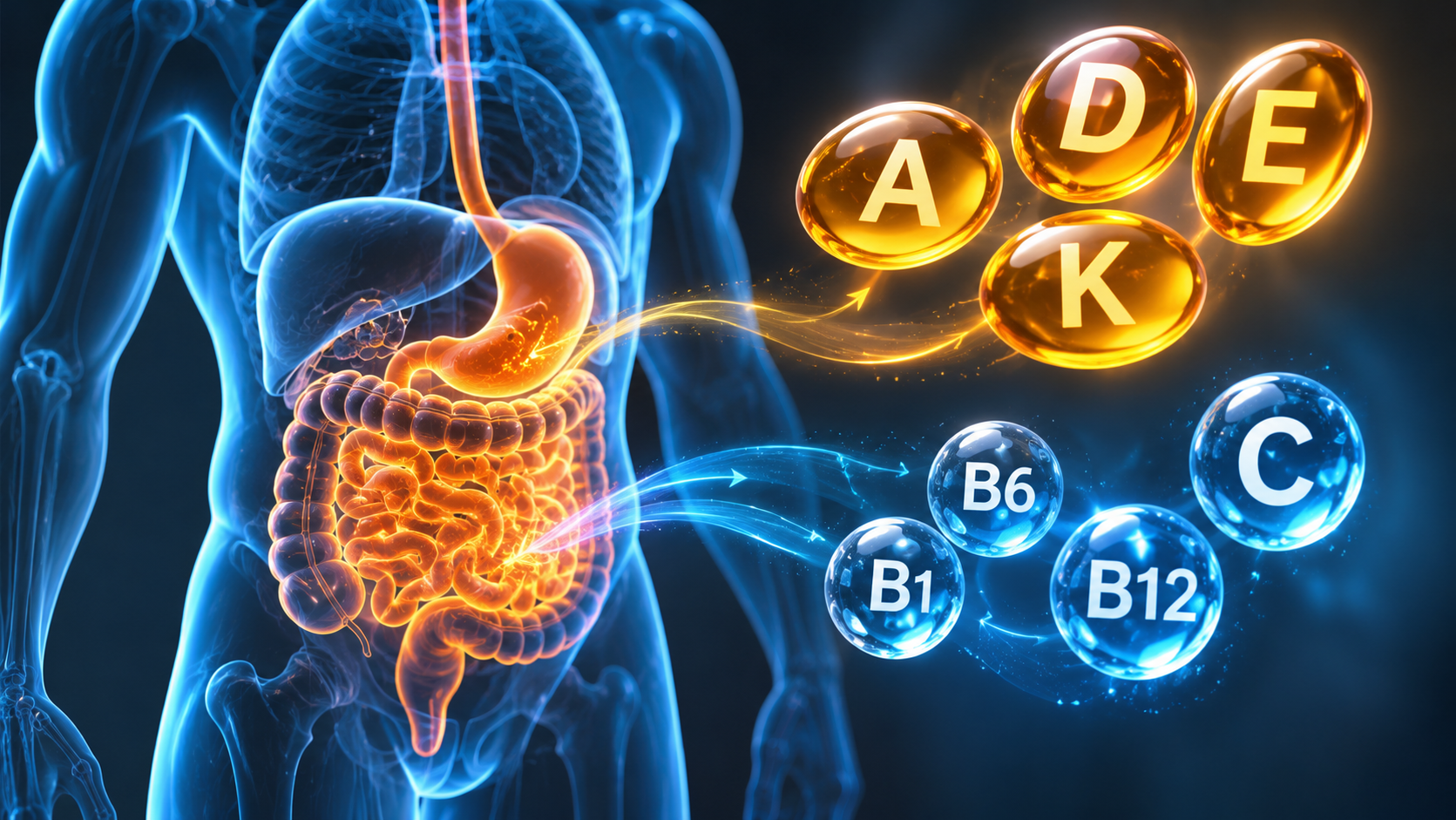
Fat-soluble vitamins A, D, E and K are absorbed with the involvement of dietary fats, bile acids and transport particles in the small intestine. Water-soluble vitamins — vitamin C and the eight B vitamins — use different transport mechanisms. This is why food composition substantially affects the body’s uptake of some substances, whereas for others the form, amount, digestive health and regularity of intake may matter more.
However, the common rule “A, D, E and K only with fatty meals, B and C only on an empty stomach” oversimplifies biology. Fat may improve the absorption of fat-soluble vitamins, but this does not mean that no absorption occurs without it. Likewise, water solubility does not require taking vitamins on an empty stomach.
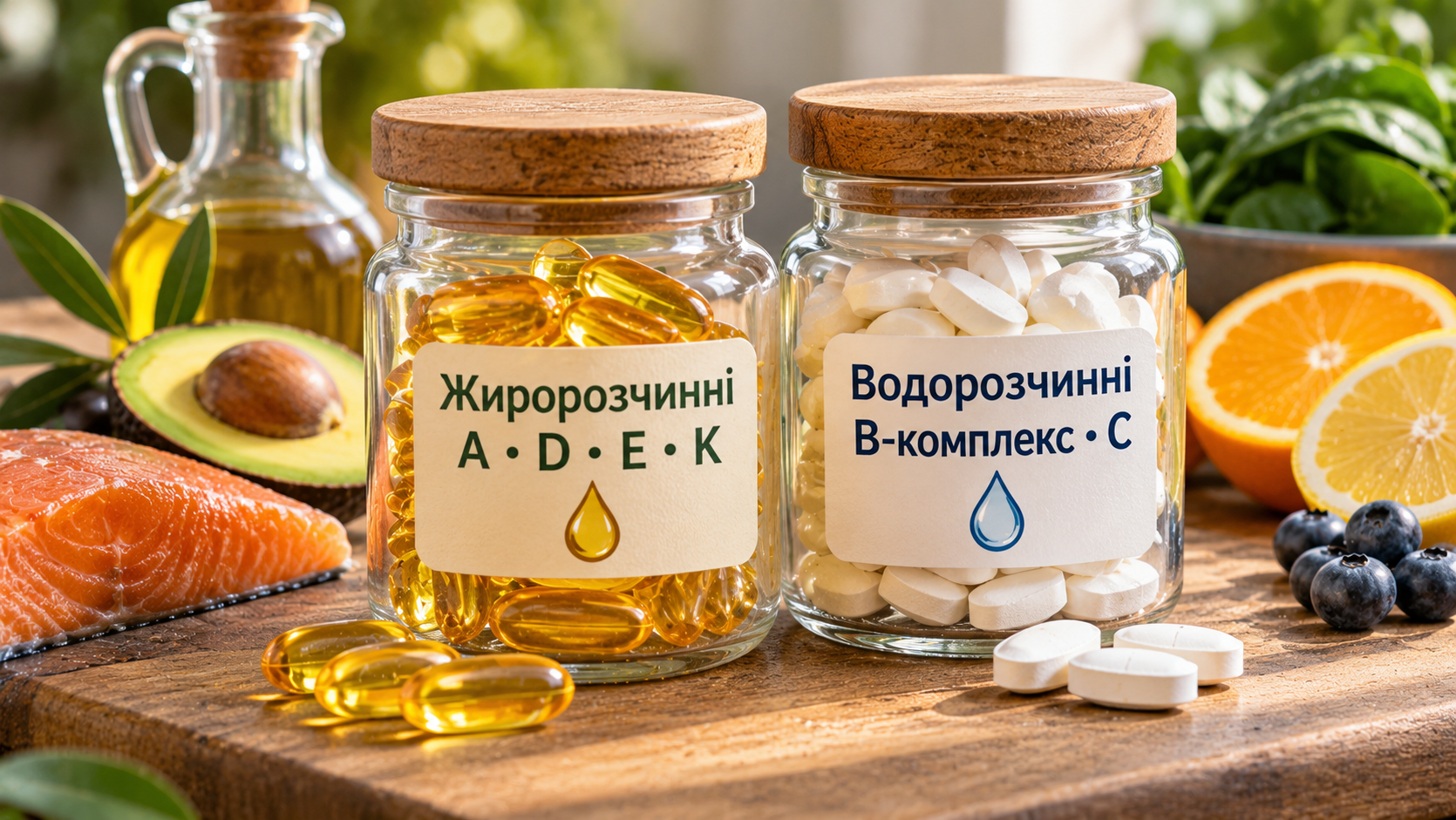
Fat-soluble and water-soluble vitamins: key differences
| Feature | Fat-soluble | Water-soluble |
|---|---|---|
| Examples | A, D, E, K | C and B1, B2, B3, B5, B6, B7, B9, B12 |
| Absorption requirements | Depend on fat digestion, bile and the formation of micelles | Mostly use specialized transporters or other aqueous pathways; there are exceptions |
| Role of food | Food containing some fat often improves absorption | Food is not a universal requirement; the effect depends on the particular vitamin |
| Body stores | Some vitamins can accumulate substantially, especially A | Stores are generally smaller, but B12 can be retained for years |
| Excess intake | Some forms carry a risk of accumulation and toxicity | Urinary excretion does not guarantee the safety of high doses |
This classification describes the physicochemical properties of molecules rather than providing universal instructions on timing. Vitamins within the same group may differ in their forms, transport pathways and rates of metabolism (NIH Office of Dietary Supplements; Micronutrient Bioavailability Review, 2025).
How fat-soluble vitamins are absorbed: bile, micelles and chylomicrons
When fat enters the small intestine, bile acids help form tiny particles called mixed micelles. These keep fat-soluble compounds dispersed in an environment dominated by water and bring them close to the surface of intestinal cells. After entering enterocytes, a substantial proportion of these compounds is incorporated into chylomicrons — lipoprotein particles that transport dietary fats and associated compounds.
This process explains why a meal containing fat may matter even when a capsule itself contains a small amount of oil. However, formulation, the properties of each vitamin and overall fat digestion all influence the outcome. In people with fat malabsorption, certain intestinal disorders or taking medicines that reduce fat absorption, uptake of vitamins A, D, E and K may decrease (NIH ODS; EFSA, 2017).
Why vitamin D is often recommended with food
Vitamin D has been studied in direct comparisons of administration conditions. In a randomized study by Dawson-Hughes and colleagues (2015), the peak plasma vitamin D3 level over 12 hours was on average 32% higher in the group receiving a fat-containing meal than in the fat-free meal group. This describes a specific study protocol and a short-term measure, not a promise of the same increase with every product.
A systematic review by Silva and Furlanetto (2018) confirmed that dietary fat can enhance vitamin D absorption, while emphasizing that some absorption still occurs without fat. Meanwhile, a review by Borel and colleagues (2015) did not find compelling evidence of a universal effect of fat quantity on D3 bioavailability. Other trials likewise have not always found consistent effects of administration conditions on long-term changes in 25(OH)D, the main laboratory marker of vitamin D status. Thus, taking it “with food” is practical guidance, not a biological necessity implying zero absorption when fasting.
The differences between drops, tablets and capsules are a separate subject covered in “Vitamin D in Drops, Capsules and Tablets: Does Absorption Differ?”
Vitamins A, E and K: a shared principle with different nuances
Vitamin A is obtained as preformed retinoids from animal products or as provitamin carotenoids from plants. Processing, particle size and fat content all affect the release of carotenoids from the food matrix. Preformed retinol and carotenoids should not be considered identical in absorption or risk of excessive intake. The liver is the main storage site for preformed vitamin A (NIH ODS).
Vitamin E also depends on fat digestion, but the food matrix influences the outcome as well. Studies using isotopically labeled alpha-tocopherol have investigated how food type, fat quantity and the timing of fat intake influence vitamin E uptake. Jeanes and colleagues (2004), for example, demonstrated the importance of both fat and the food matrix; later experiments clarified the role of meal timing (Traber and colleagues, 2019).
Vitamin K includes phylloquinone (K1) and menaquinones (K2), among other forms. Source and form affect absorption: K1 from leafy vegetables is embedded in plant structures, so adding fat to the meal may be helpful. Gijsbers and colleagues (1996) compared phylloquinone absorption from various dietary preparations. EFSA (2017) also emphasizes the food matrix rather than only the absolute vitamin content of a product.
Fat solubility, then, is a common feature but not proof that all forms of vitamins A, E and K have identical bioavailability. Even within vitamin K, findings for one form should not automatically be extended to every other form.
How much fat should a meal contain for vitamin absorption?
No universal number of grams of fat has been established for all vitamins. Different experiments have compared fat-free and fat-containing meals, various oil-based formulations and different supplement forms. Because studies differ in doses, participants and outcome measures, they cannot be reduced to one mandatory number for every dose.
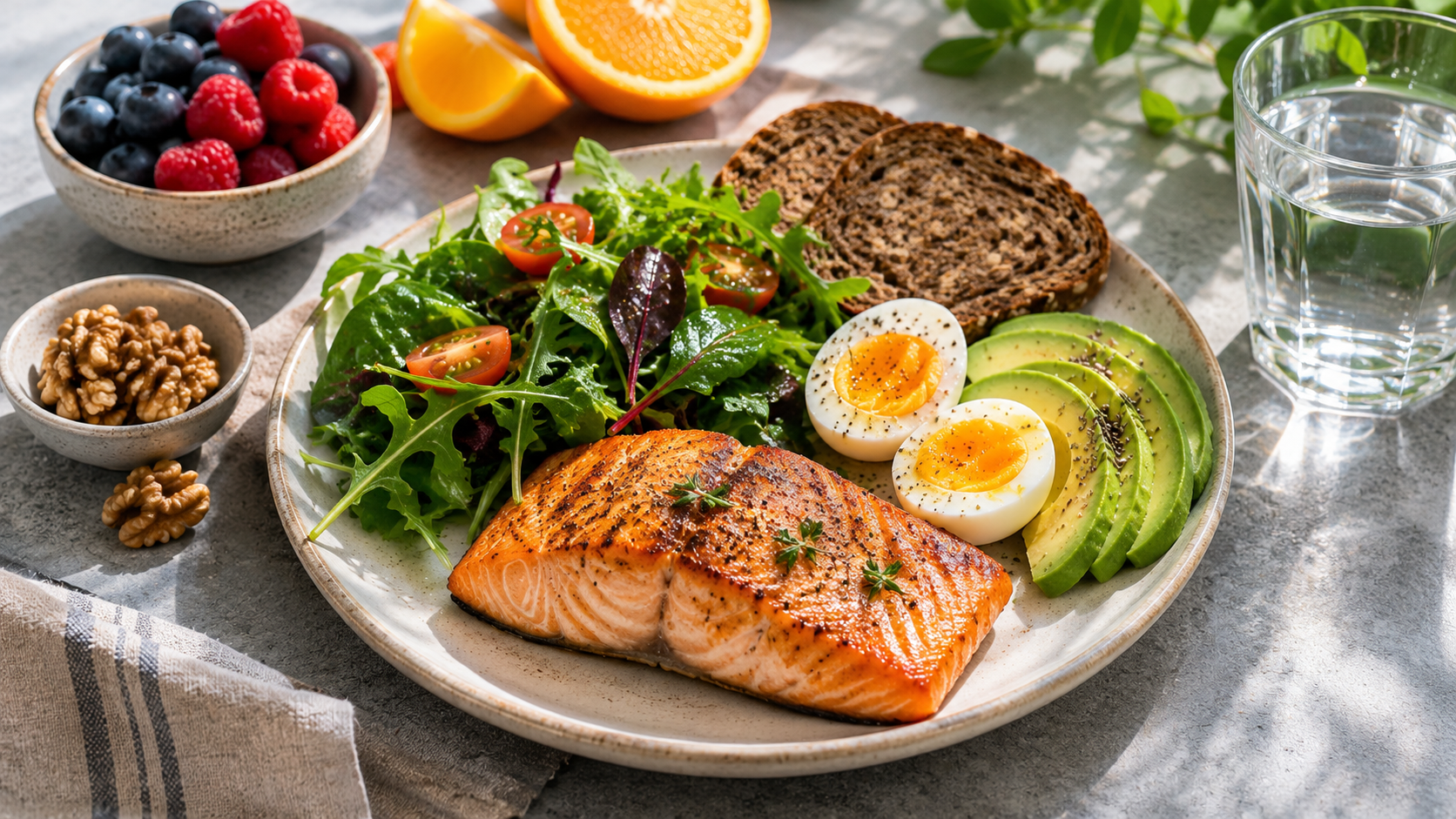
In a normal diet, fats from fish, eggs, nuts, seeds, olive oil or other foods can serve this purpose. The point is not that a very high-fat meal is necessary, but that a completely fat-free meal and an ordinary balanced meal do not always provide equivalent conditions for fat-soluble substances.
There is no reason to deliberately increase dietary fat beyond nutritional needs merely because vitamins are being taken. If a medical condition impairs fat absorption, individualized assessment of the cause may be more important than simply adding oil to meals.
How water-soluble vitamins B and C are absorbed
Water solubility means that these vitamins do not need to be incorporated into fat micelles in the same way as A, D, E and K. However, absorption is not simply a matter of “passing through with water.” It often depends on specialized transporters, the quantity consumed and the chemical form.
Vitamin C is absorbed through ascorbate transporters, and the absorbed fraction depends on the dose. According to NIH ODS, about 70–90% is absorbed at intakes of 30–180 mg daily, while at doses above 1 g the fraction falls below 50%. This illustrates why a larger dose does not produce a proportional increase in delivery to tissues. For more details, see “Vitamin C: 500 vs. 1000 mg and the Limits of Absorption.”
Vitamin B12 is an important exception to oversimplified ideas about water-soluble vitamins. Active absorption of dietary B12 requires several steps in the stomach and intestine, including the involvement of intrinsic factor. The body can maintain substantial B12 stores, so water solubility does not mean an absence of reserves. When intrinsic-factor secretion is impaired, or after certain operations, an ordinary diet may not ensure normal B12 absorption (NIH ODS).
Other B vitamins also have their own transport mechanisms, so rules for one should not be applied indiscriminately to the whole group.
Do water-soluble vitamins need to be taken on an empty stomach?
There is no scientific basis for a universal requirement that “all B vitamins and vitamin C must be taken on an empty stomach.” In many cases they can be consumed with ordinary meals. Food sometimes affects gastric transit, tolerability and the availability of particular formulations, but that does not mean it always “blocks” absorption.
Some medicines or supplements may cause nausea or discomfort when taken on an empty stomach; in those cases, the manufacturer’s instructions and individual tolerability matter. Certain prescription medicines or specialized formulations have their own directions, which should not be replaced with generic advice from the internet.
The broader issue of timing is covered separately in “When to Take Supplements: Morning, With Meals or at Night.” This article focuses instead on the physiological reasons behind the different recommendations.
Do all fat-soluble vitamins accumulate while water-soluble vitamins are excreted?
This is another overgeneralization. Vitamin A can be stored in substantial quantities in the liver, and excessive intake of preformed retinol can be harmful. Vitamin D is also stored and metabolized, and excessive doses may cause adverse effects. Vitamins E and K, however, follow different metabolic pathways, so accumulation and risks are not identical across all four vitamins.
Renal excretion plays an important role for many water-soluble vitamins. But B12 has substantial body stores, and high doses of some water-soluble vitamins can also be harmful. Therefore, the idea that “any excess simply leaves in the urine” is not a reason to ignore dosages.
When the usual rules of absorption may not apply
- Fat malabsorption. Intestinal diseases, impaired bile delivery or certain medicines may reduce the availability of vitamins A, D, E and K.
- Stomach and intestinal conditions. Intrinsic factor and the health of the terminal small intestine are important for B12 absorption.
- Drug interactions. For example, people taking warfarin should maintain relatively consistent vitamin K intake; sudden self-directed changes to diet or supplements may affect its anticoagulant action.
- High doses and combinations of products. Total intake of the same vitamins from all products must be considered, not just the number shown on one package.
- Pregnancy, breastfeeding and chronic conditions. These require special attention to vitamin form, dose and medical guidance, particularly for preformed vitamin A.
Differences in absorption do not mean everyone needs vitamin supplements. Whether a supplement is appropriate depends on diet, risk factors, health status and, when indicated, test results.
What to remember about taking vitamins with food
For A, D, E and K, an ordinary meal containing some fat often creates better absorption conditions than a completely fat-free meal. For B and C, there is no such general requirement: their individual transport pathways, dose, form and tolerability matter. In either case, follow the directions for the specific product and do not confuse bioavailability with a need for higher doses.
Frequently asked questions
Which vitamins are fat-soluble?
Vitamins A, D, E and K. Their intestinal absorption is linked to the digestion of fat.
Which vitamins are water-soluble?
Vitamin C and the eight B vitamins: B1, B2, B3, B5, B6, B7, B9 and B12.
Will vitamin D be absorbed without fatty food?
Yes. Some absorption can occur without fat, although research shows that dietary fat may improve it.
Do I need to add oil to every capsule?
No. For fat-soluble vitamins, it is usually sufficient to consider the composition of a normal meal; no universal fat requirement per capsule has been established.
Can vitamin C be taken after a meal?
Yes. Water solubility by itself does not require fasting. Follow the directions and consider individual tolerability.
Why is vitamin B12 an exception among water-soluble vitamins?
Its active absorption depends on intrinsic factor, and the body can store substantial amounts of B12.
Does water solubility make overdosing impossible?
No. Renal excretion does not eliminate the risks of excessive intakes of certain vitamins.
Can I suddenly increase vitamin K while taking warfarin?
No. Changes in vitamin K intake can affect warfarin’s action. Discuss any changes to diet or supplements with a doctor.
Sources
- National Institutes of Health, Office of Dietary Supplements. Vitamin D — Health Professional Fact Sheet. NIH ODS.
- National Institutes of Health, Office of Dietary Supplements. Vitamin A and Carotenoids — Health Professional Fact Sheet. NIH ODS.
- National Institutes of Health, Office of Dietary Supplements. Vitamin C — Health Professional Fact Sheet. NIH ODS.
- National Institutes of Health, Office of Dietary Supplements. Vitamin B12 — Health Professional Fact Sheet. NIH ODS.
- National Institutes of Health, Office of Dietary Supplements. Vitamin K — Health Professional Fact Sheet. NIH ODS.
- Dawson-Hughes B et al. (2015). Dietary fat increases vitamin D-3 absorption. Journal of the Academy of Nutrition and Dietetics. PubMed.
- Borel P et al. (2015). Vitamin D bioavailability: state of the art. Critical Reviews in Food Science and Nutrition. PubMed.
- Silva MC, Furlanetto TW. (2018). Intestinal absorption of vitamin D: a systematic review. Nutrition Reviews. PubMed.
- Jeanes YM et al. (2004). The absorption of vitamin E is influenced by the amount of fat in a meal and the food matrix. British Journal of Nutrition. PubMed.
- Traber MG et al. (2019). Vitamin E absorption and kinetics in healthy women, as modulated by food and by fat, studied using 2 deuterium-labeled α-tocopherols in a 3-phase crossover design. The American Journal of Clinical Nutrition. PubMed.
- Gijsbers BLMG et al. (1996). Effect of food composition on vitamin K absorption in human volunteers. British Journal of Nutrition. PubMed.
- EFSA NDA Panel. (2017). Dietary reference values for vitamin K. EFSA Journal. DOI.
- Richards JD et al. (2025). Micronutrient bioavailability: concepts, influencing factors, and strategies for improvement. Frontiers in Nutrition. PubMed.
Dietary supplement. Not a medicinal product. Consult your doctor before use.
Products related to this post

Related Posts
Comments
Information
Customer Service
Extras
My Account


Sports nutrition manufacturer in Ukraine StarkPharm © 2026


