Your shopping cart is empty!

Vitamin C: 500 or 1000 mg — how is it absorbed and is there a difference?
Published: 13/11/2026
Times Read: 19
Comments : 0
Vitamin C 500 mg and 1000 mg differ not only in the amount of ascorbic acid. As the dose increases, the body absorbs a smaller portion of it, the concentration in the blood plasma gradually approaches a plateau, and the excess is more actively excreted by the kidneys. Therefore, double the amount in a serving does not mean a double increase in the level of vitamin C in the body.
The key question is not only how many milligrams have reached the digestive tract, but also how much has been absorbed, what reserves are already in the tissues, and whether the additional intake affects practically significant indicators. Let's consider these differences based on pharmacokinetic studies and scientific reviews.
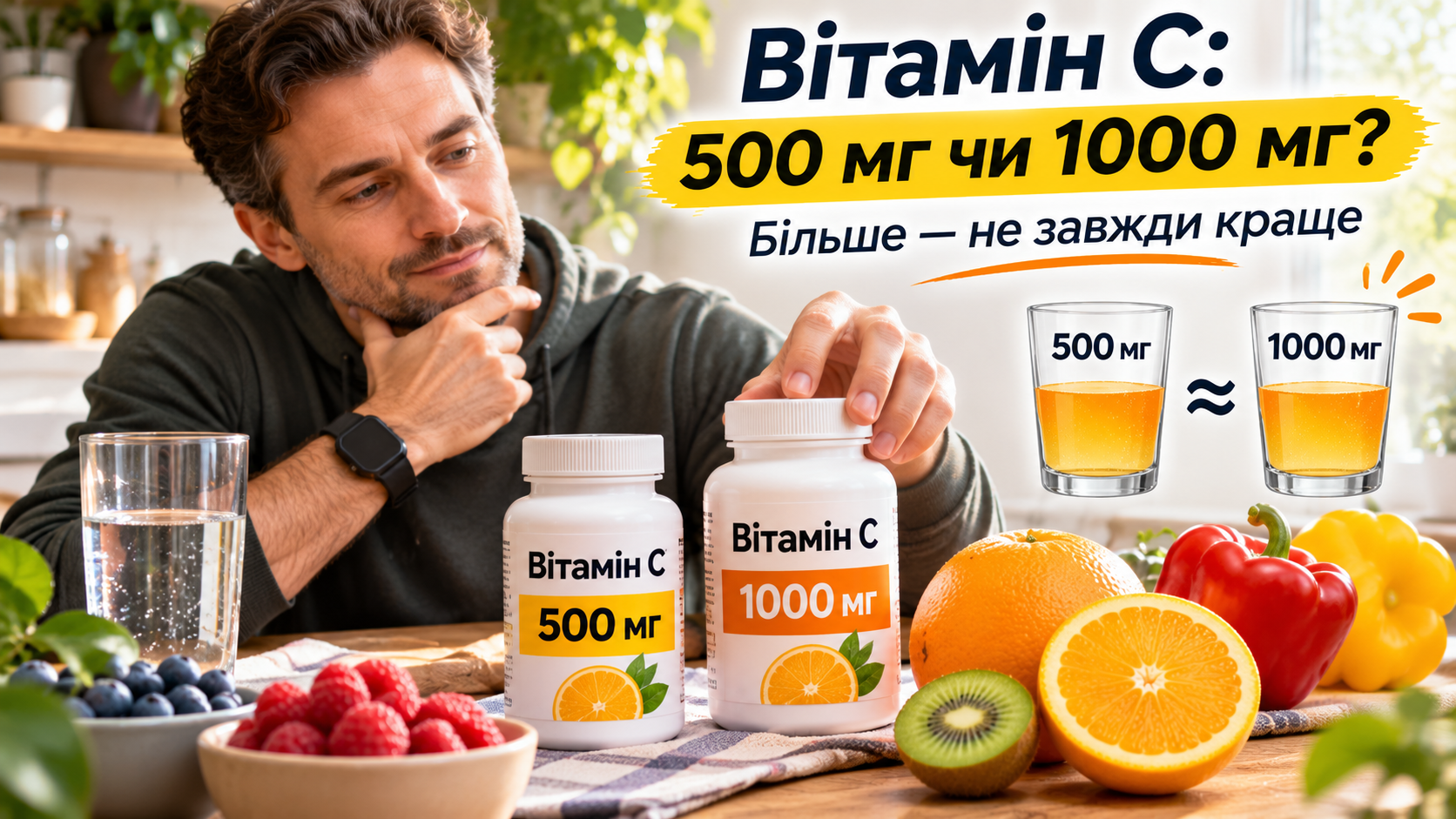
Vitamin C 500 and 1000 mg: the main differences
| Parameter | 500 mg | 1000 mg |
|---|---|---|
| Amount of ascorbic acid | 0.5 g | 1 g — twice as much |
| Share of learned | Lower than moderate food doses; depends on the body's supply | With increasing dose, relative bioavailability decreases even more. |
| Plasma concentration | Well-off people often already have a level close to saturation. | May be higher, but increases disproportionately to doubling the dose |
| Urinary excretion | Increases with tissue saturation | Excess amount is excreted more actively |
| Proven benefit for a healthy person | Not determined by the number on the label alone | Double effect compared to 500 mg not proven |
This comparison describes general patterns, not the exact percentage of absorption of each tablet. In scientific papers, values vary depending on the initial availability, study regimen, and method of measurement.
How the body absorbs vitamin C
Ascorbic acid is a water-soluble substance that a person must obtain with food. It is involved in the synthesis of collagen and carnitine, the functioning of antioxidant systems, and the absorption of non-heme iron. The main food sources remain vegetables, fruits, and berries.
The transport of ascorbate across the intestinal wall is largely mediated by a specialized sodium-dependent transporter, SVCT1. Its capacity is limited: as the amount of vitamin C passing through the intestine increases, the amount gradually decreases. Another transporter, SVCT2, is involved in the entry of ascorbate into many cells. These mechanisms are described in a review by Lykkesfeldt and Tveden-Nyborg (2019).
According to the NIH Office of Dietary Supplements, at moderate intakes of 30–180 mg/day, approximately 70–90% of vitamin C is absorbed. At doses greater than 1 g/day, absorption may fall below 50%. These ranges do not imply that exactly 50% is absorbed from a 1000 mg serving: the NIH figure applies to doses greater than 1000 mg.
Where does saturation begin: what research has shown
Levine et al. (1996) studied the pharmacokinetics of vitamin C in seven healthy volunteers, sequentially examining daily intakes from 30 to 2500 mg. The steepest increase in plasma concentration occurred at relatively low doses, and then the curve became flatter. At 1000 mg/day, plasma saturation was observed in this small study; at single doses of 500 mg and above, bioavailability decreased.
A similar study by Levine et al. (2001) also found a nonlinear relationship between ascorbic acid intake and plasma levels in healthy young women. A later review by Carr and Lykkesfeldt (2023) emphasized that this relationship was not only dependent on dosage but also on body weight, smoking status, and baseline vitamin status.
It is important to distinguish between plasma saturation, cellular accumulation, and clinical effect. When the plasma curve plateaus, this does not mean that the vitamin is no longer being absorbed completely. It means that its level is regulated simultaneously by absorption, tissue distribution, and excretion.
Why 1000 mg doesn't provide twice the concentration of 500 mg
Comparing 500 and 1000 mg is often reduced to arithmetic: if the amount is doubled, the result should also double. For ascorbic acid, this does not work because of saturable transport and renal regulation. With sufficient supply, a larger single dose does not automatically translate into a proportionally larger long-term supply in the tissues.
In a small 1986 crossover study, four subjects received 500, 1000, and 2000 mg of ascorbic acid daily for one week in each period. Despite the fourfold range of doses, the area under the concentration-time curve was relatively similar. Because of the small sample size, these data cannot be considered a universal prediction for every individual, but they do illustrate nonlinear pharmacokinetics.
A review by Lykkesfeldt and Carr (2023) highlights the differences between laboratory levels of availability and expected health effects. Higher levels of ascorbate alone after taking larger amounts do not prove additional benefits for a particular individual.
The kidneys filter ascorbate from the blood and partially reabsorb it through transporters. When the concentration is low, the body conserves vitamin C more efficiently. When the supply is sufficient, the reabsorption mechanism gradually becomes saturated and most of the excess appears in the urine.
Levine et al. (1996) observed an increase in ascorbate excretion after increasing doses. A review by Lykkesfeldt and Tveden-Nyborg (2019) describes how renal tubular transport maintains relatively stable vitamin C concentrations under normal conditions.
The phrase “vitamin C simply comes out in the urine” is also too simplified. Part of ascorbic acid performs physiological functions, part is distributed between tissues, and part is excreted. The ratio of these processes depends on the body’s supply.
Single and divided doses: what is known
Because ascorbic acid absorption is dose-dependent, researchers have compared not only the amount but also the route of administration. Yung et al. (1981) investigated how dose splitting and food affect ascorbic acid absorption. Such studies help explain why a single large dose and the same total amount distributed throughout the day can produce different concentration profiles.
However, pharmacokinetic differences do not prove that a specific dosing schedule improves well-being or other clinical outcomes. It is more important for a daily diet to obtain vitamin C regularly from a variety of foods than to try to maintain the highest possible short-term blood concentration.
Who might be interested in individual characteristics?
Vitamin C requirements and concentrations vary from person to person. According to a review by Carr and Lykkesfeldt (2023), the relationship between intake and blood values may be influenced by body weight and smoking. A pharmacokinetic study in young and elderly men also showed that baseline ascorbic acid levels can alter values after the same 500 mg dose.
Special caution is required for people with kidney disease, a tendency to oxalate stones, iron metabolism disorders, including hereditary hemochromatosis, as well as those who constantly take medications. High amounts of ascorbic acid can cause nausea, abdominal discomfort, or diarrhea. During pregnancy and breastfeeding, the choice of supplements should be coordinated with a medical specialist.
Practical conclusion: 1000 mg is twice as much substance as 500 mg, but not twice as much bioavailability or proven benefit. The additional amount should only be evaluated taking into account nutrition, individual condition and purpose of use. High doses should not be considered a universal necessity.
Frequently asked questions
Which is better absorbed: 500 or 1000 mg of vitamin C?
As the dose increases, the percentage absorbed usually decreases. This does not mean that with 1000 mg, the body necessarily receives less vitamin C in absolute quantities.
Is vitamin C more than 500 mg absorbed?
Yes. However, bioavailability is reduced with large single doses, and with sufficient supply, excretion of the excess is enhanced.
Is it true that the body absorbs a maximum of 200 mg of vitamin C?
No, there is no hard limit of 200 mg. Around this value, in some studies, further increase in blood concentration was slowed down, but absorption did not stop completely.
Does 1000 mg provide twice the benefits of 500 mg?
This general conclusion is not supported by scientific data. Doubling the amount of ascorbic acid does not mean doubling its concentration or physiological effect.
Why is vitamin C excreted in urine?
The kidneys regulate its levels in the blood. When the body has enough ascorbate, the part of ascorbate that does not need to be stored is excreted.
Is it better to divide a large amount of vitamin C into several doses?
Dose splitting may alter the pharmacokinetic profile, but this does not equate to a proven health benefit. The dosage regimen should be consistent with the instructions and individual circumstances.
Does the absorption of vitamin C depend on nutrition?
Yes, initial supply matters. Vitamin C from fruits and vegetables is a normal part of the diet; additional large servings are no substitute for a varied diet.
Who needs advice before using large doses?
First of all, people with kidney problems, a tendency to stones, excess iron, pregnant women, breastfeeding women, and people who constantly take medication.
Sources
- Levine M et al. (1996). Vitamin C pharmacokinetics in healthy volunteers: evidence for a recommended dietary allowance. Proceedings of the National Academy of Sciences. PubMed.
- Levine M et al. (2001). A new recommended dietary allowance of vitamin C for healthy young women. Proceedings of the National Academy of Sciences. PubMed.
- Melethil S, Mason WD, Chang CJ. (1986). Dose-dependent absorption and excretion of vitamin C in humans. International Journal of Pharmaceutics. DOI.
- Blanchard J et al. (1990). Vitamin C disposition in young and elderly men. The American Journal of Clinical Nutrition. PubMed.
- Carr AC, Lykkesfeldt J. (2023). Factors Affecting the Vitamin C Dose-Concentration Relationship: Implications for Global Vitamin C Dietary Recommendations. Nutrients. PubMed.
- Lykkesfeldt J, Carr AC. (2023). Vitamin C - a scoping review for Nordic Nutrition Recommendations 2023. Food & Nutrition Research. PubMed.
- Yung S, Mayersohn M, Robinson JB. (1981). Ascorbic acid absorption in man: influence of divided dose and food. Life Sciences. PubMed.
- National Institutes of Health, Office of Dietary Supplements. Vitamin C: Fact Sheet for Health Professionals. NIH ODS.
- Levine M et al. (2016). Vitamin C: the known and the unknown and Goldilocks. Oral Diseases. PubMed.
Dietary supplement. Not a medicine. Consult a doctor before use.
Products related to this post


Related Posts
Comments
Information
Customer Service
Extras
My Account


Sports nutrition manufacturer in Ukraine StarkPharm © 2026


