Your shopping cart is empty!

Vitamin D in winter in Ukraine: how latitude affects D3 synthesis
Published: 10/11/2026
Times Read: 27
Comments : 0
In winter in Ukraine, even a clear day does not always provide enough ultraviolet UVB radiation for vitamin D3 to form in the skin. The reason relates to geographical latitude, the Sun's elevation above the horizon, and the passage of sunlight through the atmosphere. Seasonal changes in vitamin D status therefore cannot be assessed simply by counting sunny days.
We will explain what changes from November to March, why blood levels may be lowest in spring, and which conclusions are supported by studies conducted in Ukraine. We will also explain why winter does not mean that everyone needs the same amount of supplementation.
Why Ukraine's latitude affects vitamin D production
Vitamin D3 forms in the skin when ultraviolet rays in the UVB range reach 7-dehydrocholesterol. Previtamin D3 is produced first and subsequently converts into cholecalciferol. The decisive factor is not simply how bright the day looks but how much UVB at the necessary wavelengths actually reaches exposed skin.
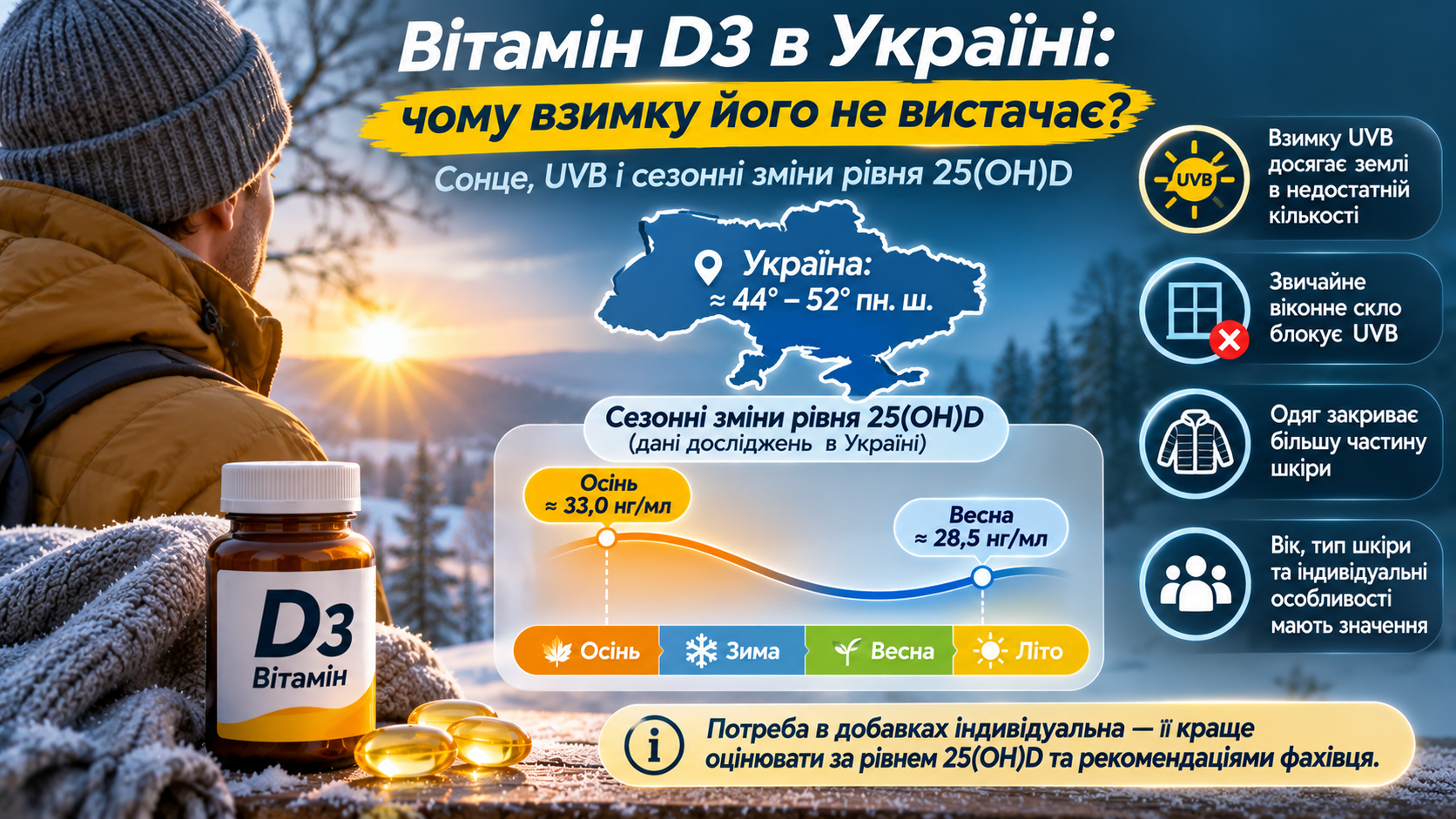
Ukraine extends from approximately 44° to 52° north latitude. During winter, the Sun stays relatively low; its rays travel a longer distance through the atmosphere, where some UVB is absorbed and scattered. Even a cloudless, frosty day therefore does not necessarily provide conditions for appreciable D3 production. Southern and northern parts of Ukraine differ, but seasonal and specific weather differences are also substantial.
In the classic experiment by Webb, Kline, and Holick (1988), human skin samples exposed outdoors in Boston (42.2° N) did not produce measurable previtamin D3 from November through February; in Edmonton (52° N), the unfavorable period extended from October through March. This illustrates a physical mechanism rather than providing an exact calendar for every Ukrainian city.
What is “vitamin D winter,” and why does it have no universal dates?
Researchers use the term “vitamin D winter” for the part of the year when natural UVB is insufficient or practically ineffective for vitamin D production in the skin. Its duration depends on latitude, the ozone layer, solar elevation, cloud cover, and local atmospheric conditions. This period does not necessarily begin on December 1 or end on the last day of February.
In comparative European modeling (Cashman et al., 2016), the duration of the unfavorable UVB period increased with latitude: from no such period at approximately 35° N to about eight months at 69° N. The analysis covered different European regions, so it cannot be converted into a single number of “months without vitamin D” for all residents of Ukraine.
A more recent analysis of radiation across 46 European capitals from 2004 to 2021 also identified substantial seasonal and geographical differences in the UVB spectrum relevant to D3 synthesis (2022). Understanding the winter situation therefore requires considering several factors, not just the calendar date.
Why sunshine, walks, and windows do not always mean D3 synthesis
Light, warmth, and UVB are different things. Visible sunlight can be bright when very little UVB involved in D3 synthesis reaches the skin. Ordinary window glass blocks much of the UVB, so sitting by a sunny window is not equivalent to being outdoors when it comes to vitamin D production.
- Solar elevation. When the winter Sun is low, UVB travels farther through the atmosphere, reducing its availability.
- Clothing. Scarves, gloves, and jackets cover most of the skin, as is natural during a Ukrainian winter.
- Time spent outdoors. A brief midday walk and spending most of the day indoors create different conditions, but neither allows an exact calculation of D3 synthesis.
- Pigmentation, age, and individual characteristics. Skin responses to radiation differ among people.
- Cloud cover and air pollution. These can further alter ultraviolet availability.
The US National Institutes of Health (NIH Office of Dietary Supplements) emphasizes that, because of these differences, there is no universally safe duration of sun exposure that will always ensure an adequate vitamin D level. Deliberately prolonged sunbathing to compensate for winter is not advisable: ultraviolet radiation can also damage the skin.

What studies in Ukraine found: levels change with the seasons
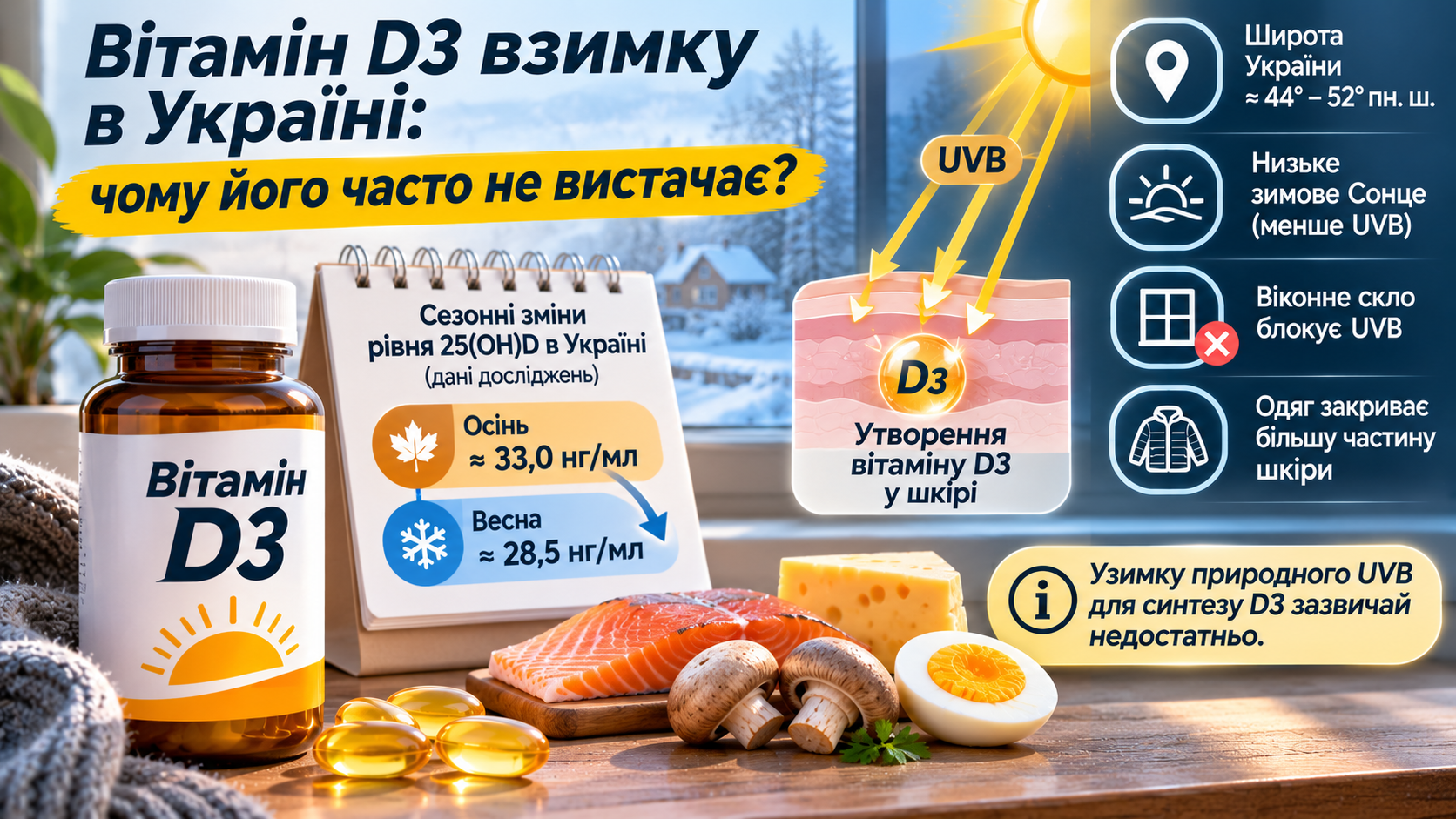
Data collected directly in Ukraine are particularly informative. The study “Vitamin D deficiency in Ukraine: current evidence” (2023) analyzed 7,418 measurements of 25(OH)D from adults aged 20–99 years between 2016 and 2022. The median was highest in September and lowest in March; by season, the authors reported 33.0 ng/mL in autumn and 28.5 ng/mL in spring. This is consistent with the accumulated influence of summer sunlight and a delayed seasonal decline during winter.
A retrospective study in Transcarpathia covering 2019 included 1,823 examinations of children and adults. Among adults examined in the winter months, 51.74% had 25(OH)D levels below 20 ng/mL. This figure describes a particular sample and threshold, not the proportion of all people living in Ukraine.
A multicenter study in Kyiv and the surrounding region (Shatylo et al., 2024) included 11,462 participants, comprising 9,932 adults and 1,530 children, whose 25(OH)D levels were measured during 2021. Among adults, approximately 26% had values below 50 nmol/L according to the authors' definition. This was also not a random, nationally representative sample.
Important caution: different studies used their own thresholds to characterize vitamin D status, so comparing percentages without examining their methods is inappropriate. Nevertheless, the overall pattern of seasonal fluctuation appears across independent datasets.
Why the lowest levels may occur as late as March
The loss of strong summer UVB does not mean that blood 25(OH)D levels change instantly. They reflect vitamin D intake and production over the preceding period, its metabolism in the body, and individual factors. Because of this lag, the seasonal minimum often occurs after the shortest day of the year.
In a US study of 25(OH)D seasonality (2013), levels peaked in late summer and reached their minimum in late winter. The researchers found the best match with the Sun's astronomical position when applying a time lag of approximately eight weeks. Ukrainian data from 2016–2022, showing a decline through March, illustrate a similar principle, although the exact month of the minimum depends on the sample and conditions.
Therefore, the claim “it's already March, so vitamin D from sunlight has recovered” is an oversimplification. A change in season does not produce an immediate change in blood levels.
Winter nutrition: which vitamin D sources really matter?
When the contribution from skin synthesis decreases, food can play a greater role in total vitamin D intake. Natural dietary sources are relatively few: fatty fish, certain fish oils, egg yolks, and some mushrooms containing D2. The amount depends on the food type, growing conditions, and processing methods.
In countries where foods are fortified with vitamin D, certain dairy products, beverages, or cereals may provide another source. Ukrainian consumers should check the product label to establish whether it is fortified: not every product in these categories contains added vitamin D.
Data from a European study of UVB and 25(OH)D (Cashman et al., 2016) revealed an interesting contrast: northern populations with weaker winter UVB sometimes showed smaller seasonal changes in blood levels than populations in Ireland, alongside higher dietary vitamin D intake. This does not establish an identical requirement for everyone; it illustrates that latitude is only one part of the picture.
Does everyone in Ukraine need additional D3 in winter?
Winter alone does not determine an individual's need for a dietary supplement. Diet, age, health conditions, medication, and existing sources of vitamin D all matter. Reduced skin synthesis is a physiological fact, but a particular daily intake cannot be inferred from geographical latitude alone.
Clinical guidelines from the Endocrine Society (Demay et al., 2024) do not support routine supplementation above established reference intakes solely for general health benefits in generally healthy adults under 75. The approach differs for certain groups. Recommendations for one population therefore should not automatically be applied to every blog reader.
If someone already uses several products containing vitamin D, the total amount should be considered to avoid unintentional excess. Individual intake plans and whether laboratory testing is appropriate should be discussed with a healthcare professional when indicated. Separate detailed articles can address interpretation of 25(OH)D and dose comparisons; here the focus is season and latitude.
What to remember about vitamin D in Ukraine during winter
- Ukraine lies at latitudes where the low winter Sun substantially reduces UVB availability at the skin.
- A sunny day or sitting near a window does not necessarily mean enough D3 is being produced.
- The boundaries of “vitamin D winter” vary with geography and weather; there is no single exact date for the whole country.
- 25(OH)D levels may be lowest in late winter or early spring, rather than on the winter solstice.
- Ukrainian studies confirm seasonal changes, but their percentages should not be treated as definitive statistics for every region.
- Diet and other sources of vitamin D matter; winter alone does not establish an individual's supplement requirement.
Frequently asked questions
Why can less vitamin D be produced in winter?
Because of the Sun's low position, less of the UVB needed to synthesize D3 in the skin reaches the Earth's surface.
Can the body make D3 on a sunny, freezing day?
That depends on latitude, month, time of day, and UVB availability. Bright visible light on its own does not indicate adequate UVB.
Does sunlight through a window help?
Not for D3 synthesis: ordinary glass blocks UVB even though it transmits much of the visible light.
When are blood vitamin D levels usually lowest?
Studies often find the seasonal minimum in late winter or early spring; in one Ukrainian dataset the lowest level was observed in March.
Is winter the same in Lviv, Kyiv, and Odesa?
No. Latitude and local conditions differ, so the duration of the low-UVB period is not necessarily the same.
Can food provide vitamin D in winter?
Yes. Some vitamin D comes from fatty fish, eggs, and certain fortified foods. The actual amount depends on the diet.
Does everyone need the same supplements in winter?
No. Age, diet, health, and other vitamin D sources all affect individual needs.
Does everyone need a 25(OH)D blood test every winter?
Routine testing is not a universal requirement for generally healthy people; the need for testing depends on individual indications.
Sources
- Webb AR, Kline L, Holick MF (1988). Influence of season and latitude on the cutaneous synthesis of vitamin D3. Journal of Clinical Endocrinology & Metabolism. PubMed.
- Cashman KD et al. (2016). Seasonal Changes in Vitamin D-Effective UVB Availability in Europe and Associations with Population Serum 25-Hydroxyvitamin D. Nutrients. PubMed.
- Comprehensive Analysis of Seasonal and Geographical Variation in UVB Radiation Relevant for Vitamin D Production in Europe (2022). PubMed.
- Vitamin D deficiency in Ukraine: current evidence (2023). PubMed.
- Vitamin D status in adults and children in Transcarpathia, Ukraine in 2019 (2020). PubMed.
- Shatylo S et al. (2024). Vitamin D deficiency in Ukraine: A multicentre cross-sectional study. Global Epidemiology. PubMed.
- Vitamin D (25OHD) Serum Seasonality in the United States (2013). PubMed.
- Environmental factors that influence the cutaneous production of vitamin D (1995). PubMed.
- Demay MB et al. (2024). Vitamin D for the Prevention of Disease: An Endocrine Society Clinical Practice Guideline. Journal of Clinical Endocrinology & Metabolism. PubMed.
- National Institutes of Health, Office of Dietary Supplements. Vitamin D: Fact Sheet for Health Professionals. NIH ODS.
Dietary supplement. Not a medicinal product. Consult your doctor before use.
Products related to this post
Related Posts
Comments
Information
Customer Service
Extras
My Account


Sports nutrition manufacturer in Ukraine StarkPharm © 2026


