Your shopping cart is empty!

Vitamin D3: 1000, 2000 and 4000 IU - what is allowed and what has been studied
Published: 10/11/2026
Times Read: 29
Comments : 0
Vitamin D3 (cholecalciferol) is available in doses of 1,000, 2,000 and 4,000 IU. These correspond to 25, 50 and 100 µg of the substance, respectively, but the numbers alone do not indicate how much any particular person needs. In clinical studies, higher doses generally raised blood concentrations of 25(OH)D more, but this did not always lead to better health outcomes.
To understand the options, it is important to distinguish three concepts: physiological requirements, the dose tested by researchers in a particular experiment, and the upper limit for long-term intake. Below is a comparison of 1,000, 2,000 and 4,000 IU and the findings of large randomized trials, without assuming that one dose suits everyone.
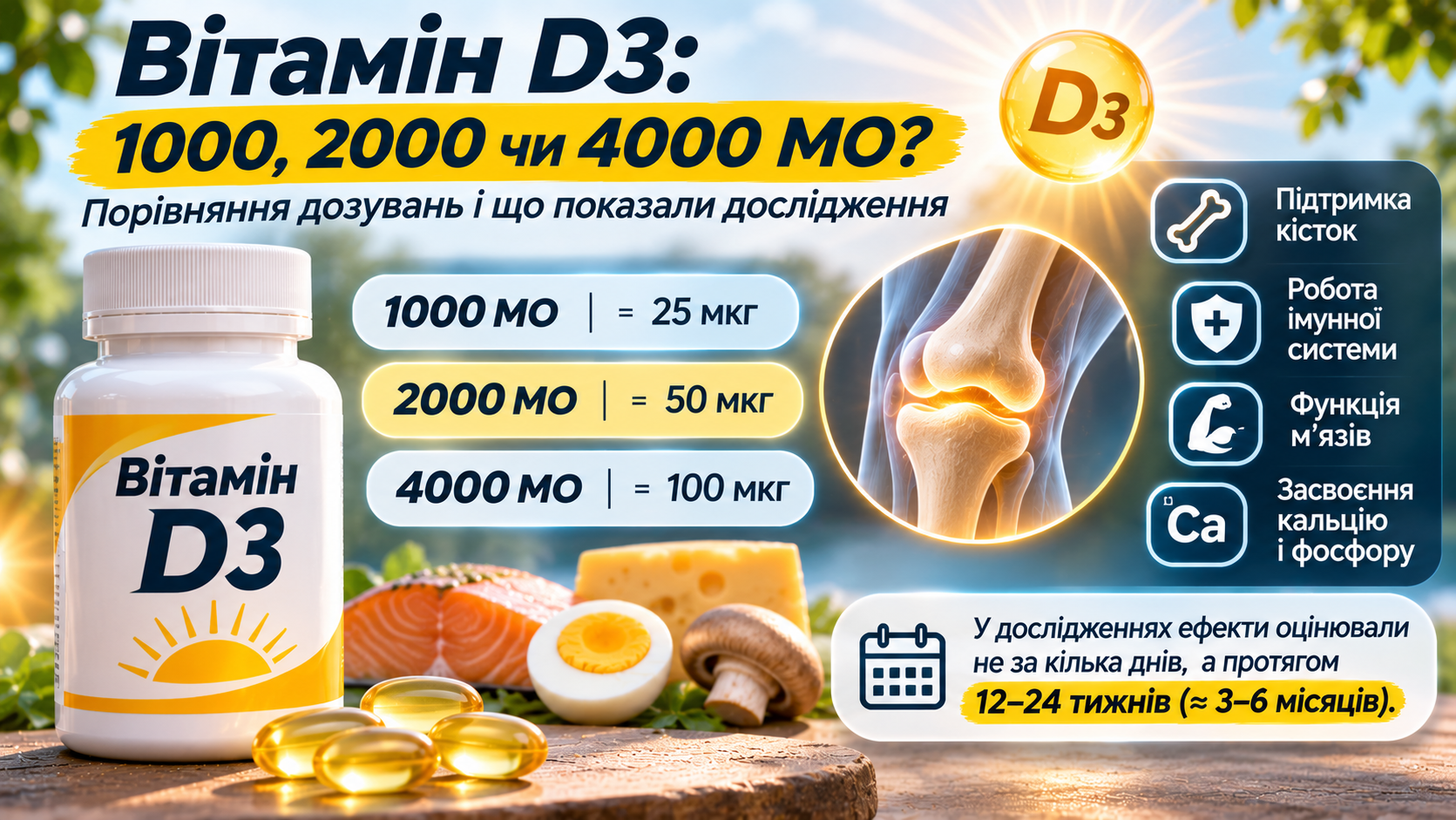
Vitamin D3 at 1,000, 2,000 and 4,000 IU: comparing doses
| Daily D3 dose | In micrograms | What is important to understand |
|---|---|---|
| 1,000 IU | 25 µg | Studied as a separate dose, including in the STURDY trial involving older adults at increased risk of falling. |
| 2,000 IU | 50 µg | Used in the VITAL study involving more than 25,000 adults; it did not, in itself, guarantee a reduction in the risks examined. |
| 4,000 IU | 100 µg | Studied in D2d and STURDY. This is a high daily amount and should not be regarded as everyone's standard requirement. |
The conversion between vitamin D units is straightforward:1 µg = 40 IU. Supplement labels may use either unit. When comparing products, pay attention to the amount of D3 in the recommended daily serving, rather than just the large number printed on the front of the package.
What vitamin D3 does in the body
Vitamin D contributes to the normal absorption and utilization of calcium and phosphorus and helps maintain normal bones. Cholecalciferol can be synthesized in the skin under ultraviolet B radiation or obtained from food or dietary supplements.
Once in the body, vitamin D undergoes two successive conversion steps. The liver produces 25-hydroxyvitamin D —25(OH)D, the principal laboratory marker of vitamin D status. In the kidneys and some other tissues, it is converted into an active hormonal form that interacts with vitamin D receptors.
Therefore, consuming additional cholecalciferol and changing a laboratory marker are not equivalent to demonstrating an effect on fractures, falls, cardiovascular events or disease development. Assessing such outcomes requires human studies with clinical endpoints, not just measurements of 25(OH)D.
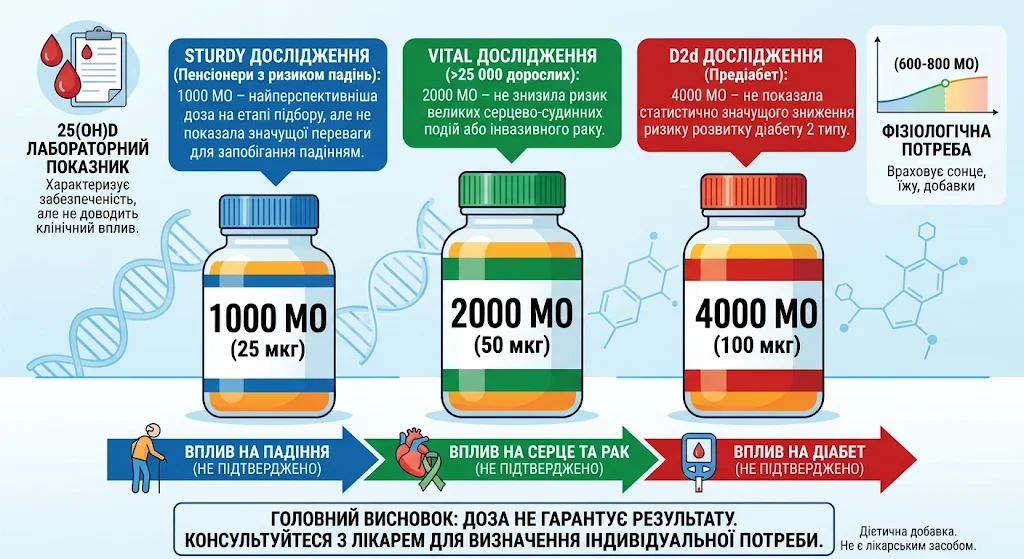
What studies of 1,000, 2,000 and 4,000 IU found
STURDY: a direct comparison of four doses. In the study by Appel and colleagues (2021), 688 people aged 70 or older with an increased risk of falling and relatively low 25(OH)D concentrations participated. At different stages, they received 200 IU (comparison group), 1,000, 2,000 or 4,000 IU of D3 daily. The protocol allowed for follow-up of up to two years, but the actual time spent on individual doses varied.
During dose selection, 1,000 IU was identified as the most promising of the three higher doses. However, the confirmatory stage found no statistically significant advantage of 1,000 IU over 200 IU for the primary outcome — time to first fall or death. Some analyses also suggested a potential risk of serious falls; the authors emphasized the study's limitations. Thus, STURDY does not support the simple rule that increasing the D3 dose reduces falls.
VITAL: 2,000 IU daily for several years. In the trial by Manson and colleagues (2019), 25,871 participants were randomized to receive 2,000 IU of vitamin D3 daily or placebo; median follow-up was 5.3 years. Primary endpoints were new cases of invasive cancer and major cardiovascular events. No statistically significant reduction in these primary risks was found in the overall study population. This does not mean that the body does not need vitamin D: the study addressed a specific question about supplemental intake in a particular population and for specific outcomes.
D2d: 4,000 IU in people with prediabetes. Pittas and colleagues (2019) studied 2,423 adults at increased risk of type 2 diabetes who were not selected on the basis of vitamin D insufficiency. Participants received 4,000 IU of D3 daily or placebo; median follow-up was 2.5 years. Despite an increase in 25(OH)D levels, the reduction in newly diagnosed diabetes did not reach statistical significance in the primary analysis (hazard ratio 0.88; 95% confidence interval 0.75–1.04). This amount formed part of a clinical trial protocol, not a universal regimen for readers.
The findings of these three trials concern different groups of people and different outcomes. They cannot be condensed into a ranking that declares 1,000, 2,000 or 4,000 IU the “best dose” for every age and health condition.
Why a higher dose does not always produce a better outcome
Blood 25(OH)D concentration generally responds to additional vitamin D intake, but the speed and magnitude of the change vary. Baseline levels, body weight, absorption, diet and duration of intake all matter. An increase in a blood test result is a biochemical response, not automatic proof of a lower risk of fractures or other events.
STURDY examined falls, VITAL examined cancer and cardiovascular events, and D2d examined the development of type 2 diabetes. Even when the same amounts of D3 were used in different trials, the clinical questions and participant characteristics differed. A meaningful comparison therefore requires considering not only micrograms or IU but also the study population, control group, duration and endpoint.
It is particularly important to distinguish supplementation in generally healthy people from medically indicated treatment of an established deficiency. Findings from general-population studies do not replace individualized clinical decisions for people with impaired absorption or other medical indications.
What determines vitamin D requirements
Vitamin D sources include synthesis in the skin under sunlight, natural dietary sources (particularly oily fish and egg yolks), fortified foods and supplements. The amount produced in the skin depends on the season, latitude, time spent outdoors, exposed skin area and other factors. Sunbathing or increasing exposure to intense sunlight to “treat deficiency” is not advisable: ultraviolet radiation carries separate skin risks.
According to the NIH Office of Dietary Supplements fact sheet, the reference recommended intake for most adults aged 19–70 is 600 IU (15 µg) daily, and for adults over 70 it is 800 IU (20 µg). This estimates total needs from all sources under conditions of minimal sun exposure; it is not an instruction for taking a particular supplement. Values of 1,000, 2,000 and 4,000 IU should not automatically be treated as every adult's requirements.
If vitamin D deficiency or impaired vitamin D metabolism is suspected, the need for testing and additional intake should be determined with a healthcare professional. Interpreting a single laboratory value without clinical context can be misleading.

What to consider when taking additional D3
- Add up all sources. Vitamin D may be present in a standalone supplement, multivitamin and other products at the same time. Total intake matters, not just the dose from one bottle.
- Do not treat 4,000 IU as a target. A high dose used in a study is not a recommendation to take it without an individual assessment.
- Be aware of excess intake. Prolonged excessive vitamin D intake can cause elevated blood calcium, nausea, weakness, kidney problems and other adverse effects.
- Consider medications and other health conditions. Orlistat, systemic corticosteroids and thiazide diuretics may affect vitamin D absorption or metabolism, or calcium-related risks. People with kidney disease, calcium metabolism disorders or those taking these medicines should consult a doctor.
- Do not replace food with supplements. Dietary supplements cannot replace a complete and varied diet. Use any particular product according to the instructions on its package.
Key conclusion: 1,000, 2,000 and 4,000 IU are different amounts of cholecalciferol that have indeed been studied in clinical trials. However, the strength and relevance of the evidence depend on who was studied, for how long and for what purpose. The number on a label alone reveals neither individual needs nor expected results.
Frequently asked questions
How many micrograms are in 1,000 IU of vitamin D3?
1,000 IU equals 25 µg of cholecalciferol. To convert IU into micrograms, simply divide by 40.
Is 2,000 IU of vitamin D3 a high or low dose?
It is 50 µg of vitamin D3. Whether this amount is appropriate depends on diet, age, health status and other vitamin D sources.
Can 4,000 IU of vitamin D3 be taken every day?
4,000 IU (100 µg) has been studied in clinical trials, but that does not mean everyone needs this dose. Long-term supplemental intake of high doses should be discussed with a doctor.
Does 2,000 IU work better than 1,000 IU?
No universal advantage has been demonstrated: the outcome depends on the specific endpoint and population. In STURDY, increasing the dose did not produce the expected reduction in fall risk.
Why do studies use doses above normal requirements?
Researchers test specific hypotheses and establish dosing regimens in advance in trial protocols. A clinical trial dose does not thereby become a general recommendation.
Can the right D3 dose be determined from a 25(OH)D test alone?
25(OH)D indicates vitamin D status, but decisions also take account of medical context, symptoms and risk factors. A healthcare professional can help interpret the result.
Should vitamin K2 be added to D3?
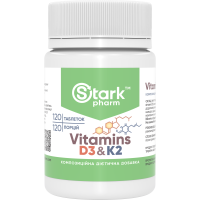
D3 and K2 are involved in different processes related to calcium metabolism, but combining them is not proven necessary for everyone. Supplements containing vitamin K should be discussed with a doctor, particularly when taking vitamin K antagonists.
Can several supplements containing vitamin D3 be combined?
The total D3 content of all supplements and other sources must be considered. Without adding them up, it is easy to increase daily intake unintentionally.
References
- Appel LJ et al. (2021). The Effects of Four Doses of Vitamin D Supplements on Falls in Older Adults: A Response-Adaptive, Randomized Clinical Trial. Annals of Internal Medicine. PubMed.
- Manson JE et al. (2019). Vitamin D Supplements and Prevention of Cancer and Cardiovascular Disease. New England Journal of Medicine. PubMed.
- Pittas AG et al. (2019). Vitamin D Supplementation and Prevention of Type 2 Diabetes. New England Journal of Medicine. PubMed.
- National Institutes of Health, Office of Dietary Supplements. Vitamin D: Fact Sheet for Health Professionals. NIH ODS.
Dietary supplement. Not a medicinal product. Consult a doctor before use.
Products related to this post
Related Posts
Comments
Information
Customer Service
Extras
My Account


Sports nutrition manufacturer in Ukraine StarkPharm © 2026


