Your shopping cart is empty!

Vitamin D3 + K2: is it really necessary to take them together?
Published: 04/10/2026
Times Read: 239
Comments : 0
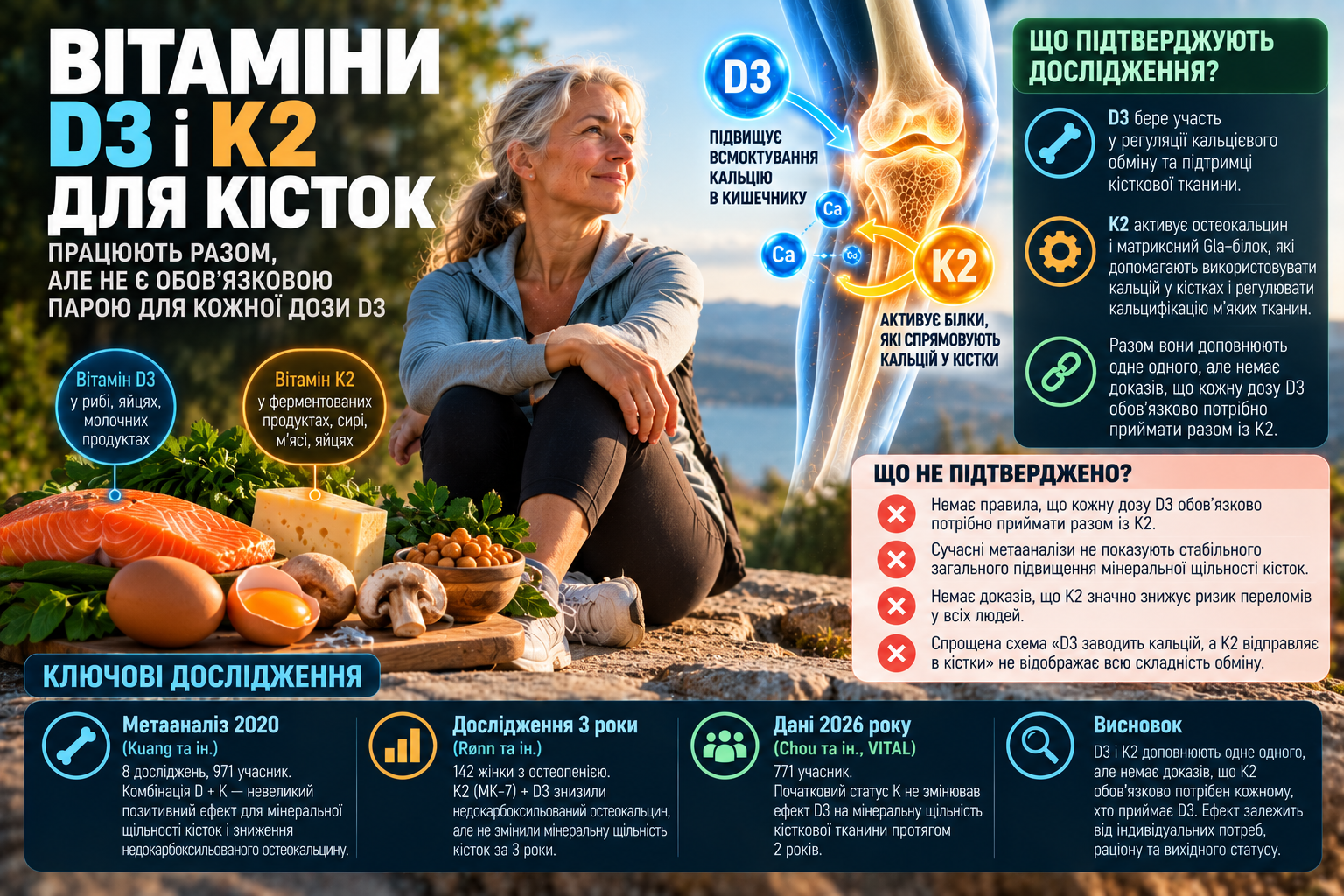
Vitamins D3 and K2 are indeed involved in the related processes of calcium and bone metabolism. That is why they are often combined. But the biological interaction does not follow from the rule that every dose of D3 must be taken together with K2.
The clinical evidence is much more complex than the popular “D3 increases calcium and K2 directs it to the bones” paradigm. In some studies, the combination has shown positive effects on certain bone parameters and laboratory markers, but long-term randomized trials and new data from 2026 do not support the universal need for K2 for D3 to “work properly.”
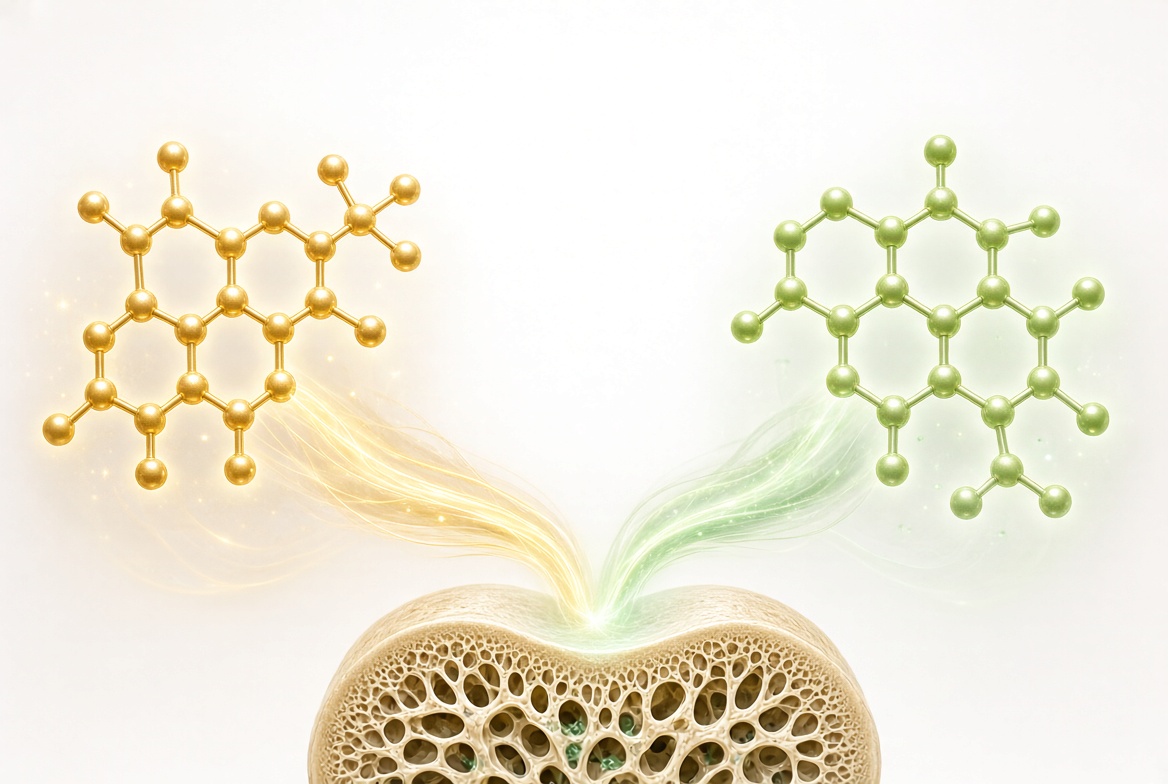
What does vitamin D do to calcium metabolism?
Active forms of vitamin D are involved in regulating the absorption of calcium and phosphorus in the intestines, maintaining their concentration in the blood, and normal bone metabolism.
Vitamin D also affects the synthesis of some proteins whose function depends on vitamin K. This is where the biological basis for the potential interaction of these two vitamins appears.
What does vitamin K do and where is K2?
Vitamin K is required for the carboxylation of a number of proteins. In the context of bone tissue, osteocalcin is most often discussed, and in the context of soft tissues and blood vessels, matrix Gla protein.
Carboxylation alters the functional state of these proteins. This is why researchers use undercarboxylated osteocalcin or undercarboxylated matrix Gla protein as biochemical indicators of vitamin K status.
Vitamin K comes in different forms. K1 is phylloquinone, and K2 is a group of menaquinones, of which MK-4 or MK-7 are often used in supplements. Data from one form and dose may not always automatically translate to another.
Why the scheme “D3 brings calcium, and K2 sends it to the bones” is too simplistic
This phrase is convenient for explaining the mechanism, but it gives the impression that calcium has only two directions—bones or blood vessels—and K2 works as a simple switch between them.
In fact, calcium metabolism is regulated by the intestines, kidneys, bone tissue, parathyroid hormone, active forms of vitamin D, mechanical stress, and many other factors. Vitamin K is an important part of this system, but it is not the only regulator of calcium distribution.
Therefore, the mechanistic compatibility of D and K is a basis for research, but not proof that D3 without additional K2 will necessarily work incorrectly.
A 2020 meta-analysis did indeed find a positive signal for D+K
Kuang et al. (2020) pooled eight randomized controlled trials with a total of 971 participants. The combination of vitamins K and D was associated with a small positive effect on total bone mineral density and a significant reduction in undercarboxylated osteocalcin.
This is an important argument that the biological interaction may have practical significance. But the meta-analysis combined different populations, different forms of vitamin K, different doses, and different control conditions.
Therefore, it does not directly answer the question "should every person who takes D3 necessarily supplement K2?"
Why a positive meta-analysis doesn't prove K2 is necessary for everyone
A positive average result in a group of studies does not mean that the effect is the same for all people. Much of the work was done in postmenopausal women or people with reduced bone mass, which is not the same as a healthy young person without deficiencies.
Additionally, older studies used different forms of vitamin K and sometimes high study doses. Such protocols cannot be directly transferred to conventional combination supplements.
Three-year study: biochemical score improved, but bone density did not
Rønn et al. studied 142 postmenopausal women with osteopenia. They received MK-7 at a dose of 375 mcg/day or placebo for three years. Both groups were also given D3 at a dose of 38 mcg/day and calcium at 800 mg/day.
MK-7 significantly reduced the proportion of undercarboxylated osteocalcin, meaning that biochemically vitamin K was clearly acting.
However, after three years, there was no significant difference between the groups in bone mineral density, markers of bone turnover, or microarchitecture.
This is one of the best examples of why an improvement in a lab result should not automatically translate into a claim of stronger bones.
Latest data from 2026: Does the D3 effect depend on K status?
In 2026, Chou et al. analyzed the bone subgroup of the large VITAL study. In this study, 771 participants were assessed for vitamin K status and the randomized intervention included D3 at a dose of 2000 IU or 50 μg daily for two years or placebo.
Higher baseline vitamin K status was not associated with more favorable two-year change in spine, hip, or total body mineral density. Similarly, K status did not modify the effect of supplemental D3 on these measures.
This is not a direct randomized comparison of "D3 vs. D3 + K2," so the study does not definitively answer the question. But it does not support the hypothesis that a normal bone response to D3 necessarily requires a high K status.
Matrix Gla protein is a vitamin K-dependent protein involved in the regulation of soft tissue calcification. This has led to the popular idea that adding K2 to D3 should automatically protect blood vessels from calcium.
Mechanistically, this is an interesting hypothesis. But for a clinical conclusion, it is necessary to show not only a change in the laboratory marker, but also less progression of calcification or better clinical outcomes.
A large study of D + K2 and vascular calcification
In a randomized, double-blind study, 365 men with severe aortic valve calcification received MK-7 at a dose of 720 mcg/day along with vitamin D 25 mcg/day or placebo for 24 months.
In the MK-7 + D group, the biochemical indicator of vitamin K status significantly improved - the level of undercarboxylated matrix Gla protein decreased.
However, progression of aortic valve, aorta, and coronary artery calcification was not significantly different from placebo.
That is, the biochemical effect was obvious, but the expected clinically important result was not confirmed.
Laboratory values may improve without clinical effect
This is one of the main reasons for the conflicting findings in the D3 + K2 topic. Vitamin K has a fairly consistent effect on the carboxylation of K-dependent proteins, so laboratory values can vary significantly.
But there are many intermediate links between a laboratory result and actual bone mineral density, fractures, or progression of vascular calcification. Therefore, “improved marker” and “proven better clinical outcome” are not the same thing.
K1, MK-4 and MK-7 should not be mixed in the same protocol
Vitamin K is not a single molecule. Studies use K1, MK-4, or MK-7, in very different amounts and in different populations.
MK-4 has been used in some clinical studies in pharmacological regimens, while MK-7 has typically been studied in much smaller amounts. Therefore, a positive result from one form should not automatically translate to any product labeled “K2.”
Do I need to add K2 to any D3?
There is currently no clinical basis for the universal rule “always take D3 with K2.” Both vitamins are important, but the need for one does not automatically prove the need for additional amounts of the other.
The combination may be logical in certain situations and has a biological basis, but its feasibility depends on diet, health status, baseline nutritional status, concomitant medications, and specific goal.

What is proven and what remains a popular simplification
| Assertion | What the data shows | Conclusion |
|---|---|---|
| D and K are involved in related processes | Yes, in particular through K-dependent proteins of bone and soft tissues | Biological interaction is real |
| K2 is mandatory with every D3 intake | There is no direct evidence of universal necessity. | Not proven |
| D + K may improve certain bone markers | There is a positive signal in some randomized trials and meta-analyses | The effect depends on the population, the form of K, and the final indicator |
| K2 improves osteocalcin carboxylation | Yes, this is shown quite consistently. | The biochemical effect is |
| Improving carboxylation automatically increases bone density | No, long studies do not consistently confirm this | Laboratory result does not equal clinical outcome |
| K2 with D3 automatically protects blood vessels from calcification | Large two-year study shows no slowing of calcification | This wording is too strong. |
Who needs special care with vitamin K?
The most important situation is treatment with vitamin K antagonists, primarily warfarin. Vitamin K is directly related to the mechanism of action of such drugs, so sudden changes in its intake can affect the anticoagulant effect.
People taking these medications should not start taking K2 on their own, suddenly increase or decrease their intake, or change their anticoagulant regimen without first consulting a doctor.
What can be said today?
- D3 and K2 are biologically related: this is a real mechanistic connection, not a marketing myth.
- But the necessity of the combination has not been proven: there is no quality data that each dose of D3 should be taken only together with K2.
- K2 consistently affects K-dependent laboratory parameters: this does not always translate into higher mineral density or less calcification.
- Clinical results are mixed: older meta-analyses were more positive, while long-term randomized trials and new data from 2026 are much more modest.
- Vitamin K antagonists are a separate situation: with such therapy, changes in K intake should be coordinated with a doctor.
Frequently asked questions
Is it necessary to take vitamin D3 together with K2?
No. Vitamins D and K are involved in related processes, but current clinical evidence does not establish a universal rule that every dose of D3 must be combined with K2.
Can I take D3 without K2?
This combination is not a prerequisite for D3 to work. The feasibility of additional K2 depends on nutrition, health status, concomitant medications, and specific goals.
Is it true that taking D3 without K2 causes calcium to deposit in the blood vessels?
This clinical rule has not been proven. The popular scheme oversimplifies the complex regulation of calcium metabolism.
Does K2 improve vitamin D3 absorption?
No. The main role of K in this topic is not related to the absorption of D3, but to the carboxylation of vitamin K-dependent proteins.
Is the combination of D3 + K2 better for bones?
Some studies show a positive signal for individual measures, but long-term randomized trials do not show a consistent benefit for bone mineral density in all populations.
Does K2 protect against vascular calcification when taking D3?
A mechanistic hypothesis exists, but a large two-year randomized trial of MK-7 along with vitamin D showed no significant slowing of calcification.
Can I take K2 with warfarin?
You should not change your vitamin K intake on your own during treatment with warfarin or other vitamin K antagonists. This should be discussed with your doctor, as changes may affect the anticoagulant effect.
Sources
- Kuang X. and others. (2020). The combination effect of vitamin K and vitamin D on human bone quality: a meta-analysis of randomized controlled trials. Food & Function. PubMed
- Rønn SH and others. (2021). The effect of vitamin MK-7 on bone mineral density and microarchitecture in postmenopausal women with osteopenia, a 3-year randomized, placebo-controlled clinical trial. Osteoporosis International. PubMed
- Chou SH and others. (2026). Investigating the interrelationship of vitamin K and vitamin D status on bone density: results from the VITamin D and OmegA-3 TriaL. JBMR Plus. PubMed
- Diederichsen ACP and others. (2022). Vitamin K2 and D in Patients With Aortic Valve Calcification: A Randomized Double-Blinded Clinical Trial. Circulation. PubMed
- Aaseth JO and others. (2024). The Importance of Vitamin K and the Combination of Vitamins K and D for Calcium Metabolism and Bone Health: A Review. Nutrients. PubMed
- Violi F. and others. (2016). Interaction Between Dietary Vitamin K Intake and Anticoagulation by Vitamin K Antagonists: Is It Really True? A Systematic Review. Medicine. PubMed
Dietary supplement. Not a medicine. Consult a doctor before use.
Products related to this post

Comments
Information
Customer Service
Extras
My Account


Sports nutrition manufacturer in Ukraine StarkPharm © 2026