Your shopping cart is empty!

Vitamin D in drops, capsules and tablets: is there a difference in absorption?
Published: 12/11/2026
Times Read: 5
Comments : 0
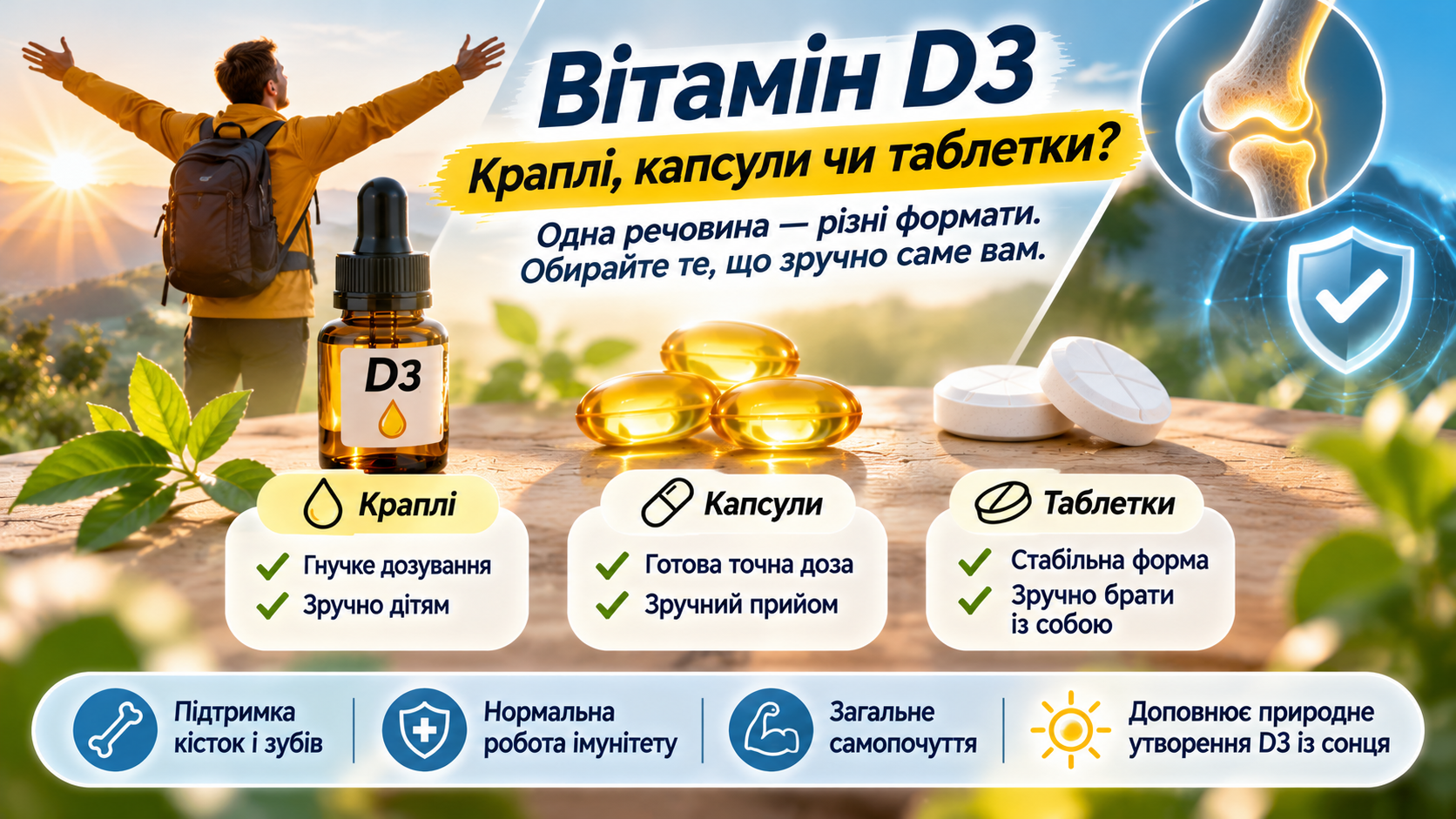
Vitamin D3 in drops, capsules or tablets contains the same active ingredient - cholecalciferol, but differs in the method of administration, auxiliary components and convenience of measuring the portion. The question "which is better absorbed?" has no universal answer: in comparative studies, all three formats are able to increase the concentration of 25(OH)D in the blood, and the advantage of one particular formula is not always repeated for another.
Vitamin D is a fat-soluble vitamin. Therefore, when evaluating a supplement, it is important to look not only at the words "oil" or "dry", but also at the actual amount of D3 in a serving, the composition of the carrier, the characteristics of digestion and the regularity of consumption. Below we compare drops, soft and hard capsules and tablets according to these criteria.
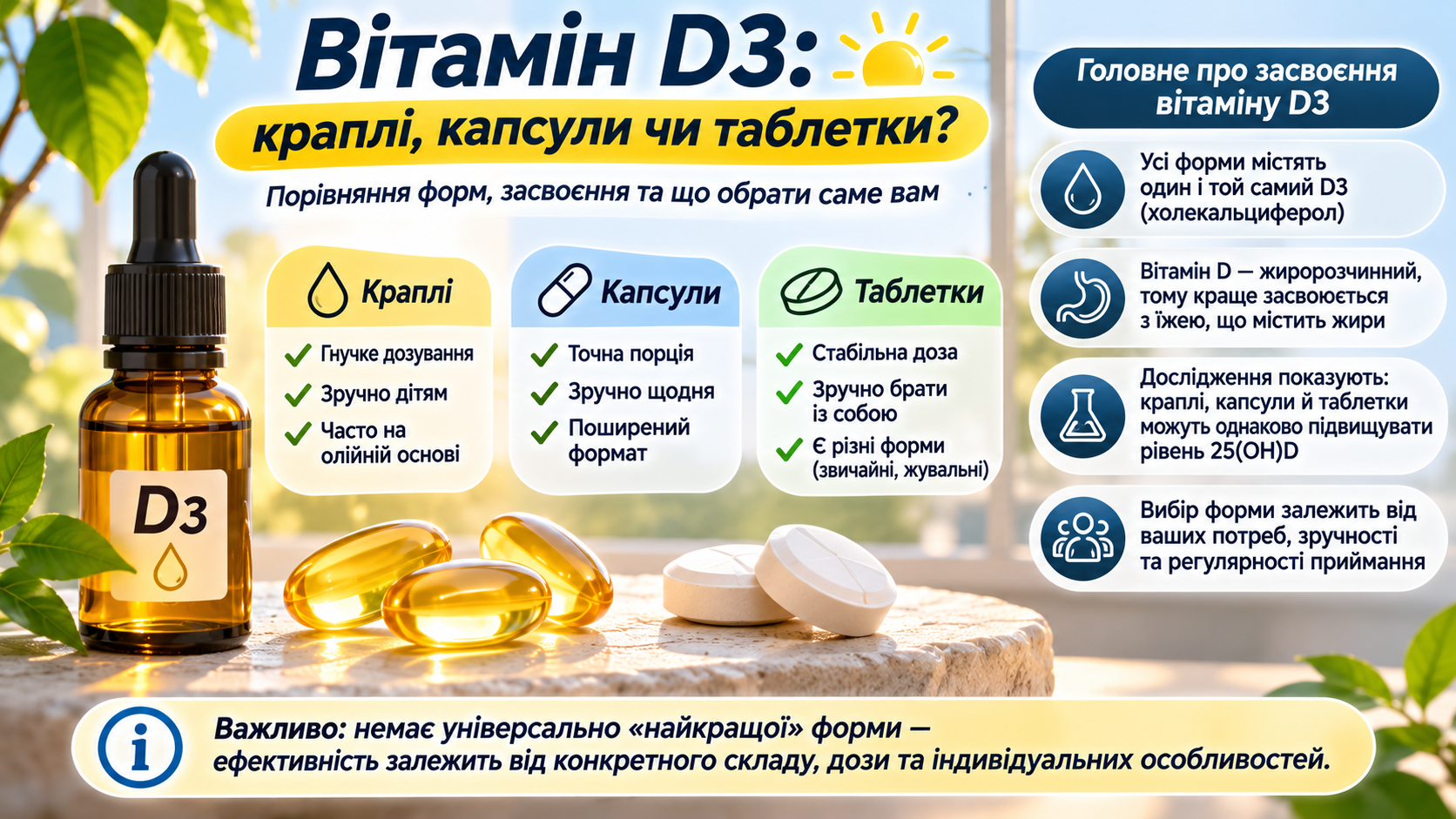
Drops, capsules or tablets: the main differences
| Form | What's inside | Practical advantage | What to look out for |
|---|---|---|---|
| Oil drops | Vitamin D3 in a liquid carrier; type of oil depends on composition | Flexible droplet measurement | One-drop concentration, dispenser accuracy, storage instructions |
| Soft capsules | Often an oil solution in a gelatin or other shell | Premeasured amount of vitamin | Shell composition, size, quantity per capsule |
| Hard capsules | Powder, granules or other dry matrix | Clear portion without measuring drops | Excipients, storage conditions, suitability for ingestion |
| Tablets | A pressed mixture of ingredients; sometimes in chewable form | Stable portion, easy to transport | Type of tablet, composition and rules of administration |
This table describes typical formats, not all products on the market. For example, a tablet may have a special dispersion technology, and a liquid form may not be just an oil, but an emulsion. It is these technological differences that sometimes affect the results of studies more than the name of the form itself.
How vitamin D3 is absorbed in the intestine
After entering the digestive tract, cholecalciferol undergoes stages of dissolution and transport together with lipid components of food. This process involves bile acids, the formation of mixed micelles and transport through intestinal cells. Vitamin D then enters the bloodstream and undergoes transformation, in particular to 25-hydroxyvitamin D — 25(OH)D.
Theoretically, an oil carrier may facilitate the distribution of a fat-soluble substance. However, this does not mean that any oil droplet is necessarily more effective than a powdered capsule or tablet. The 2024 International Consensus on the Assessment of Vitamin D Status explicitly states: there is no convincing evidence for an overall advantage of oil carriers.
The result is also influenced by the person's initial status, diet, intestinal condition, and the actual D3 content of the supplement. Therefore, absorption data for one specific brand should not be extrapolated to all drops or all tablets.
What do direct studies of drops, capsules, and tablets show?
Holvik et al., 2007. In a randomized trial, young adults were given 10 μg (400 IU) of vitamin D3 daily for four weeks, either in a multivitamin tablet or in a fish oil capsule. The mean increase in 25(OH)D was not significantly different between groups. This is an example of how the presence of fat directly in the capsule did not provide a measurable benefit on the outcome of choice.
Coelho et al., 2010. A small crossover study of 18 women compared capsules and oil drops of D3. The forms were considered bioequivalent based on pharmacokinetic criteria. An important limitation is that they studied specific formulations with large single doses, not typical daily supplements.
D3 Matrix Study, 2014. A 12-week randomized trial of 66 adults compared a chewable tablet, emulsified oil drops, and a powder capsule. After adjusting for the actual measured content, the drops produced a greater mean increase in 25(OH)D per microgram than the tablet, but not the capsule. However, the proportion of participants who reached the researchers’ chosen threshold was lower in the drops group. The results are mixed and do not prove superiority of the drops as a class.
Comparison in People with Immunodeficiency Conditions, 2020. In a reanalysis of data from 206 participants who had a follow-up after at least three months, 1600 IU/day tablets and 1500 IU/day oil drops increased 25(OH)D similarly; the difference between groups was not statistically significant. This does not mean that the results are necessarily the same for all populations.
Together, these works show that the specific formulation, participant characteristics, and evaluation criteria are important, not just the name "drops" or "capsules."
Why certain new formulas demonstrate higher bioavailability
Other comparisons have examined orodispersible matrices, oral sprays, and soft capsules. Such studies explain why two products with the same MO number may behave differently under specific conditions, but do not provide a universal ranking of dosage forms.
It is particularly important not to confuse two measures: the short-term concentration of initial cholecalciferol after a single dose and the change in 25(OH)D after several weeks. They answer different research questions.
Should you take vitamin D with food and fats?
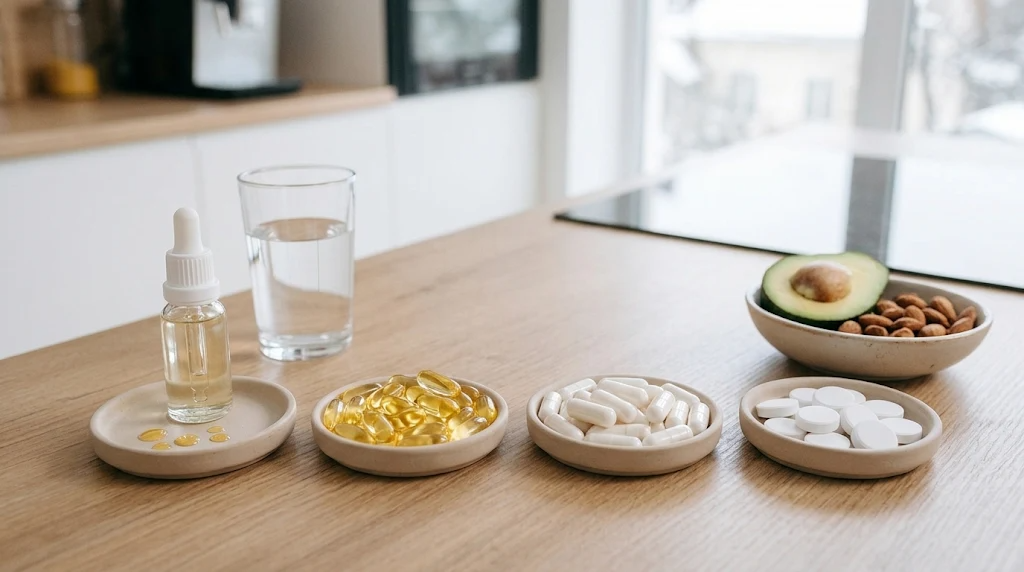
Because vitamin D is fat-soluble, the presence of dietary fat can affect its absorption. In a 2014 study of 50 adults, peak concentrations after a single dose of D3 were higher in the groups given a meal with fat than after a low-fat meal. However, another trial showed that differences in early absorption rates do not necessarily translate into differences in 25(OH)D levels after one to three months.
Therefore, taking with food containing a certain amount of fat is a practically justified option for many oral supplements. At the same time, it is not necessary to specifically consume a very fatty meal. The instructions for a specific form take precedence, and in medical conditions with impaired fat absorption, tactics are determined individually.
When the form of release has practical importance
- Serving Size Accuracy: A capsule or tablet usually contains a predetermined amount of D3. For drops, it’s important to check whether the amount listed is for one drop, a milliliter, or a full serving.
- Ease of swallowing. For someone who has difficulty swallowing solid forms, a liquid form may be more convenient. However, not all products are designed to be mixed with drinks or food.
- Auxiliary components. Oils, gelatin, dyes, and other ingredients are important for people with certain dietary restrictions or sensitivities.
- Regularity of use. A convenient format helps you stick to your chosen regimen. If it’s difficult to count the drops each time, a fixed dose may be easier.
- Storage conditions: After opening the bottle, follow the manufacturer's instructions regarding light, temperature, and shelf life.
For most healthy adults, practicality and correct dosing may be as important as theoretical matrix differences. However, this is not a substitute for individual assessment of health status.
When simple form comparison may not be enough
Some intestinal diseases, certain bariatric surgeries, or fat malabsorption may affect the response to oral D3. The NIH Office of Dietary Supplements notes that these conditions can make it difficult to absorb the fat-soluble vitamin. However, you should not switch to a “stronger” emulsion based on advertising.
It is also necessary to take into account medications that may affect fat absorption, taking several D3 preparations at the same time, kidney disease, and calcium metabolism disorders. In such situations, it is worth agreeing on the choice of format and quantity with a doctor.
Important: The difference between drops, tablets, and capsules is not a reason to increase the amount of D3 beyond the prescription or instructions. Excessive consumption of vitamin D has its own risks regardless of the form of release.
How to choose a format without marketing myths
Start by comparing the ingredients on the label. Check to see if it specifically says vitamin D3 (cholecalciferol) , how many micrograms or international units are in a serving, and how to measure it correctly. The unit ratio is standard: 1 mcg of vitamin D is equal to 40 IU. This is not a recommendation for a specific amount per day.
Next, evaluate the carrier composition, ease of swallowing, storage conditions, and the ability to follow the instructions exactly. The words “micellar,” “nano,” “oil,” or “maximum absorption” do not in themselves prove the superiority of a particular product: it is important whether there are comparative studies of this particular formula.
If vitamin D status needs to be assessed, 25(OH)D is used in clinical practice, but the need for analysis and interpretation of results are determined by the circumstances. The choice of supplement format and the interpretation of the laboratory value should not be mixed into one issue.
Conclusion: Tablets, capsules, and drops can be effective ways to get D3. Studies of individual technologies show differences, but the available data do not allow us to declare one format best for everyone. The guidelines are proven composition, accurate serving size, convenience, and recommendations for a specific person.
Frequently asked questions
What is better absorbed: vitamin D in drops or capsules?
There is no universal advantage. In some studies, the results were similar, while in others they varied due to the specific formulation and method of assessment.
Are oil drops always better than dry pills?
No. The fat solubility of vitamin D does not mean that any oil product will necessarily give a greater increase in 25(OH)D.
How does a soft capsule differ from a hard one?
A soft capsule often contains a liquid oil base, while a hard capsule contains a powder or granules. Both may contain cholecalciferol, but the excipients differ.
Can I take vitamin D without food?
This depends on the instructions for the specific product. For many forms, taking with a meal containing fat is a practical option, but studies on different formulations are not entirely consistent.
Are drops more accurate than pills?
Not necessarily. A tablet has a fixed portion, and for drops, accuracy depends on the dispenser and correct counting of drops.
Does the form of D3 affect the result of the 25(OH)D test?
The form can affect the absorption of a particular formulation, but the result also depends on the initial status, regularity of intake, and individual factors.
Do I need more vitamin D if it is in tablets?
No, the format itself is not a reason to increase the quantity. You should focus on the instructions and individual recommendations of a specialist.
Are regular forms of D3 suitable for people with fat malabsorption?
The reaction may be different. In such conditions, the choice of form, portion, and the need for monitoring indicators should be discussed with a doctor.
Sources
- Holvik K et al. (2007). A randomized comparison of increase in serum 25-hydroxyvitamin D concentration after 4 weeks of daily oral intake of 10 microg cholecalciferol from multivitamin tablets or fish oil capsules in healthy young adults. British Journal of Nutrition. PubMed.
- Coelho IMG et al. (2010). Bioavailability of vitamin D3 in non-oily capsules: the role of formulated compounds and implications for intermittent replacement. Arquivos Brasileiros de Endocrinologia & Metabologia. PubMed.
- Impact of Vitamin D3 Dietary Supplement Matrix on Clinical Response (2014). Journal of Clinical Endocrinology & Metabolism. PubMed.
- Are Vitamin D3 Tablets and Oil Drops Equally Effective in Raising S-25-Hydroxyvitamin D Concentrations? A Post-Hoc Analysis of an Observational Study on Immunodeficient Patients (2020). Nutrients. PubMed.
- Marwaha RK et al. (2022). An open-label, randomized, crossover study to evaluate the bioavailability of nanoemulsion versus conventional fat-soluble formulation of cholecalciferol in healthy participants. Journal of Orthopaedics. PubMed.
- A comparative absorption study of sucrosomal orodispersible vitamin D3 supplementation vs. a reference chewable tablet and soft gel capsule vitamin D3 in improving circulatory 25(OH)D levels in healthy adults with vitamin D deficiency (2023). Frontiers in Nutrition. PubMed.
- Dietary fat increases vitamin D-3 absorption (2014). Journal of the Academy of Nutrition and Dietetics. PubMed.
- Meal conditions affect the absorption of supplemental vitamin D3 but not the plasma 25-hydroxyvitamin D response to supplementation (2013). Journal of Bone and Mineral Research. PubMed.
- Consensus Statement on Vitamin D Status Assessment and Supplementation: Whys, Whens, and Hows (2024). Endocrine Reviews. PMC.
- National Institutes of Health, Office of Dietary Supplements. Vitamin D: Fact Sheet for Health Professionals. NIH ODS.
Dietary supplement. Not a medicine. Consult a doctor before use.
Products related to this post
Related Posts
Comments
Information
Customer Service
Extras
My Account


Sports nutrition manufacturer in Ukraine StarkPharm © 2026


