Your shopping cart is empty!

Vitamin D 25(OH)D test: what do the numbers in the result mean?
Published: 12/11/2026
Times Read: 5
Comments : 0
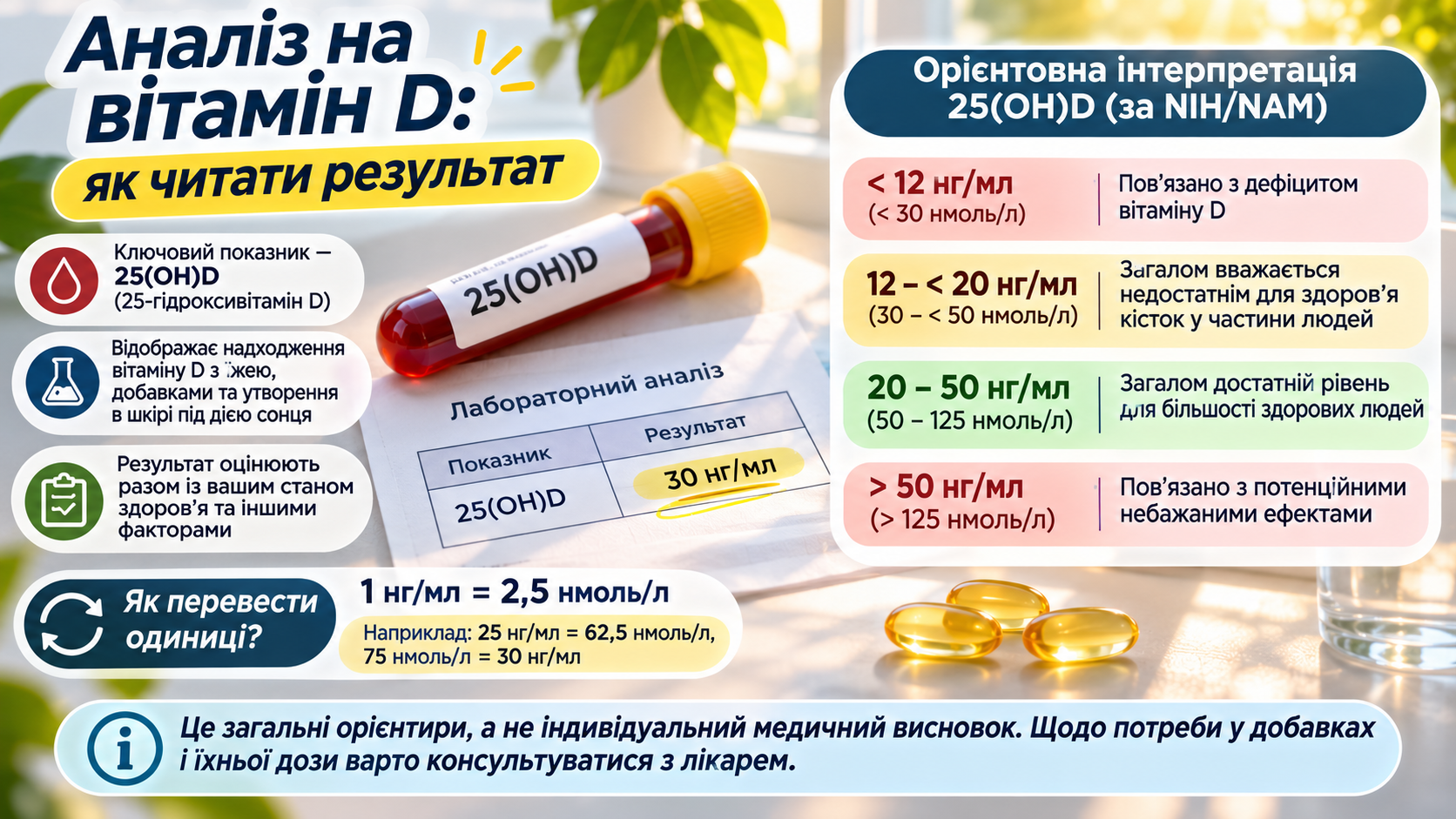
A vitamin D test usually measures the concentration of 25-hydroxyvitamin D — 25(OH)D — in the blood. This is a laboratory measure that reflects vitamin D intake from food and supplements, as well as its production in the skin when exposed to sunlight. The result may be printed as 18 ng/mL, 45 nmol/L, or some other number — and you need to check the units first before reading the reference range.
The 25(OH)D test is useful for assessing vitamin D status, but it does not provide a medical diagnosis on its own or automatically determine whether or not supplementation is needed. Different professional organizations use different thresholds; values are also affected by season, health status, and laboratory methods. Here's how to read the numbers without making common mistakes.
What kind of analysis shows vitamin D status?
On the lab form, look for the name 25(OH)D, 25-hydroxyvitamin D, 25-hydroxyvitamin D, or total vitamin D. This is the sum of two metabolites — 25(OH)D2 and 25(OH)D3. The liver forms them after receiving the corresponding forms of vitamin D. It is this total indicator that is most often used to assess the body's vitamin D supply.
Another indicator, 1,25(OH)2D, or calcitriol, is a biologically active metabolite. Its concentration is regulated, among other things, by parathyroid hormone, calcium, phosphate, and renal function. Therefore, a normal or even elevated 1,25(OH)2D does not exclude low 25(OH)D. Calcitriol measurement usually has specific clinical indications and does not replace a routine test for assessing vitamin D status.
According to the NIH Office of Dietary Supplements and the CDC, total 25(OH)D is the most commonly used laboratory marker of vitamin D status. However, its level is not a direct measure of bone strength, immune function, or overall well-being.
Ng/ml and nmol/l: how to correctly convert the indicator
Ukrainian laboratories may report results in nanograms per milliliter (ng/mL) or nanomoles per liter (nmol/L). These are different units for the same indicator. For 25(OH)D, the ratio is used: 1 ng/mL = 2.5 nmol/L. To convert ng/mL to nmol/L, multiply the number by 2.5; to convert back, divide by 2.5.
| 25(OH)D, ng/ml | 25(OH)D, nmol/l | Why is the example given? |
|---|---|---|
| 10 | 25 | Low value requiring clinical evaluation |
| 12 | 30 | One of the landmarks used in the NIH/NAM classification |
| 20 | 50 | Common guideline for adequacy for bone health in most healthy people |
| 30 | 75 | A threshold that often occurs in laboratory forms but is not a universal target |
| 50 | 125 | The level above which the NIH notes possible adverse effects |
For example, 25 ng/mL = 62.5 nmol/L, and 75 nmol/L = 30 ng/mL. You cannot compare a "25" from one lab and a "50" from another until the units have been verified. A value of 25 ng/mL is not equal to 25 nmol/L.
What 10, 20, 30 and 50 ng/ml mean: a table of guidelines
The NIH Office of Dietary Supplements provides an interpretation of the National Academies of Medicine (NAM) guidelines, focusing primarily on bone health. These are general population guidelines and not individual medical judgment. In different clinical situations, the physician may consider other criteria.
| 25(OH)D | NIH/NAM indicative interpretation | What is important to remember |
|---|---|---|
| Less than 12 ng/mL (less than 30 nmol/L) | Associated with vitamin D deficiency | Individual assessment of causes and clinical circumstances is required. |
| 12–less than 20 ng/mL (30–less than 50 nmol/L) | Generally considered insufficient for bone health in some people | The value does not allow you to independently determine the reception scheme |
| 20–50 ng/mL (50–125 nmol/L) | Levels above 20 ng/mL are generally considered adequate for most healthy people; values closer to the upper limit do not indicate additional benefit | Bigger is not necessarily better |
| Above 50 ng/mL (above 125 nmol/L) | Associated with potential adverse effects | Assess possible excessive intake and consult a specialist |
These categories are useful for understanding the form, but you should not independently determine your deficiency, norm, or required dose of the supplement based on a single number. If necessary, the doctor compares 25(OH)D with your medical history, diet, bone condition, calcium level, kidney function, and other indicators.
It is especially important not to interpret 20–30 ng/mL as an automatic indication of disease. This range is subject to different expert approaches, and the presence of a specific number in the laboratory reference range is not an independent clinical recommendation.
Why are 20 and 30 ng/ml called “normal” differently?
In the 2024 Endocrine Society guidelines, the authors did not identify universal 25(OH)D thresholds that would ensure better outcomes for healthy individuals. This is because there is a lack of convincing clinical trial evidence that one concentration over another provides additional benefit for different diseases. The guidelines also do not support routine 25(OH)D measurement in healthy adults without specific indications.
Therefore, a result of 24 or 28 ng/mL cannot be mechanically declared “unsafe” simply because a particular form has a lower limit of 30 ng/mL. Conversely, important clinical circumstances may require attention even when the number formally falls within the reference interval. The indicator should be read in conjunction with the context, not in place of it.

Should everyone get their vitamin D levels checked every year?
No, there is no universal recommendation to test 25(OH)D annually for all healthy individuals. The Endocrine Society (2024) suggests against routine testing in healthy adults without an established indication. The USPSTF (2021) also concluded that there is insufficient evidence to determine the balance of benefits and harms of universal screening of asymptomatic adults.
This is not a prohibition of the analysis. It may be appropriate if the doctor is assessing a specific clinical situation - for example, calcium metabolism disorders, certain bone diseases, malabsorption syndromes, certain chronic diseases, or the condition after certain digestive tract surgeries. The list of indications depends on medical recommendations and the person's situation.
Fatigue, being indoors, or being in the winter months alone do not prove a deficiency and do not mean that everyone needs the same lab test. The decision to have a test should be made together with a specialist if there are specific complaints or risk factors.
How season, diet and lifestyle affect results
The concentration of 25(OH)D can vary throughout the year because the formation of vitamin D in the skin depends on ultraviolet radiation UVB. In Ukraine, its availability is usually lower in autumn and winter than in the warm season. At the same time, the level is influenced by dietary sources, the use of supplements, age, body weight, absorption characteristics and other factors.
These changes are important when comparing two tests performed in different seasons. If one result is obtained in late summer and another in winter, the difference is not necessarily due to a change in diet or additional intake. However, seasonality does not allow us to predict the exact value of a particular person.
An in-depth analysis of latitude, UVB, and winter changes belongs in a separate article on vitamin D seasonality. Here, it is important to remember a rule of thumb: to compare results, record the study date and context, not just the number.
Why results from different laboratories may vary
The measurement method also affects the result. Various immunochemical tests and chromatographic methods are used for total 25(OH)D. The CDC reference methods are based on liquid chromatography-tandem mass spectrometry (LC-MS/MS), which allows for the separate determination of 25(OH)D2 and 25(OH)D3. However, the name of the method itself does not mean that any particular measurement cannot have errors.
The CDC maintains the Vitamin D Standardization-Certification Program (VDSCP) to improve comparability and accuracy of results. This is important because different laboratories and analytical systems can measure the same sample slightly differently. This variability is particularly significant near the conventional thresholds.
If you are comparing results over time, it is helpful to use the same laboratory and, if possible, similar methodology to keep the units of measurement consistent, and to inform your doctor of any supplements you are taking. A small difference between two numbers does not always indicate a real change in your status.
What to do if the result is lower or higher than the reference interval
The first step is to verify that the 25(OH)D and not 1,25(OH)2D was measured, and to understand the units. The second is to look at the lab's reference interval and understand that it may differ from the recommendations of individual professional organizations. The third is to evaluate the result with your doctor if you have symptoms, risk factors, or a significant deviation.
If the indicator is low, it is worth discussing possible causes: insufficient intake, limited sunlight exposure, peculiarities of absorption, taking certain medications or concomitant conditions. There is no need to automatically transfer the dosage from clinical studies to your own diet or independently create high-dose regimens.
If your levels are high, it is especially important to consider all sources of vitamin D, including multiple supplements and complex foods. Excess vitamin D can be associated with calcium metabolism disorders. If you experience excessive thirst, frequent urination, vomiting, weakness, or other worrisome symptoms with high doses, seek medical evaluation without delay.
It should be remembered separately: the analysis does not determine the dose in IU by itself. The selection of additional consumption depends on many circumstances, and not on a simple formula "how much is not enough to reach 30 ng/ml."

One indicator cannot reliably determine the cause of fatigue, sleep quality, immune status, or the cause of any pain. It also does not directly indicate whether there is malabsorption, how the kidneys are working, what the calcium level in the blood is, or whether there are other reasons for changes in laboratory markers.
Even when 25(OH)D increases after dietary changes or supplementation, this does not automatically mean that all clinical outcomes will improve. Therefore, reading the test correctly is a combination of laboratory data, evidence-based recommendations, and personal circumstances, rather than finding one “perfect” number for everyone.
Frequently asked questions
What test should I take to check vitamin D?
Typically, total 25-hydroxyvitamin D — 25(OH)D — is used to assess adequacy. The need for the study itself is determined by clinical indications.
What does 25(OH)D mean on the form?
This is the concentration of 25-hydroxyvitamin D in the blood, the main laboratory marker of vitamin D status. It is distinct from the active metabolite 1,25(OH)2D.
Is 20 ng/ml of vitamin D normal?
The NIH/NAM considers values of 20 ng/mL and above to be generally adequate for bone health in most healthy individuals. However, individual interpretation depends on the clinical context.
Is it necessary to have more than 30 ng/ml?
No, there is no universal requirement for all healthy people. Different reference ranges do not mean that reaching 30 ng/mL automatically improves health.
How to convert nmol/L to ng/mL?
For 25(OH)D, divide the nmol/L value by 2.5. For example, 50 nmol/L equals 20 ng/mL.
Do I need to take a vitamin D test every winter?
Routine testing is not recommended for healthy adults without specific indications. The specific need for testing should be determined together with a specialist.
Why are two tests in different laboratories different?
Reasons may include methodology, analytical variability, and time of study. A small difference does not always indicate a real change in vitamin D status.
Is it possible to calculate the dose of D3 yourself based on the results of the analysis?
No. The 25(OH)D indicator is not a ready-made formula for determining the amount of supplementation; health status, intake from various sources, and other factors are important.
Sources
- National Institutes of Health, Office of Dietary Supplements. Vitamin D: Fact Sheet for Health Professionals. NIH ODS.
- Demay MB et al. (2024). Vitamin D for the Prevention of Disease: An Endocrine Society Clinical Practice Guideline. Journal of Clinical Endocrinology & Metabolism. PubMed.
- US Preventive Services Task Force (2021). Screening for Vitamin D Deficiency in Adults: US Preventive Services Task Force Recommendation Statement. JAMA. PubMed.
- Kahwati LC et al. (2021). Screening for Vitamin D Deficiency in Adults: Updated Evidence Report and Systematic Review for the US Preventive Services Task Force. JAMA. PubMed.
- Wise SA et al. (2017). Baseline Assessment of 25-Hydroxyvitamin D Assay Performance: A Vitamin D Standardization Program (VDSP) Interlaboratory Comparison Study. Journal of AOAC International. PubMed.
- Phinney KW et al. (2017). General Steps to Standardize the Laboratory Measurement of Serum Total 25-Hydroxyvitamin D. Journal of AOAC International. PubMed.
- Sempos CT et al. (2018). Vitamin D assays and the definition of hypovitaminosis D: results from the First International Conference on Controversies in Vitamin D. British Journal of Clinical Pharmacology. PubMed.
- O'Neill CM et al. (2016). Seasonal Changes in Vitamin D-Effective UVB Availability in Europe and Associations with Population Serum 25-Hydroxyvitamin D. Nutrients. PubMed.
Dietary supplement. Not a medicine. Consult a doctor before use.
Products related to this post
Related Posts
Comments
Information
Customer Service
Extras
My Account


Sports nutrition manufacturer in Ukraine StarkPharm © 2026


