Your shopping cart is empty!

Hair loss in autumn: seasonal norm or a consequence of stress and deficiencies?
Published: 14/11/2026
Times Read: 5
Comments : 0
Hair loss in the fall doesn't always mean a vitamin deficiency or health problem. Studies have indeed found seasonal variations in the hair growth cycle, with a higher proportion of hairs in the resting phase in late summer and early fall. But the same complaint can occur after prolonged stress, fever, sudden weight loss, dietary changes, or other events that occurred months before the symptoms appeared.
The key question is: is this a mild, temporary seasonal increase in hair loss or a separate condition that requires clarification of the cause? The answer is not determined by the calendar: the nature of the loss, its duration, the person's general condition, and the results of the examination, if necessary, are important. Let's analyze what is known from the scientific literature about seasonality, telogen effluvium, and the role of nutrients.

Why hair can fall out more intensely in the fall
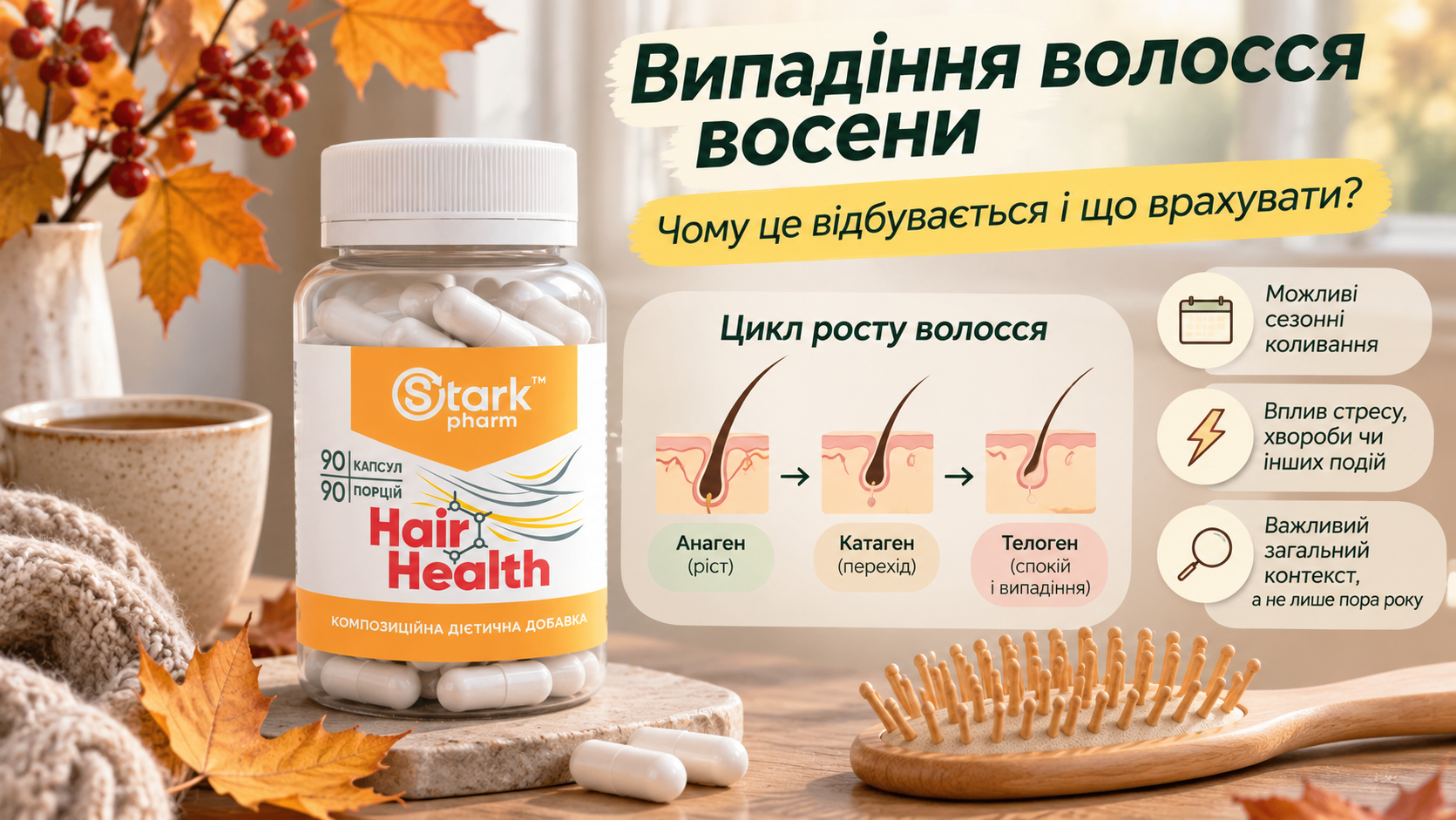
Each hair goes through its own cycle: anagen - a period of active growth, catagen - a transitional phase, telogen - a resting period, after which the hair falls out and the cycle is renewed. The hair on the head does not go through the phases simultaneously, so a certain amount of hair falls out every day even with a normal scalp.
Courtois et al. (1996) observed an annual periodicity in the proportion of telogen hair with a maximum in late summer and early autumn. Another study, Kunz et al. (2009), analyzed data from healthy women with complaints of hair loss and also found seasonal patterns. This supports the hypothesis that for some people, fluctuations throughout the year may be physiological.
However, seasonality does not mean that any noticeable hair loss in the fall is normal. Studies describe group patterns, not a universal schedule for every person. The magnitude of the fluctuations depends on the individual hair cycle, and a sharp decrease in density or the appearance of bald spots require special attention.
Seasonal hair loss and telogen effluvium: what's the difference?
Telogen effluvium is a diffuse, increased hair loss in which more follicles than normal enter the resting phase. Triggers can include significant physiological or psychological stress, illness, surgery, hormonal changes, dietary restrictions, or certain medications. A review by Malkud (2015) describes a characteristic delay between the event and the onset of noticeable hair loss.
| Sign | Possible seasonal increase | Telogen effluvium |
|---|---|---|
| Appearance time | May recur at a similar time of year. | Often occurs several months after the provoking event. |
| Spread | Usually moderate diffuse loss. | Noticeable diffuse increase in hair loss throughout the head. |
| Possible cause | Seasonal changes in the hair growth cycle. | Stress, fever, sudden weight change, medication, or other factor. |
| What is important to check? | Is there thinning, patches of hair loss, or other symptoms? | Was there a trigger, how long is the process, are there any accompanying symptoms? |
| What you can't do according to the table | Make a diagnosis only after a season. | Establish the exact cause without clinical evaluation. |
These variations are not always easy to distinguish on your own. There are also other types of hair loss, such as androgenetic alopecia or alopecia areata. These should not automatically be called “seasonal hair loss” just because the changes become noticeable in the fall.
Stress, illness and loss after two to three months
One reason for the confusion is the delayed response of the hair. In clinical reviews, telogen effluvium is usually described as a process that becomes noticeable approximately 2–3 months after the triggering event. Some sources indicate a wider window of up to 3–4 months. This is explained by the cycle of the follicle: a change in its state is not necessarily accompanied by immediate hair loss.
For example, a person may have experienced intense stress in August, a fever in September, or a severe dietary restriction in early summer. Increased hair loss in October or November may coincide with the fall season, but this does not prove that the season is the cause. Reviews by Malkud (2015) and Jimeno Ortega and Stefanato (2023) consider physiological stress, disease, medication, and psychological stress as potential factors.
For people in Ukraine, this is a particularly pressing issue due to prolonged stress, sleep disturbances, and repeated stressful events. However, even if there is obvious stress, it should not be automatically attributed to any hair loss: other causes may coexist, including changes in blood parameters or scalp diseases.
Ferritin and iron: why they are often asked about
But the scientific results are mixed. In the work of Olsen et al. (2010), the difference in the prevalence of iron deficiency between women with different types of hair loss and a control group did not support the simple rule that “low ferritin always explains hair loss.” In contrast, other studies, including a large retrospective series from 2025, reported a prevalence of low iron levels among patients with telogen effluvium.
A more recent meta-analysis from 2026 found lower ferritin levels on average in groups with telogen effluvium compared to controls. However, the association does not prove causation: lower ferritin does not mean that it is the sole cause of hair loss in a particular person, and taking iron without a proven need does not guarantee changes in hair density.
That is why it is worth evaluating ferritin in the context of symptoms, general blood test results, nutrition, and other circumstances. You should not self-prescribe iron just because of hair loss.
Vitamin D, Zinc, and Biotin: What's Proven and What's Not
The three nutrients most often mentioned in the context of hair are vitamin D, zinc, and biotin. They are involved in physiological processes, but it is important to separate the role of a substance in the body from the evidence of the benefit of a supplement for a person without a deficiency.
Vitamin D. Systematic reviews have found associations between lower 25(OH)D levels and some forms of hair loss. A 2024 meta-analysis of cicatricial and non-cicatricial alopecias reported the prevalence of vitamin D deficiency in specific groups. However, different types of alopecia have different mechanisms, and correlation of laboratory value with symptom does not prove the effectiveness of vitamin D supplementation for everyone.
Zinc. This trace element is needed for normal cell division and the function of many enzymes. Some studies have measured its concentration in the blood of patients with telogen effluvium, but the results have varied. Excess zinc is also undesirable: prolonged excessive consumption can disrupt copper metabolism. Without a confirmed deficiency, taking large doses of "hair" is not worth it.
Biotin. Severe deficiency can be associated with hair and skin changes, but such deficiencies are relatively rare. Reviews by Patel et al. (2017) and Yelich et al. (2024) highlight the lack of good quality evidence that supplemental biotin improves hair in people without deficiency. The NIH ODS also warns that high doses of biotin can interfere with some laboratory tests, including hormone tests.
| Nutrient | What was researched? | What is not proven |
|---|---|---|
| Iron/ferritin | The relationship between iron stores and diffuse hair loss. | That extra iron is needed by anyone who notices hair loss. |
| Vitamin D | 25(OH)D levels in people with different forms of alopecia. | That increasing the dose without deficiency will definitely restore hair. |
| Zinc | Micronutrient status and indicators in patients with hair loss. | That high doses of zinc universally improve hair density. |
| Biotin | Consequences of deficiency and limited clinical data on supplementation. | That biotin helps most people without a deficiency. |
What tests may be appropriate for hair loss?
There is no universal list of tests that every person with autumnal hair loss needs. The doctor first assesses how long the hair loss has been going on, whether there are partings, bald patches, itching, scaling, recent illness, weight changes, medication use, or other symptoms.
Depending on the clinical situation, a complete blood count, iron metabolism indicators, including ferritin, TSH to assess thyroid function, and other tests may be considered as indicated. Studies of patients with telogen effluvium show that laboratory abnormalities are sometimes encountered, but their frequency does not make it advisable to order every possible test for everyone.
For example, a vitamin D test may be warranted if there are additional risk factors for deficiency, but is not an absolute requirement for everyone with hair loss. A biotin test is also not part of the standard mass testing for hair loss alone.
It is important to inform your doctor about any supplements you are already taking, especially high-dose biotin, as it can affect the accuracy of laboratory results. Test selection and interpretation of results should be done in the context of the clinical picture.
Do supplements help with seasonal hair loss?
If a deficiency of a specific nutrient is suspected, the logic is different: first, assess whether there is a deficiency and only then discuss its correction. Without this, another cause may be missed, such as a scalp disease or a certain type of alopecia. Research results from supplements cannot be equated with a guarantee of hair restoration.
A balanced diet, adequate protein and energy intake, attention to possible dietary restrictions and general health are sensible components of daily body care. But no single nutrient can replace determining the cause of significant hair loss.
When to see a dermatologist
Consultation is especially important if the hair loss is sudden, intense or prolonged, hair is noticeably thinning, rounded areas of hairlessness appear, itching, pain, redness or peeling of the scalp. Also, do not write off everything to the season if there is accompanying severe fatigue, significant changes in body weight or other symptoms.
In clinical practice, a dermatologist can assess the nature of the thinning and the condition of the scalp by examination and, if necessary, trichoscopy. Looking for a possible precipitating event a few months before the onset of hair loss is a useful part of the conversation, but is not a stand-alone way to make a diagnosis.
If the cause is temporary telogen effluvium, it may take time for hair density to return. A review by Malkud (2015) describes a gradual reduction in hair loss over months after the trigger is removed, but the timing is highly individual. Self-assessment of progress based solely on the number of hairs in the shower is often inaccurate: it is affected by the frequency of washing, the length of the hair, and the way it is combed.

Summary: When autumn seasonality is an insufficient explanation
Seasonal fluctuations in the hair cycle are a real phenomenon that has been documented in studies. But autumn alone does not explain the intense or prolonged hair loss. Delayed reactions to stress or illness, dietary habits, and certain health conditions can all contribute to the seasonal pattern.
The most useful approach is not to start multiple supplements at once, but to assess the nature of the loss and possible causes. The data on ferritin, vitamin D, zinc, and biotin should be interpreted with caution: the association found in the study does not prove that additional intake of the substance is necessary for everyone.
Frequently asked questions
Why does hair fall out more in the fall?
Some people experience seasonal fluctuations in their hair growth cycle. However, hair loss can also occur in the fall after stress or previous illness.
How long does seasonal hair loss last?
There is no universal term: the intensity and duration are individual. If the loss is pronounced, prolonged or accompanied by thinning, it is better to consult a dermatologist.
Can hair fall out due to stress?
Yes, significant stress is a possible trigger for telogen effluvium. Noticeable changes often occur several months after the event.
How long after an illness can hair loss begin?
In clinical reviews, telogen effluvium is often described as occurring approximately 2–3 months after the triggering event. This is not the only possible time frame.
Is low ferritin associated with hair loss?
Some studies have found lower ferritin levels in people with telogen effluvium, but the results are mixed. Ferritin should be evaluated in conjunction with other tests and symptoms.
Do I need to take a vitamin D test?
Not everyone. The appropriateness of the test depends on additional risk factors and the clinical situation.
Does biotin help if there is no deficiency?
There is insufficient evidence to support the benefits of supplemental biotin for hair in people without a deficiency. High doses may distort the results of some tests.
What tests can be prescribed for hair loss?
Depending on your symptoms, your doctor may consider a complete blood count, ferritin, TSH, and other tests. There is no one-size-fits-all test.
When does hair loss require a doctor's consultation?
If it is sudden, severe, accompanied by noticeable thinning, bald spots, scalp changes, or other symptoms, you should see a dermatologist.
Sources
- Kunz M et al. (2009). Seasonality of Hair Shedding in Healthy Women Complaining of Hair Loss. Dermatology. PubMed.
- Courtois M et al. (1996). Periodicity in the Growth and Shedding of Hair. British Journal of Dermatology. PubMed.
- Malkud S. (2015). Telogen Effluvium: A Review. Journal of Clinical and Diagnostic Research. PubMed.
- Jimeno Ortega I, Stefanato CM. (2023). Telogen Effluvium: A 360 Degree Review. Journal of the European Academy of Dermatology and Venereology. PubMed.
- Olsen EA et al. (2010). Iron Deficiency in Female Pattern Hair Loss, Chronic Telogen Effluvium, and Control Groups. Journal of the American Academy of Dermatology. PubMed.
- Retrospective Review of 2851 Female Patients With Telogen Effluvium: A Single-Center Experience. (2025). Journal of Cosmetic Dermatology. PubMed.
- Alali A et al. (2026). Association Between Serum Trace Elements and Telogen Effluvium: A Systematic Review and Meta-Analysis. Skin Appendage Disorders. PubMed.
- A Comprehensive Investigation of Biochemical Status in Patients With Telogen Effluvium: Analysis of Hb, Ferritin, Vitamin B12, Vitamin D, Thyroid Function Tests, Zinc, Copper, Biotin, and Selenium Levels. (2024). PubMed.
- Patel DP et al. (2017). A Review of the Use of Biotin for Hair Loss. Skin Appendage Disorders. PubMed.
- Yelich A et al. (2024). Biotin for Hair Loss: Teasing Out the Evidence. Journal of Clinical and Aesthetic Dermatology. PubMed.
- Drake L et al. (2022). Evaluation of the Safety and Effectiveness of Nutritional Supplements for Treating Hair Loss: A Systematic Review. JAMA Dermatology. PubMed.
- National Institutes of Health, Office of Dietary Supplements. Biotin: Fact Sheet for Health Professionals. NIH ODS.
Dietary supplement. Not a medicine. Consult a doctor before use.
Products related to this post

Related Posts
Comments
Information
Customer Service
Extras
My Account


Sports nutrition manufacturer in Ukraine StarkPharm © 2026


