Your shopping cart is empty!

Vitamin C and iron: how does it affect absorption and whether to take them together
Published: 14/11/2026
Times Read: 29
Comments : 0
Vitamin C and iron are often mentioned together because ascorbic acid can increase the absorption of non-heme iron—the form that predominates in plant foods. However, there is a fundamental difference between saying that “vitamin C increases iron absorption from food” and that “every iron supplement must be taken with vitamin C.” The former is well supported by meal-based experiments; the latter has not received unequivocal support in clinical trials.
To understand how these substances work together, it is important to consider the source of iron, meal composition, initial iron stores and the outcome being measured: absorption after a single meal, hemoglobin concentration or ferritin levels after several weeks.
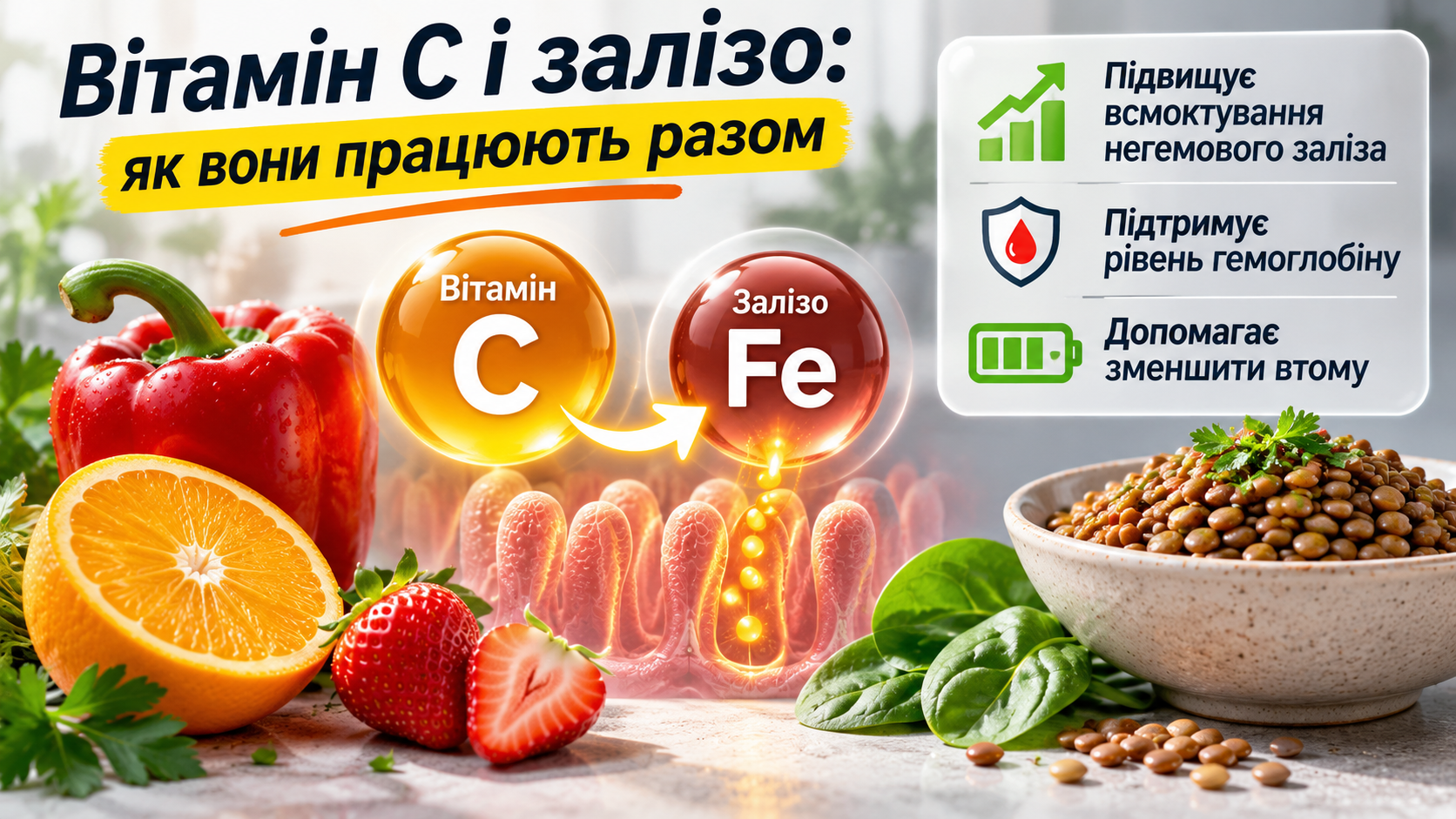
How vitamin C helps iron absorption
Iron is a component of hemoglobin, myoglobin and enzymes involved in oxygen transport and metabolism. Dietary iron occurs in two main forms: heme and non-heme. Their absorption mechanisms differ.
In the intestinal lumen, non-heme iron may be present in the ferric Fe(III) form, which is less soluble under certain conditions. Ascorbic acid helps reduce Fe(III) to ferrous Fe(II) and form soluble complexes, keeping iron more readily available for absorption. This mechanism is described by Hallberg and colleagues (1989) and in a review by Teucher and colleagues (2004).
This does not mean that iron cannot be absorbed without vitamin C. Ascorbic acid is one of several factors affecting iron availability, alongside food type, other meal components and the body's physiological needs.
Heme versus non-heme iron: comparison
| Criterion | Heme iron | Non-heme iron |
|---|---|---|
| Main sources | Meat, poultry, fish | Legumes, grains, seeds, leafy greens, fortified foods; also some iron in animal foods |
| Dependence on meal composition | Generally lower | Higher: affected by ascorbic acid, phytates, polyphenols and other components |
| Effect of vitamin C | Not a primary factor in absorption | May increase absorption, especially when inhibitors are present |
| Can absorption be predicted precisely? | No; it depends on the body's condition | No; it depends on both the body and the entire meal |
According to the NIH Office of Dietary Supplements, iron bioavailability from a mixed diet containing meat, seafood and vitamin C sources is generally higher than from plant-based diets. However, these average estimates cannot simply be applied to every meal or individual.
What studies of iron absorption from food have shown
Hallberg, Brune and Rossander (1986) investigated how ascorbic acid from various foods and as an isolated substance affects non-heme iron absorption from meals. They observed increased absorption, although the size of the effect varied considerably depending on meal composition. The study used different amounts of ascorbic acid; the authors discussed approximately 50 mg in a main meal as a research reference point, not a universal supplementation regimen.
Hallberg and colleagues (1989) also examined how ascorbic acid interacts with phytates—substances found in grains and legumes, among other foods. Their experiments showed that, with certain meal compositions, vitamin C can partially offset phytate-related inhibition of iron absorption. Siegenberg and colleagues (1991) extended this conclusion to polyphenols and phytates using controlled test meals.
Nevertheless, the result of a single meal is not the same as a long-term change in iron stores. Cook and Reddy (2001) assessed iron absorption from complete diets during three dietary periods in 12 participants. Although average vitamin C intake varied from approximately 51 to 247 mg/day, there was no statistically significant difference in mean absorption between periods. After accounting for iron status, however, a positive association between absorption and ascorbic acid was identified. Later complete-diet models likewise suggest that initial iron stores, including ferritin, can explain a substantial share of individual differences.
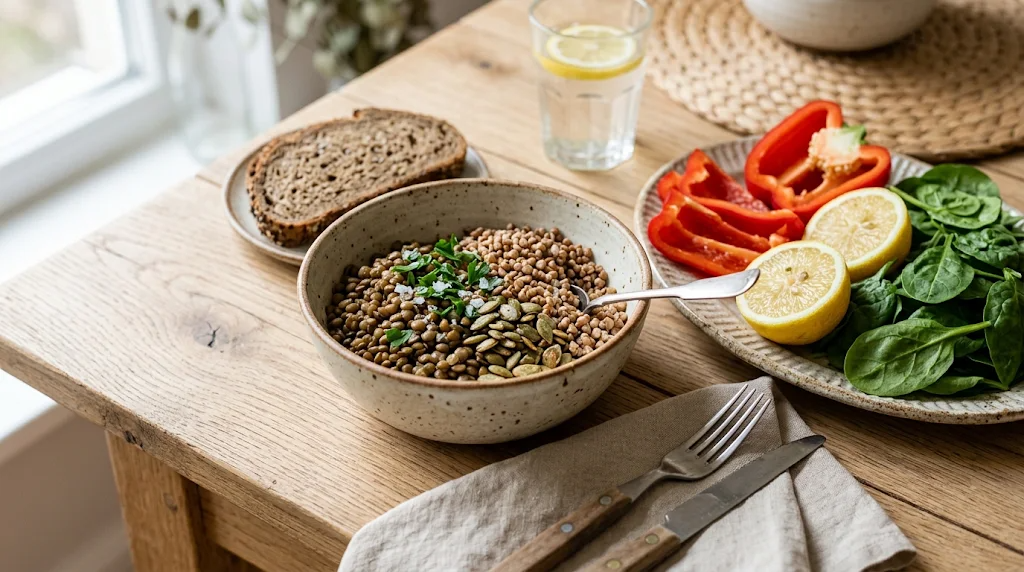
Which foods combine iron and vitamin C?
In practical terms, it is enough to consider the entire plate rather than an isolated food. Sources of non-heme iron can be paired with vegetables, berries or fruits rich in vitamin C.
| Non-heme iron source | Dietary vitamin C source | Example combination |
|---|---|---|
| Lentils, beans, chickpeas | Bell peppers, tomatoes | Warm legume salad with fresh peppers |
| Buckwheat and other grains | Broccoli, sauerkraut | Grains with a vegetable side dish |
| Tofu | Lemon juice, herbs, peppers | Tofu with vegetables and citrus dressing |
| Pumpkin seeds | Kiwi, strawberries | Seeds as part of a fruit-containing dish |
The vitamin C content of prepared dishes depends on the ingredients, storage duration and cooking methods. Prolonged heating and contact with water can reduce it. Raw or lightly cooked vegetables and fruits are therefore convenient components of a varied diet.
Must iron supplements be taken with vitamin C?
No, this combination is not universally necessary. The positive effect of ascorbic acid on non-heme iron absorption from particular meals does not prove that adding vitamin C to every oral iron formulation improves long-term outcomes.
In a randomized trial by Li and colleagues (2020), involving 440 adults with iron-deficiency anemia, oral iron with and without additional vitamin C was compared. Both groups showed comparable changes in hemoglobin over two weeks: averages of 2.00 and 1.84 g/dL, respectively. The authors concluded that, under the conditions studied, adding ascorbic acid was not necessary to achieve a similar outcome.
Importantly, this is the result of one particular clinical study, not a reason to change prescribed treatment independently. People with confirmed iron deficiency need an individualized approach because low hemoglobin or ferritin can have different causes.
What systematic reviews from 2023–2024 found
A 2023 systematic review and meta-analysis of combined iron and ascorbic acid supplementation found no convincing advantage of the combination over iron alone for key hematological markers. The researchers also highlighted heterogeneity among the included studies.
A meta-analysis by Deng and colleagues (2024) evaluated 10 randomized trials and one prospective cohort study. In pooled data, adding vitamin C was associated with small mean differences: approximately +0.14 g/dL in hemoglobin and +3.23 µg/L in ferritin. The authors noted statistical signals but, given the small magnitude of the changes and heterogeneity of the findings, did not support routinely adding vitamin C to oral iron for all patients.
There is therefore no contradiction: vitamin C may improve iron absorption from a particular meal, but this does not guarantee substantial additional changes in hemoglobin or iron stores during prolonged supplement use.
What can reduce non-heme iron absorption?
Iron absorption depends on how meal components are combined. Studies identify several factors that can reduce it under certain conditions:
- Phytates in grains, bran and legumes can bind non-heme iron; the extent depends on the amount and preparation method.
- Polyphenols in tea, coffee and certain other drinks may reduce iron absorption when consumed with iron-containing foods.
- Calcium may affect iron absorption under some experimental conditions, but the long-term practical significance is less clear.
- Initial iron stores alter physiological responses: a body with lower iron status may absorb iron differently from one with sufficient stores.
Hurrell, Reddy and Cook (1999) demonstrated inhibition of non-heme iron absorption by polyphenol-containing beverages. In a controlled study by Ahmad Fuzi and colleagues (2017) involving 12 healthy women, a one-hour gap between an iron-containing meal and tea reduced this effect. These findings primarily concern food interactions, not a universal rule for all iron formulations.
Who should take extra care?
Low ferritin or hemoglobin should not automatically be attributed to vitamin C deficiency. Iron markers may be influenced by diet, blood loss, malabsorption and other causes requiring professional assessment. Taking large quantities of iron without an established need is inadvisable.
Caution is also needed with conditions involving iron overload, including hereditary hemochromatosis: ascorbic acid can increase non-heme iron absorption. During pregnancy or breastfeeding, in chronic illness, when taking medications or when pronounced symptoms occur, supplementation decisions should be discussed with a healthcare professional.
Key takeaway: combining plant-based iron sources with vitamin C-rich foods in one meal is a sound dietary approach. However, extra ascorbic acid alongside an iron preparation is not mandatory for everyone; the benefits of this combination should be judged by clinical evidence, not solely by the mechanism of absorption.
Frequently asked questions
Why are vitamin C and iron combined?
Ascorbic acid may improve absorption of non-heme iron from food. The extent to which this affects overall iron stores depends on many factors.
Is it essential to take iron with vitamin C?
No. Large clinical studies have not confirmed a universal need to add vitamin C to oral iron. Do not change a physician's prescription on your own.
Does vitamin C help absorb all forms of iron?
Its effect on non-heme iron is best established. This mechanism is not the main factor for heme iron from meat or fish.
Is adding lemon or pepper to an iron-containing meal enough?
These foods can provide dietary vitamin C. The exact effect, however, depends on portion size, meal composition and initial iron status.
Can I drink tea or coffee with iron-containing food?
Polyphenols in these beverages may reduce non-heme iron absorption. In studies, separating tea consumption from meals reduced this effect.
Can vitamin C increase ferritin?
Vitamin C affects non-heme iron availability, but studies found only a small or no additional ferritin benefit from combining it with oral iron.
Do I need 500 or 1,000 mg of vitamin C to absorb iron?
Dietary absorption studies do not establish a need for such large doses for everyone. More ascorbic acid does not guarantee a better outcome.
When should iron markers be checked?
If iron deficiency is suspected or laboratory values are already low, discuss appropriate tests and next steps with a physician. A single marker without clinical context does not establish the cause.
Sources
- Hallberg L, Brune M, Rossander L. (1986). Effect of ascorbic acid on iron absorption from different types of meals. Studies with ascorbic-acid-rich foods and synthetic ascorbic acid given in different amounts with different meals. Human Nutrition: Applied Nutrition. PubMed.
- Hallberg L, Brune M, Rossander L. (1989). Iron absorption in man: ascorbic acid and dose-dependent inhibition by phytate. The American Journal of Clinical Nutrition. PubMed.
- Siegenberg D et al. (1991). Ascorbic acid prevents the dose-dependent inhibitory effects of polyphenols and phytates on nonheme-iron absorption. The American Journal of Clinical Nutrition. PubMed.
- Cook JD, Reddy MB. (2001). Effect of ascorbic acid intake on nonheme-iron absorption from a complete diet. The American Journal of Clinical Nutrition. PubMed.
- Armah SM et al. (2013). A complete diet-based algorithm for predicting nonheme iron absorption in adults. The Journal of Nutrition. PubMed.
- Hurrell RF, Reddy M, Cook JD. (1999). Inhibition of non-haem iron absorption in man by polyphenolic-containing beverages. British Journal of Nutrition. PubMed.
- Ahmad Fuzi SF et al. (2017). A 1-h time interval between a meal containing iron and consumption of tea attenuates the inhibitory effects on iron absorption: a controlled trial in a cohort of healthy UK women using a stable iron isotope. The American Journal of Clinical Nutrition. PubMed.
- Teucher B et al. (2004). Enhancers of iron absorption: ascorbic acid and other organic acids. International Journal for Vitamin and Nutrition Research. PubMed.
- Li N et al. (2020). The Efficacy and Safety of Vitamin C for Iron Supplementation in Adult Patients With Iron Deficiency Anemia: A Randomized Clinical Trial. JAMA Network Open. PubMed.
- Tuntawiroon M et al. (1991). Dose-dependent inhibitory effect of phenolic compounds in foods on nonheme-iron absorption in men. The American Journal of Clinical Nutrition. PubMed.
- National Institutes of Health, Office of Dietary Supplements. Iron: Fact Sheet for Health Professionals. NIH ODS.
- National Institutes of Health, Office of Dietary Supplements. Vitamin C: Fact Sheet for Health Professionals. NIH ODS.
- Deng J et al. (2024). Efficacy of vitamin C with Fe supplementation in patients with iron deficiency anemia: a systematic review and meta-analysis. Blood Vessels, Thrombosis & Hemostasis. PubMed.
- Loganathan V et al. (2023). Treatment efficacy of vitamin C or ascorbate given as co-intervention with iron for anemia - A systematic review and meta-analysis of experimental studies. Clinical Nutrition ESPEN. PubMed.
Dietary supplement. Not a medicinal product. Consult your doctor before use.
Products related to this post


Related Posts
Comments
Information
Customer Service
Extras
My Account


Sports nutrition manufacturer in Ukraine StarkPharm © 2026


