Your shopping cart is empty!

Does vitamin C help with colds: what studies show
Published: 14/11/2026
Times Read: 60
Comments : 0
Vitamin C for colds is one of the most researched topics in nutrition. The result is not reduced to a simple “works” or “does not work”: regular intake of vitamin C, starting its additional intake after the onset of a cold, and use in conditions of extreme physical exertion are different research scenarios. They have received different results.
The main conclusion of a large Cochrane review: For most people, regular vitamin C supplementation has not been shown to significantly reduce the frequency of colds, but has been associated with a small reduction in the duration of colds in studies. When vitamin C supplementation was started only after the first symptoms appeared, no consistent positive effect was found. Let's look at the specific numbers, the limitations of the studies, and the practical implications of these differences.
Does vitamin C help you catch colds less often?
To answer this question, it's important not to confuse the frequency of colds with the duration of symptoms already present. If a person gets a cold twice a year instead of three times, that's one endpoint. If their cold lasts six days instead of seven, that's another.
In a systematic review, Hemilä and Chalker (2013) analyzed 29 comparisons with a total of 11,306 participants on the risk of colds with regular vitamin C supplementation. They found no convincing reduction in cold incidence in the general population. In a large subgroup of regular participants, the relative risk was about 0.97: a result very close to no effect.
That is, the statement “take vitamin C every day and you won’t catch a cold” is not supported by the available array of tests. At the same time, this does not deny the physiological role of vitamin C in the body: ascorbic acid is necessary for normal cell functions, collagen synthesis, and other processes. The question of sufficient nutrient supply and the question of additional intake in the absence of deficiency are not identical.
Does vitamin C shorten the duration of a cold?
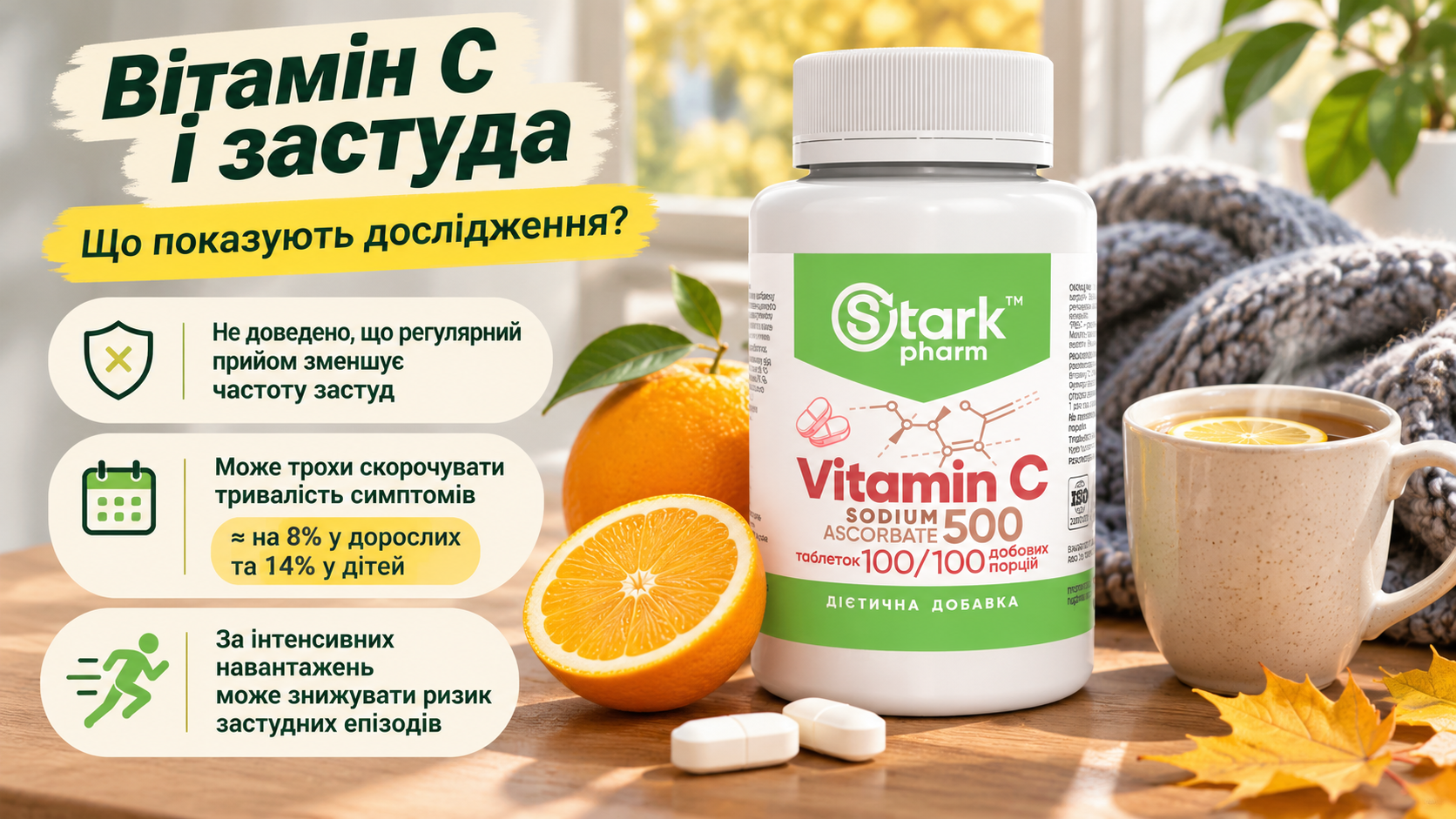
Here the evidence is a bit different. In the same Cochrane review, researchers pooled 31 comparisons with data on 9,745 cold episodes. With regular vitamin C use over the study period, the average duration of a cold was shortened by about 8% in adults and 14% in children. These are relative averages, not guaranteed results for a specific person.
To illustrate: if a cold lasts seven days, then 8% is about 13 hours. This example illustrates the scale of the relative difference, but is not a prediction of how quickly your cold will go away. The duration, symptom cessation criteria, and doses varied across trials.
Earlier analyses by Douglas et al. (2007) also found a small reduction in the duration of colds among participants who received regular vitamin C. Taken together, this indicates a potentially modest effect on duration, but not a radical acceleration of recovery or absence of symptoms.
Regular use and starting after symptoms: the main difference
A common mistake is to extrapolate the results of studies of long-term regular use to a situation where a person first takes a supplement after developing a runny nose, sore throat, or cough. The designs of these trials are different, so this conclusion cannot be drawn.
| Scenario in research | What was evaluated? | Main conclusion |
|---|---|---|
| Regular use | Frequency of colds during the observation period. | No convincing reduction in incidence has been established in the general population. |
| Regular use | The duration of colds that still occur. | On average, episodes are 8% shorter in adults and 14% shorter in children. |
| Onset after symptoms appear | Do the duration and severity of symptoms change? | Studies have not produced a consistent convincing effect. |
| Regular use under extreme loads | The frequency of colds in specific groups. | The risk was lower in a small group of trials; generalizations cannot be made to everyone. |
So, when someone says "vitamin C reduces colds," it's worth clarifying: under what regimen, in whom, and by what index? Without this, it's easy to get an exaggerated or simply incorrect impression of the study.
Why did the athletes' results differ?
An interesting detail of the Cochrane review is a separate subgroup of participants who underwent short-term extreme physical exertion, sometimes in cold environments. This included, among others, marathon runners, skiers, and military personnel during specific training.
In five trials with a total of 598 participants in this subgroup, regular vitamin C use was associated with approximately half the frequency of cold-like episodes. The analysis by Hemilä (1996) also noted differences specifically in groups with significant physical activity.
However, this does not mean that a normal walk in the winter or daily training automatically equates to the workload of marathon runners. In addition, some of the symptoms after extreme physical exertion may be related not only to infection, but also to respiratory tract irritation. The review authors explicitly caution against extrapolating the results of this subgroup to the general population.

Does vitamin C reduce the severity of symptoms?
The duration of a cold isn't the only measure. Researchers also looked at the intensity of a runny nose, cough, sore throat, general malaise, and sometimes the number of days with more severe symptoms. Combining all of these measures is more difficult than simply comparing the number of days.
A meta-analysis by Hemilä (2023) looked at more severe and milder cold symptoms separately. It found that in the included studies, regular vitamin C use may have a different effect on more severe symptoms than on less severe symptoms. However, the study endpoints varied, so the results should not be interpreted as a universal promise of all symptom relief.
A 2022 systematic review on respiratory infections also reported a possible shortening of their duration in some studies of vitamin C, but the authors emphasized the need for additional high-quality trials, especially for the scenario of starting use after the onset of symptoms.
What explains the role of vitamin C in the body?
Vitamin C is a water-soluble nutrient that humans must obtain from food or other sources. It is involved in the normal functioning of the immune system, acts as an antioxidant, and is needed for collagen synthesis, particularly in tissues that form the body's physical barriers.
However, there is a gap between the biological mechanism and a clinically relevant outcome. Even if a nutrient is required for normal cellular function, it does not follow that additional amounts above physiological requirements will necessarily provide a stronger response or reduce the risk of colds. It is to test such assumptions that randomized clinical trials are conducted.
The NIH Office of Dietary Supplements summarizes the physiological functions of ascorbic acid and the results of studies on the common cold. The conclusions of this scientific statement are consistent with the main difference: the general population, extreme exercise groups, regular use, and onset after symptoms are different contexts.
Why the dose in the study is not a ready recommendation
The trials used varying amounts of vitamin C, from hundreds of milligrams to much higher doses in some protocols. These numbers describe the conditions of specific studies and are not intended to be a regimen for every person.
Dose alone does not explain the entire result. The duration of the study, the nutritional status of the participants before the study, the season, the level of physical activity, and the precise definition of the cold are all important. In addition, the absorption of vitamin C varies with increasing intake, so the principle of "more is necessarily better" has no sufficient scientific basis.
The difference between 500 and 1000 mg, the rate of absorption, and the bioavailability of the forms are separate issues. They should not be confused with clinical judgment about the duration of a cold: better absorption does not equal a proven effect on the frequency or course of a cold.
Safety and limitations of high doses
Vitamin C is generally well tolerated in amounts obtained from the diet. Higher supplemental amounts may cause nausea, abdominal discomfort, and diarrhea. Special caution should be exercised in people with certain kidney diseases, iron metabolism disorders, and individual medical conditions.
Drug interactions and underlying conditions may alter the appropriateness of supplement use. Pregnant women, breastfeeding women, people with chronic medical conditions, and those taking regular medications should discuss supplement use with their doctor. The high doses used in the research studies were in controlled protocols, which does not mean they are suitable for self-replication.
It is also important not to substitute nutritional intake for health assessment: high fever, difficulty breathing, worsening condition, or unusual symptoms require medical evaluation.
What to remember about vitamin C during cold season
The best summary of the current evidence is that regular vitamin C supplementation has not been shown to significantly reduce the frequency of colds in most people, although in clinical trials the average duration of colds has been somewhat shorter. Starting after symptoms have started has not been as consistently supported. In some groups with extreme physical activity, the results for episode frequency were different, but this does not automatically apply to everyone.
Therefore, the scientifically correct approach is to maintain a balanced diet, understand the limitations of the available data, and not turn the average study result into an individual guarantee. Vitamin C is an important nutrient, but it is not a universal way to avoid seasonal respiratory infections.

Frequently asked questions
Does vitamin C help prevent colds?
In studies of the general population, regular vitamin C supplementation has not shown a convincing reduction in the frequency of colds. Individual results for people with extreme physical exertion have varied.
Does vitamin C shorten the duration of a cold?
A Cochrane review found a small average reduction in episode duration among participants who took vitamin C regularly throughout the studies. This is not a guarantee for a specific individual.
How many days can vitamin C shorten a cold?
The review reports results for regular use as relative reductions of approximately 8% in adults and 14% in children. Conversion into days depends on the initial episode duration.
Does it make sense to start taking it only after a runny nose appears?
Studies that started vitamin C after the first symptoms did not show a consistent, convincing effect. This is a different scenario than regular use.
Why do athletes' results vary?
In some studies, people with short-term extreme exertion and cold stress have experienced fewer cold-like episodes. These conditions cannot be equated with normal daily activity.
Does vitamin C reduce the severity of symptoms?
Some meta-analyses have found differences in severity of cold symptoms, but the results depend on how symptoms are assessed. Universal relief of all symptoms has not been proven.
Does a higher dose of vitamin C mean better results?
No. The studies used different doses, and the absorption of vitamin C varies with increasing amounts. Doses from scientific protocols should not be repeated on your own.
Do different forms of vitamin C work the same way for colds?
Data on the bioavailability of the form do not provide direct evidence of an effect on the frequency or duration of colds. Such conclusions require studies with appropriate clinical outcomes.
Can excess vitamin C cause unwanted effects?
Large amounts of supplements may cause digestive upset. If you have a chronic condition or are taking regular medications, it is advisable to discuss supplements with your doctor.
Sources
- Hemilä H, Chalker E. (2013). Vitamin C for Preventing and Treating the Common Cold. Cochrane Database of Systematic Reviews. PubMed.
- Hemilä H. (2023). Vitamin C Reduces the Severity of Common Colds: A Meta-Analysis. BMC Public Health. PubMed.
- Douglas RM et al. (2007). Vitamin C for Preventing and Treating the Common Cold. Cochrane Database of Systematic Reviews. PubMed.
- Hemilä H. (1996). Vitamin C and Common Cold Incidence: A Review of Studies with Subjects Under Heavy Physical Stress. International Journal of Sports Medicine. PubMed.
- Vitamin C for the Common Cold and Pneumonia. (2025). PubMed.
- Effect of Vitamin C Supplements on Respiratory Tract Infections: A Systematic Review and Meta-Analysis. (2022). PubMed.
- Examining the Evidence for the Use of Vitamin C in the Prophylaxis and Treatment of the Common Cold. (2009). PubMed.
- National Institutes of Health, Office of Dietary Supplements. Vitamin C: Fact Sheet for Health Professionals. NIH ODS.
- National Institutes of Health, Office of Dietary Supplements. Dietary Supplements for Immune Function and Infectious Diseases. NIH ODS.
Dietary supplement. Not a medicine. Consult a doctor before use.
Products related to this post


Related Posts
Comments
Information
Customer Service
Extras
My Account


Sports nutrition manufacturer in Ukraine StarkPharm © 2026


