Your shopping cart is empty!

NAC 600 mg on the label: what doses have been studied in studies
Published: 05/11/2026
Times Read: 89
Comments : 0
The label “NAC 600 mg” itself tells you how much N-acetylcysteine is in a given unit of product—for example, a capsule or serving, if that’s what the manufacturer says. But that number doesn’t tell you how much of the substance is in a daily serving, how long it was studied, or what results were observed. You’ll need to read the full label and the scientific protocol separately to get the answer.
In the publications there are schemes of 600 mg per day, 600 mg twice a day and other regimens. They were used in different groups of people with different tasks of researchers. The figures below are a description of clinical trials, and not advice on taking.
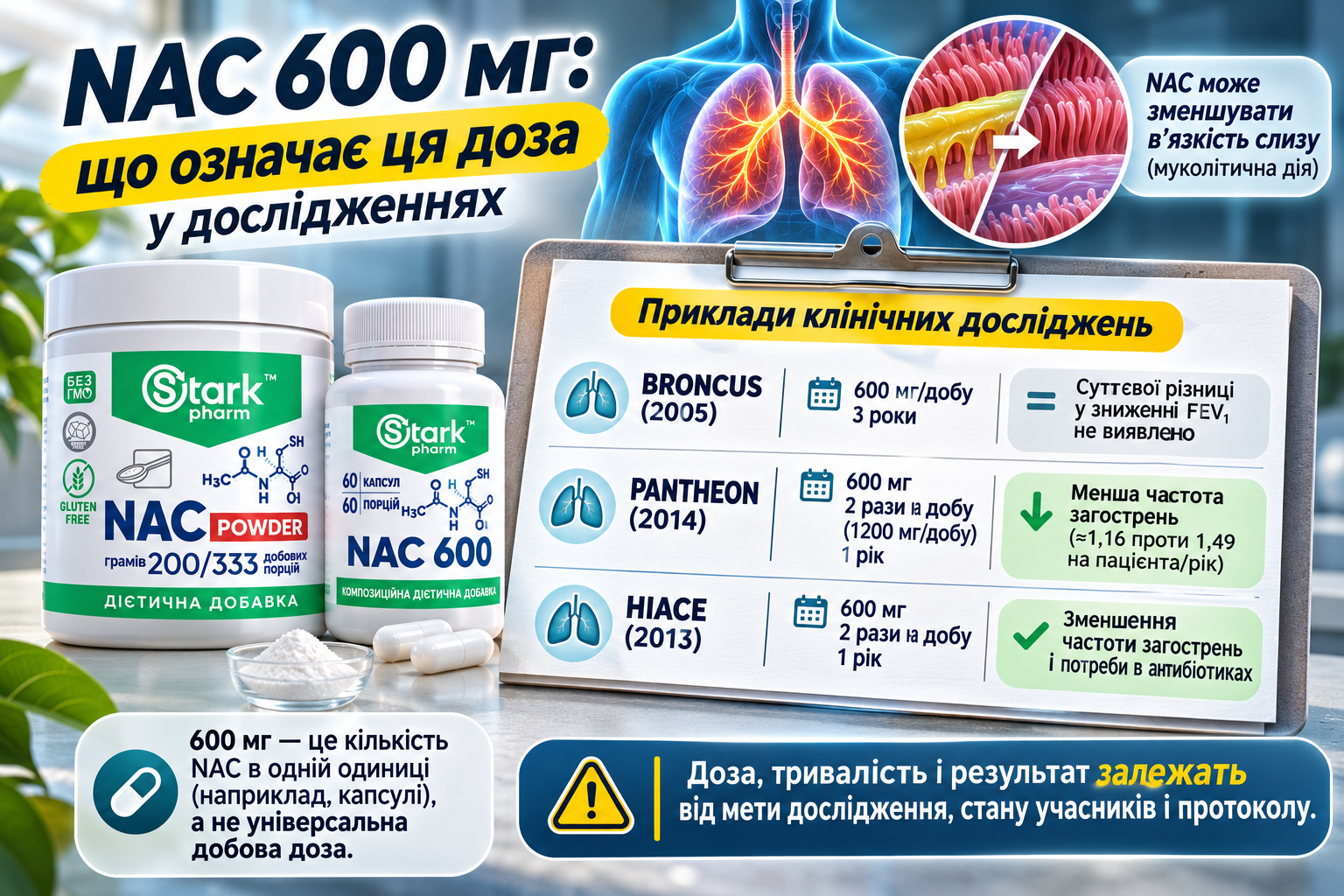
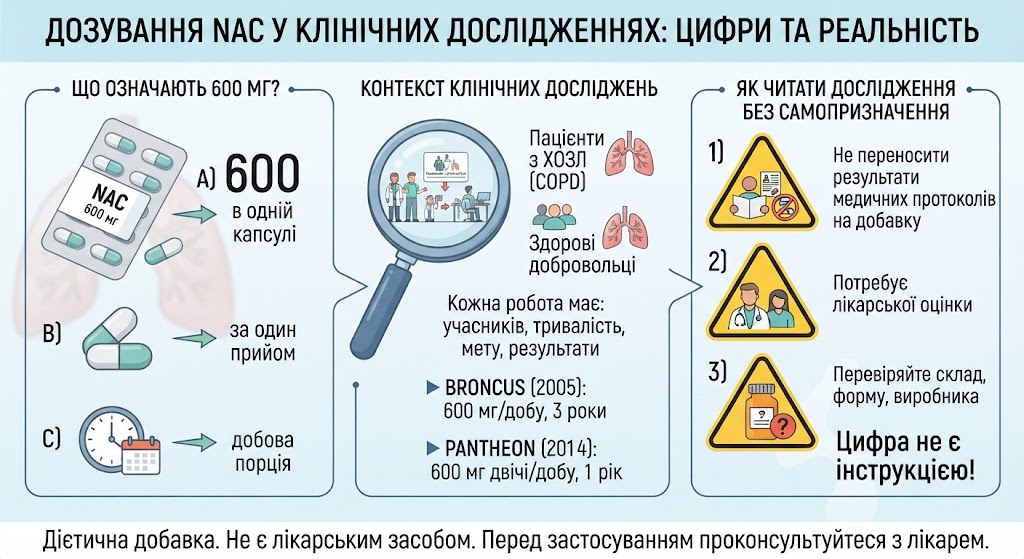
What exactly does 600 mg mean in the name or on the label?
Manufacturers may indicate a large number on the front of the package, but it only makes sense when the unit of measurement is specified. “600 mg in one capsule,” “600 mg per serving,” and “600 mg per day” are different statements. If a daily serving consists of multiple servings, the total amount of active ingredient is calculated separately.
In the dosage article, it is also important to distinguish NAC as the active ingredient from the total weight of the capsule including excipients. Without information on the composition, it is impossible to determine the amount of active ingredient from the capsule shape or powder weight.
The presence of a number on the label does not prove effectiveness in a specific scenario. It describes the composition; studies evaluate the result in a specific group, over a specific time period, and using a specific methodology.
Why a dose from clinical work cannot be copied from the abstract
| Research | Dose in the protocol | Duration | Who was studied? |
|---|---|---|---|
| BRONCUS, 2005 | 600 mg/day | 3 years | Patients with COPD |
| Neutrophils, 2006 | 600 mg/day | 14 days | 10 healthy volunteers |
| PANTHEON, 2014 | 600 mg twice daily | 1 year | Patients with COPD |
| HIACE, 2013 | 600 mg twice daily | 1 year | Patients with COPD |
| Exacerbation study, 2005 | 600 or 1200 mg/day | 10 days | Patients with COPD exacerbation |
| Zhou et al., 2024 | 600 mg twice daily | 2 years | Patients with mild or moderate COPD |
A clinical trial has criteria for selecting participants, duration, route of administration, control group, and outcomes that the authors planned to measure. Outside of this context, the dose becomes a number detached from the conditions.
For example, one study might examine lung function dynamics in people with confirmed disease, another might examine inflammatory marker levels, and a third might examine changes in immune cell function in healthy volunteers. Even the same number in milligrams does not make the results interchangeable.
You also need to separate the amount per dose from the total amount per day. Two groups in different studies may receive 600 mg per dose, but the total daily amount will be different.
BRONCUS: 600 mg daily for three years
In the large BRONCUS trial (Decramer et al., 2005), 523 patients with COPD were randomized to NAC 600 mg/day or placebo. Follow-up was for three years. The investigators were primarily interested in the dynamics of FEV1 and exacerbation rate in a defined clinical population.
The main measure of the rate of decline in FEV1 was not statistically significant, meaning that the long-term study of 600 mg does not mean that this dose had the expected effect by all criteria.
The key lesson from BRONCUS— 600 mg per day—was the experimental condition of a specific study, not a universal amount for maintaining health.
Healthy volunteer study: 600 mg and neutrophil markers
In another study (2006), ten healthy volunteers were given 600 mg of NAC daily for 14 days. The authors assessed the activity of neutrophils—immune system cells—and certain laboratory processes, including the oxidative burst and chemotaxis.
After 14 days, changes in some parameters were noted compared to baseline; after a short interval of two hours, no such effect was observed. These data describe a laboratory response in a very small sample, and not well-being or long-term consequences in the wider population.
Most importantly, 10 participants are not enough to draw a general conclusion that the same amount of NAC will necessarily change immune function in any individual.
PANTHEON: 600 mg twice daily for a year
The PANTHEON trial (Zheng et al., 2014) randomized 1006 participants with COPD to 600 mg twice daily for 1 year, with placebo as the control group. This resulted in a total dose of 1200 mg per day in the protocol.
In this particular group, the researchers reported a lower rate of exacerbations: approximately 1.16 versus 1.49 per patient per year. However, the design, indications, and duration of the trial were significantly different from studies in healthy volunteers or short-term experiments.
The comparison of BRONCUS and PANTHEON does not show the “right” dose, but the difference between clinical questions. Both studies were concerned with people with lung disease, not with the everyday use of dietary supplements.
A randomized trial in patients with COPD exacerbations (2005) compared 600 mg/day, 1200 mg/day, and placebo for ten days. The authors analyzed inflammatory markers, including C-reactive protein, as well as some clinical parameters.
On some laboratory results, both NAC groups differed from placebo, with a higher dose producing a stronger response for one of the measures. However, this does not mean that a healthy person would need a higher dose: the context was the specific acute condition and medical protocol.
HIACE (2013) also investigated 600 mg twice daily for a year in people with stable COPD. Changes in some measures of small airway function and exacerbation rate were reported, but not in all measures of well-being. Such data should not be confused with the results of a short 10-day trial.
Is the effect confirmed with longer observation?
A study by Zhou et al. (2024) enrolled 968 patients with mild to moderate COPD. The protocol compared 600 mg of NAC twice daily with placebo for two years. The primary endpoints were exacerbation rate and change in FEV1.
Long-term follow-up is important to assess the stability of the result, but even a large clinical trial does not answer the question of the benefit of a dietary supplement for every healthy person. Conclusions are limited by the selection criteria of participants, the defined outcomes, and the method of administration.
Therefore, “the dose has been studied for two years” does not equal “it can be taken for two years without consultation.” These are fundamentally different statements.
How to read results correctly without self-prescribing
When you see 600 mg in the abstract, ask five questions: is it for one dose or per day; who participated; how long the observation lasted; what was compared with; what exactly changed. Without these clarifications, it is easy to attribute a meaning to the number that the study does not contain.
Also, the medicinal products used in clinical trials should not be equated with any dietary supplement with the same active ingredient name. Product requirements, form, accompanying ingredients, and reason for use may differ.
Tolerability, drug interactions, and individual characteristics should be considered separately. If a person has a chronic condition, is taking medication, is pregnant, or is breastfeeding, a doctor's consultation is necessary before making any decisions regarding NAC.

Why the same number on the label doesn't mean the same scientific result
Even when two studies report 600 mg of NAC, there can be large differences between them. The participants have different ages, baseline health, and concomitant medications; one study measures laboratory values after just two weeks, the other measures clinical event rates over several years. Accordingly, the same hypothesis is not being evaluated.
How the effect is determined also plays a significant role. A statistically significant difference in one marker may not be accompanied by changes in another, more important indicator for everyday life. Therefore, in short descriptions of studies, it is undesirable to leave only the number of milligrams and the wording “a positive effect was found.” Without specifying the endpoint, the reader does not understand what exactly was established.
It is also important not to confuse the concepts of tolerability within a trial with long-term safety in other settings. If participants in a particular experiment did not experience serious adverse reactions over a specified period, this does not mean that any route of administration of the substance in other people has the same risk profile.
So, the figure “600 mg” is just an initial description. The scientific meaning appears only after specifying “for whom”, “how often”, “how long” and “what exactly the result”. Without these four details, any conclusion about the dosage remains incomplete.
Frequently asked questions
Is 600 mg of NAC always the daily amount?
No. On the label, it may be the amount per capsule or serving; you need to read the full ingredients and the recommended daily serving.
Has 600 mg of NAC per day been studied?
Yes. For example, BRONCUS studied 600 mg per day for three years in patients with COPD.
Are there any works with two doses of 600 mg?
Yes. PANTHEON studied 600 mg twice daily for a year, but this is a medical protocol for a specific group of patients.
Can the results of different studies be compared based on dose alone?
No. Participants, duration, control group, and endpoints must be considered.
Does changing biomarkers prove an overall benefit?
No. A laboratory result may change without a corresponding improvement in clinical outcomes.
Is 600 mg a universally optimal amount of NAC?
No. Different works have studied different goals, and no universal conclusion can be drawn from this.
Can I repeat the doses from the trials myself?
No. The numbers are provided only to describe scientific protocols and not as recommendations.
What to check on the NAC packaging?
Amount of active ingredient per unit, serving size, daily serving, composition, and manufacturer's warnings.
Sources
- Decramer M. et al. (2005). Effects of N-acetylcysteine on outcomes in chronic obstructive pulmonary disease (Bronchitis Randomized on NAC Cost-Utility Study, BRONCUS): a randomized placebo-controlled trial. The Lancet, 365(9470), 1552–1560. PubMed
- Zheng JP et al. (2014). Twice daily N-acetylcysteine 600 mg for exacerbations of chronic obstructive pulmonary disease (PANTHEON): a randomized, double-blind placebo-controlled trial. The Lancet Respiratory Medicine, 2(3), 187–194. PubMed
- Sadowska AM et al. (2006). Effect of N-acetylcysteine on neutrophil activation markers in healthy volunteers: in vivo and in vitro study. Pharmacological Research, 53(3), 216–225. PubMed
- Zuin R. et al. (2005). High-dose N-acetylcysteine in patients with exacerbations of chronic obstructive pulmonary disease. Clinical Drug Investigation, 25(6), 401–408. PubMed
- Zhou Y. et al. (2024). Effect of high-dose N-acetylcysteine on exacerbations and lung function in patients with mild-to-moderate COPD: a double-blind, parallel group, multicenter randomized clinical trial. Nature Communications. PubMed
- High-dose N-acetylcysteine in stable COPD: the 1-year, double-blind, randomized, placebo-controlled HIACE study. (2013). Chest. PubMed
Dietary supplement. Not a medicine. Consult a doctor before use.
Products related to this post
Related Posts
Comments
Information
Customer Service
Extras
My Account


Sports nutrition manufacturer in Ukraine StarkPharm © 2026


