Your shopping cart is empty!

NAC and Glutathione: How N-Acetylcysteine Works in the Body
Published: 04/11/2026
Times Read: 112
Comments : 0
N-acetylcysteine (NAC) is a derivative of the amino acid cysteine that is being studied as a source of this sulfur-containing compound for cellular metabolism. NAC is most often mentioned in connection with glutathione, a small molecule involved in maintaining redox balance. The connection between the two is real, but it is more complex than the scheme "take NAC and get more glutathione in every cell."
The body synthesizes glutathione on its own using three amino acids and special enzymes. NAC can provide the material for one of the steps in this process. However, the final result depends on the availability of other components, the state of the cell and how exactly the researchers measure the changes. Let's analyze the mechanism without exaggeration and advertising promises.
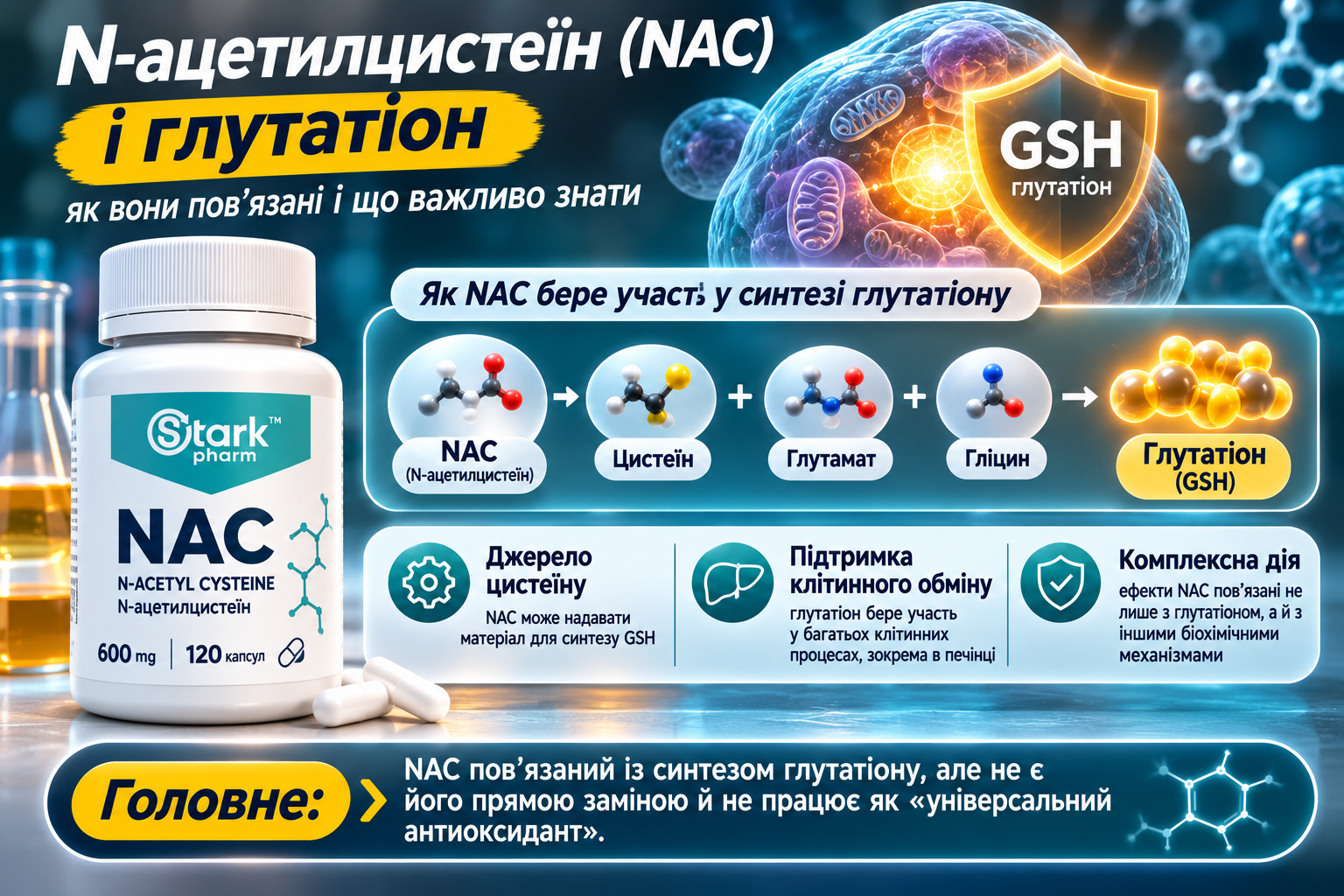
What is NAC and how is it different from regular cysteine?
NAC is an abbreviation for N-acetylcysteine, in Ukrainian “N-ацетилцистейн”. It is a cysteine molecule with an acetyl moiety attached to the nitrogen atom of its amino group. This chemical modification changes the properties of the substance, including its behavior in aqueous environments and metabolic reactions. At the same time, NAC is not a separate vitamin, an essential amino acid, or glutathione itself.
Cysteine is a sulfur-containing amino acid. The body obtains it from protein foods and can form it from other compounds with the participation of methionine. The need for cysteine and the rate of its use vary between tissues: it is needed for the synthesis of proteins, sulfur compounds, and glutathione.
Once ingested, NAC can be metabolized to form cysteine. Therefore, in biochemical studies, it is often considered a precursor to cysteine. However, "precursor" refers to potential participation in a chain of reactions, not the automatic conversion of the entire amount of the substance to one specific product.
What is glutathione and why do cells need it?
Glutathione (GSH) is a tripeptide composed of glutamate, cysteine, and glycine. It is found in many cells and helps maintain the balance between oxidation and reduction processes. Contrary to the common perception of an antioxidant as a sponge for all free radicals, glutathione works within a system of enzymes and interconnected reactions.
In particular, glutathione participates in the reactions of glutathione peroxidases, the work of systems that maintain the state of protein thiol groups, and the formation of conjugates with certain substances. The liver plays a significant role in glutathione metabolism, but this molecule is needed not only by it: synthesis and use occur in many tissues.
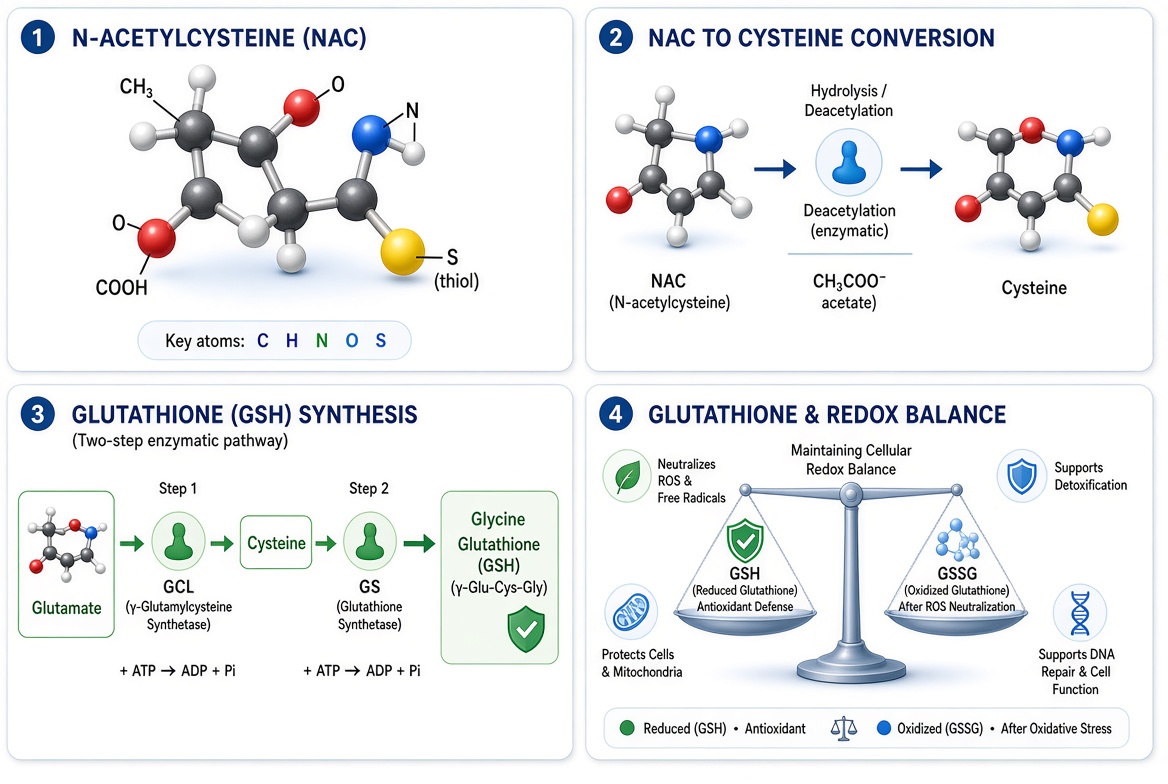
How NAC is linked to glutathione synthesis: a chain of reactions
Glutathione formation occurs within the cell in two main enzymatic steps. First, the enzyme glutamate-cysteine ligase joins glutamate with cysteine to form gamma-glutamylcysteine. Then, glutathione synthetase adds glycine to form GSH. Both steps use energy from ATP. This mechanism is described in fundamental reviews of glutathione biosynthesis.
- Step 1. NAC can be a source of cysteine after metabolic transformations.
- Step 2. Cysteine, together with glutamate, participates in the formation of an intermediate molecule.
- Step 3. Addition of glycine completes the synthesis of glutathione.
- Step 4. The formed GSH is used and regenerated in other cellular reactions.
This is where the interest in NAC comes from: Cysteine availability can sometimes limit GSH synthesis. However, this does not mean that any additional cysteine will necessarily speed up the reaction. It is also controlled by enzyme activity, and glutathione itself is involved in the feedback regulation of its own formation.
An important detail: the body does not store all the amino acids it receives for a single task. Cysteine is distributed among different metabolic pathways. Therefore, NAC cannot be described as a substance that directly “replenishes” the glutathione supply in any organ.
Why NAC Shouldn't Be Called a Universal Antioxidant
In the laboratory, NAC can participate in reactions involving thiol groups. But the behavior of the substance in the test tube, in the blood, and inside a specific cell are different issues. A review by Pedre et al. (2021) emphasizes that the popular explanation for all of NAC's effects by directly scavenging reactive oxygen species or increasing glutathione is overly simplistic.
Researchers also consider the formation of hydrogen sulfide and related reactive sulfur compounds as additional possible mechanisms of action for NAC. Such pathways are important in fundamental biochemistry, but their presence does not yet prove a specific, tangible effect of a common dietary supplement for a specific individual.
The word "antioxidant" is often used to refer to a whole group of different processes. In fact, some substances participate in the reduction of other molecules, others affect enzymes, and still others serve as building blocks. NAC is most appropriately described because of its known connection with cysteine metabolism and because of the studied but not equally confirmed cellular mechanisms.
Before drawing conclusions from scientific work, it is worth checking what exactly was measured: the content of glutathione in the blood, its forms in certain cells, enzyme activity, or the well-being of a person. These are different endpoints. An increase in a single laboratory indicator does not automatically equal improved health.
In a small clinical study by Roes et al. (2002) in nine healthy non-pregnant women, oral NAC administration increased whole blood glutathione concentrations. This supports the biological feasibility of such an effect, but the size of the study does not allow generalization to all individuals or tissues.
A systematic review and meta-analysis by Mahmoudinezhad et al. (2023), which included 26 controlled trials, reported statistically significant changes in some markers of antioxidant status, including glutathione and total antioxidant capacity. However, no convincing changes were found for a number of other enzyme measures. This result is best interpreted as a heterogeneous effect on biomarkers rather than a general promise of benefit.
In a meta-analysis of exercise by Sadowski et al. (2024), the authors also described increases in GSH in the pooled data. However, not all other markers were statistically significant. Studies in individual sports or clinical groups do not provide evidence that every healthy person will experience the same effect.
What exactly does “increased glutathione” mean in tests?
The result is highly sample-dependent. Glutathione can be assayed in plasma, whole blood, or individual cell fractions; values from these materials should not be mechanically equated. The time of collection, sample preparation conditions, and measurement method are also important.
Even if a change in a particular biomarker is statistically significant, there remains a separate question of its practical significance: whether a person feels the difference, how persistent it is, and whether it is accompanied by other outcomes. In the same study, biochemical and clinical endpoints may not coincide.
Therefore, it is not worth looking for one “ideal glutathione number” or concluding that you need NAC based on a single indicator without medical context. For a healthy person, such tests are not a universal way to assess the need for supplementation.
What is the difference between NAC, cysteine, and glutathione?
| Compound | What is this? | Glutathione connection |
|---|---|---|
| NAC | Acetylated cysteine derivative | May be a source of cysteine after metabolism |
| Cysteine | Sulfur-containing amino acid | One of the three direct components of GSH |
| Glutamate | Amino acid | Together with cysteine, it forms the first intermediate product |
| Glycine | Amino acid | Joins in the second step of GSH synthesis |
| Glutathione | Tripeptide synthesized by cells | The final molecule of this biosynthetic pathway |
This table describes the biochemical roles of the substances, not a ranking of supplements. Comparing the direct intake of ready-made glutathione with its precursors requires separate absorption analysis and specific clinical studies. Based on the synthesis scheme itself, it is impossible to say that one form is “better”.
What does the synthesis of glutathione depend on?
One of the key factors is the availability of amino acids. Protein foods provide the necessary components and precursors for their formation. The enzymes that control the two stages of synthesis are also important: if the regulation of the reaction does not allow it to be accelerated, an additional source of cysteine will not necessarily increase the result.
Glutathione metabolism is influenced by physiological state, metabolic rate, redox stress, and tissue characteristics. Scientific studies have explored these relationships, but they do not translate into a simple formula of "the more NAC, the better."
Good nutrition, sleep, and overall habits remain an important part of maintaining a healthy metabolism. NAC does not replace protein, essential nutrients, or other components of the diet.
Is it possible to predict the result from NAC in advance?
No, there is no one-size-fits-all response. In experiments, groups may differ in age, baseline, diet, duration of observation, and method of measuring glutathione. Even within a single trial, the average effect does not describe the response of each participant.
It is also necessary to separate the data on NAC as a substance used in medicine and its role as an ingredient in dietary supplements. Medical protocols have specific indications, methods of use and supervision by a specialist. It is incorrect to transfer such schemes to independent daily use.
For general educational material about NAC, the most accurate formulation is this: it is a cysteine derivative, associated with glutathione metabolism, and some studies show changes in certain laboratory markers. How beneficial these changes are for a particular person is a separate question, which the fact of the biochemical connection itself does not answer.
Safety and caution
Before using NAC supplements, it is advisable to seek medical advice, especially if you have a chronic medical condition, asthma, are pregnant, breast-feeding, or are taking medications. Potential drug interactions require special attention. Doses from clinical publications are not instructions for self-administration.
One should not base one’s need for NAC solely on popular online “oxidative stress” tests. Testing for this condition requires reliable methods and expert interpretation; a single advertised test cannot replace a full health assessment.
The main thing about the connection between NAC and glutathione
NAC and glutathione are not the same thing. NAC can provide the body with cysteine, and cysteine is one of the three components of GSH. The mechanism of synthesis is well understood; changes in individual glutathione levels have indeed been observed in human studies. However, the magnitude and practical significance of such changes depend on the context.
The most important thing is not to confuse biochemical mechanism with proven health benefits. Understanding this difference allows you to read scientific articles correctly and critically evaluate marketing promises.
Frequently asked questions
What does the abbreviation NAC stand for?
NAC stands for N-acetylcysteine, a derivative of the amino acid cysteine.
Is NAC glutathione?
No. NAC and glutathione are different compounds. NAC can be a source of cysteine, which is needed for glutathione synthesis.
What does the body make glutathione from?
From three amino acids: glutamate, cysteine, and glycine. The process occurs with the participation of enzymes.
Does NAC increase glutathione in all people?
No, the same result has not been proven for every person. In some studies, certain glutathione indicators have changed, but the data is inconsistent.
Can NAC be considered a direct antioxidant?
This explanation oversimplifies its mechanisms of action. Researchers are studying several pathways, and not all effects are due to direct binding of the active compounds.
Is a glutathione test a reason to start taking NAC?
A single lab result without clinical context does not determine the need for supplementation. Interpretation should be discussed with a physician.
Is glutathione the same in the blood and inside cells?
It is the same molecule, but the concentrations and conditions of its measurement vary between biological materials. The results of different assays are not interchangeable.
Can NAC be combined with medication?
This combination should be discussed with a doctor or pharmacist in advance due to possible interactions and individual risks.
Sources
- Wu G. et al. (2004). Glutathione metabolism and its implications for health. The Journal of Nutrition, 134(3), 489–492. PubMed.
- Lu SC (2013). Glutathione synthesis. Biochimica et Biophysica Acta, 1830(5), 3143–3153. PubMed.
- Pedre B. et al. (2021). The mechanism of action of N-acetylcysteine (NAC): The emerging role of H2S and sulfane sulfur species. Pharmacology & Therapeutics, 228, 107916. PubMed.
- Roes EM et al. (2002). Effects of oral N-acetylcysteine on plasma homocysteine and whole blood glutathione levels in healthy, non-pregnant women. Clinical Chemistry and Laboratory Medicine, 40(5), 496–498. PubMed.
- Mahmoudinezhad M. et al. (2023). N-acetylcysteine, a powerful agent in the reinforcement of antioxidant profile: A systematic review and dose-response meta-analysis of controlled clinical trials. Clinical Nutrition ESPEN, 54, 227–238. PubMed.
- Sadowski M. et al. (2024). The impact of N-acetylcysteine on lactate, biomarkers of oxidative stress, immune response, and muscle damage: A systematic review and meta-analysis. Journal of Cellular and Molecular Medicine, 28(23), e70198. PubMed.
Dietary supplement. Not a medicine. Consult a doctor before use.
Products related to this post
Comments
Information
Customer Service
Extras
My Account


Sports nutrition manufacturer in Ukraine StarkPharm © 2026


